
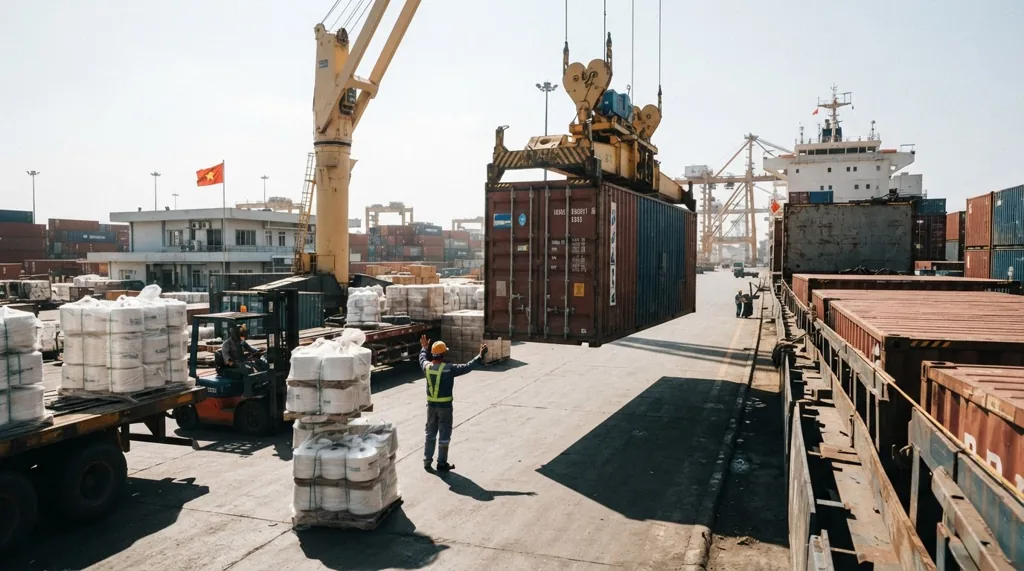
Viet Nam extended its anti-dumping duty on polyester yarn from China, India, Indonesia and Malaysia for five years on Oct. 13, 2026.
Viet Nam’s Ministry of Industry and Trade extended anti-dumping duties on polyester yarn from China, India, Indonesia and Malaysia on Oct. 13, 2026.
The ministry’s Decision No. 2652/QD-BCT keeps the duties for five more years and closes a final review of them1. The review asked one question: would ending the duties bring back unfairly cheap imports that hurt yarn makers in Viet Nam?
In short, polyester filament yarn from the four countries keeps paying the extra import tax at the Vietnamese border. The duty does not end after its first five years, and the yarn stays under the ministry’s watch for five more years.
What did Decision 2652 change for polyester yarn?
An anti-dumping duty is an extra import tax on goods sold abroad below their normal price. Viet Nam first put this duty on certain polyester filament yarn, which is long, continuous polyester thread, in 20211. Decision 2652 does not create a new duty. It keeps the existing one in place.
Decision 2652 at a glance
| Point | What the decision says |
|---|---|
| Issued by | Ministry of Industry and Trade, Oct. 13, 2026 |
| Goods | Certain polyester filament yarn |
| Origin | China, India, Indonesia, Malaysia |
| Result | Anti-dumping duty extended for 5 more years |
| Monitoring | Ministry tracks imports using customs data |
The decision states the result plainly: the measure is extended for another 5 years1. Shipments of the yarn from the four named countries will keep paying it at entry.
The Trade Remedies Authority, the ministry’s department that investigates unfair trade, ran the review. It published the decision and the notice that comes with it on the ministry’s website1.
Which countries and goods does the duty cover?
The duty covers polyester filament yarn that originates in four countries1:
- the People’s Republic of China
- the Republic of India
- the Republic of Indonesia
- Malaysia
The duty applies by origin, meaning the country where the yarn was made. A shipment of the same yarn from another country does not fall under this decision. The ministry’s announcement does not set out the customs codes or the rate for each company. Those details appear in the decision and its notice, which the ministry attached to its announcement1.
The ministry calls the goods "certain" polyester filament yarn products1. That wording means not every kind of polyester yarn is caught. Only the products described in the original 2021 decision remain under the duty.
How did the polyester yarn case begin?
The case has a long history. On April 6, 2020, the ministry opened the first investigation with Decision No. 1079/QD-BCT2. That decision covered certain polyester filament yarn from China, India, Indonesia and Malaysia2. The minister at the time, Tran Tuan Anh, signed it2.
Four decisions in the polyester yarn case
On Oct. 13, 2021, the minister issued Decision No. 2302/QD-BCT1. It applied the official anti-dumping duty on the yarn from the same four countries1. That decision is the duty that has now been extended.
On Oct. 16, 2025, the ministry started the final review with Decision No. 3013/QD-BCT3. The case carries the code ER01.AD103. The review began after 4 years of the duty being in force3.
Why did the ministry keep the duty?
The ministry first listed what the duty has achieved since 2021. It said the duty helped create fairer competition and limited the harm from dumping, which means selling goods abroad below their normal price1. Imports from India, Indonesia and Malaysia fell significantly compared with the start of the review period1.
The ministry also said Vietnamese yarn makers kept investing during this time. They expanded capacity and built new factories, and total domestic output rose1. The duty helped keep jobs and incomes for workers in the provinces where the factories stand1.
The ministry linked yarn to the wider clothing and textile industry. Yarn feeds the weaving and dyeing stages that come after it1. Yarn makers also buy raw materials and services from suppliers earlier in the chain1. The ministry said keeping yarn production supports more local content in Vietnamese textiles1.
What risks did the Trade Remedies Authority find?
The authority said there was clear evidence that local makers could be harmed if the duty ended1. It gave four reasons.
First, yarn from all four countries was still being dumped in Viet Nam during the review period1. The authority said this could continue or return if the duty stopped.
Second, imports from the four countries kept rising during the review period, especially from China1. Without the duty, the authority expects imports to grow fast at low prices. That would push down and hold down the prices of yarn made in Viet Nam1.
Third, local yarn makers improved in some ways but still showed weak results1. The authority pointed to output, use of factory capacity, market share, stock levels and profits. It also named labour productivity, investment and cash flow1.
Fourth, some of the four countries, such as China, can make and export large volumes of polyester yarn1. Several other markets also keep their own trade defence measures on this yarn. The authority said this raises the risk that the yarn will be redirected to Viet Nam1.
How did the final review work?
The final review followed Viet Nam’s Law on Foreign Trade Management and the rules of the World Trade Organization (WTO)1. When it began, the ministry said the review would judge whether the duty was still needed and reasonable. It would also weigh the duty’s effect on the economy and society3.
Steps in the final review
The review followed these steps in order:
- The authority sent questionnaires to the companies and groups involved to collect information3.
- It assessed whether dumping would continue or return if the duty ended3.
- It assessed whether local makers would again suffer serious harm, or face a threat of it3.
- It checked and verified the information that the parties supplied3.
- It sent a draft conclusion to the parties for comment1.
- The ministry issued its final decision on Oct. 13, 20261.
The questionnaire stage gave foreign makers and Vietnamese importers a chance to submit their own figures. The final decision came almost exactly one year after the review began.
Who could take part in the review?
When the review opened, the authority urged companies to register in the case. It named those that import, export, make, distribute, trade or use the yarn3. Registering let them defend their rights and interests during the review3.
Companies used the interested party registration form in Annex I of Circular No. 26/2025/TT-BCT3. They filed it through TRAV Online, the authority’s online case system. The deadline was 60 working days after the start decision took effect3. Companies could also send the form by post or email3.
Who is affected by the extension?
Vietnamese importers of polyester filament yarn from the four countries keep paying the duty at customs. That cost passes on to the weaving and dyeing companies that buy the yarn. For them, imported yarn from these countries stays more expensive than it would be without the duty.
Yarn makers in China, India, Indonesia and Malaysia keep facing the extra charge when they sell to Viet Nam. The ministry’s findings show the yarn makers in Viet Nam are the group the duty is meant to protect1.
Customs also has a role after the decision. It supplies the ministry with data on imports of the goods that pay the duty1.
What happens after Decision 2652 takes effect?
Once the decision takes effect, the ministry will work with other agencies to check how the duty is applied1. It will track and supervise the measure’s results1.
The ministry will use import information that the customs authority provides on goods that pay the duty1. This rests on Article 18 of Decree No. 86/2025/ND-CP of April 11, 20251. That government decree sets detailed rules on trade defence measures under the Law on Foreign Trade Management1.
During the 5-year extension, imports of the yarn from the four countries will stay under watch through customs data.
Key points on Viet Nam’s polyester yarn duty
The table below sums up the extension.
| Question | Answer |
|---|---|
| What changed? | Anti-dumping duty extended |
| How long? | 5 more years |
| Who issued it? | Ministry of Industry and Trade |
| Which decision? | Decision No. 2652/QD-BCT |
| Date issued | Oct. 13, 2026 |
| Which goods? | Certain polyester filament yarn |
| Which countries? | China, India, Indonesia, Malaysia |
| Original duty | Decision No. 2302/QD-BCT, Oct. 13, 2021 |
| Review started | Oct. 16, 2025 |
| Case code | ER01.AD10 |
| Who pays? | Importers of the yarn into Viet Nam |
| Who monitors? | The ministry, using customs import data |
Polyester filament yarn from the four countries keeps paying the extra import tax at the Vietnamese border. The ministry will follow the imports through customs data for the next 5 years1.
Sources
- ↩ Bộ Công Thương ra kết quả rà soát cuối kỳ việc áp dụng chống bán phá giá đối với sợi dài làm từ … https://moit.gov.vn/tin-tuc/bo-cong-thuong-ban-ha-nh-quye-t-di-nh-ve-ra-soat-cuoi-ky-viec-ap-dung-bien-phap-chong-ban-pha-gia-doi-voi-san-pham-soi-d.html
- ↩ Quyết định số 1079/QĐ-BCT của Bộ Công thương: Điều tra áp dụng biện pháp chống bán phá giá đối với một số sản phẩm sợi dài làm từ polyester có xuất xứ từ Cộng hòa Nhân dân Trung Hoa, Cộng hòa Ấn độ, Cộng hòa In-đô-nê-xi-a và Ma-lai-xi-a https://vanban.chinhphu.vn/default.aspx?pageid=27160&docid=199736
- ↩ Bộ Công Thương rà soát cuối kỳ biện pháp chống bán phá giá đối với sản phẩm sợi polyester nhập khẩu https://moit.gov.vn/tin-tuc/bo-cong-thuong-ra-soat-cuoi-ky-bien-phap-chong-ban-pha-gia-doi-voi-san-pham-soi-polyester-nhap-khau.html