
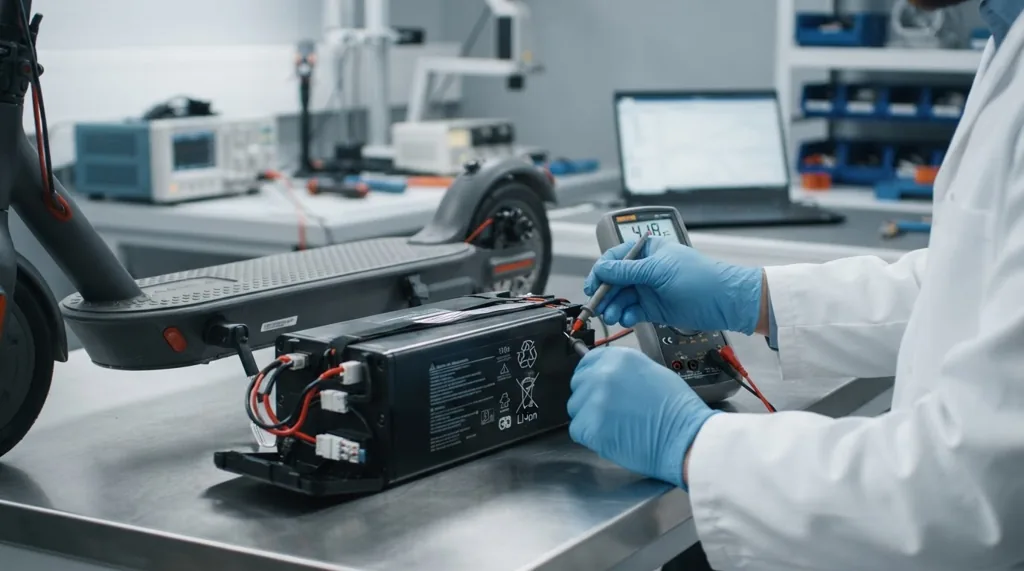
United States of America has enacted mandatory safety standards for Lithium-Ion Batteries, Micromobility Products, and Electrical Systems used in consumer mobility devices.
The U.S. Consumer Product Safety Commission (CPSC) will hold a public hearing on Oct. 21, 2026, on its proposed mandatory safety standard for lithium-ion batteries in e-bikes, e-scooters, hoverboards and similar products, a rule it first published on June 24, 20261.
The CPSC is the federal agency that sets safety rules for goods sold to American consumers. Its proposal would make battery and electrical safety tests, which are now voluntary, a legal condition for selling these products in the United States2.
In short, the rule is not yet in force, and no shipment is stopped because of it today. But it is moving forward, and if the CPSC adopts it, e-bikes, e-scooters and their batteries and chargers would have to pass modified UL safety tests and carry new warning labels before they could be sold.
What is the CPSC hearing on Oct. 21?
The CPSC published a notice in the Federal Register on Oct. 5, 2026, offering people a chance to give spoken comments on the proposal1. The hearing is a virtual meeting that starts at 10 a.m. Eastern time on Oct. 21, 20261.
Anyone who wants to speak must send a request, with the written text of the talk, to the CPSC’s Office of the Secretary1. The request must arrive by 5 p.m. Eastern time on Oct. 15, 2026, and speakers must also register online by the same time1. Attendance is free1.
Each talk is limited to 5 minutes, not counting questions from the commissioners or CPSC staff1. Talks must stay within the subject of the proposal. Groups with very similar comments are asked to pick one spokesperson1.
The CPSC says it received requests to speak, and the law requires it to offer this chance1. The Consumer Product Safety Act, the law behind the rule, says interested parties must be able to present "data, views, or arguments" orally, and the CPSC must keep a transcript1. The commissioners voted 3-0 to publish the hearing notice1.
What did the CPSC propose in June?
The proposal is a notice of proposed rulemaking, which is a draft rule published for public comment before a final decision2. It appeared in the Federal Register on June 24, 2026, under docket number CPSC-2025-00122. It would create a new part of U.S. federal rules, 16 CFR part 1265, and change part 11122.
The proposal covers lithium-ion batteries used in micromobility products, meaning small electric vehicles for one rider2. It also covers the whole electrical system of those products2. That includes the battery, the battery management system (the electronics that control charging and discharging), the charger, and any other electrical part named in the relevant standard2.
The rule would also reach batteries sold on their own. The CPSC calls these user replaceable battery packs2. Parts sold in kits that turn an ordinary bicycle into an e-bike, called conversion kits, are covered too2.
Which products would the battery rule cover?
The proposal names six types of micromobility products3:
- eBikes, bicycles with working pedals and one or more electric motors.
- eScooters, stand-up or sit-down scooters without working pedals.
- Self-balancing scooters, such as hoverboards, with two foot pads side by side.
- eSkateboards, skateboards with a battery-powered motor under the deck.
- eUnicycles, one-wheeled electric riders.
- Hybrids of these products.
The proposed rule text is split by product group2. It has separate sections for eBikes, for personal eMobility products such as scooters and hoverboards, for user replaceable battery packs, for eBike conversion kits, and for aftermarket battery chargers sold separately2.
Some products are outside the CPSC’s reach. The law excludes motor vehicles, meaning vehicles built mainly for use on public roads, which belong to the National Highway Traffic Safety Administration (NHTSA), the road safety agency3. Such vehicles usually have a vehicle identification number and features like headlights, brake lights and mirrors3. The UL 2272 standard used for scooters also excludes motorized wheelchairs and mobility scooters for medical use3.
Rental fleets are not excluded. The CPSC says its authority includes commercially owned products that consumers use, for example in rental fleets3.
Which UL standards would e-bike and scooter batteries have to meet?
The UL standards are product safety tests that, today, firms follow by choice. The proposal would make each product meet the tests in the matching UL standard, with changes2:
- UL 2849-20 for the electrical systems of eBikes.
- UL 2272-24 for electrical systems of eScooters, self-balancing scooters, eSkateboards, eUnicycles and hybrids.
- UL 2271-23 for batteries used in light electric vehicles, which covers user replaceable battery packs.
Proposed standards by product
| Product | Standard and added tests |
|---|---|
| eBikes | UL 2849-20, plus enclosure, post-discharge and reverse polarity tests |
| Scooters, hoverboards, eSkateboards, eUnicycles | UL 2272-24, plus reverse polarity test |
| Spare battery packs | UL 2271-23, plus enclosure, post-discharge and reverse polarity tests |
| Labels | New warnings on shock, thermal runaway, charging |
The CPSC found that these standards, as written, do not deal with every hazard it identified2. So it proposes three added tests2:
- A tamper-resistant battery enclosure for eBikes and spare battery packs, taken from the scooter standard, so that users cannot easily open the battery.
- A post-discharge charge test for eBikes and spare packs, which checks that the electronics block charging if the cells are too hot.
- A reverse polarity test in all three standards, which protects the battery if someone uses the wrong charger.
The proposal would also rewrite the warning labels in all three standards2. The new messages would cover electric shock, thermal runaway, homemade batteries and unsafe charging2.
Why does the CPSC want mandatory battery rules?
The CPSC points to fires. From 2019 through 2023, it knows of 227 incidents involving fires, explosions, gas releases, burns, overheating and smoke inhalation that the rule could have prevented2. Of these, 90 incidents are linked to 39 deaths and 181 injuries2. In 39 of the 227 incidents, more than one person was killed or hurt2.
Battery incidents known to the CPSC, 2019 to 2023
The main danger is thermal runaway. This is a chemical reaction inside a battery cell that feeds itself and quickly creates heat, which ignites the flammable liquid inside2. Hot gases can then push burning material out of the cell, causing an explosion or fire that can spread to the cells next to it2.
The CPSC also sees a risk of electric shock at voltages of 42.4 volts peak alternating current or 60 volts direct current and above2. Most batteries in these products are rated below 60 volts today, and CPSC staff have found no shock incidents2. But the agency expects more powerful packs in the future, and chargers run on 120-volt household power2.
Why are voluntary standards not enough?
U.S. law tells the CPSC to rely on a voluntary standard instead of writing its own rule if that standard would deal with the risk and most products already meet it3. The CPSC concluded that neither condition is met3.
Its first finding is that the UL standards do not cover all the hazards2. Its second is that micromobility products as a whole do not substantially comply with the voluntary standards, meaning too many products on the market do not meet them2. For both reasons, the CPSC proposes to turn the modified standards into a mandatory rule2.
What would change for importers and sellers of e-bikes?
At present, meeting the UL standards is a choice. Under the proposal, it would become a legal condition for selling these products in the United States2. That would apply to e-bikes and scooters sold complete, and to spare batteries, conversion kit parts and separate chargers2.
Makers abroad would need to design batteries and electrical systems that pass the three added tests. Importers would need products that meet the rule and carry the new labels. Sellers of spare batteries and chargers would face the same tests as sellers of complete products, because the proposal covers these parts on their own2.
Some micromobility products are made for children. For these, the proposal adds the rule to the list of rules that need third party testing, meaning tests by an outside testing body rather than the maker2. That is the reason the proposal also changes part 1112, which sets the rules for those testing bodies2.
The proposed rule text also contains a section titled "Prohibited Stockpiling"2. The CPSC also asks for public comment on stockpiling2.
When could the lithium-ion battery rule start?
No start date is in force yet. The deadline for written comments was Aug. 24, 2026, and that comment period has closed2. The Federal Register page for the proposal shows 62 comments received2.
Steps in the CPSC battery rule
After the comment period and the hearing, the CPSC will weigh the comments and decide whether to issue a final rule3. To adopt it, the commission must find that the rule is reasonably necessary to reduce an unreasonable risk of injury and is in the public interest3. It must also find that the benefits bear a reasonable relationship to the costs and that the rule is the least burdensome way to reduce the risk3.
A start date would be set in a final rule. The proposal includes a section on the effective date and asks the public to comment on it2.
Key points on the lithium-ion battery rule
The rule is still a proposal, and the next step is a public hearing.
| Question | Answer |
|---|---|
| Who acts? | U.S. Consumer Product Safety Commission |
| What is it? | Proposed mandatory battery safety standard |
| When was it proposed? | June 24, 2026 |
| What is new? | Oral hearing notice, published Oct. 5, 2026 |
| Hearing date | Oct. 21, 2026, 10 a.m. Eastern |
| Deadline to ask to speak | 5 p.m. Eastern, Oct. 15, 2026 |
| Goods covered | eBikes, eScooters, hoverboards, eSkateboards, eUnicycles, hybrids |
| Parts covered | Spare battery packs, conversion kits, separate chargers |
| Standards used | UL 2849-20, UL 2272-24, UL 2271-23, with changes |
| Added tests | Tamper-resistant enclosure, post-discharge charge, reverse polarity |
| Children’s products | Third party testing required |
| Is it in force? | No; a final rule is still needed |
The hearing on Oct. 21, 2026, is the last public step the documents set out before the CPSC decides on a final rule1. Until then, e-bikes, scooters and their batteries can still be sold in the United States without meeting the proposed tests.
Sources
- ↩ Federal Register :: Safety Standard for Lithium-Ion Batteries Used in Micromobility Products and Electrical Systems of Micromobility Products Containing Such Batteries — 2026 20296 / safety standard for lithium ion batteries us… https://www.federalregister.gov/documents/2026/10/05/2026-20296/safety-standard-for-lithium-ion-batteries-used-in-micromobility-products-and-electrical-systems-of
- ↩ Federal Register :: Safety Standard for Lithium-Ion Batteries Used in Micromobility Products and Electrical Systems of Micromobility Products Containing Such Batteries — 2026 12749 / safety standard for lithium ion batteries us… https://www.federalregister.gov/documents/2026/06/24/2026-12749/safety-standard-for-lithium-ion-batteries-used-in-micromobility-products-and-electrical-systems-of
- ↩ Regulations.gov https://www.regulations.gov/document/CPSC-2025-0012-0001