
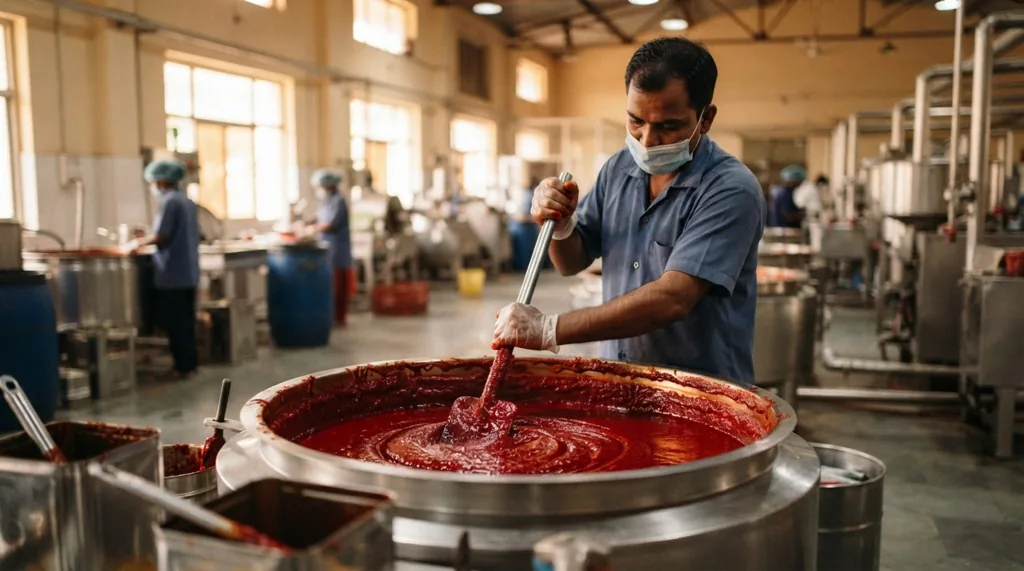
United States importers of oleoresin paprika from India must pay subsidy cash deposits of 18.67% to 25.42% under orders published Oct. 8, 2026.
The U.S. Department of Commerce has issued an antidumping duty order and a countervailing duty order on oleoresin paprika from India, in a notice published in the Federal Register on Oct. 8, 20261.
The orders follow a finding by the U.S. International Trade Commission (ITC), the agency that judges harm to American industry, that these imports hurt U.S. producers2.
In short, U.S. importers of this red food colouring from India must now pay cash deposits to customs when the goods enter. The deposit for subsidies is 18.67% to 25.42% of the goods’ value, while the separate dumping deposit is set at 0.00%1.
What did Commerce order on Indian oleoresin paprika?
Commerce issued two orders in one notice, dated Oct. 5, 2026 and signed by Scot Fullerton, Acting Deputy Assistant Secretary for Antidumping and Countervailing Duty Operations1. The cases carry the numbers A-533-938 for dumping and C-533-939 for subsidies1.
The first is an antidumping duty order, an extra import tax on goods sold in the United States below their normal price. The second is a countervailing duty order, an extra import tax that cancels out subsidies a foreign government gives its producers1.
Under both orders, Commerce will direct U.S. Customs and Border Protection (CBP), the U.S. border agency, to collect the duties1. The notice states that the orders are applicable from the date of publication in the Federal Register, which was Oct. 8, 20261.
Why did the United States act on paprika extract?
The orders end an investigation that started in July 2025. Commerce opened both its dumping case and its subsidy case on July 22, 20253. The period it examined ran from April 1, 2024, through March 31, 20253.
On Aug. 21, 2026, Commerce published two final findings1. In the first, it found that Indian oleoresin paprika is being, or is likely to be, sold in the United States at less than fair value3. In the second, it found that producers and exporters in India receive subsidies that can be offset by duties4.
Commerce’s subsidy notice lists the Indian programmes that the parties argued over. They include import duty exemptions under the Advanced Authorization Program, the Export-Oriented Units programme, the Remission of Duties and Taxes on Export Products scheme (RoDTEP), and the Export Promotion of Capital Goods Scheme4.
The second step belonged to the ITC. On Sept. 18, 2026, the commission voted that imports of oleoresin paprika from India injure the U.S. industry2. Five commissioners voted yes, and one did not take part2. The ITC formally told Commerce of its decision on Oct. 5, 20261.
What are the duty rates for each Indian company?
Commerce examined two Indian producers in detail: Synthite Industries Pvt. Ltd and Mane Kancor Ingredients Private Ltd.3. Each received its own rates. Every other Indian producer or exporter gets an "all others" rate1.
Subsidy cash deposit by exporter, %
The subsidy rates, given as a percentage of the goods’ value, are1:
- Synthite Industries: 25.42%
- Mane Kancor Ingredients: 18.67%
- All other Indian exporters: 21.90%
The dumping margins are lower. A dumping margin is the gap between the price in the home market and the U.S. export price. Commerce found margins of 5.78% for Synthite, 4.24% for Mane Kancor and 5.08% for all others1.
Why is the dumping cash deposit zero?
Commerce does not collect both duties in full on the same subsidy. When a country pays export subsidies, Commerce lowers the dumping deposit by the export subsidy amount found in the companion subsidy case3.
For oleoresin paprika, this adjustment takes each dumping margin down to a cash deposit rate of 0.00%1. This applies to Synthite, to Mane Kancor and to all other exporters1.
In practice, this means the subsidy deposit is the charge importers pay at entry for now. The dumping order still stands, and duties are later assessed on the gap between the normal value and the export price1.
How will customs collect the deposits?
The orders work through cash deposits and "suspension of liquidation". Liquidation is the moment customs fixes the final duty on an entry. When it is suspended, the final bill stays open until Commerce sets the duty later1.
How a shipment is charged
The steps run in this order:
- Commerce tells CBP to suspend liquidation again on shipments of oleoresin paprika from India1.
- When the importer pays normal customs duties, CBP also collects a cash deposit at the rates in the orders1.
- The deposit is an estimate. Commerce later instructs CBP on the final duty to assess on each entry1.
- These instructions stay in effect until further notice1.
The deposits take effect on the date the ITC’s final injury decision is published in the Federal Register1. The all-others rate applies to any producer or exporter not named in the tables1.
Which goods do the orders cover?
The orders cover oleoresin paprika, a thick, deeply coloured red or orange liquid made from the extract of Capsicum peppers. It is used as a colouring additive1.
The product is covered when it has an American Spice Trade Association (ASTA) colour value of at least 500, or a colour unit value of at least 20,0001. Any pepper variety counts1.
The goods may be sold under other names, which the orders also cover1:
- paprika oleoresin or oleoresin of paprika
- paprika extract or extract of paprika
- paprika oil or paprika essential oil
The food additive code is E160c, and the Chemical Abstracts Service numbers are 68917-78-2 and 84625-29-61. Blending with oil, water, emulsifiers or preservatives does not take the goods out of the orders1.
The scope also reaches beyond India’s borders in one way. Crude Indian oleoresin paprika that is blended, finished or packed in a third country is still covered, if that processing would not otherwise take it out of the scope1. When it is mixed with paprika extract from other sources, only the Indian part is covered1.
Which tariff codes apply to oleoresin paprika?
The goods are classified under HTSUS subheadings 3203.00.8000 and 3301.90.1010 of the U.S. tariff schedule1. They may also enter under subheadings 1301.90.9190, 1302.19.9140 and 3205.00.05001.
The codes are listed for convenience only. The written description of the goods decides what the orders cover1. A shipment under a different code can still owe the duties if the product matches the description.
Which earlier shipments face duties?
The orders also reach back to some shipments that entered before Oct. 8. Dumping duties will be assessed on entries made on or after April 2, 2026, the date of Commerce’s preliminary dumping decision1. Subsidy duties apply to entries on or after Feb. 6, 2026, the date of the preliminary subsidy decision1.
Which entry dates the duties reach
| Date | Duty | What happens |
|---|---|---|
| Feb. 6, 2026 | Subsidy duty | Entries from this date face duties |
| April 2, 2026 | Dumping duty | Entries from this date face duties |
| June 6, 2026 | Subsidy duty | Gap begins until ITC decision is published |
| Sept. 29, 2026 | Dumping duty | Gap begins until ITC decision is published |
There are gaps. U.S. law limits these early "provisional measures" to a set period1. For dumping, Commerce extended the period to six months at the request of exporters, so it ended on Sept. 28, 20261. Entries from Sept. 29, 2026 until the day before the ITC decision is published will be cleared without dumping duties1.
For subsidies, the four-month period ended on June 5, 20261. Entries from June 6, 2026 until the day before the ITC decision is published are not subject to subsidy duties1.
What happens to Synthite’s earlier deposits?
Commerce had found "critical circumstances" for Synthite, a finding that a surge of imports came just before the case4. That finding let duties reach back 90 days before the preliminary subsidy decision4.
The ITC did not agree that critical circumstances existed for Synthite’s shipments1. As a result, Commerce will tell CBP to refund subsidy cash deposits on Synthite entries made on or after Nov. 8, 2025 but before Feb. 6, 20261.
In the dumping case, Commerce found no critical circumstances for any company3.
What comes next for paprika extract importers?
The ITC will publish its public report on the case, USITC Publication 5794, by Oct. 29, 20262. The ITC investigation numbers are 701-TA-771 and 731-TA-17552.
Commerce will create a service list for the orders in its online filing system within five business days of the order’s publication1. Parties who want to be on this list must file an entry of appearance within 30 days of the order’s publication1. The list is used when someone asks Commerce whether a product falls inside the orders1.
Key points on the oleoresin paprika orders
The table sums up the main facts of the two orders.
| Question | Answer |
|---|---|
| What changed? | Antidumping and countervailing duty orders issued |
| Who issued them? | U.S. Department of Commerce |
| Which goods? | Oleoresin paprika from India |
| Main tariff codes | 3203.00.8000 and 3301.90.1010 |
| Subsidy deposit, Synthite | 25.42% |
| Subsidy deposit, Mane Kancor | 18.67% |
| Subsidy deposit, all others | 21.90% |
| Dumping cash deposit | 0.00% after subsidy offset |
| Who pays? | U.S. importers, at customs entry |
| Published | Oct. 8, 2026 |
| ITC report due | By Oct. 29, 2026 |
From now on, every U.S. shipment of Indian oleoresin paprika carries a subsidy cash deposit of at least 18.67% of its value1. The next date in the record is Oct. 29, 2026, when the ITC’s full report is due2.
Sources
- ↩ 2026-20690.pdf https://public-inspection.federalregister.gov/2026-20690.pdf
- ↩ Oleoresin Paprika from India Injures U.S. Industry, Says USITC | United States International Trade Commission https://www.usitc.gov/press_room/news_release/2026/er0918_69241.htm
- ↩ Federal Register :: Oleoresin Paprika From India: Final Affirmative Determination of Sales at Less Than Fair Value and Final Negative Determination of Critical Circumstances https://www.federalregister.gov/documents/2026/08/21/2026-17047/oleoresin-paprika-from-india-final-affirmative-determination-of-sales-at-less-than-fair-value-and
- ↩ Federal Register :: Oleoresin Paprika From India: Final Affirmative Countervailing Duty Determination and Final Affirmative Critical Circumstances Determination, in Part https://www.federalregister.gov/documents/2026/08/21/2026-17048/oleoresin-paprika-from-india-final-affirmative-countervailing-duty-determination-and-final