
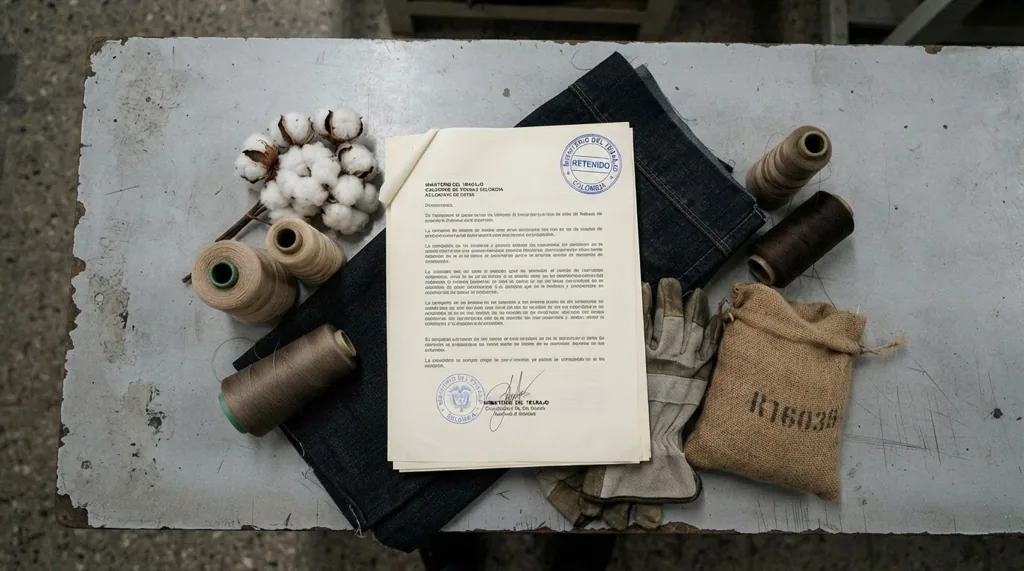
Colombia has banned imports of goods made wholly or partly with forced labour under Decree 1444 of Sept. 28, 2026, with immediate effect.
Colombia’s government, through Decree 1444 of Sept. 28, 2026, has banned imports of any goods made wholly or partly with forced or compulsory labour, at every stage of the supply chain1.
The decree was signed by the President and issued under the Ministry of Trade, Industry and Tourism (MinCIT)2. It makes such goods "prohibited goods" under Colombia’s customs law, so customs can seize them1.
In short, a shipment to Colombia can now be stopped and confiscated if forced labour was used anywhere in making it. That includes the raw material, the harvest, the factory work and the finishing.
What does Decree 1444 ban?
Article 1 of the decree bans the entry into Colombia’s customs territory of goods that were, wholly or partly, extracted, produced, manufactured or transformed with forced or compulsory labour1. The ban is not limited to one product, one sector or one country.
From draft to decree
The ban covers all stages of the supply chain1. The decree lists extraction, growing, harvesting, manufacturing, assembly, processing and finishing as examples1. A finished product can therefore be caught because of forced labour in one of its inputs.
Goods made this way take the legal status of prohibited goods1. They fall under the controls, procedures and penalties that Law 2586 of 2026, Colombia’s customs penalties law, sets for prohibited goods1.
How does the decree define forced labour?
The decree uses the definition in Convention No. 29 of the International Labour Organization (ILO), which Colombia approved by Law 23 of 19671. Forced or compulsory labour is any work or service demanded from a person under threat of a penalty, which the person has not offered to do freely1.
Work that does not count as forced labour
The decree also lists five kinds of work that do not count as forced labour, taken from the same ILO convention1:
- Military service work, of a purely military kind, required by conscription laws.
- Normal civic duties of citizens.
- Work by convicted prisoners, when public authorities supervise it and the prisoner is not hired out to private companies or persons.
- Work in emergencies, such as cases of force majeure, meaning events outside anyone’s control.
- Minor community work done in the direct interest of the community.
The prison work exemption has a limit. Goods made by prisoners who are hired out to private companies are not exempt. The decree says the ban on such prison-made goods also rests on Article XX(e) of the General Agreement on Tariffs and Trade (GATT) of 1994, the World Trade Organization rule that allows bans on prison-labour goods1.
Which agencies enforce the import ban?
Three government bodies have a role, each with a different task1:
- DIAN, Colombia’s tax and customs authority, enforces the ban. It can investigate, request information, collect evidence, and seize and confiscate goods under Law 2586 of 2026.
- The Ministry of Trade, Industry and Tourism supports trade policy, shares information and helps identify risk factors.
- The Ministry of Labour decides, when customs asks, whether the facts customs reports amount to forced labour under the decree’s definition.
Who decides what
| Question | DIAN (customs) | Ministry of Labour |
|---|---|---|
| Main task | Enforces the ban | Classifies the facts, when asked |
| Says if facts are forced labour? | No, follows the classification | Yes |
| Decides if facts are proven? | Yes | No |
| Seizes and confiscates goods? | Yes | No |
The labour ministry’s decision is called a "calificación", or classification1. DIAN must follow it on the narrow question of whether the facts are forced labour1. But the labour ministry does not decide whether the facts are proven, which goods or shipment they apply to, or whether to seize the goods1. Those decisions belong only to DIAN1.
The classification is not a penalty, and it can be challenged under the applicable rules1. Other authorities keep their powers on forced labour, human trafficking and human rights1.
How will customs check a shipment?
Article 4 sets what the decree calls a "reasonable grounds" standard1. DIAN will start control action on goods once the Ministry of Labour has classified them as made wholly or partly with forced labour at any stage of the supply chain1.
From suspicion to confiscation
In practice, the steps described in the decree run in this order1:
- DIAN gathers information about goods and their supply chain.
- DIAN asks the Ministry of Labour whether the facts amount to forced labour.
- The ministry issues its classification.
- DIAN starts control action on the goods.
- DIAN decides on confiscation, based on the facts and evidence in the case file.
The final decision to confiscate must rest on the evidence in the file and on the labour ministry’s classification1. The procedure is the one set out in Law 2586 of 20261. The decree requires due process, the right of defence and written reasons for every decision, including the weight given to each piece of evidence1.
DIAN can act during checks before the goods arrive, at the moment of clearance, or after release1. Law 2586 of 2026 makes finding prohibited goods at any of these points a reason for seizure and confiscation1. The same law puts prohibited goods through direct confiscation, a shorter procedure for goods that cannot legally enter1.
What information can trigger a forced labour case?
Article 5 lists the information that authorities may weigh, among others1:
- Information from Colombian or foreign authorities.
- Reports from international organisations, treaty monitoring bodies or multilateral forums.
- Court or administrative decisions on forced labour, trafficking, servitude or similar practices.
- Data from the risk systems used by customs and trade authorities.
- Complaints, petitions or reports from people, companies, workers’ groups, business groups, civil society, affected communities or other interested parties.
- Reliable and verifiable public information.
- Information on origin, traceability, audits and corrective action from actors in the supply chain.
- Evidence gathered by customs under Law 2586 of 2026.
This list means a complaint from a competitor, a union or a community group can feed a case. It also means an importer’s own records on origin, traceability and audits are part of the evidence that can be weighed.
Under Article 6, the Ministry of Labour can ask DIAN or any other body for information it needs for its classification1. Public bodies involved in foreign trade must hand over the information requested1. Information that is confidential, or protected as business secrets of importers or exporters, keeps that protection1.
Why did Colombia ban forced labour goods?
The decree says global supply chains are now so linked that trade measures are needed to stop imports of forced labour goods1. Its stated aims are to protect human dignity, protect fundamental rights and keep goods tied to serious human rights abuses out of the Colombian market1.
It rests on Article 17 of Colombia’s Constitution, which bans slavery, servitude and trafficking in all forms1. It also cites ILO Conventions 29 and 105 on forced labour, and Law 985 of 2005 against human trafficking1.
The decree cites Colombia’s trade commitments as well. These include Article 269 of the trade agreement with the European Union and Peru, later joined by Ecuador, where each party commits to apply core labour standards1. They also include Colombia’s OECD membership and the OECD guidelines asking companies to check their supply chains for forced labour1.
How does the ban fit with WTO rules?
The government says the ban meets the general exceptions in Article XX(a) and (d) of GATT 19941. Those allow measures to protect public morals and to enforce national laws, here the laws against forced labour and trafficking1.
The decree also says the ban treats imports the same as Colombian goods1. Goods made with forced labour inside Colombia already face criminal and administrative penalties1. The government states the ban does not aim to protect, and does not protect, Colombian producers1.
It argues there is no less trade-restrictive option that would work as well1. In its view, any tolerance for forced labour imports would make the measure useless and keep demand for the practice alive1.
The decree says the ban is not a technical regulation, because it does not set product features or production methods tied to those features1. The draft was sent to the World Trade Organization, the General Secretariat of the Andean Community and trade partners with notification duties, and comments received were addressed1.
How was the decree prepared?
The trade ministry published the draft decree on its website for public comment from Aug. 11 to Aug. 15, 20263. The comment period was five calendar days3.
The decree explains the short period by the special constitutional protection of human dignity and the need to act quickly1. On Aug. 18, 2026, the Committee on Customs, Tariff and Foreign Trade Affairs, in its session 403, recommended the ban1.
When does the forced labour ban apply?
Law 1609 of 2013 normally requires customs and trade decrees to wait 15 to 90 calendar days after publication in the Diario Oficial, Colombia’s official gazette, before taking effect1. The law allows an exception when special circumstances require immediate effect1.
The decree says such circumstances exist and that the measure needs to take effect immediately1. It gives three reasons: protecting human dignity, keeping goods tied to serious rights abuses out of the market, and responding in time to the economic, trade and human rights situation1.
Who is affected, and what comes next?
Importers into Colombia carry the direct risk. If customs finds that goods were made with forced labour, the goods can be seized and confiscated under the customs penalties law1. Law 2586 of 2026 makes importing prohibited goods an administrative customs offence1.
Exporters and makers abroad selling to Colombia can see shipments stopped if forced labour appears anywhere in their supply chain, including at a supplier of raw materials. Customs brokers handling these shipments will face DIAN’s checks before, during and after clearance.
The government plans to add lists of risk indicators, covering goods, sectors, regions, producers, exporters, entities or supply chains where there is objective, verifiable and sufficient information on forced labour risks1. The lists are meant to help customs focus its checks and guide companies’ supply chain checks1. The decree says the ban applies even before such lists exist, and the lists do not shift the burden of proof to importers1.
Personal data gathered under the decree must be handled under Colombia’s data protection laws, Laws 1266 of 2008, 1581 of 2012 and 1712 of 20141.
Key points on Colombia’s forced labour import ban
The table below sums up the main facts of Decree 1444.
| Question | Answer |
|---|---|
| What changed? | Imports of goods made with forced labour are banned |
| Which instrument? | Decree 1444 of Sept. 28, 2026 |
| Who issued it? | The President, through the trade ministry |
| Which goods? | Any goods made wholly or partly with forced labour |
| Which stages count? | All, from extraction to finishing |
| Definition used | ILO Convention No. 29 |
| Who enforces it? | DIAN, the customs authority |
| Who classifies forced labour? | The Ministry of Labour, at DIAN’s request |
| What happens to the goods? | Seizure and confiscation as prohibited goods |
| Penalty law | Law 2586 of 2026 |
| When does it apply? | Immediately, under the decree’s stated reasons |
| What comes next? | Lists of risk indicators |
The ban applies to every shipment entering Colombia from now on, with no product list needed. The next step the decree sets out is the publication of lists of risk indicators, which will show where customs will look first.
Sources
- ↩ Decreto 1444 de 2026 Nivel Nacional https://www.alcaldiabogota.gov.co/sisjur/normas/Norma1.jsp?i=194363
- ↩ DECRETO No. 1444 DEL 28 DE SEPTIEMBRE DE 2026.pdf https://dapre.presidencia.gov.co/normativa/normativa/DECRETO%20No.%201444%20DEL%2028%20DE%20SEPTIEMBRE%20DE%202026.pdf
- ↩ Proyectos de Decreto 2026 | MINCIT – Ministerio de Comercio, Industria y Turismo https://www.mincit.gov.co/normatividad/proyectos-de-normatividad/proyectos-de-decreto-2026