
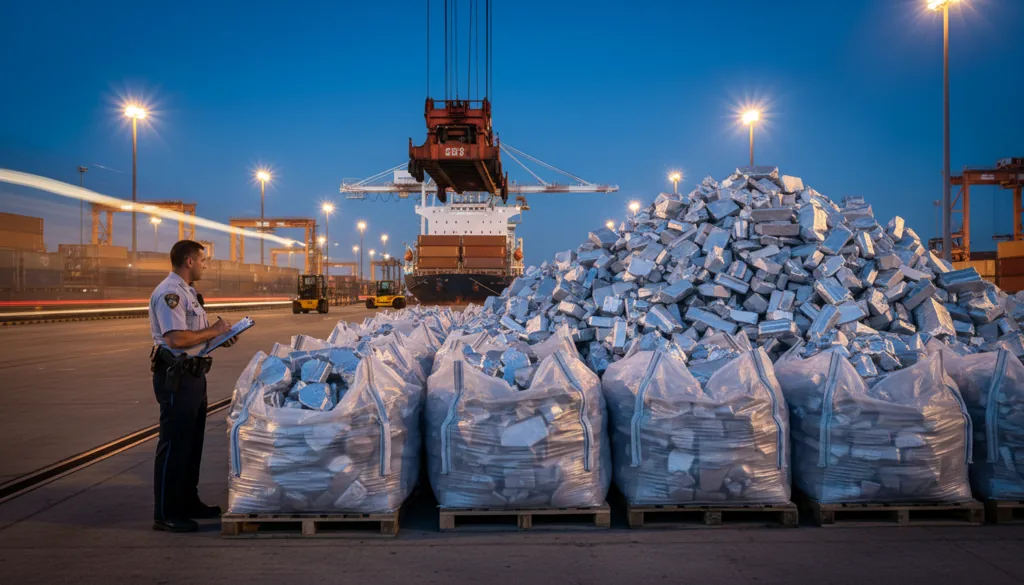
United States restricts imports of polysilicon and polysilicon derivatives by newly established importers of record effective September 22, 2026, through December 3, 2026.
United States share of global polysilicon production capacity
One set of goods, two stages of obligations
| From | Stage | What falls due |
|---|---|---|
| Aug. 3, 2026 | Interim anti-stockpiling rule | Weekly ceilings for new importers; past-volume scrutiny for existing ones |
| Dec. 4 | Tougher measures | Entry documents showing first independent sale meets the MIP, or a qualifying contract signed before Aug. [n] |
The United States has restricted imports of polysilicon and polysilicon derivatives by newly established importers of record from Sept. 22 through Dec. 3, 2026, ahead of tougher measures due to begin on Dec. 4.
The temporary rule targets companies that Customs and Border Protection, or CBP, identifies as bringing in unusually large volumes before new minimum prices and tariffs take effect. The products include the high-purity material used in solar panels and semiconductors, as well as wafers, cells and other derivatives. The restrictions cover importers registered with CBP on or after Aug. 6, when the President signed Proclamation 11052.1
The measure is designed to stop stockpiling and protect the market for United States production. The importing company bears the immediate burden through volume limits, possible entry bans and the cost of proving that its trade is legitimate. Commerce said the temporary rule was needed because waiting for the usual notice and comment process could leave time for further stockpiling.1
Polysilicon before Dec. 4
The rule sits between the presidential proclamation and a later pricing and tariff regime. Proclamation 11052 found that imports threatened to impair US national security and directed the Commerce secretary to restrict companies that accumulated products before Dec. 4. The Bureau of Industry and Security, or BIS, is carrying out that instruction with CBP through a temporary final rule.1
That later regime will apply to goods entered for consumption, or removed from a warehouse for consumption, from 12:01am eastern time on Dec. 4. It will impose minimum import prices, known as MIPs, and a 15% tariff on downstream polysilicon derivatives.1 Until then, the interim rule controls the pace at which certain businesses can bring goods into the country.
The policy is intended to support a domestic supply chain rather than simply delay imports. The proclamation describes polysilicon as a base material for semiconductor and solar-power supply chains, while the Commerce findings say United States production capacity fell from 50% of the global total in 2005 to less than 2% in 2024.2 That makes the short transition period commercially important for importers whose goods are scheduled to arrive before the December changes.
The financial effect will differ by product and business model. A company that can remain within its permitted weekly amount may continue importing, while one that exceeds the limit can lose access to further entries before Dec. 4. The restriction therefore creates an immediate customs risk even before the MIP and tariff obligations begin.
Four product limits for new importers
The sharpest limits apply to new importers of record, or IORs. An IOR is the company named to customs as responsible for the entry, and the rule treats a business registered on or after Aug. 6 as new for this purpose. Such an importer is barred from exceeding 12 kg per week for one polysilicon classification.1
The limits vary by product type and measurement. Certain compounds and related materials face a ceiling of 7 kg per week, while solar cells are measured by number rather than weight. The rule permits up to 2,000 cells per week under one classification and 55 cells per week under another.1
Those thresholds are based on historic import data and are intended to allow limited commercial shipments without opening a route for advance accumulation. The amounts are small enough to constrain ordinary supply arrangements where a new importer has no established import history. They also make the classification and quantity recorded at entry central to whether a shipment can proceed.
Commerce can notify CBP when a new IOR exceeds the applicable weekly amount. CBP will then notify the importer and any customs broker acting for it, and further entries can be prohibited before Dec. 4.1 The restriction follows the importer of record, making a change in the named importing company a potentially significant event rather than a routine administrative adjustment.
Brokers drawn into enforcement
The rule also assigns a direct role to customs brokers. Brokers entering polysilicon products, or acting as the IOR, between Sept. 22 and Dec. 4 are reminded of an affirmative duty not to facilitate violations. The wording brings broker conduct into the enforcement picture alongside the importer’s own entries.1
Three regimes under the interim rule
| Question | New importers | Existing importers | Brokers |
|---|---|---|---|
| How the limit is set | Fixed weekly ceiling | Compared against own past volumes | None set on the broker |
| Business case required | Yes — why established, prior United States customers [n] | No | No |
| Role at entry | Own entries checked | Own entries checked | Drawn into preventing prohibited entries [n] |
| Affiliates in scope | New IORs used to bring in the products | Affiliates that do not usually import polysilicon | Information requested covers them [n] |
The factors identified for broker review include whether the IOR was established after Aug. 6 and how much product it has already entered during the current week. Ownership arrangements are also relevant, including the possible use of affiliates or newly formed importers that do not normally handle polysilicon products.1
That approach reflects Commerce’s concern that stockpiling could be shifted between related companies. The rule says Commerce is monitoring existing importers for volumes substantially above their historic averages, as well as new IORs exceeding the stated weekly quantities.1 The practical result is that shipment planning, importer identity and affiliate relationships can all affect whether an entry remains available.
Existing IORs are not treated in the same way as businesses formed after the proclamation. They can continue to import, but Commerce may act when their volumes rise substantially above historic averages and appear connected to stockpiling. Those companies therefore face a comparison against their own past activity rather than a single fixed limit.
Commerce waiver process
A company that is prohibited or restricted can apply to Commerce for a waiver. For an existing IOR facing a prohibition, approval would allow imports to resume; for a new IOR subject to a quantitative limit, it could allow imports under the less restrictive rules applied to existing importers. Applications are submitted through BIS’s process and sent with supporting documents to the agency’s designated email address.1
The application focuses on the company, its import history and the commercial reason for its activity. Applicants must provide aggregate imports since Aug. 6, weekly imports since that date, comparable weekly imports from Jan. 1 through Aug. 6, and the weekly average for 2025. The requested information also covers affiliates that do not usually import polysilicon and new IORs used to bring in the products.1
For new IORs, the business case must explain why the company was established and whether it had United States customers or commercial relationships before Aug. 6. It must also identify the foreign manufacturers whose products it wants to enter. A senior company official must sign the application and certify that its statements and facts are accurate.1
The process shifts a substantial evidential burden onto the company seeking continued access. A waiver application must connect the import volume to legitimate business activity rather than the expected December changes. Commerce can use the information to examine whether the importer, its affiliates or its broker arrangement is being used to avoid the temporary restrictions.
December prices and tariffs
The temporary restrictions are only the first stage of the policy. From Dec. 4, the proclamation requires importers to provide entry documents showing that the first independent sale in the United States will meet the applicable MIP, or that the sale is covered by a qualifying contract signed before Aug. 6.2 The documentation requirement links customs clearance to the eventual selling price.
If the importer cannot provide that evidence, the goods face a specific tariff equal to the applicable MIP. That is separate from the 15% duty imposed on downstream polysilicon derivatives. The combination is intended to prevent imported material from entering below the price level set by the government while also adding a tariff to certain processed products.
The stated economic goal is to create a commercially viable market for United States producers. The proclamation says the new tariffs and MIP programme will promote domestic production of polysilicon derivatives and replace a narrower safeguard tariff on solar cells and modules that expired in February 2026.2 It also gives Commerce authority to make company-specific arrangements with producers investing in United States capacity.
That later system changes the commercial calculation for every shipment arriving after the transition period. A company importing before Dec. 4 must first navigate the temporary stockpiling controls; after that date, it must address prices, entry evidence and tariffs. The two stages are therefore connected, but they impose different obligations on the same goods.
A short window for enforcement
Commerce made the rule effective from Sept. 22 even though the Federal Register document was published on Sept. 24. Its stated period runs through Dec. 3, the day before the MIP and tariff measures begin.1 The compressed timetable reflects the agency’s view that a normal delay would reduce the period available to stop stockpiling.
The rule was issued without the usual opportunity for prior public comment. Commerce invoked emergency processing and said delay could allow importers to accumulate products before the new regime took effect. The waiver process was made available after Sept. 22, allowing companies to seek relief during the temporary period.1
The final days of the interim regime will determine whether Commerce identifies further importers for restriction. The agency is monitoring entries and can send written notices to CBP when the limits are exceeded. CBP can then notify the IOR and its broker, turning a weekly volume calculation into an immediate entry problem.
The central effect is a narrow passage for polysilicon shipments before the United States moves to price-based controls. New importers face fixed weekly ceilings, existing importers face scrutiny against past volumes, and brokers are drawn into preventing prohibited entries. On Dec. 4, the focus shifts from stockpiling to the MIP documents and tariffs that will govern the goods themselves.
Sources
- ↩ Measures to Restrict Stockpiling of Polysilicon and Derivatives Under Proclamation 11052 https://www.federalregister.gov/documents/2026/09/24/2026-19537/measures-to-restrict-stockpiling-of-polysilicon-and-polysilicon-derivatives-under-proclamation-11052
- ↩ Adjusting Imports of Polysilicon and Its Derivatives Into the United States https://www.federalregister.gov/documents/2026/08/11/2026-16400/adjusting-imports-of-polysilicon-and-its-derivatives-into-the-united-states