
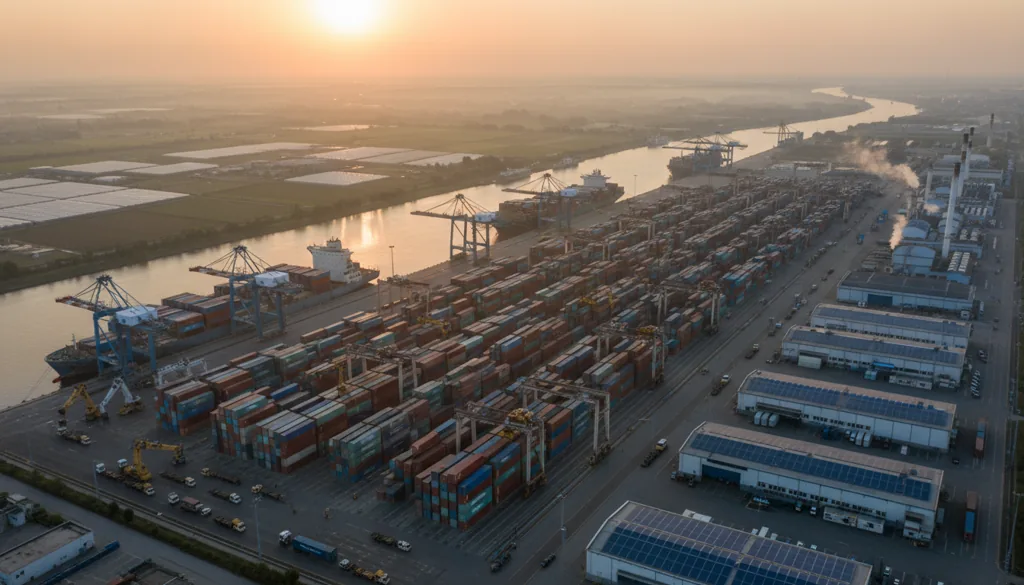
China introduced export restrictions on dual-use items targeting specified Japanese entities on February 24, 2026, prohibiting exports to restricted entities and applying strict licensing reviews for those on a watch list.
China has imposed export restrictions on dual-use goods, technology and services destined for specified Japanese entities, with the measures taking effect on Feb. 24, 2026.
The action covers products that can serve civilian or military purposes, from advanced electronics and industrial machinery to technologies used in weapons development. It creates an outright ban for 20 Japanese entities and a tougher licensing regime for another 20.1
The measure is intended to block support for Japanese military capabilities. The exporter, and in some cases an overseas company handling Chinese-origin goods, carries the compliance burden.
Japan’s 40-entity export split
The first group is on China’s restricted namelist. Exporters are barred from supplying dual-use items to those entities, while organisations and individuals outside China are also barred from transferring or providing Chinese-origin dual-use items to them.2
Japan’s 40 entities, by treatment
The prohibition applies to goods, technology and services that could be used for civilian or military purposes, or that could increase military potential. That definition reaches beyond finished defence equipment and can include items used in design, development, production or delivery systems for weapons of mass destruction.3
The ministry’s later account named Mitsubishi Heavy Industries Shipbuilding among the 20 restricted entities. It placed another 20 Japanese entities, including Subaru, on a separate watch list because their end-users and end-uses could not be verified.1
That split matters for trade operations. A shipment linked to a restricted entity is prohibited, while a shipment linked to a watch-list entity enters a much more demanding review process. The named company is only one part of the check, since intermediaries and overseas recipients can also fall within the rules.
For the restricted group, exports to listed entities are prohibited. The ban also reaches transactions already in progress, which the ministry said must be stopped immediately.2
The watch-list licensing barrier
Watch-list shipments cannot use general licences or obtain export certificates through a simplified filing route. Exporters seeking an individual licence must submit a risk assessment report on the listed entity and provide a written commitment on the proposed use.1
Restricted vs watch-list entities
| Question | Restricted namelist | Watch list |
|---|---|---|
| Can the export proceed? | No — prohibited outright | Only with an individual licence |
| General / simplified licences | Not applicable — banned | Barred |
| Evidence required | None — no application possible | Risk assessment report and written end-use commitment |
| Review timing | Immediate stop to ongoing deals | Stricter end-user and end-use check, no fixed time limit |
| Military users or uses | Covered by the ban | Applications will not be approved |
That commitment must say the dual-use item will not be used for any purpose that could help strengthen Japan’s military capabilities. The ministry will conduct a stricter examination of both the end-user and the end-use.2
The review has no fixed time limit under the normal licensing timetable. This creates a practical risk for shipment planning because a complete application may still remain under review beyond the period expected for ordinary licence processing.1
The distinction between restricted and watch-list companies therefore affects more than the chance of approval. It changes whether an order can proceed at all, whether a licence application is possible, and how much evidence must be assembled before goods leave China.
For the watch-list group, exporters must provide a risk assessment report and a written end-use undertaking. Applications involving Japanese military users or military purposes will not be approved.1
Chinese-origin goods beyond Japan
The restrictions follow the goods through third countries. An organisation or individual in another country can face legal accountability if it transfers or supplies relevant Chinese-origin dual-use items to an organisation or individual in Japan in breach of the measure.4
Who is caught beyond China’s border
That provision brings freight forwarders, distributors and overseas processing arrangements into the risk picture. A shipment that leaves China for a non-Japanese destination may still become problematic if the goods are later provided to a covered Japanese recipient. The rule is aimed at the chain of supply, not only the first export declaration.
The same principle appears in the restricted-namelist notice. Overseas organisations and individuals are prohibited from transferring or providing dual-use items originating in China to the listed entities.2
The practical effect is to make origin and destination controls operate together. A non-Chinese company cannot assume that a shipment has left Chinese jurisdictional reach merely because it is re-exporting from another country.
The measure also stops relevant activities already under way. That is a sharper commercial requirement than a rule applying only to new orders, because contracts, production schedules and goods awaiting dispatch may all need to be reviewed. The source material gives no general transition period for those activities.
For covered shipments, Chinese-origin items cannot be transferred onward to the listed Japanese entities. That restriction applies to organisations and individuals outside China as well as to exporters at the point of origin.5
The licence system behind the measure
The restrictions sit within China’s newer dual-use export-control system. The State Council’s regulation took effect on Dec. 1, 2024, and contains six chapters and 50 articles covering licensing, control lists, supervision and enforcement.6
The dates that bind
The regulation describes dual-use items as goods, technologies and services that can serve civilian or military purposes, or contribute to increased military potential. It also sets out controls on end-users and end-uses, including a controlled-list system and a watch-list system.6
That framework removed the earlier registration system for dual-use exporters while keeping export licensing in place. The change was presented as a trade-facilitation measure, but it did not remove the need to obtain approval for controlled exports.3
The Japan action uses the framework’s two levels of intervention. Restricted entities face a direct prohibition, while watch-list entities remain subject to individual licensing and a deeper review of the proposed transaction.
China’s 2026 dual-use import and export licence directory took effect on Jan. 1, replacing the 2024 directory. The Ministry of Commerce and the General Administration of Customs said the revision was made under the Export Control Law, the dual-use regulation and the 2026 tariff schedule.7
The directory is important for customs processing because an importer of radioactive isotopes must obtain approval from the Ministry of Ecology and Environment before applying for a dual-use import licence. That is a separate import procedure, but it shows how licensing and customs clearance are linked within the wider system.7
Beijing’s stated purpose and reach
The Ministry of Commerce said the Japan measures were taken under China’s Export Control Law and the Regulations on Export Control of Dual-Use Items. It linked the action to national security, national interests and international non-proliferation obligations.5
The ministry also described the restrictions as targeting a small number of Japanese entities and applying only to dual-use items. In a statement on the measures, it said normal economic and trade exchanges would not be affected.2
That assurance narrows the formal scope, but the operational effect is still significant for companies dealing with the listed names. The dual-use category is broad enough to include civilian products when their technical features, destination or proposed end-use create a military concern.
The restrictions also form part of a wider use of entity-based controls by China in 2026. Separate ministry announcements added US and European entities to export-control lists, with similar prohibitions on dual-use exports and transfers of Chinese-origin items.8
Those later measures do not alter the Japan rules, but they show the mechanism being applied across several trading relationships. The common structure is a named-entity ban, an onward-transfer restriction and an immediate halt to relevant activities.
For Japan-related trade, the key dividing line is now the entity’s status. A restricted-namelist company cannot receive covered exports, while a watch-list company triggers individual licence review and a commitment on military use.2
The Feb. 24 action therefore reaches beyond a simple customs restriction. It changes how exporters must screen Japanese customers, how overseas distributors handle Chinese-origin goods and how existing orders are treated. Its effect will be greatest where a product has both a civilian market and a plausible military application.
Sources
- ↩ MOFCOM Announces Export Control Measures on Dual-Use Items https://english.mofcom.gov.cn/News/SpokesmansRemarks/art/2026/art_8a8c97213a8341b5b1c43cab9d26dc72.html
- ↩ China Adds 20 Japanese Entities to Export Control List http://english.scio.gov.cn/m/pressroom/2026-02/24/content_118343507.html
- ↩ China Enacts New Export Control Regulations for Dual-Use Items https://en.moj.gov.cn/2024-10/21/c_1037580.htm
- ↩ China Tightens Export Controls on Dual-Use Items to Japan http://english.scio.gov.cn/pressroom/2026-01/06/content_118264833.html
- ↩ MOFCOM Tightens Export Controls on Dual-Use Items to Japan https://english.mofcom.gov.cn/News/SpokesmansRemarks/art/2026/art_ad432d69b63545ef81b6b0c9d21c0fa1.html
- ↩ China Releases New Dual-Use Exports Control Regulation https://www.moj.gov.cn/pub/sfbgw/gwxw/xwyw/202410/t20241019_508006.html
- ↩ Commerce and Customs Release 2026 Edition of Dual-Use Items and Technologies Import and Export License Management Directory https://aqygzj.mofcom.gov.cn/qdml/art/2025/art_7c31035e701f4ed79b664a118d218367.html
- ↩ China adds 10 U.S. entities to export control list http://english.scio.gov.cn/pressroom/2026-06/22/content_118560332.html