
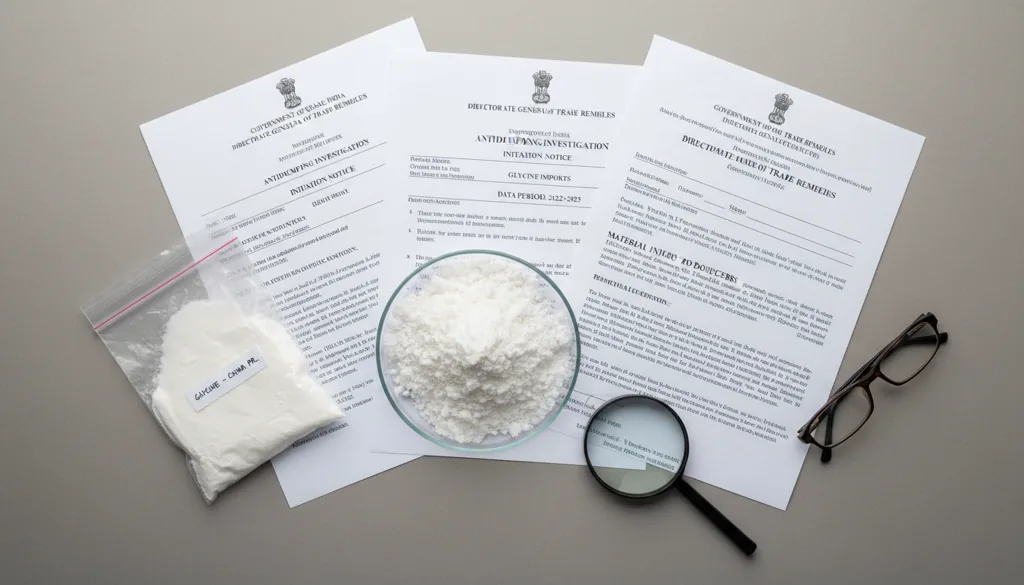
India initiated an antidumping investigation on imports of glycine originating in or exported from China PR on September 22, 2026.
India’s Directorate General of Trade Remedies has opened an anti-dumping investigation into glycine from China, starting a process that could lead to duties on the chemical. The investigation was initiated on Sept. 22, 2026.1
Glycine is a white, salt-like amino acid used in medicines, food products, animal feed and industrial chemicals. The case covers Chinese glycine entering India in pharmaceutical, food, technical, feed and other grades, rather than a single end-use product.2
No duty rate has been imposed at this stage. The immediate burden is paperwork and evidence: importers, Chinese exporters and Indian users that take part must provide information through the investigation process, and each company bears the cost of preparing its response.
Glycine reaches medicines and feed
The product is the simplest non-essential amino acid and is sold in several grades whose purity and additional testing determine its use. Pharmaceutical-grade glycine can be used as an ingredient in medicines, while food-grade material is used as a sweetener or flavour enhancer. Technical and feed grades serve industrial, agricultural and animal-diet applications.2
Like article: Indian vs Chinese glycine
| Question | Indian-made glycine | Chinese glycine |
|---|---|---|
| Physical and chemical characteristics | Similar | Similar |
| Uses | Comparable | Comparable |
| Specifications | Comparable | Comparable |
| Pricing | Comparable | Comparable |
| Buyers can substitute | Interchangeable | Interchangeable |
That wide scope matters because the investigation is not limited to one niche in the chemical market. The notification says the product under consideration includes crude, industrial, technical, feed, food, European Pharmacopoeia, United States Pharmacopeia and injectable grades. It therefore covers all grades of glycine identified in the application.2
The authority has also treated Indian-made glycine and the Chinese product as comparable for the opening stage. The application says the products have similar physical and chemical characteristics, uses, specifications and pricing. It also says buyers can use them interchangeably, leading the authority to consider them a “like article” for the investigation.
The goods are normally imported under tariff subheadings 29224910 and 29224990 in Chapter 29 of India’s customs tariff. The notification warns that these classifications are only indicative and do not, by themselves, decide the investigation’s product scope. That leaves the product definition wider than a simple customs-code search.
The period under examination
The authority will examine alleged dumping during the 12-month period from April 1, 2025 to March 31, 2026. It will assess injury across four financial periods, beginning with April 1, 2022 to March 31, 2023 and continuing through the investigation period.2
Periods the investigation covers
That structure separates the alleged pricing conduct from its effect on Indian production. Evidence about Chinese export prices will be measured against a normal value, meaning the benchmark price or cost used to decide whether exports were sold below a fair level. Evidence about Indian producers will then be reviewed across the longer injury period.
The application uses customs systems data to determine the Chinese export price at the factory gate. Adjustments are made for ocean freight, marine insurance and other expenses. The authority says the comparison produced a dumping margin above the minimum level that can be disregarded, with the margin described as significant.2
For normal value, the applicant sought treatment of China as a non-market economy under India’s anti-dumping rules. Because reliable third-country price or cost information was not available, the application used estimated raw materials, utilities, manufacturing overheads, administrative costs and a profit margin. That approach is an opening calculation, not a final finding.
Evidence of pressure on Indian producers
The authority has accepted the application for investigation after finding initial evidence of dumping, injury and a connection between the two. The legal purpose is to determine whether dumping exists, how large it is and what effect it has on Indian producers. If the findings support it, the authority can recommend a duty amount intended to remove the injury.2
Three claims in the injury case
The injury case rests on three main claims. Chinese import volumes increased in absolute terms, import prices suppressed Indian prices and the domestic producer’s operating performance deteriorated. The authority described the evidence as sufficient to justify starting the investigation, not as a final conclusion on liability.2
The application was filed by Avid Organics Pvt. Ltd., which said it had not imported the product from China and had no relationship with Chinese producers or exporters. It claimed a 66% share of Indian production during the investigation period. The authority accepted the company as an eligible part of the domestic industry under the anti-dumping rules.2
This gives the case a defined domestic-industry base, while the final assessment will require responses from companies on both sides of the trade. Indian importers and users are listed among the parties that may receive questionnaires or submit relevant information. The result could affect the delivered cost of glycine used in medicines, food processing, chemical production and animal feed.
Filing rules shift work to companies
The investigation will be conducted under Rule 6 of India’s anti-dumping rules. Known Chinese producers and exporters, the Chinese government through its embassy, Indian importers and Indian users are to be informed separately. Other interested parties can also make submissions within the deadlines in the initiation notice.2
Deadlines for participating companies, days
The central filing system is the SETU portal, and the notice assigns each matter a case identity. Submissions must be uploaded under the registered name and case number, with narrative material in searchable PDF or Word format and data files in Excel format. Questionnaire responses must be filed through the SETU portal only.2
The first major deadline is tied to circulation of the domestic industry’s non-confidential application. Both confidential and non-confidential versions of each submission must be uploaded within 37 days of that circulation or transmission to the appropriate diplomatic representative. Late or incomplete information can allow the authority to make findings from the facts available on the record.2
That timetable puts the administrative cost on participating companies, not on customs officials at the border. Importers and users must gather purchase, sales and consumption information, while exporters face requests for production, cost and export data. A party that misses the deadline risks having its position assessed without the information it intended to provide.
Confidential files and possible duties
The notice separates information that can be kept confidential from material that must be available to other participants. A company making a confidential submission must file a corresponding non-confidential version, and it must explain why the protected information cannot be disclosed. The required confidential and non-confidential versions are to be marked clearly as such.2
The public version must be detailed enough to give other parties a reasonable understanding of the confidential material. Where information is not properly summarised or the confidentiality claim lacks an adequate explanation, the authority may reject the response or allow the material to be inspected by other interested parties. Non-confidential submissions will be available to participants through their accounts on the portal.2
The investigation could also examine whether duties should apply to imports made before a final measure. The domestic applicant has requested retrospective imposition, citing alleged persistent dumping, importer awareness, a significant dumping margin and a sharp decline in the domestic industry. The authority will seek comments before deciding whether that issue merits further action.2
A retrospective duty would create a different risk from an ordinary prospective measure because past entries could become relevant to the eventual liability calculation. The notification records the request but does not impose such a duty. The immediate change for the glycine trade is therefore the investigation and its evidence demands, while any tariff consequence remains subject to later findings.
The authority can classify a participant as non-cooperative if it refuses access, fails to provide necessary information within the stated period or significantly obstructs the investigation. In that situation, findings may be based on the available record and recommendations may be made to the Indian government. The investigation therefore makes complete and properly formatted participation commercially important.2
The next procedural decisions will shape whether the product scope changes. Parties have 15 days after receiving notice of initiation to comment on the scope of the product under consideration and to propose a product-control-number method, if needed. If a later notice changes that scope or method, a further 15-day extension is available for the affected responses.2
For importers, the practical exposure is concentrated in product identity, supplier data and the treatment of different grades. A shipment classified under one of the listed tariff headings may still fall within the wider product definition. The final outcome will determine whether Chinese glycine used across medicines, food, agriculture and industrial production faces an additional Indian trade charge.
Sources
- ↩ Anti-Dumping Investigation on Glycine Imports from China PR https://www.dgtr.gov.in/en/anti-dumping-cases/initiation-anti-dumping-investigation-concerning-imports-glycine-originating-or
- ↩ Initiation of Anti-Dumping Investigation on Imports of Glycine from China https://dgtr.gov.in/sites/default/files/2026-09/Glycine%20Initiation%20Notification%20English%20Signed%20and%20Dated.pdf