


 Feb 17,2026
  By Alice
Germany is one of the prominent countries in Europe and particularly in international trade. The initiator country of the European Union is deemed an economic growth driver of Europe due to its robust industrial presence and strong innovation, along with its high human capital. No doubt that Germany has become the largest economy in Europe, which is driven by numerous high-technology industrial sectors, including automotive, construction, chemical, machinery, and others. This article will explain the German export and import procedure, including the list of Germany’s HS codes and its largest trading partners for export and imports.
The difference between the HS code for Germany and the European Union
Harmonized System or HS code is a universal international code specially designed for export and import, which is regulated and updated regularly by the World Customs Organization (WCO). This code is used worldwide, including in Germany and the European Union. This code has a function to identify the products or goods based on their functionality, characteristics, and materials. Hence, this code is one of the mandatory aspects for international trade to assist the customs officer in categorizing the traded products.
Over the decades, customs regulations in Germany have been adopted from the combined nomenclature for statistics and tariffs systems from the European Union, which is known as the Common Customs Tariff for classifying goods. Not only in Germany, but these tariff systems are also applied to all of the EU member countries. The Common Customs Tariff is administered by the European Commission regarding some updated goods classification codes in the EU, also known as the EU commodity code, as well as applicable tariff rates. Here is the explanation regarding the EU commodity codes:
- HS code consists of a 6-digit code that is recognized internationally.
- CN (Combined Nomenclature) including 8-digit code numbers.
- TARIC, or the Integrated Tariff of the European Union, is used for all of the EU member countries, which include 10-digit code numbers.
Even though the HS tariff number in the EU is universally applied to all of the EU member countries, including Germany. However, the German customs agency, also known as Zoll, adopted its own code system with an additional one-digit number behind the 10-digit TARIC code number. This code is called the national code in Germany, and it is particularly made for statistical purposes. Here is an example of the structure of an 11-digit national classification code for importing a newspaper or magazine into Germany.
| Code number | Structure |
| 49 | Chapter under the HS code for printed books |
| 4902 | Heading under the HS code |
| 4902 90 | Subheading under the HS Code |
| 4902 9020 | Subheading under the Combined Nomenclature (CN) |
| 4902 9020 00 | Subheading under the TARIC for a magazine or a newspaper |
| 4902 9020 00 0 | Specific code number from the German national customs agency |
However, some products need to be more precise in order to be classified; therefore, the national customs in Germany can extend the HS code to 4 additional digit numbers. This code should be understood by the international trade parties, especially those who want to transfer their goods from another country to the German territory.
HS tariff code list for importing products to Germany
HS tariff code for exporting products from other countries to Germany uses the HS code that is universally recognized and administered by the WCO. Therefore, the 6-digit code for exporting products to Germany is similar to that of other countries. The difference is only in the additional code, including Combined Nomenclature (CN) and TARIC or EU commodity codes, as well as the additional customs code number. Here is the HS tariff code list of popular sections for exporting products to Germany.
| Section | Products description |
| Section 5 (Chapter 25-27) | Mineral products, including ore, salt, mineral fuels, or others. |
| Section 6 (Chapter 28-38) | Chemical products or other similar industries, such as pharmaceuticals, fertilisers, and others. |
| Section 7 (Chapter 39-40) | Plastics and other similar products, including rubber. |
| Section 8 (Chapter 41-43) | Skins, leather, or raw hides, for travel goods, handbags, or other similar products. |
| Section 11 (Chapter 50-63) | Textiles and other garment products, such as knitted and other apparel, clothing. |
| Section 15 (Chapter 72-83) | Base metals and other metals for industries, such as steel, iron, aluminum, and others. |
| Section 16 (Chapter 84-85) | Machinery, electrical equipment, mechanical appliances, and other electronic products. |
| Section 17 (Chapter 86-89) | Vehicle, aircraft, vessels, and other transportation equipment. |
The table above is a summary of the popular sections of the HS code in Germany. These products are important for German export and import. However, the lists section is only the beginning process of exporting products to Germany. Please note that you need to do deep research regarding the latest HS code in Germany before the shipment process. This is important because if you are declaring an inaccurate HS code, it will be a serious problem and it will lead to a complicated process.
The biggest export and import products in Germany
After understanding the structure of Germany’s HS code, we should know about the largest export and import products in Germany. The largest export and import products in Germany are important to grasp the economic structure in Germany based on the comparative advantages of this country and its contribution to the world. On the other hand, Germany also needs to import products from other countries to meet domestic needs that it does not have. Here are the top 5 biggest export commodities from Germany in 2024.
| Export Commodity | Total export value (1000 Euro) |
| Vehicles other than railway and tram | 262,793,256 |
| Machinery and other mechanical equipment | 251,809,971 |
| Electrical machinery and other electrical equipment | 166,953,611 |
| Pharmaceutical products, including cosmetics and medical products | 113,632,613 |
| Optical, photographic, and other similar instruments using optics. | 79,119,176 |
Source: Federal Statistics Office of Germany, retrieved December 15, 2025
As shown above, the biggest commodities in Germany are vehicle products. This is obvious because Germany is well-known for its automotive industry. It has many popular automotive brands, such as BMW, Mercedes-Benz, Volkswagen, and others. The second largest export product from Germany is machinery because, as we know, Germany has big machinery companies, such as Bosch, and others. The other biggest export commodities are electrical machinery, pharmaceutical or medical products, and optical products.
We know that every country, including Germany, needs to buy products from others to meet its domestic demands. Here are the top 5 largest import commodities in Germany in 2024.
| Import Commodity | Total import value (1000 Euro) |
| Electrical machinery and other electrical equipment | 187,338,739 |
| Machinery and other mechanical equipment | 160,216,675 |
| Vehicles other than railway and tram | 135,932,294 |
| Mineral fuels, oil, and other raw mineral materials. | 106,875,063 |
| Pharmaceutical products, such as medical products, or others | 71,385,271 |
Source: Federal Statistics Office of Germany, retrieved December 15, 2025
In 2024, Germany imported electrical machinery with a valuation of more than 187 billion euros, and it became their largest imported product. The second and third largest imported products in Germany are machinery and vehicle parts, which are important to meet the needs of the global auto industry and other high-technology industries. Meanwhile, Germany has a great demand for mineral fuels from other countries due to a lack of local fuel resources to drive its industries. Moreover, the fifth largest imported product in this Western European country is pharmaceutical products.
The 5 largest import and export German trading partners
When we grasp the largest export and import commodities in Germany, we need to know where the products come from and where they are destined. There are the top 5 largest German foreign partners whose roles are indispensable for Germany and their countries. Here are the largest exporting countries of German products in 2024 from the Federal Statistics Office of Germany.
| Country | Export value (1000 Euro) |
| United States | 161,426,972 |
| France | 115,150,602 |
| Netherlands | 109,342,977 |
| Poland | 93,463,625 |
| China | 89,934,332 |
Source: Federal Statistics Office of Germany, retrieved December 15, 2025
From the table, we can see that the United States is the largest export destination of German products, with a value of more than 161 billion euros. The second and third biggest exports from Germany are destined for its neighboring countries, including France and the Netherlands. Moreover, the fourth and fifth largest recipients of German products are Poland and China, respectively. When we already know the biggest export destination, then what are the largest importers in Germany? Here are the top 5 biggest importing countries into Germany.
| Country | Import value (1000 Euro) |
| China | 156,847,473 |
| Netherlands | 93,048,755 |
| United States | 91,827,837 |
| Poland | 77,313,974 |
| Italy | 67,232,491 |
Source: Federal Statistics Office of Germany, retrieved December 15, 2025
Based on the table, China has become the largest supplier in Germany with a valuation of more than 156 billion euros in 2024. This East Asian country is followed by the Netherlands and the United States as the second and third largest importers. Then, Poland and Italy have a role as the fourth and fifth biggest suppliers in Germany. This data concluded that Germany depends on its neighboring countries, such as the Netherlands, Poland, and Italy, in order to meet its domestic demands.
Finding HS code in Germany using HS Code Match
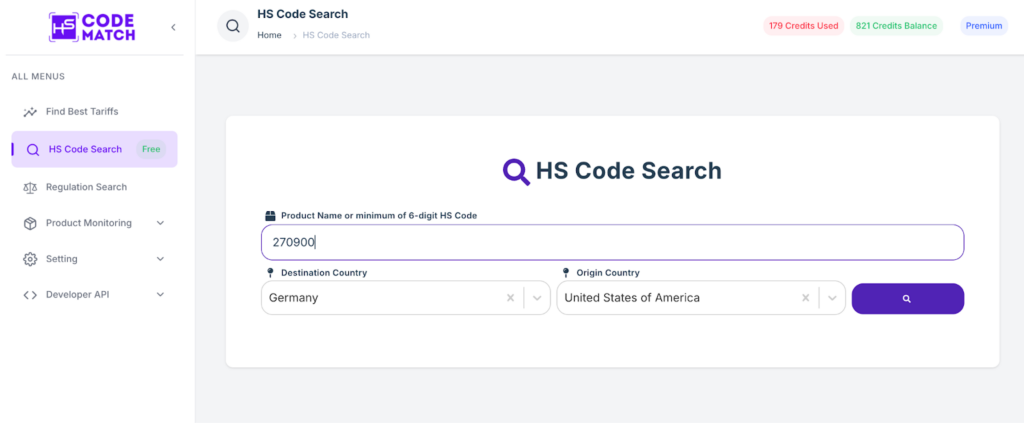
Finding Germany’s HS code is indeed complicated due to the intricate codes of the extension of the national code in the European Union and Germany. To ease your work in finding the HS code for Germany, you can use HS Code Match. This application is simple and easy to use for beginners. Here are the step-by-step instructions to find the HS code for Germany. For instance, we can use the example of exporting mineral fuels from the United States to Germany.
- First step: Open the HS Code Match application by tapping hscodematch.com on your device. Then, choose the product’s name, country of origin, and destination country. We can select transport mineral fuels from the United States to Germany.
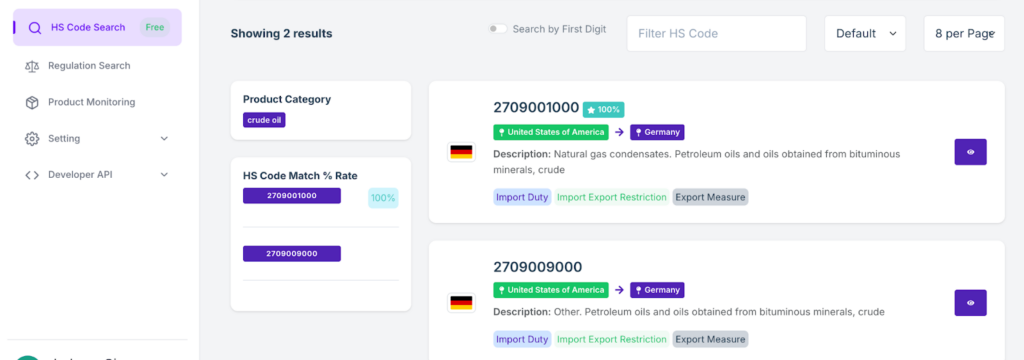
- Second step: Once all sets are complete, the HS Code Match will provide the best HS code that you are looking for. Then, we can choose the natural gas condensates under HS code 2709001000 from the United States to Germany.
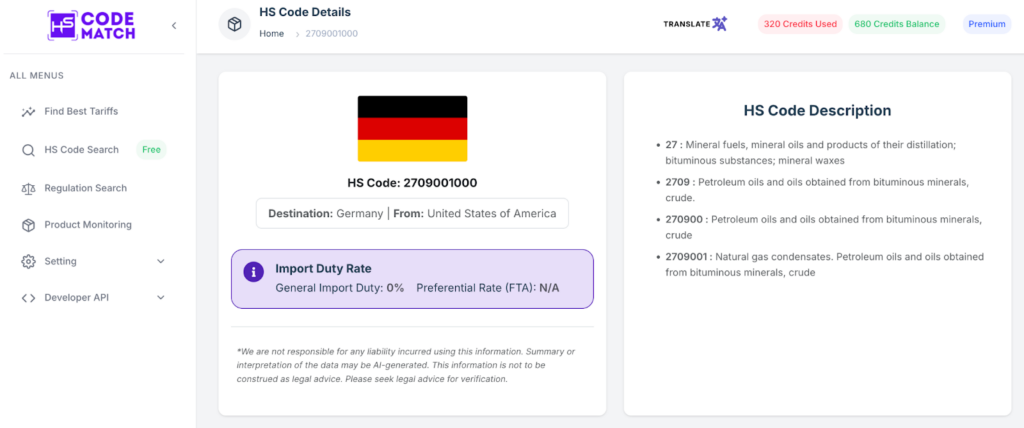
- Third step: You will be directed to the HS Code Details page, which consists of detailed information about the products. The description allows you to know the detailed description of these products and know that the general import duty rate of natural gas is 0%.
- Fourth step: In the bottom section of the HS Code Details, you will get the information on tariff rates and the latest regulations. You can also use the AI chatbot assistant provided by HS Code Match to find the specific insights that you need to know regarding the HS code 2709001000.
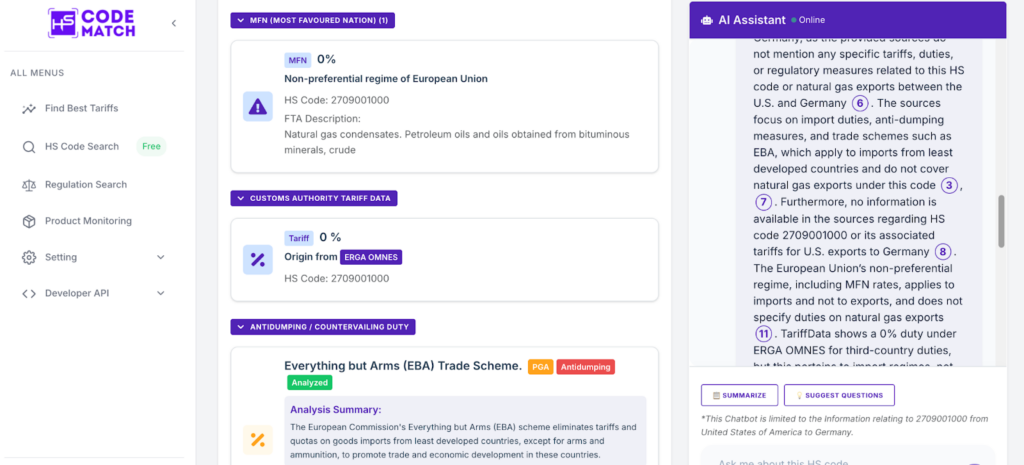
These are examples of answers from an AI chatbot assistant for exporting crude oil from the United States to Germany.
Are there any additional tariffs for exporting crude oil under HS code 2709 001 000 from the United States to Germany?
There are no additional tariff rates for exporting crude oil with the HS code 2709001000 from the United States to Germany. This not only applied to the natural gas from the United States, but to other countries as well, based on the non-preferential regime of the European Union. The zero tariff on natural gas is under the Most Favored Nations (MFN) and applies to imports, but not to exports, because there is no information related to the exportation of natural gas. Meanwhile, the latest regulations from the EU are more focused on import duties and antidumping measures. Here is the summary tariff rates table for exporting crude oil from the United States to Germany.
| Tariff item | Rate | Applicable regime |
| Export Duty for crude oil under HS code 2709001000 | 0% | Not applicable |
| Non-preferential regime or MFN duty rates | 0% | Import regime only |
| Antidumping duties | 10% – 35.6% | Biodiesel import from other countries |
| EBA Scheme | 0% | Only applied to Least Developed Countries (LDCs) |
What are the general EU import procedures for goods under HS code 2709001000 from the United States?
For exporting crude oil products under HS code 2709001000 from the United States to the European Union (EU) member countries, there are several general procedures that need to be followed. The general procedure includes several steps as follows:
1. Check the Import Restriction: This will ensure that the products are not subject to the import restriction or prohibition because some goods might be under the restriction based on the latest EU regulations.
2. Antidumping Duties: The exporters or importers need to verify if the products are subject to antidumping duties because it will affect the tariff rate. These measurements are determined by the EU customs authorities if there is any evidence of unfair practices.
3. Customs Documentation: Preparing the customs documentation for the products under HS code 2709001000. The documentation includes a commercial invoice, a packing list, a bill of lading, and others.
4. Compliance with EU Standards: The exporter and importers need to comply with the EU standards and regulations. Therefore, they must understand and stay informed about the latest regulations imposed by the EU.
5. Payment of Import Duties and Taxes: The exporters and importers need to pay the duties, taxes, and other fees upon the entry of their products into the EU, including in Germany.
What are the potential penalties or consequences for non-compliance with EU import regulations for goods under HS code 2709001000?
Penalties for non-compliance with the EU import regulation for products under HS code 2709001000 include the potential imposition of antidumping duties with a range from 10% to 35.5%, especially for importing biodiesel from China. These measures are mentioned in the trade defense action from the European Commission. Meanwhile, the non-compliance with the EU import regulation will open an investigation for alleged duty evasion, similar to the case where the EC pursues the antidumping evasion. Here is the summary of the consequences of non-compliance with EU import regulations.
| HS code | Product | Potential Penalty | Basis |
| 2709001000 | Biodiesel (pure or blend) | 10-35% imposition of antidumping duties | Imposition from the European Commission to counter dumped Chinese biodiesel import |
| 2709001000 | Biodiesel | Investigation into potential tariff evasion | European Commission investigation for 5 million EUR duty evasion |
Conclusion
Declaring Germany’s standard HS code is essential for importing products from other countries to Germany. However, the international trade parties should be aware of the detailed structure of Germany’s HS code to ensure that the products will be permitted to enter the country without problem. The national code for Germany consists of 11-digit numbers from the general 6-digit HS code and an additional 4-digit from the Combined Nomenclature (CN) and TARIC. The 1-digit last code number is based on the national code in Germany for statistical purposes. Even though finding the HS code is only the beginning process, it should never be neglected, as it is a crucial step for the export and import process.
Frequently Asked Questions (FAQs) about Germany HS Code
1. Are there any differences between the EU commodity code and the German national code?
Yes, the EU commodity code consists of 10-digit code numbers of the HS code, the CN code, and the TARIC code. Meanwhile, the German standard code consists of 11-digit code numbers from the additional code based on the EU commodity code.
2. Is the German HS code updated regularly?
Yes, the updated HS code in Germany follows the Common Customs Tariff from the European Commission. You can find the specific tariff code on TARIC websites, or you can use a third-party website, such as HS Code Match, to find and match the code with your products.
3. Are there any tariff rates for exporting natural gas from the United States to Germany?
No, there are no tariff rates to export natural gas products under HS code 2709001000 from the United States to Germany. This measure not only applies to the United States, but also to other countries under Most Favored Nations (MFN).
4. Are there any restrictions on exporting natural gas from the United States to Germany?
No, there are no restrictions on exporting natural gas to Germany because it is categorized as an essential product. Therefore, the parties who want to export natural gas from the US to Germany do not need to worry about the tariff or other restrictions.
5. Are there any antidumping measures from Germany to import natural gas from the United States?
No, currently there are no antidumping measures for exporting natural gas under HS code 2709001000 from the United States to Germany. The only antidumping measure from the EU applied to the liquid polysulphide polymers (PSPs).
Find and Match the Right HS Code for Your Products.
Try Our App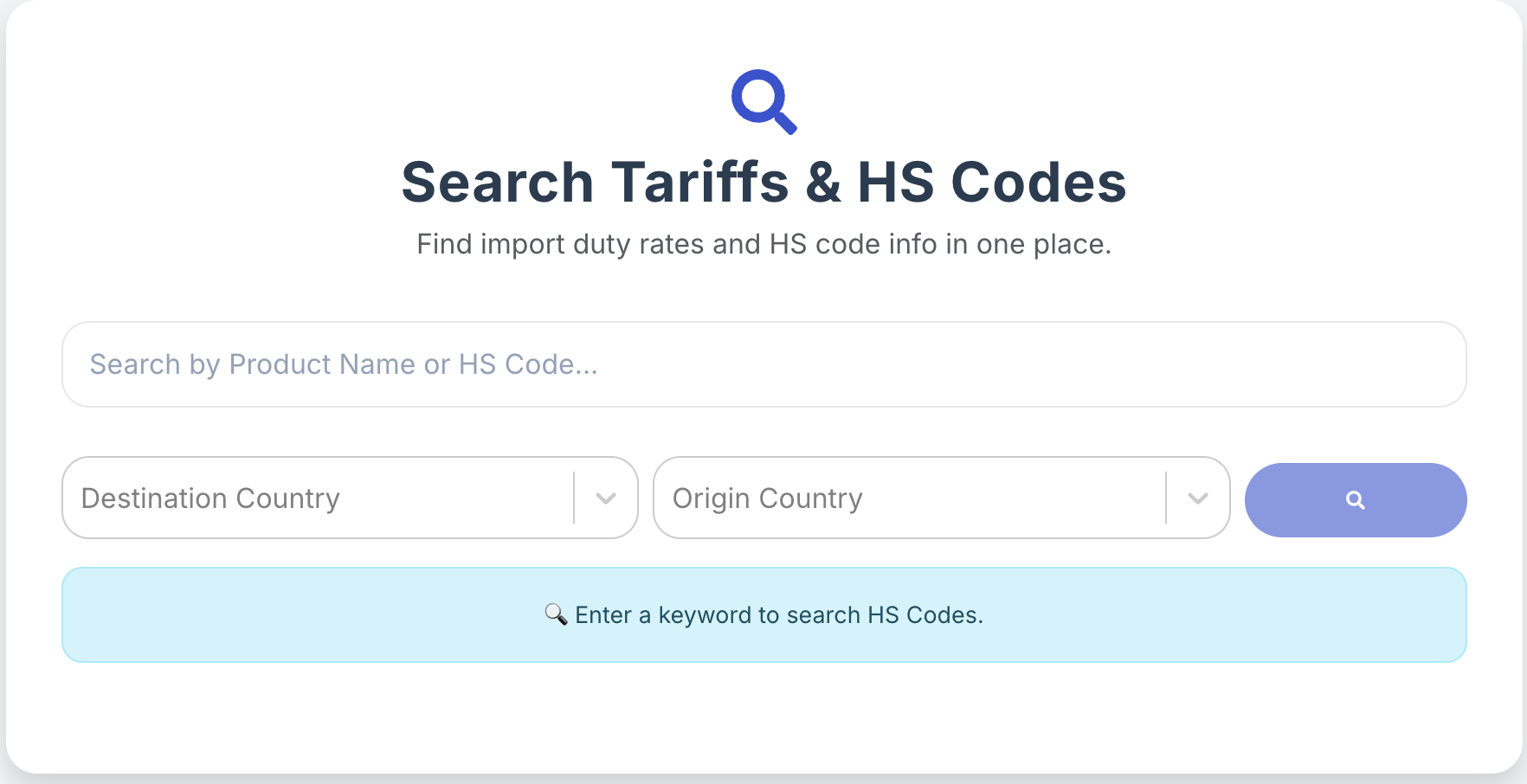

 Sep 10, 2026

