


 Feb 10,2026
  By Alice
International trade cannot be separated from the customs agency. This is because the customs agency has the authority to protect the border, particularly from products or goods that cross into the national border. In the United States, the customs agency is called Customs and Border Protection (CBP). In order to promote the transparency and efficiency of the products to come into its territory, this agency has its own customs rulings and USA tariffs. The customs ruling programs in the USA are important to know for international actors. This article will explain customs rulings and the USA tariffs, and how important they are for transnational trade.
What is a Customs Ruling?
Customs Ruling in the USA, called CBP ruling, is a legal decision that is officially issued by the CBP to respond to the importation of products into the United States. The customs ruling USA tariff is requested by importers, exporters, customs brokers, or other international trade actors. With this policy, the CBP ruling interprets how the products will be treated based on the latest regulation on products and where they come from.
Customs ruling in the USA can provide detailed information about the latest designation regulations in the United States to promote transparency for international trade parties.
Therefore, the proof of customs rulings is called a ruling letter that is issued by the CBP. This letter is important for facilitating trade compliance with the law in the United States. This letter will allow companies in international trade to make business decisions related to how their products will be treated by customs right after they come into the United States territory. In fact, not only in the United States, but also in every member of the World Trade Organization (WTO).
Who can request the customs rulings in the United States?
Anyone or any business can request a customs ruling, especially for parties that want to import goods into the United States. Based on the CBP ruling, the request is covered under Part 177 of the CBP Regulations, and a person who can request a customs ruling includes an individual, partnership, corporation, company, or other group that has an interest in international trade. They might request the binding ruling from CBP before their products arrive at the ports or airports in the United States.
How to request customs rulings in the United States?
Different from before, the procedure for customs ruling the USA tariff is quite easy due to the digitalization of bureaucracy. The parties who want to request the customs ruling can directly fill in the blanks on the eRulings Template provided by the CBP. This method allows you to request from the National Commodity Specialist Division (NCSD) online without needing to come to the office.
After submitting the eRuling Template, the requester will obtain an email with the details of the information in the template. If the request is received by the NCSD, the requester will get the email notification accompanied by the ruling control number within one working day. If the eRuling is not in the appropriate order, the CBP will provide the notification and return it to the requester.
Once everything is clear, the NCSD will send the ruling letter within 30 days. However, there could be a delay in the process of issuing rulings due to laboratory requirements or other consultations with other agencies. Moreover, the rulings must obtain a referral to Headquarters and Regulations and Rulings (RR); those institutions will send rulings letters within 90 days after the receipt is created.
What must be included in a customs ruling in the United States?
After understanding the bodies that issue customs rulings and how to make a request, we might know what must be included for a customs ruling request. These documents are a requirement for requesting rulings to the NCSD and RR Headquarters Office:
- Name, address, email address, and phone number of international trade parties.
- The names, addresses, email addresses, and other identification information of all parties who are requesting the rulings, as well as the manufacturer ID.
- Names of ports in the USA where the products will be entered.
- The description of a detailed transaction is an identification of a prospective importation product from some countries.
- The statement that declares the importer’s knowledge and can be proof of the possibility of pending.
- A Statement as proof that has sought advice from the CBP office and containing from who and the advice that was rendered, if any.
The requirements documentation can be found at the CFR 177.2 (a) and (b). Additionally, other written ruling requests may be requested by the CBP. The customs agency may include confidential information, including trade secrets, for issuing rulings. The requester has the right to ensure that the information is confidential and state the reasons why they must give the confidential information to the CBP.
Type of Customs Ruling in the USA
Other than the requirement above, there are five other types of customs ruling the USA tariff. These tariffs are important and have a crucial impact on the determination of tariff rates for imported products in the United States:
1. Tariff Classification Rulings
Classification rulings have a function to determine the HTSUS provision for imported goods. The HTUS number defines the tariff rate and eligibility of a product included in various Free Trade Agreements (FTAs). The request for a classification ruling must be sent to the NCSD in order to be reviewed based on the tariff classification. The information should be provided in the classification rulings, such as a full detailed description of imported goods, component materials of imported goods, principal use in the United States, technical designation or commercial, illustrative or charts, chemical analysis, and any other invoicing requirements. This ruling is important for the classification of the HTS code lookup for certain products.
2. Country of Origin (CoO) Rulings
Country of origin (CoO) rulings have a function to determine the country of origin of imported products. This ruling is important to define the duty rates or other preferential regimes under the Free Trade Agreements. The originality of products is determined by the source of material used and where the production or assembly process of a product took place.
3. Special Trade Program or Agreement
Special trade programs or agreements are the rulings to explain and determine if there are any Free Trade Agreements or other special trade programs for some imported goods. This ruling also requests information on where the production of some products takes place. All of the requirements to request the trade program and agreement should be sent to the NCSD using the method above.
4. Country of Origin Labelling or Marking Request
This ruling is requested to determine that the products meet the labelling standard in the United States. This includes a description of the article and the container will be marked or labelled based on the origin country, an illustration that shows clearly how goods are labelled and packaged, an illustration of other labelling and packaging details, and a detailed description of how the products will be sold after importation.
5. Valuation Request
Valuation request ruling has a function to determine the value of imported products to the United States. This ruling process is conducted by the Valuations and Special Programs Branch of RR Headquarters Office. The request for information related to the transactions includes a description of the nature of the transaction, the relationship of international parties, whether or not the transaction is from a third party, and additional information related to these issues.
Examples of customs rulings in the United States for tariff classification
In order to find the documentation or record regarding the publications of customs rulings results in the USA, you can find it on the CBP website (rulings.cbp.gov). Here are the examples of customs rulings on several products, including the fatty acid methyl ester (FAME), clonidine classification rulings, and a printer from the CBP publications records:
1. Fatty Acid Methyl Ester (FAME) tariff classification ruling
Fatty acid methyl ester (FAME) is a product that is popular these days because it is used for many industries, especially for making perfume, biodiesel, etc. Due to discrepancies in the functions, it needs more clarification for the exporters or other international trade parties. Here are several publications of tariff classification rulings for FAME products in the USA:
- HQ H325687
- The ruling letter answers the request about the tariff classification of agricultural oil feedstock in the United States. After the analysis of the facts of the products, it can be classified under HTSUS subheading 1518.00.40. This product is under the general duty rate of 8% ad valorem.
- NY N330003
- This letter provides information regarding the tariff classification of FAME from India. The requested products are considered under the HTSUS 3824.99.41.40. Moreover, the tariff rate of these products is 4.6% ad valorem and can be changed based on the latest regulation.
- HQ H284810
- This letter responds to the request for tariff classification of MetaSmartDry, which contains FAME. After analyzing based on the submitted facts, this product is classified under the HSTUS code 2309.90.95. The MetaSmartDry is subject to a rate duty of 1.4% ad valorem.
2. Clonidine tariff classification ruling
Clonidine Hydrochloride, also known as clonidine, is a type of medicine used for the treatment of hypertension. This medication is claimed to be effective for reducing high blood pressure. Therefore, the information related to the clonidine classification is requested by the exporters. Here is the list of publications regarding the tariff classification of clonidine:
- NY N336754
- This letter informed the request about tariff classification for Clonidine Hydrochloride in the form of a tablet from India. The tariff classification of this medicine product will be included in 3004.90.9220. There is no tariff rate applied to these products.
- NY N189386
- This letter answers the request related to the tariff classification for importing Clonidine dosage from India to the United States. The subheading of the HTSUS code for this product is 3004.90.9120. There is no duty rate for the importation of medicine.
- NY N086421
- The ruling letter informed the classification of Clonidine Hydrochloride and Clonidine in bulk from India. The CBP explains that these clonidine products in bulk can be covered under HTSUS code 2933.29.2000. The duty rate for these products is free based on the regulation in 2009.
3. Printer tariff classification ruling
A printer is considered one of the most important things. These products are used everywhere to meet the demand of the office, school or even individual usage for simple printing. There are some of the rulings for printer products to be exported into the United States.
- NY N336858
- The ruling related to the request for the tariff classification for the K600i Digital UV Inkjet Printer. This HS code printer product is under the HTSUS code 8443.32.1040. The printer products from China are subject to 7,5% ad valorem duty based on the United States regulation at the time.
- NY N326354
- This ruling is about the tariff classification of printer parts imported from China to the United States. This letter explains that the Core Charge Roller, 1M Core Developer Assy, and Core Developer Assy are under the HTSUS 8443.99.2550. This equipment printer product is subject to a 7.5% ad valorem tariff rate.
- NY N308933
- This ruling is about tariff classification for the HP Laser Toner Reload Kit from China. These products are classified under the HTSUS code 8443.99.5015 and subject to a 25% ad valorem tariff rate. The information from this letter is important to look up for the HTS code for the printer products.
HTS Code Look Up using HS Code Match
Finding the HTS code is somewhat challenging due to the regular updates of the product classification, which most likely altered the HTS code structure. The HTS code can be clarified by requesting the rulings from the CBP, but it takes time because it will take more than a week or a month to receive a response.
However, nowadays, looking up the HTS code classification can be done easily and quickly with the help of a third-party application, such as HS Code Match. This is an example of finding the HTS codes for the three products above, including fatty acid methyl ester, clonidine hydrochloride, and printer in the United States:
1. HTS code for Fatty Acid Methyl Ester (FAME)
For example, we can use the export of fatty acid methyl ester from China to the United States. Based on the results from HS Code Match, the most relevant for fatty acid methyl ester is under the HS code 3824994140. From the HS Code Details page, we can see that the general import duty for exporting this product from China to the United States is 4.6% under the Most Favoured Nations (MFN) regime.
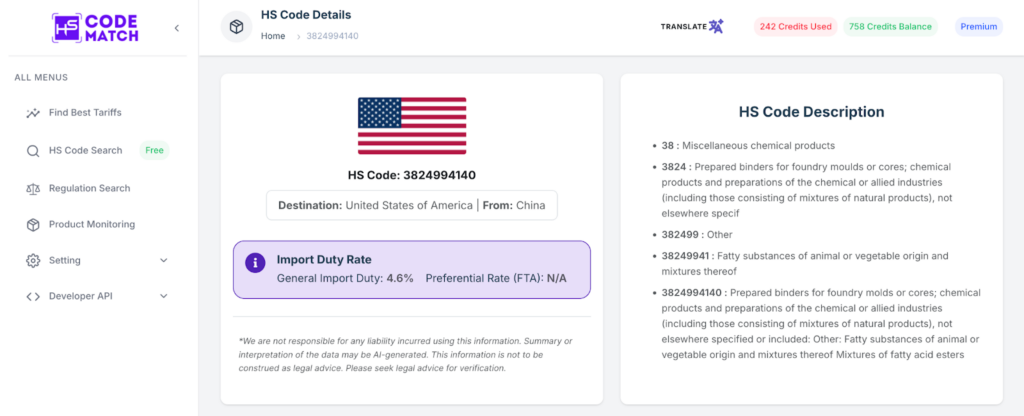
Not only showing the general duty import and the HS code description for the HTS code 3824994140. On HS Code Details, you can find the AI chatbot to assist you in finding the specific answer and insights regarding the exportation of fatty acid methyl ester from China to the USA.
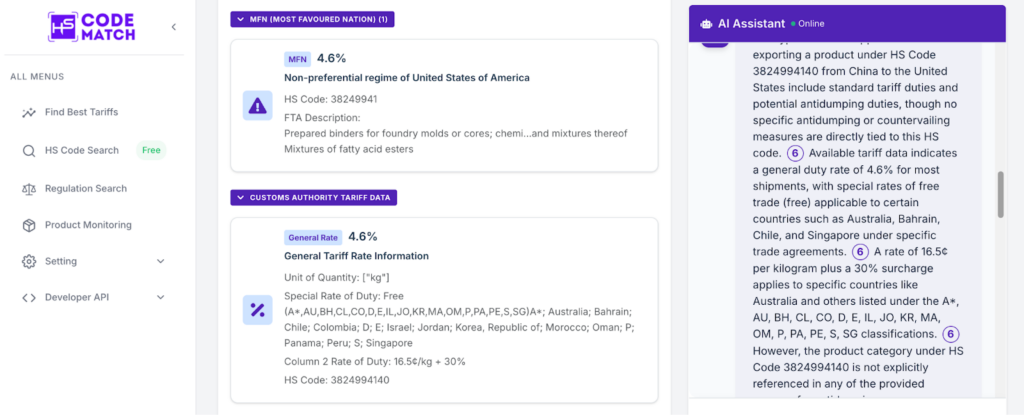
What are the types of tariff for exporting a product under HS code 3824994140 from China to the United States?
There are several types of tariffs to export products under HS code 3824994140 from China to the USA. The general tariff rate for exporting fatty acid methyl ester to the US is 4.6%. This rate is under the MFN regime, which applies to other countries as well, including Australia, Bahrain, Chile, etc. However, there are potential additional tariffs due to the antidumping or countervailing measures for these products from China. Fortunately, there are no antidumping duties yet for exporting these products to the US. The related government agencies, such as the US International Trade Commission (USITC) and the Department of Commerce, have conducted an investigation on some chemical products under this code, such as 2,4-Dichlorophenoxyacetic Acid, due to the potential breach of the lower price when marketed in the US. This is the table information on tariffs for exporting products under HS code 3824994140:
| Types of Tariff | Applicable Duty Rate | Countries |
| General Duty | 4.6% | This tariff applies to all countries with no FTA with the US, including China |
| Special Duty or under Free Trade Agreements | Free or exempt from tariff | The special treatment only applied to the countries that have an FTA with the USA, including Australia, Colombia, etc. |
| Additional charge for these products | 16.5/kg + 30% | This tariff is applied to some countries under conditions of monitoring and is not applied to all countries. |
2. HTS code for Clonidine Hydrochloride
For example, to find the HTS code for clonidine hydrochloride, we can use the popular exportation from India to the United States. Based on the HS Code Match results, the most relevant HS code for these products is under the HS code 3004909257. On the HS Code Details page, the general import duty for exporting clonidine hydrochloride under this code is 0%.
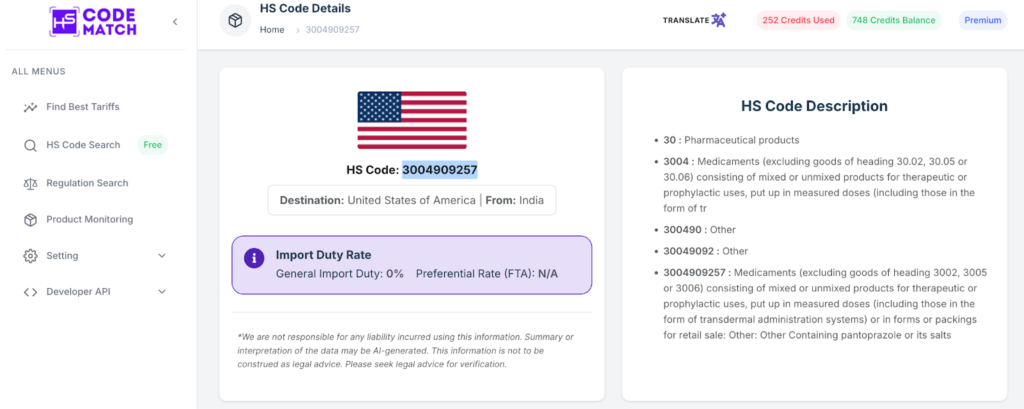
The HS Code Details page allows you to check the HS code description whether it is close to your products or not. You can also use the AI chatbot to find the specific answer that you need for exporting clonidine hydrochloride from India to the USA.
This is an example of an AI chatbot assistant’s answer for exporting clonidine hydrochloride from India to the United States:
Is there any additional tariff for exporting clonidine hydrochloride under HS code 3004909257 from India to the United States?
There are no additional tariff rates for exporting clonidine hydrochloride from India to the United States because it is classified as a medicine. The HS code 3004909257 is under the pharmaceutical products that are exempted from any tariff due to their essentiality for medicinal purposes. However, some conditions apply to these products based on the Column 2 rate of duty, which states that the tariff rate is 30%, but it is not categorized as an additional tariff. Hence, the standard condition of importing these products into the United States is 0%.
| Tariff Information | Description |
| HS Code | 3004909257 |
| General Duty Rate | Free |
| Column 2 Rate of Duty | 30% |
| Unit of Quantity | kg |
| Applicable | Standard conditions |
3. HS Code for Printer
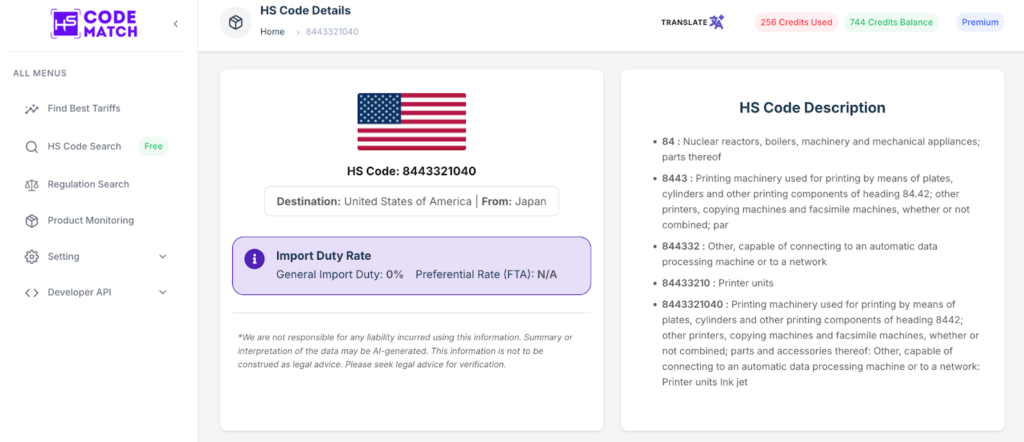
For example, finding the HTS code for a printer, we can choose the exportation of a printer from Japan due to its popularity as a major producer of electronic products. Based on HS Code Match results, the most relevant and most preferred HS code for exporting a printer from Japan to the United States is 8443321040. The general import duty for importing a printer from Japan to the USA is 0%.
On HS Code Details, you can see the detailed description of these printer products under HS code 8443321040. Please use the AI chatbot to find the specific parts of the tariff rates or any other confusion regarding this HS code.
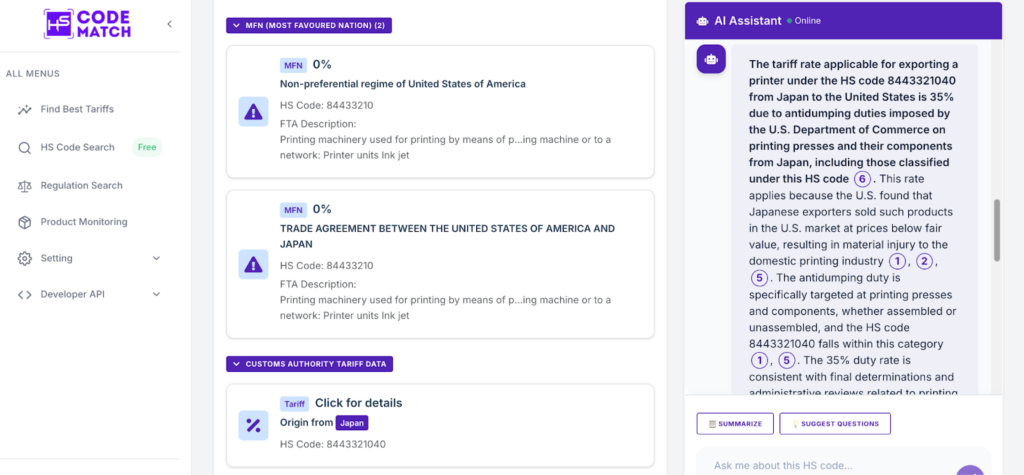
What is the tariff rate applicable for exporting a printer under the HS code 8443321040 from Japan to the United States?
The latest tariff rate that is applicable for a printer product under HS code 8443321040 from Japan to the United States is 35%. Even though the initial general tariff duty rate for printer products from Japan to the US is 0%. This is because the US Department of Commerce has imposed the antidumping measure for printing presses and their components from Japan. The reason behind the implementation of the antidumping duty is that the exported product from Japan has a lower price than the general price, and is affecting the domestic printing industry in the USA. This duty rate is a final decision from the US institution based on the investigation. Hence, the printer products are not eligible for the FTA between the US and Japan.
| HS Code | Product Description | Duty Rate | Basis of duty imposition |
| 8443321040 | Printing presses and their components, including the general printers’ products | 35% | There is proof that this product is sold below the fair price and has caused injury to the domestic printing industry in the USA |
Conclusion
Customs rulings in the USA for the tariff classification are important to assist the international trade parties. The individual or a person on behalf of the company can request the CBP regarding the tariff classification, country of origin ruling, applicable trade agreement, and others. Customs ruling USA tariff allows you to avoid the risk of an inaccurate HS code for tariff calculation, which has a huge impact on your business. However, you need to be patient while requesting the ruling because the CBP will answer your request within 30 working days. Some of the products need more time because CBP needs to ask other institutions to ensure the answer is correct.
Frequently Asked Questions (FAQs)
1. Why is the customs ruling on the USA tariff important to international trade?
Customs Ruling USA tariff is important to ensure that the international trade actors get information from the CBP and other related agencies. This information will be sent to the requester through ruling letters.
2. What are the functions of customs ruling the USA tariff for business?
The function of customs rulings is to promote transparency for international actors regarding the latest regulations in the United States, such as tariff classification, country of origin, trade agreements, etc.
3. How can I find the record customs ruling tariff classification in the USA?
You can find the customs ruling USA tariff on the CBP website (rulings.cbp.gov). Through this website, you can access the previous request related to the product that you are looking for.
4. What is the tariff rate for exporting a printer from Japan to the USA?
The general tariff rate for exporting a printer from Japan to the USA is 0% based on the FTA between the two countries. However, the US government imposed an antidumping duty and charged this product with a 35% tariff.
5. What is the tariff rate for exporting clonidine hydrochloride from India to the USA?
The general tariff rate for exporting clonidine hydrochloride from India to the USA is 0%, and it is under the MFA regime. No duty rate because of the essentiality of these products for high blood pressure.
Find and Match the Right HS Code for Your Products.
Try Our App

 Sep 10, 2026

