


 Feb 12,2026
  By Alice
Candy can be described as one of the most delightful foods, especially for children. Even though candy is commonly deemed as an unhealthy treat due to its ingredients, which are mostly sugar or other sweeteners with a high amount of calories. Too much consumption of sugar can lead to serious diseases and increase calories. However, we still allow ourselves to consume candy, with the limitation, and it actually helps boost our moods and energy. Hence, candy is included in one of the most traded goods globally. Then, the declaration of the HS code for candy is indispensable. In this article, we will answer the question related to the HS code for candy, the major trading countries, as well as find the accurate HS code for candy or sugar confectionery.
What is candy, and what are the types of candy?
Candy is a sweet food which mostly made from sugar and other sweeteners. Therefore, the term candy can be called sugar confectionery. Not only sugar-based, but this food is also commonly combined with other ingredients, such as fruits or nuts, in order to make it more flavorful and delightful. Moreover, candy can be included as a dessert alongside fruit, pastry, cake, and ice cream.
The history of candy can be traced back to ancient people, when most of the candy was made from honey. Even the first candy is a honey which is combined with the fruits and nuts that were found in ancient Egypt, Greece, China, and the Roman Empire. In the Middle Ages, sugar had become the susceptible of honey to make a candy due to its more accessible availability in Europe.
The Industrial Revolution led to the mass production of candy in the 19th century. This is because new technologies in the manufacturing industry make the candy production more efficient and faster than before. Therefore, the candy is more and more accessible and easy to get for many people during this era. These treats came to their peak popularity in the 20th century due to the rise of some popular candy brands.
In this modern era, the innovation of candy is more towards healthy options since many people are more conscious about their health. The healthier option for candy includes gluten-free, sugar-free, organic ingredients, and vegan candies.
What is the HS code for candy or sugar confectionery?
As mentioned above, the declaration of the HS code for candy is compulsory for transferring candy or other products across national borders. Therefore, you need a deep grasp of the Harmonized System (HS) code for each product, including candy and sugar confectionery. Remember that an inaccurate HS code for candy can lead to harmful consequences, such as seizure, fines, delays, and even criminal charges.
Additionally, declaring the accurate HS code will help you to pass the customs process smoothly. The correct HS code also gives international trade parties a chance to exploit the tariff reduction from the Free Trade Agreements (FTAs). Thus, you need to be careful when classifying your product and ensure that the HS code for candy or other products is correct.
HS code for candy can be classified under Chapter 17, which covers any kind of sugar and sugar confectionery without containing cocoa. However, if the products contain cocoa as their ingredient, they are covered under Chapter 18. Here is the common list of HS codes for candy and sugar confectionery.
| HS code | Description |
| 1704.10 | HS code for sugar confectionery, especially for chewing gum, whether coated with sugar or not, including peanut candy. |
| 1704.90 | HS code for sugar confectionery for products other than chewing gum. |
| 1806.10 | HS code for cocoa powder, containing added sugar or other sweeteners. |
| 1806.20 | HS code for chocolate in the form of blocks, slabs, or bars with a weight of more than 2 kg. |
| 1806.31 | HS code for chocolate and other cocoa preparation products filled with cream, liquid, or fruit. |
From the list of HS codes for candy above, we can conclude that the HS code for candy can be differentiated under two chapters, namely 17 and 18. In addition, the HS code for candy is classified based on its ingredients, whether they are made from regular sugar or contain chocolate.
Top 5 candy exporters and importers worldwide
In order to enhance your grasp on the global candy trade, you might need to know the biggest candy exporters and importers in the world. This knowledge is important to understand what are the major players. Here are the top 5 largest exporting countries of candy under HS code 1704.10 worldwide from the UN Comtrade Database in 2024.
| Country | Total export value (USD) |
| China | 103,254,028 |
| Mexico | 77,940,726 |
| Netherlands | 74,379,512 |
| Canada | 65,724,964 |
| Turkiye | 64,757,860 |
Source: UN Comtrade Database, accessed January 28, 2026
From the data above, China is deemed the largest producer and exporter of chewing candy under the HS code 170410, with an export value of more than 103 million USD. Meanwhile, the second position is Mexico with the export value of more than 77 million USD. They are followed by the Netherlands, Canada, and Turkiye as the third, fourth, and fifth largest exporters.
After understanding the biggest producers and sellers of candy under HS code 170410, we should know where the largest buyers of those products are. These are the largest importing countries of chewing candy under the HS code 170410 worldwide.
| Country | Total import value (USD) |
| United States | 136,608,294 |
| Germany | 42,395,946 |
| South Africa | 31,857,300 |
| Netherlands | 31,314,191 |
| France | 26,887,332 |
Source: UN Comtrade Database, accessed January 28, 2026
The United States is undoubtedly the largest importer of chewing gum in the world, with the import amount of more than 136 million USD. The second position is held by Germany with an import value of more than 42 million USD. They are followed by South Africa, the Netherlands, and France as the biggest importers of chewing gum in the world in 2024.
Finding the correct HS code for candy
After grasping the biggest candy trade players, you need to understand how to find the right HS code for candy and sugar confectionery. We know that finding an accurate HS code for candy is not an easy thing to do. Therefore, HSCodeMatch exists to assist you in finding the correct HS code for all products and all countries. Here is the step-by-step guide for finding the HS code for candy under HS code 170410 on HSCodeMatch.
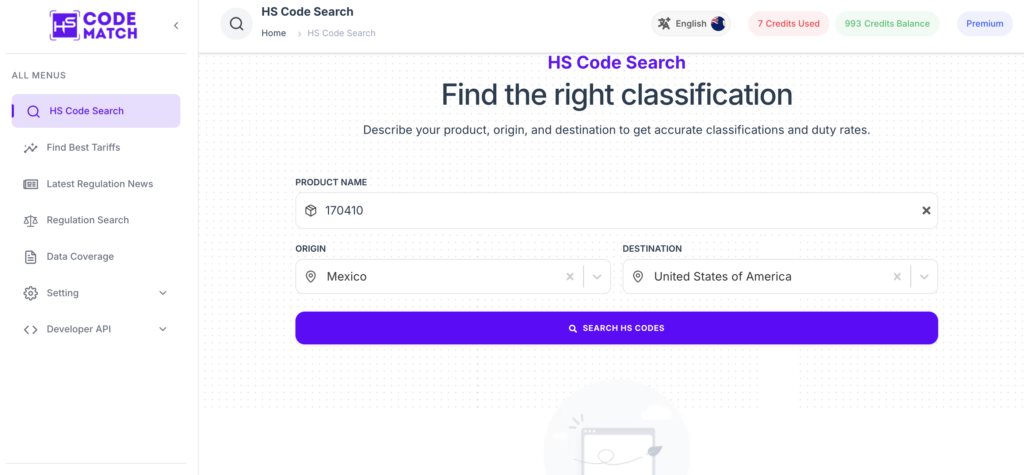
- First step: Open the HSCodeMatch application on your browser and access hscodematch.com. Then, choose the HS Code Search to search for the specific HS code on your products. For this example, we can use chewing gum with HS code 170410 from Mexico to the United States.
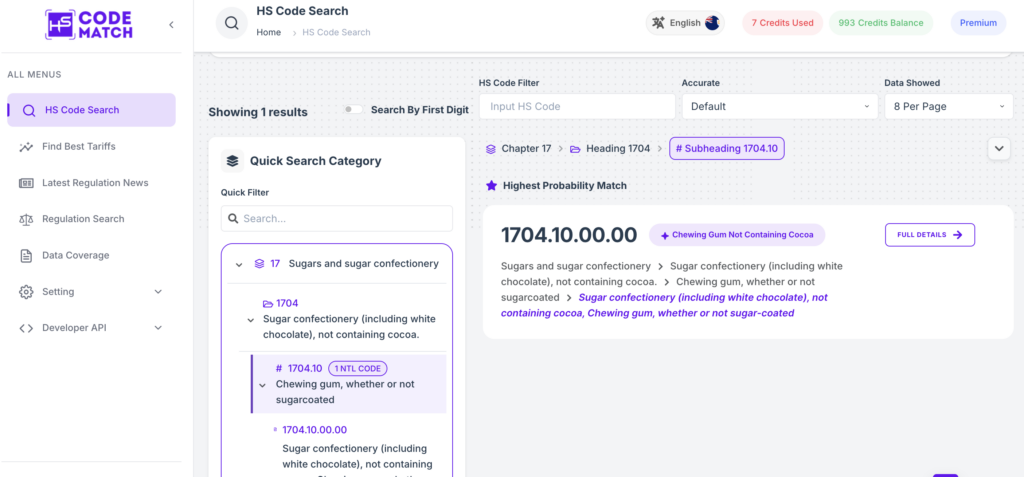
- Second step: After submitting the product’s name and countries, you can find the list of HS codes for candy under the code 170410. From the example, there is only one HS code for chewing gum from Mexico to the United States, which is under code 17041000.
- Third step: Once you choose the HS code for candy and chewing gum, you will be redirected to the HS Code Details page. This page contains the full information on the HS code as well as the tariff rate for exporting products under HS code 17041000 from Mexico to the United States.
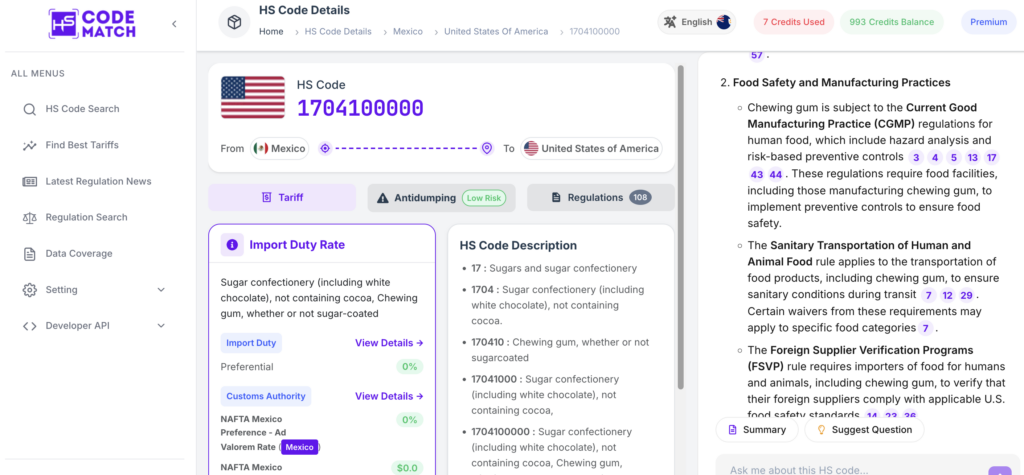
- Fourth step: In the lower part of the HS Code Details, there are full of information on regulations and tariff rates. You can find the real documents from the government to ensure the information. In addition, there is an AI chatbot assistant to help you summarize the documents quickly and get insight from them.

These are examples of answers from an AI chatbot assistant for exporting chewing gum from Mexico to the United States.
Are there any tariff reductions for exporting products under HS code 17041000 from Mexico to the United States?
No, the chewing gum products that do not contain cocoa under HS code 17041000 from Mexico are eligible for tariff reduction under the Free Trade Agreement (FTA) between the United States, Mexico, and Canada (USMCA). Therefore, there is no tariff rate or 0% tariff for exporting chewing gum products from Mexico to the United States. If there is no FTA, the United States has a Most Favoured Nation (MFN) or non-preferential tariff rate of 4% for importing chewing gum products from other countries.
What documentation is required to qualify for the USMCA tariff reduction for chewing gum under HS code 17041000?
Several documentation needed to qualify for the USMCA tariff reduction for products under HS code 17041000, including chewing gum with no cocoa. These are the documents required to be eligible for tariff reduction under USMCA:
- Certificate of Origin: In order to comply with the USMCA, importers need to have a Certificate of Origin (COO) to ensure that the products are originating from a member of the USMCA. This document needs to include details of the exporter’s name, the importer’s name, the goods description, and a statement on the original country the products are made in.
- Supporting Documentation: Other than the COO, there is supporting evidence to meet the USMCA rules of origin. These documents include manufacturing records, bills of materials, and proof of production within the member of USMCA.
- Commercial Invoice: The detailed invoice must include the HS code for candy or chewing gum under code 17041000, the value of goods, and other descriptions for the shipping process. The invoice must follow the information provided in the COO.
- Additional Documentation: There are other required documentations for exporting these products, including packing lists, bill of lading, and shipping documents, which might be needed for claiming tariff reduction under USMCA, depending on the products.
What are the certifications for exporting chewing gum from Mexico to the United States?
There are several certifications required for exporting chewing gum from Mexico to the United States. This is important to ensure that the products comply with certain regulations in the United States as follows:
- Food Safety Verification: The Food and Drug Administration (FDA) might require certification from specific auditors to ensure that imported foods, including chewing gum, do not have safety risks. Therefore, the importers need to certify their products to guarantee that the products can be exported to the United States smoothly.
- USDA Organic Standards: There are other exceptions for chewing gum export in the United States, particularly on organic gums, including acacia gum, guar gum, locust bean gum, and carob bean gum. Those products must meet the USDA organic standards, according to the guidelines. These are important to guarantee the ingredients and the process of making them.
- Antidumping and Countervailing Duties: As we know, Mexico has been impacted by the antidumping and countervailing duties from the United States. There are some certifications as proof that the products have a fair value to be sold in the United States.
Conclusion
Declaring the HS code for candy and chewing gum is not as hard as other products. These products are under Chapters 17 and 18. The difference between the two chapters is only whether they contain chocolate or not, with chapter 17 not containing chocolate and chapter 18 containing chocolate. Even though finding the HS code for candy might seem easier than for other products, you still need to ensure that the candy products are correct. You also need to understand the national code for a specific country to avoid trouble during the customs process and obtain customs clearance smoothly.
Frequently Asked Questions (FAQs) about the HS code for candy and sugar confectionery
1. What is the tariff rate for exporting candy and chewing gum from other countries to the United States?
The tariff rate for exporting chewing gum from other countries in the United States is 4%. This is based on the Most Favoured Nation (MFN) regime, which means this is the general tariff for exporting these products.
2. What is the tariff rate for exporting chewing gum and candy from countries under USMCA to the United States?
For exporting candy and chewing gum from the countries under USMCA, including Mexico and Canada, to the United States is 0%. The reduction of tariffs due to the agreement among those countries to improve trade relations.
3. Are there any specific guidelines for exporting organic chewing gum to the United States?
Yes, based on the USDA Organic Guidelines, the organic chewing gum products, especially acacia gum, Arabic gum, carob bean gum, guar gum, and locust bean gum, need to include detailed descriptions.
4. What are the factors to classify HS code for candy and sugar confectionery?
The most important factor is the ingredients, whether the products contain sugar or chocolate. Then, you need to consider the products based on the form of the candy, whether they are chewing gum or a lollipop.
5. What is the HS code for candy that contains chocolate?
The HS code for candy with the main ingredient of chocolate is under Chapter 18. The common HS codes for chocolate candy are 1806.10, 1806.20, and 1806.31.
Find and Match the Right HS Code for Your Products.
Try Our App

 Sep 10, 2026

