
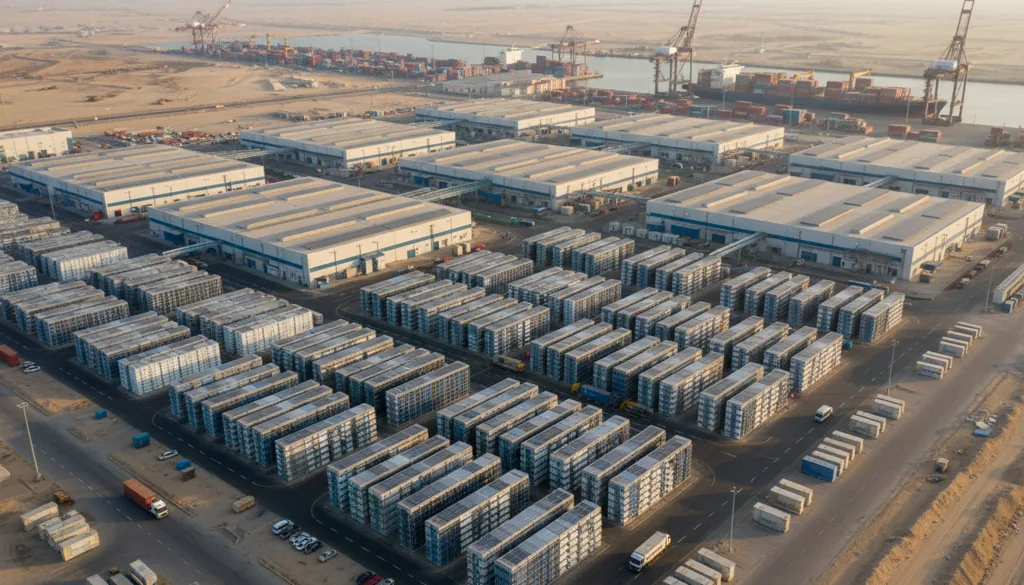
United Arab Emirates imposes definitive anti-dumping duties on GCC imports of electric accumulators and related separators.
The United Arab Emirates has imposed definitive anti-dumping duties on lead-acid vehicle batteries and their separators from China and Malaysia, with the measure applying from Feb. 20, 2026.
The duties target batteries used to start piston engines, including rectangular and square units. They apply across the Gulf Co-operation Council customs market, covering goods declared under the unified tariff code for lead-acid accumulators.
The measure is intended to counter imports sold at dumped prices and protect Gulf producers from injury under the UAE’s trade-remedy system. The importer pays the duty, calculated on the shipment’s cost, insurance and freight value, before the goods can clear customs.
The UAE battery code
The covered goods are electric accumulators, including separators, made with lead acid and used for starting piston engines. In everyday trade, that means a broad class of conventional automotive batteries rather than batteries identified only by a particular brand or vehicle model. The directive places them under 85071000, the GCC unified tariff code cited for the product.1
Scope: 2026 order vs earlier battery actions
| Question | 2026 China/Malaysia order | Earlier GCC action |
|---|---|---|
| Tariff code | 85071000 | Same unified code |
| Capacity band | Not limited | One band only |
| Shapes covered | Rectangular, square, other shapes | Rectangular including square |
That classification matters because the duty follows the customs description, not simply the commercial name on an invoice. A shipment presented as a starter battery can therefore fall within the measure when its technical description matches the covered product. Separators are included even when supplied as part of the battery product described by the directive.
The wording covers batteries that are rectangular, including square, as well as other shapes within the product definition. It does not limit the measure to one capacity band in the way an earlier GCC battery action did. That wider description gives the new order a potentially broader reach across conventional lead-acid starter batteries.
The measure sits alongside other UAE trade actions involving batteries and electrical goods. The ministry’s anti-dumping listings include a 2023 continuation measure for Korean lead-acid batteries with capacities from 35 to 115 amperes, as well as a 2022 action covering batteries from Turkey and India.2 Those entries show that battery imports are already subject to more than one country-specific trade-remedy measure.
China’s company-by-company rates
For Chinese goods, the duty is not one uniform rate. It varies by named exporter or producer, with a separate rate for companies that were not selected for detailed sampling and a higher rate for all other suppliers. The highest listed rate is 74% of the CIF value for “others”.1
Chinese duty margins, % of CIF value
Guangdong Aokly Group is assigned a 63% margin, while Camel Group Xiangyang Storage Battery is assigned 50.7%. Jiujiang Power Group, Zhejiang Jiujiang Power Supply Manufacturing and the listed non-sampled Chinese producers receive a 25.8% margin. The structure makes the exporter’s identity a direct customs-cost issue.
The different rates mean that the same type of battery can attract materially different charges depending on the producer named in the supporting records. A shipment from a company carrying the 74% residual rate will face a much larger additional payment than one linked to the 25.8% rate. That makes accurate producer and exporter information central to the customs declaration.
The directive also identifies Zhejiang Just Electrical Appliances as a cooperating Chinese exporting producer with a 25.8% margin in its attachment.1 The attachment separates that company from the general “others” category, showing how the order uses company-specific findings rather than relying only on the country of origin.
For importers, the practical effect is a new layer between the tariff code and the final customs bill. Classification identifies the product, but the applicable margin depends on the company and country information attached to the entry. The duty is therefore capable of changing from one shipment to the next even when the battery specifications are similar.
Malaysia’s higher residual charge
Malaysia has three rates in the schedule. Camel Power receives 68%, Just Energy receives 43.2%, and all other Malaysian producers face 77% of CIF value.1 That residual rate is the highest figure listed in the directive for either country.
Malaysian rates, % of CIF value
| Supplier category | Rate | Charged on |
|---|---|---|
| All other Malaysian producers | 77% | CIF value |
| Camel Power | 68% | CIF value |
| Just Energy | 43.2% | CIF value |
The Malaysian structure is shorter than the Chinese schedule, but it carries the same commercial consequence. A shipment linked to a named producer can qualify for a lower margin, while an entry falling into the residual category faces the full rate for other suppliers. The distinction is especially important where trading documents identify a seller but do not clearly identify the factory that made the goods.
The duties are ad valorem, meaning they are calculated as a percentage rather than as a fixed charge per battery. CIF value includes the goods, insurance and freight used for customs valuation. As the declared value rises, the anti-dumping payment rises with it.
The new action is separate from the older Turkey and India measure, which also used exporter-specific percentages. Under that 2022 order, the rates ranged from 8% for one Indian producer to 41% for “others” in India, while all Turkish producers were assigned 39%.3 The comparison shows a familiar design, but the China and Malaysia rates are substantially higher for several supplier categories.
February customs payment
The definitive duties began for a period of no more than five years on 20 February 2026.1 The start date gives customs entries from that point a different cost treatment from earlier imports, subject to the order’s product and origin rules. It also starts the clock on a measure that can remain in force for a substantial part of the normal planning cycle for vehicle and replacement-parts supply chains.
The two numbers that bind
Payment is due at the customs directorate before clearance. The directive says the final margin is applied to the CIF value and asks companies and government authorities to implement the order accordingly. In operational terms, before customs clearance is the key payment deadline.1
That timing puts the charge directly into the import-release process rather than leaving it to a later settlement. The importer must have the amount available when the declaration is processed, and the duty becomes part of the delivered cost of the batteries. Delays in confirming the correct supplier rate can therefore affect both cash flow and release timing.
The earlier Turkey and India directive used the same basic collection route. It required payment at the customs directorate through the applicable dumping margin and set implementation from Oct. 1, 2022.3 The repeated approach indicates that the UAE is treating definitive anti-dumping duties as a customs-collected charge tied to the declared CIF value.
The financial effect will be largest for entries assigned the residual rates. China’s 74% and Malaysia’s 77% categories can add almost as much as the customs value itself before ordinary import costs, taxes and distribution expenses are considered. That is likely to make supplier classification and origin documentation commercially significant, not merely administrative.
The UAE anti-dumping framework
The legal basis is Federal Law No. 1 of 2017 on anti-dumping, countervailing and safeguard measures. The law applies to injurious trade practices coming from outside the GCC and allows a domestic industry, or its representative, to file a complaint with the relevant department or through a competent government body.4
Who has to act under Federal Law No. 1 of 2017
The framework covers the investigation and verification process, the circumstances for imposing measures and the authorities responsible for enforcement. It also deals with notices, confidential information, customs clearance, data collection, registration, monitoring, penalties and court enforcement. The battery directive is therefore one step within a wider legal system rather than an isolated customs notice.
The UAE’s published anti-dumping material shows a continuing use of that system across different product groups. Listed actions include aluminium products from China, electrical connectors and plugs from China, ceramic sanitary goods from China and India, and a 2025 investigation into heavy sections from China.5 The range of goods indicates that trade remedies are being used across industrial supply chains, not only for vehicle parts.
That wider setting helps explain why the battery order distinguishes between individual exporters and residual categories. Trade-remedy calculations often depend on the information supplied by companies during the investigation, while the residual rate applies where the order does not provide a more specific margin. The customs consequence is that origin alone is not enough to determine the final charge.
The measure also has to be read beside earlier battery exclusions. The 2022 action against Turkey and India expressly excluded AGM and EFB batteries, two battery technologies used in automotive applications.3 That exclusion was specific to that directive, so the product wording and any attachments to the 2026 order remain important when determining whether a particular battery falls inside its scope.
The new duties will raise the delivered cost of covered conventional lead-acid starter batteries from China and Malaysia, with the sharpest increase applying to suppliers in the residual categories. The order’s five-year maximum period and its Feb. 20 start date make the effect more than a short customs adjustment. For the affected goods, the central commercial question is now which producer category applies before the shipment reaches the UAE border.
Sources
- ↩ Directive No (72) of 2026 on Definitive Anti-Dumping Duties against GCC Imports of Lead Acid Electric Accumulators from China and Malaysia https://www.moet.gov.ae/documents/20121/0/%D8%A7%D9%84%D9%86%D8%B3%D8%AE%D8%A9+%D8%A7%D9%84%D8%A7%D9%86%D8%AC%D9%84%D9%8A%D8%B2%D9%8A%D8%A9+%D9%84%D9%84%D8%AA%D8%B9%D9%85%D9%8A%D9%85+%D8%A7%D9%84%D9%88%D8%B2%D8%A7%D8%B1%D9%8A.pdf/62e6493e-90e0-a8fa-a817-b92ca1770a16?t=1770096599446
- ↩ Certificate of Origin and Anti-Dumping Regulations in the UAE — portal / update language https://www.moet.gov.ae/c/portal/update_language?p_l_id=144&redirect=%2Finvestor-success-stories%2F-%2Fasset_publisher%2Fbomu%2Fcontent%2F%2525D8%2525AA%2525D8%2525B4%2525D8%2525B1%2525D9%25258A%2525D8%2525B9%2525D8%2525A7%2525D8%2525AA-%2525D8%2525A7%2525D9%252584%2525D9%252585%2525D9%252586%2525D8%2525A7%2525D9%252581%2525D8%2525B3%2525D8%2525A9-%2525D9%252588%2525D9%252585%2525D9%252583%2525D8%2525A7%2525D9%252581%2525D8%2525AD%2525D8%2525A9-%2525D8%2525A7%2525D9%252584%2525D8%2525A5%2525D8%2525BA%2525D8%2525B1%2525D8%2525A7%2525D9%252582-1%3F_com_liferay_asset_publisher_web_portlet_AssetPublisherPortlet_INSTANCE_bomu_assetEntryId%3D774448%26_com_liferay_asset_publisher_web_portlet_AssetPublisherPortlet_INSTANCE_bomu_redirect%3Dhttps%253A%252F%252Fwww.moet.gov.ae%252Far%252Finvestor-success-stories%253Fp_p_id%253Dcom_liferay_asset_publisher_web_portlet_AssetPublisherPortlet_INSTANCE_bomu%2526p_p_lifecycle%253D0%2526p_p_state%253Dnormal%2526p_p_mode%253Dview%2526_com_liferay_asset_publisher_web_portlet_AssetPublisherPortlet_INSTANCE_bomu_cur%253D0%2526p_r_p_resetCur%253Dfalse%2526_com_liferay_asset_publisher_web_portlet_AssetPublisherPortlet_INSTANCE_bomu_assetEntryId%253D774448&languageId=en_US
- ↩ Directive No (2) for 2022: Definitive Anti-dumping Duties on Electric Accumulators from Turkey and India https://www.trade.gov.ae/documents/d/guest/-eng
- ↩ Certificate of Origin and Anti-Dumping Legislations https://www.trade.gov.ae/certificate-of-origin-and-anti-dumping-legislations
- ↩ Certificate of Origin and Anti-Dumping Regulations in the UAE — content / %25D8%25AA%25D8%25B4%25D8%25B1%25D9%258A%25D8%2… https://www.moet.gov.ae/en/sustainable-development-goals-sdg-/-/asset_publisher/czgb/content/%25D8%25AA%25D8%25B4%25D8%25B1%25D9%258A%25D8%25B9%25D8%25A7%25D8%25AA-%25D8%25A7%25D9%2584%25D9%2585%25D9%2586%25D8%25A7%25D9%2581%25D8%25B3%25D8%25A9-%25D9%2588%25D9%2585%25D9%2583%25D8%25A7%25D9%2581%25D8%25AD%25D8%25A9-%25D8%25A7%25D9%2584%25D8%25A5%25D8%25BA%25D8%25B1%25D8%25A7%25D9%2582-1?_com_liferay_asset_publisher_web_portlet_AssetPublisherPortlet_INSTANCE_czgb_assetEntryId=774448&_com_liferay_asset_publisher_web_portlet_AssetPublisherPortlet_INSTANCE_czgb_redirect=https%3A%2F%2Fwww.moet.gov.ae%2Fsustainable-development-goals-sdg-%3Fp_p_id%3Dcom_liferay_asset_publisher_web_portlet_AssetPublisherPortlet_INSTANCE_czgb%26p_p_lifecycle%3D0%26p_p_state%3Dnormal%26p_p_mode%3Dview%26_com_liferay_asset_publisher_web_portlet_AssetPublisherPortlet_INSTANCE_czgb_cur%3D0%26p_r_p_resetCur%3Dfalse%26_com_liferay_asset_publisher_web_portlet_AssetPublisherPortlet_INSTANCE_czgb_assetEntryId%3D774448