
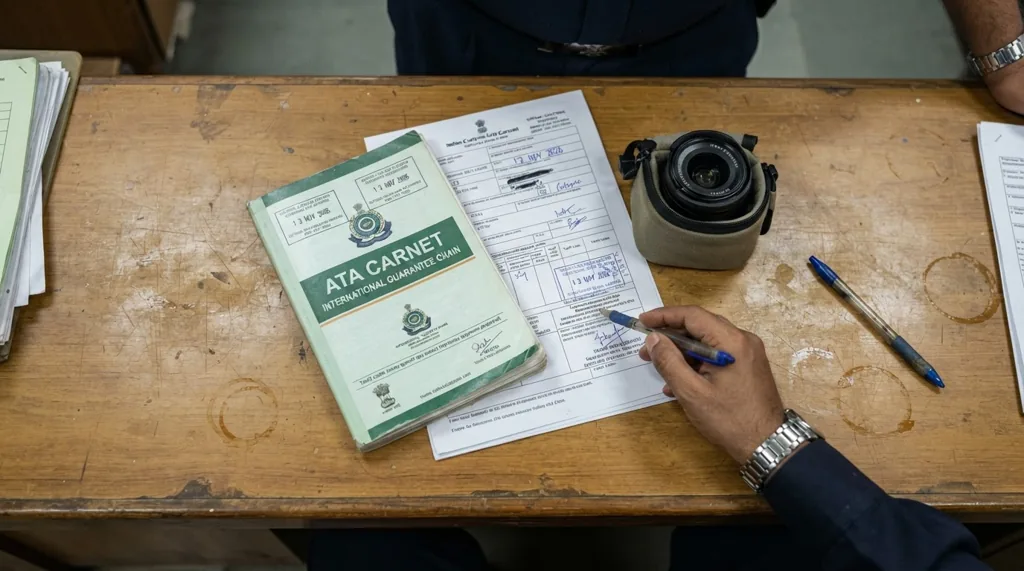
India lets senior customs officers extend the four-month stay for ATA Carnet goods, from Nov. 13, 2026, up to carnet expiry.
On Nov. 13, 2026, India’s Finance Ministry let senior customs officers extend the four-month stay for goods imported temporarily on an ATA Carnet.
The change came in Notification No. 36/2026-Customs, published in the Gazette of India on Nov. 13, 20261. It amends an earlier exemption order, Notification No. 4/2018-Customs of Jan. 18, 20181.
In short, goods that enter India duty-free on an ATA Carnet no longer face a fixed four-month exit date. A senior customs officer can now allow them to stay longer, but never past the date the carnet itself expires.
What is an ATA Carnet?
An ATA Carnet is an international customs document for the temporary import of goods. The name comes from the French and English words "Admission Temporaire" and "Temporary Admission"2. It lets goods cross a border for a short stay without paying import duty, as long as they leave again.
In India, the carnet is issued abroad under the Customs Convention on ATA Carnets. The issuing body must belong to the International Bureau of Chambers of Commerce2. The Federation of Indian Chambers of Commerce and Industry (FICCI) guarantees the carnet in India2.
Customs at Jawaharlal Nehru Custom House (JNCH), the customs office at the Nhava Sheva port, describes typical uses. Goods imported under a carnet "for display, demonstration, or use in fairs, exhibitions, or similar events" can enter duty-free for a temporary stay2. In return, the holder must meet the conditions of the customs notifications and the convention2.
What changes under Notification 36/2026?
The new notification adds one sentence to condition (vi) of the 2018 exemption order. Condition (vi) sets a period of four months for the goods1. The new text sits after the two exceptions, called provisos, already in that condition1.
Carnet time limit, before and after Nov. 13, 2026
| Question | Before | After |
|---|---|---|
| Basic period | Four months | Four months |
| More time beyond four months | Only under two existing provisos | Extension possible |
| Outer limit | Four months, subject to two provisos | Until the carnet expires |
The new sentence says a Principal Chief Commissioner or Chief Commissioner of Customs may extend the four months. The officer may grant "such further period as it may deem fit"1. The officer must first be satisfied that the extension is "necessary in the public interest"1.
There is one firm limit. Any extension must end no later than the carnet’s expiry date1. A carnet has its own period of validity, and customs cannot go beyond it.
Who can grant more time for carnet goods?
Only the most senior customs officers in a region can grant the extension. These are the Principal Chief Commissioner of Customs or the Chief Commissioner of Customs, "as the case may be"1. The extension is not automatic. The notification uses the word "may", so the officer decides each case. The test is the public interest, and the officer also decides how long the extra time should be.
The notification does not set a form, a fee or a deadline for asking. It also does not list the papers an applicant must send. Because the officer must be satisfied of the public interest, a holder who wants more time has to make that case.
Why did the Finance Ministry act?
The government gave one stated reason. It acted "on being satisfied that it is necessary in the public interest so to do"1. It gave no figures or further explanation.
The legal power is section 25(1) of the Customs Act, 19621. The 2018 order is the exemption that lets carnet goods in without duty, and the time limit is one of its conditions.
Ports had already been working on carnet rules. On Nov. 2, 2026, JNCH said it had received "representations from Trade" asking for simpler procedures for carnet imports and re-exports2. It then rewrote its own procedures2.
How does a carnet shipment move through Nhava Sheva?
The JNCH public notice, No. 140/2026, shows the steps for a carnet shipment at that port2. It sets up a Centralized Carnet Cell to handle all carnet papers for import and re-export2. The cell keeps the records and closes each carnet case2.
Papers for a carnet import at JNCH
| Document / Filing | Issuing authority or requirement |
|---|---|
| ATA Carnet and General List | Handed to the Centralized Carnet Cell |
| FICCI letter | For the carnet, guaranteed by FICCI |
| Event or participation letter | For the event the goods are used at |
| Bill of lading copy | The carrier’s shipping document |
| Broker authorisation and request letter | From the carnet holder |
For import, the carnet holder or customs broker hands in a set of papers to the cell2. These are:
- the ATA Carnet and its General List of goods
- the FICCI letter for the carnet
- the customs broker’s authorisation
- the event or participation letter
- a copy of the bill of lading, the shipping document from the carrier
- a request letter
The cell checks the papers and records the carnet in a register2. Then, in order:
- An Assistant or Deputy Commissioner approves the file.
- An examiner checks the goods against the carnet and marks the white import voucher "Examined".
- A superintendent gives final clearance and the goods leave the port.
The broker then gives the original white voucher back to the cell for later use2. No duty is paid while the goods stay under the carnet.
What must happen when the goods leave India?
For re-export, the broker presents the papers to the cell before the deadline for re-export2. No separate shipping bill, the usual export declaration, is needed for a carnet re-export2. An examiner checks that the goods leaving are the same ones that came in2.
Leaving India under a carnet
If the goods leave from a different port, that port sends the papers to the JNCH cell2. The broker or importer must send proof of re-export within one month to close the carnet2.
Some carnet goods are sold in India instead of leaving. Where a customs notification allows this, the holder pays duty with interest2. The details must reach the cell within one month of the sale2.
What happens if carnet goods stay too long?
The JNCH notice is clear about late goods. If goods are not re-exported within the time limit, "including any time extension as prescribed in the customs notification", the cell will act2. It will recover the duty with interest2.
This is where the new rule matters. Before Nov. 13, 2026, the four-month period in condition (vi) was the limit, subject only to the two existing provisos1. Now a holder whose goods need more time can ask for an extension. If it is granted, the goods are not late and customs does not demand the duty.
A holder who does not ask, or whose request is refused, still faces the four-month limit. After that, customs can treat the goods as not re-exported and demand the duty and interest2.
Who is affected by the longer carnet stays?
The change helps anyone whose carnet goods need to stay in India for more than four months. This includes foreign exhibitors whose goods move between several fairs. It also includes firms whose demonstration goods are held up by events that run late.
Customs brokers are affected too. They file the carnet papers and must track the re-export date2. With an extension, the date in the carnet register moves, but the end date of the carnet itself does not.
Other rules for carnet goods stay the same. The goods must still leave India, or be sold with duty paid where this is allowed2. The extension only changes how long the goods may stay.
Which rules govern carnet goods in India?
Several official texts work together. The JNCH notice lists the main ones2:
- Notification No. 157/1990-Customs of March 28, 1990
- Notification No. 14/1990-Customs (N.T.) of April 6, 1990, the carnet forms rules
- Notification No. 58/2016-Customs of Oct. 5, 2016
- Notification No. 4/2018-Customs of Jan. 18, 2018, now amended
The 1990 forms rules are the ATA Carnet (Form of Bill of Entry and Shipping Bill) Regulations, 19903. They let the carnet stand in for the usual import and export declarations3. The new notification changes only the 2018 order1.
Key points on the ATA Carnet time extension
The table sums up the change.
| Question | Answer |
|---|---|
| What changed? | Four-month carnet period can be extended |
| Which document? | Notification No. 36/2026-Customs |
| Who issued it? | Finance Ministry, Central Board of Indirect Taxes and Customs |
| When published? | Nov. 13, 2026 |
| Which order is amended? | Notification No. 4/2018-Customs, condition (vi) |
| Which goods? | Goods imported temporarily on an ATA Carnet |
| Who grants more time? | Principal Chief or Chief Commissioner of Customs |
| What is the test? | Necessary in the public interest |
| Longest possible stay? | Until the carnet expires |
| What if goods stay too long? | Duty and interest are recovered |
The notification was published on Nov. 13, 20261. Under it, carnet goods that need more than four months in India can stay longer, but only with a senior officer’s approval and only until the carnet expires.
Sources
- ↩ 277893.pdf https://egazette.gov.in/WriteReadData/2026/277893.pdf
- ↩ PN 140.pdf https://www.jawaharcustoms.gov.in/pdf/PN-2026/PN%20140.pdf
- ↩ Explore https://taxinformation.cbic.gov.in/content-page/explore-regulations/1000061