
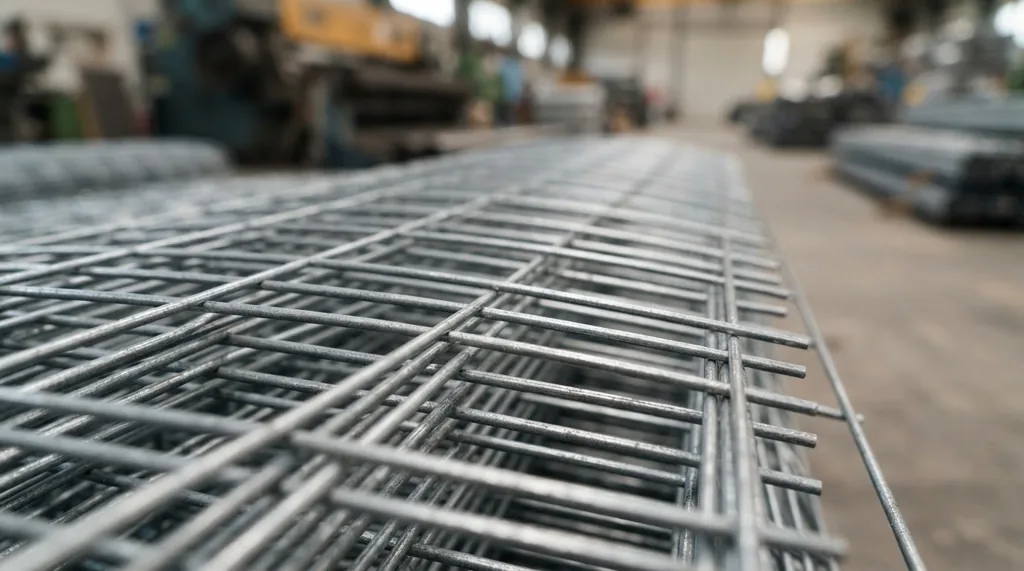
United States keeps anti-dumping and anti-subsidy duties on uncoated steel wire mesh from Mexico, effective Sept. 23, 2026.
The U.S. Department of Commerce has kept its extra duties on plain steel wire mesh from Mexico, with effect from Sept. 23, 2026.
Commerce published the continuation notice in the Federal Register on Oct. 26, 20261. It covers both orders on the goods: an anti-dumping duty order and a countervailing duty order1.
In short, nothing changes at the border for a shipment of this mesh from Mexico. U.S. Customs and Border Protection (CBP) will keep collecting the same duty deposits as before, at the rates in force on the day the goods enter1.
What did Commerce decide on Mexican wire mesh?
The notice from Commerce’s International Trade Administration orders the continuation of both duty orders on standard steel welded wire mesh from Mexico1. The decision follows the first five-year review of the orders, often called a sunset review.
Two duties are involved. An anti-dumping duty is an extra import tax on goods sold in the United States below their normal price. A countervailing duty is an extra import tax that cancels out government subsidies paid to the foreign maker.
Commerce first published the orders in 2021. The countervailing duty order appeared on April 12, 2021, and the anti-dumping duty order on Aug. 9, 20211. A correction to the anti-dumping order followed on Aug. 16, 20211.
The continuation notice is dated Oct. 19, 20261. It was signed by Scot Fullerton, Commerce’s acting deputy assistant secretary for anti-dumping and countervailing duty operations1.
Why does a sunset review decide the duties’ future?
U.S. law sets a time limit on these duties. Commerce must revoke an anti-dumping or countervailing duty order after five years, unless two agencies find a reason to keep it2.
Commerce must find that ending the order would likely bring back dumping or subsidies2. The U.S. International Trade Commission (USITC), an independent federal agency that judges harm to U.S. industry, must find that ending it would likely bring back material injury, meaning serious harm to U.S. producers2. Both findings are needed, and both were made in this case.
The rule comes from the Uruguay Round Agreements Act2. The review itself rests on section 751(c) of the Tariff Act of 19301.
How did the wire mesh review unfold?
The review began on March 2, 2026. On that day the USITC opened its review and Commerce started its own1. The steps then ran in this order:
- On March 16, 2026, Commerce received a notice from U.S. producers that they would take part3.
- On March 31, 2026, the U.S. producers filed a full response3.
- No Mexican producer or exporter replied, and neither did the Government of Mexico4.
- On April 29, 2026, Commerce told the USITC it had no response from the Mexican side4.
- On June 5, 2026, the USITC decided to hold expedited reviews2.
- Commerce published its final results on July 1 and July 6, 20261.
- The USITC voted to keep the orders, and its decision was announced on Sept. 10, 20262.
Because the Mexican side did not respond, Commerce ran a 120-day expedited review for each order3. An expedited review is a shorter review based on the facts already on file. The USITC also used the faster path. It generally holds no hearing in expedited reviews2.
What rates did Commerce say would return?
Commerce does not set new duties in a sunset review. It tells the USITC how large the dumping and subsidies would likely be if the orders ended1. These figures are forecasts for the review, not new deposit rates.
Likely subsidy rates if the duties ended, %
For dumping, Commerce found that margins of up to 110.42% would likely prevail3. A dumping margin is the gap between the price in the United States and the normal price, as a share of the price.
For subsidies, Commerce named a likely rate for each Mexican company in its countervailing duty notice4:
- Deacero S.A.P.I. de C.V.: a subsidy rate of 102.10% of the goods’ value.
- Aceromex S.A. de C.V.: a subsidy rate of 1.03% of the goods’ value.
- All other producers and exporters: a subsidy rate of 1.03% of the goods’ value.
The gap between Deacero and the other companies is large. Commerce’s notice does not explain it, and refers readers to a separate decision memorandum4.
Which wire mesh products do the duties cover?
The orders cover uncoated steel reinforcement wire mesh used in concrete1. The mesh is made of smooth or ridged steel wires welded at every crossing point, in square or rectangular grids1. It may be sold in rolls or in flat sheets1.
What the wire mesh duties cover
| Point | What the orders say |
|---|---|
| Goods | Uncoated steel reinforcement wire mesh for concrete |
| Form | Rolls or flat sheets |
| Standard | ASTM A1064/A1064M, or similar foreign standards |
| Tariff codes | 7314.20.0000 and 7314.39.0000 |
| Excluded | Galvanized and epoxy-coated mesh |
The covered mesh is made to ASTM A1064/A1064M, a U.S. standard for carbon-steel wire and welded wire for concrete1. The notice lists seven styles, written as grid size and wire size1:
- 6X6 W1.4/W1.4 or D1.4/D1.4
- 6X6 W2.1/W2.1 or D2.1/D2.1
- 6X6 W2.9/W2.9 or D2.9/D2.9
- 6X6 W4/W4 or D4/D4
- 6X12 W4/W4 or D4/D4
- 4X4 W2.9/W2.9 or D2.9/D2.9
- 4X4 W4/W4 or D4/D4
In these codes, "6X6" means a grid of six inches by six inches1. "W" means smooth wire, and "D" means ridged wire, called deformed wire. The number after the letter gives the wire’s cross-section in hundredths of a square inch1.
The goods enter under U.S. tariff codes 7314.20.0000 and 7314.39.00001. The codes are for convenience only. The written product description decides what is covered1.
How wide is the product description?
The description is written to catch small changes in size. All rolled mesh in the listed styles is covered, whatever its length1. Any product imported, sold or invoiced in one of the listed sheet or roll sizes is covered1.
The orders also allow for variation. Mesh still counts if its width or length differs by one grid size, such as 6 inches on a "6X6" grid1. It also counts if the wire spacing differs by up to a quarter of an inch1.
Heavier wire does not take mesh out of the orders either. The standard allows a maker to use wire up to two sizes thicker than stated, which is called oversteeling1. The notice gives the actual wire thickness ranges that remain covered1:
- 10 gauge (W/D 1.4): 0.093 to 0.211 inches.
- 8 gauge (W/D 2.1): 0.161 to 0.231 inches.
- 6 gauge (W/D 2.9): 0.189 to 0.253 inches.
- 4 gauge (W/D 4.0): 0.223 to 0.280 inches.
Paperwork does not change the result. A shipment without test reports or certificates for the U.S. standard is still covered1. Mesh made to similar foreign standards, such as DIN or JIS, or to a company’s own standard, is also covered1.
Which wire mesh is left out?
Two kinds of coated mesh are excluded1:
- Galvanized mesh, coated with zinc. The zinc layer must meet the thickness set in ASTM A641/A641M, a U.S. standard for zinc-coated wire1.
- Epoxy-coated mesh, covered with a mix of epoxy resin and hardener1.
Galvanized mesh with a thinner zinc layer than the standard requires does not qualify for the exclusion1. Such mesh can still face the duties at the border.
Who is affected by the wire mesh decision?
U.S. importers of Mexican mesh keep paying cash deposits for both duties when goods enter1. A cash deposit is money paid to CBP at entry against the final duty. Customs brokers keep filing these entries as anti-dumping and countervailing duty entries.
Mexican makers and exporters keep facing the duties on sales to the United States. Deacero and Aceromex are the two companies named in Commerce’s countervailing duty results4.
U.S. producers keep their protection from low-priced imports. Five U.S. companies took part in the review4:
- Keysteel Corporation
- Mid-South Wire Company
- National Wire LLC
- Oklahoma Steel & Wire Co.
- Wire Mesh Corp.
The USITC vote was unanimous among those who voted. Chairman Brett W. Doyle and Commissioners Jason E. Kearns, Peter-Anthony Pappas, Bart Thanhauser and David Foley Jr. voted to keep the orders2. Commissioner Samuel T. Negatu did not take part2.
When does the continuation start, and what comes next?
The continuation took effect on Sept. 23, 20261. That is the date the USITC’s final decision appeared in the Federal Register1. Commerce published its own notice about a month later, on Oct. 26, 20261.
Key dates in the wire mesh review
The USITC’s full report is USITC Publication 57912. The commission said the report would be on its website by Oct. 22, 20262.
The orders now run until the next five-year review. Commerce plans to open the next five-year review no later than 30 days before the fifth anniversary of the USITC’s last decision1. Until then, the duties stay in place for every entry of covered mesh from Mexico1.
Key points on Mexican steel wire mesh duties
The table sums up the decision.
| Question | Answer |
|---|---|
| What changed? | Both duty orders continued |
| Who issued it? | U.S. Department of Commerce |
| Which goods? | Uncoated steel welded wire mesh for concrete |
| From where? | Mexico |
| Tariff codes | 7314.20.0000 and 7314.39.0000 |
| Which duties? | Anti-dumping and countervailing duties |
| Likely dumping margin | Up to 110.42% |
| Likely subsidy rates | 102.10% Deacero, 1.03% all others |
| What is excluded? | Galvanized and epoxy-coated mesh |
| Who pays at entry? | U.S. importers, as cash deposits |
| Effective date | Sept. 23, 2026 |
| Next review | Opens 30 days before fifth anniversary |
Shipments of uncoated wire mesh from Mexico will keep paying both duties at entry from Sept. 23, 20261. The next sunset review will decide whether the orders run beyond their next five-year period.
Sources
- ↩ Federal Register :: Standard Steel Welded Wire Mesh From Mexico: Continuation of Antidumping and Countervailing Duty Orders https://www.federalregister.gov/documents/2026/10/26/2026-21780/standard-steel-welded-wire-mesh-from-mexico-continuation-of-antidumping-and-countervailing-duty
- ↩ USITC Makes Determinations in Five-Year (Sunset) Review Concerning Standard Steel Welded Wire Mesh from Mexico | United States International Trade Commission https://www.usitc.gov/press_room/news_release/2026/er0910_69214.htm
- ↩ Federal Register :: Standard Steel Welded Wire Mesh From Mexico: Final Results of the Expedited First Sunset Review of the Antidumping Duty Order https://www.federalregister.gov/documents/2026/07/06/2026-13510/standard-steel-welded-wire-mesh-from-mexico-final-results-of-the-expedited-first-sunset-review-of
- ↩ Federal Register :: Standard Steel Welded Wire Mesh From Mexico: Final Results of the Expedited First Sunset Review of the Countervailing Duty Order https://www.federalregister.gov/documents/2026/07/01/2026-13342/standard-steel-welded-wire-mesh-from-mexico-final-results-of-the-expedited-first-sunset-review-of