
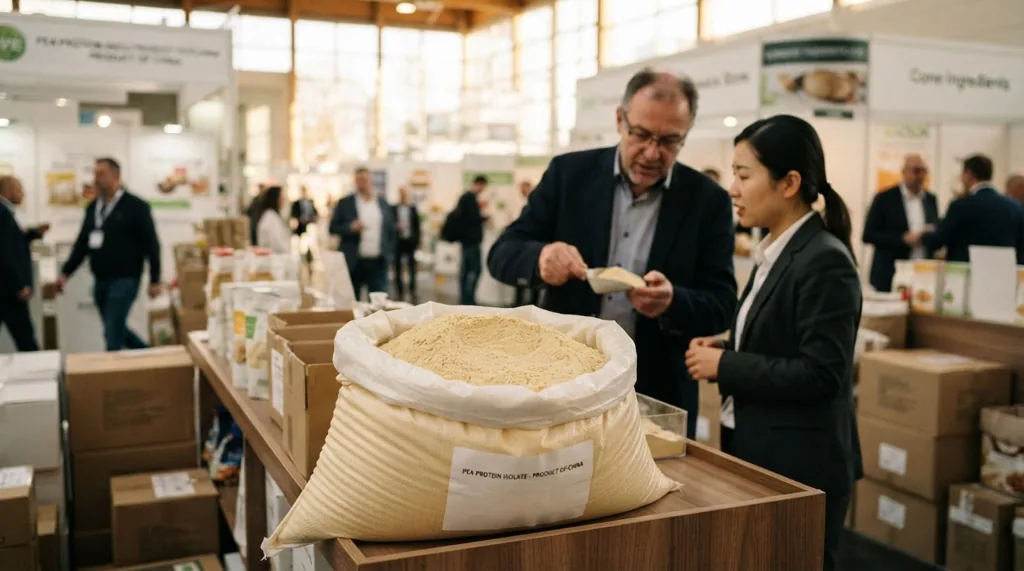
European Union importers of Chinese pea protein pay definitive anti-dumping duties of 40.5% to 67.1% for five years under Regulation (EU) 2026/2101, announced on 25 September 2026.
The European Commission has imposed final anti-dumping duties of 40.5% to 67.1% on pea protein from China for five years, replacing provisional duties1.
The measure is Commission Implementing Regulation (EU) 2026/2101, adopted in Brussels on Sept. 24, 20262. The Commission announced it on Sept. 25, 2026, in a news item from its trade department1.
In short, every shipment of Chinese pea protein entering the EU now pays an extra import tax on top of normal customs duty. A shipment from a named, cooperating Chinese maker pays 40.5%, and a shipment from any other Chinese maker pays 67.1%2.
What is the EU duty on Chinese pea protein?
An anti-dumping duty is an extra import tax on goods sold abroad below their normal price. The EU calls this selling "at dumped prices"1. The Commission found that Chinese pea protein was entering the EU at dumped prices and that this was hurting EU producers1.
The new duty is definitive, which means it is the final measure after the investigation. It replaces a provisional duty, a temporary charge that customs collected during the investigation1. The definitive duties will stay in place for five years1.
The rates are a share of the net, free-at-Union-frontier price, before duty2. In plain words, this is the price of the goods delivered to the EU border, before any duty is added.
Which pea protein products are covered?
Pea protein is a powder or liquid made from peas. It is used instead of animal protein, both in food for people and in animal feed1. People can eat it directly, or companies use it as an ingredient in food and drink. It also goes into pet food, special animal feed and fish feed (aquafeed)1.
The case covers high-protein pea protein with more than 65% protein, measured on a dry weight basis3. It covers protein from all types of peas, including yellow and green field peas. It covers all physical forms, such as powder and liquid, whether textured or not3.
The duty applies to goods originating in China2. A Chinese product counts if it falls under the listed customs codes. These codes include parts of the following headings2:
- 3504 00 90, under TARIC code 3504 00 90 91;
- 2106 10 20 and 2106 10 80, under four TARIC codes;
- 2106 90 92, under TARIC code 2106 90 92 75;
- 2303 10 90, under TARIC code 2303 10 90 10;
- many codes under 2309, from 2309 10 11 to 2309 90 96.
The regulation marks each code with "ex", which means only part of that code is covered. Each covered product has its own 10-digit TARIC code, the EU’s detailed customs code2. A product under one of these codes that is not high-protein pea protein does not pay the duty.
Mixtures were treated with care during the investigation. The Commission said blends fall outside the scope if their original physical, chemical and other properties had changed4.
Which Chinese companies pay 40.5% and 67.1%?
The regulation sets one rate for each company or group. Each has a TARIC additional code, a short code that customs uses to apply the right rate2. The rates are:
- Sanjia Group, 40.5%: Jiujiang Tiantai Food Co., Ltd. and Yantai Oriental Protein Tech Co., Ltd, under code 88BQ2.
- Yantai Shuangta Food Co. Ltd., 67.1%: under code 88BR2.
- Other cooperating companies, 40.5%: the companies listed in the annex, each with its own code2.
- All other Chinese imports, 67.1%: under code 88ZZ2.
Definitive duty by Chinese maker, %
The annex lists nine cooperating makers that were not in the sample2. They are Anhui Wanshen Biotechnology, the Jianyuan Group (Hengyuan Biotechnology and Jianyuan International), Linyi Yuwang Vegetable Protein, Shandong Furun Biotechnology, Shandong Hua-Thai Foodproducts, Shandong Jindu Talin Foods, Yantai T.Full Biotech, Yosin Biotechnology (Yantai) and Zhaoyuan Xiriben Food Stuff2. Their codes run from 88BS to 88CA2.
So the highest rate falls on one of the two sampled exporters and on every Chinese maker not named in the regulation. A buyer who moves orders from one Chinese supplier to another can change the duty by 26.6 percentage points.
What paperwork does a shipment need for the lower rate?
The company rates do not apply automatically. The importer must give customs a valid commercial invoice with a signed declaration on it2. An official of the company that issued the invoice must date and sign it, with name and job title2.
The declaration must state the volume in tonnes of pea protein on the invoice. It must name the company that made the goods in China, with its address and TARIC additional code2. It must also confirm that the invoice is complete and correct2.
Until the importer shows such an invoice, customs charges the rate for all other Chinese imports, 67.1%2. A missing or wrong invoice therefore costs the importer the full higher rate. The normal EU customs rules also apply to the duty, unless the regulation says otherwise2.
Why did the Commission act on pea protein?
The Commission said the dumped imports were causing injury to the EU’s own industry1. It puts the EU market for pea protein at some €175 million1.
The case began with a complaint from EU producers. When it set the provisional duties, the Commission summarised the figures in that complaint4. According to the complaint, imports from China rose by 29% from 2021 to 2024. Their share of the EU market reached 59% in 20244.
The complaint also said Chinese prices were 22% below EU producers’ prices in 20244. The complaining producers’ profit margin fell by 23 percentage points, and they made losses in 20244. The Commission found this was enough evidence to open the investigation4.
Chinese exporters disputed the case. A Chinese food trade chamber (CFNA), which represented several exporting producers, argued that the import figures were unreliable4. It also blamed other causes, such as higher energy costs and EU measures on peas from Russia and Belarus4. The Commission rejected these arguments at the start of the case4.
The EU producers who complained asked to keep their names secret. They said they feared retaliation in China, where they have business links. The Commission agreed4.
How did the pea protein investigation work?
The Commission opened the case with a notice published on Aug. 29, 20252. It studied a period of one year, from July 1, 2024 to June 30, 20252.
The pea protein case
Thirteen Chinese exporting producers came forward and agreed to be in a sample4. The Commission chose two exporting groups, the largest by exports to the EU. Together they made about 70% of those 13 producers’ exports to the EU4. It also picked three EU producers, which made more than 60% of EU production and sales4.
China’s government did not answer the Commission’s questionnaire on market distortions in China4. The Commission said it would therefore use the facts available on that point4. No independent EU importer agreed to join a sample4.
From October 2025, imports were made subject to registration, under Implementing Regulation (EU) 2025/2144 of Oct. 21, 20252. Registration means customs keeps a record of each import while a case is open.
What happens to the provisional duty deposits?
Since April 29, 2026, importers had to give a security deposit equal to the provisional duty before goods could be released3. The provisional rate for most Chinese imports was 67.4%, with 40.5% for some companies3. These came from Implementing Regulation (EU) 2026/916 of April 27, 20263.
Provisional and definitive duties
| Question | Provisional | Definitive |
|---|---|---|
| Legal act | Regulation (EU) 2026/916 | Regulation (EU) 2026/2101 |
| Rate for most imports | 67.4% | 67.1% |
| Rate for cooperating firms | 40.5% | 40.5% |
| How it is paid | Security deposit | Duty collected |
Now the money held under the provisional duty will be definitively collected2. Customs will keep the deposits as duty paid. Any amount above the definitive rates will be released2.
For most companies the rate did not change between the two stages. The rate for all other Chinese imports fell slightly, from 67.4% to 67.1%2. An importer who paid the deposit at the higher rate will get back the difference above 67.1%.
Can a new Chinese exporter get the lower rate?
The regulation leaves a door open for new exporters. The Commission may add a new Chinese producer to the list. That producer would then pay the rate for cooperating companies outside the sample2.
A new exporting producer must show three things2:
- It did not export pea protein to the EU between July 1, 2024 and June 30, 2025.
- It is not related to any exporter or producer already subject to the duties.
- It has exported to the EU since then, or has signed a binding contract to export a large quantity.
Until the Commission amends the list, such a producer pays the 67.1% rate. The regulation entered into force on the day after its publication in the Official Journal of the European Union2.
Who feels the pea protein duties?
EU importers of Chinese pea protein pay the duty at the border. Food makers, pet food makers and feed makers that buy the protein face higher costs if they keep using Chinese supply.
Chinese exporters now face a fixed rate for five years. Those on the 40.5% list must send correct invoices with each shipment so their buyers can claim the lower rate.
Customs brokers must declare the right TARIC code and additional code for each shipment. They must check the invoice declaration before claiming a company rate. EU producers of pea protein are the group the duty is meant to protect1.
Key points on the EU pea protein duties
The table sums up the main facts of the regulation.
| Question | Answer |
|---|---|
| What changed? | Definitive anti-dumping duties replace provisional ones |
| Who issued it? | European Commission |
| Legal act | Implementing Regulation (EU) 2026/2101 |
| Which goods? | Pea protein above 65% protein, from China |
| Lowest rate | 40.5% (Sanjia Group, cooperating firms) |
| Highest rate | 67.1% (Yantai Shuangta, all others) |
| Earlier provisional rate | 67.4% for most imports |
| Paperwork for lower rate | Commercial invoice with signed declaration |
| Provisional deposits | Collected; excess above final rates released |
| How long? | Five years |
| Provisional duty start | April 29, 2026 |
The duties will stay in place for five years1. Every Chinese pea protein shipment without a valid company invoice will pay the 67.1% rate at the EU border2.
Sources
- ↩ Commission acts against imports of pea protein from China – Trade and Economic Security https://policy.trade.ec.europa.eu/news/commission-acts-against-imports-pea-protein-china-2026-09-25_en
- ↩ Implementing regulation – EU – 2026/2101 – EN – EUR-Lex https://eur-lex.europa.eu/legal-content/EN/TXT/?uri=OJ:L_202602101
- ↩ Trade and Industry Department – European Union (EU)* : Imposition of a provisional anti-dumping duty on imports of pea protein originating in Chinese Mainland https://www.tid.gov.hk/en/tradecircular/2026/ci4032026.html?categoryId=20
- ↩ Implementing regulation – EU – 2026/916 – EN – EUR-Lex https://eur-lex.europa.eu/eli/reg_impl/2026/916/oj/eng