
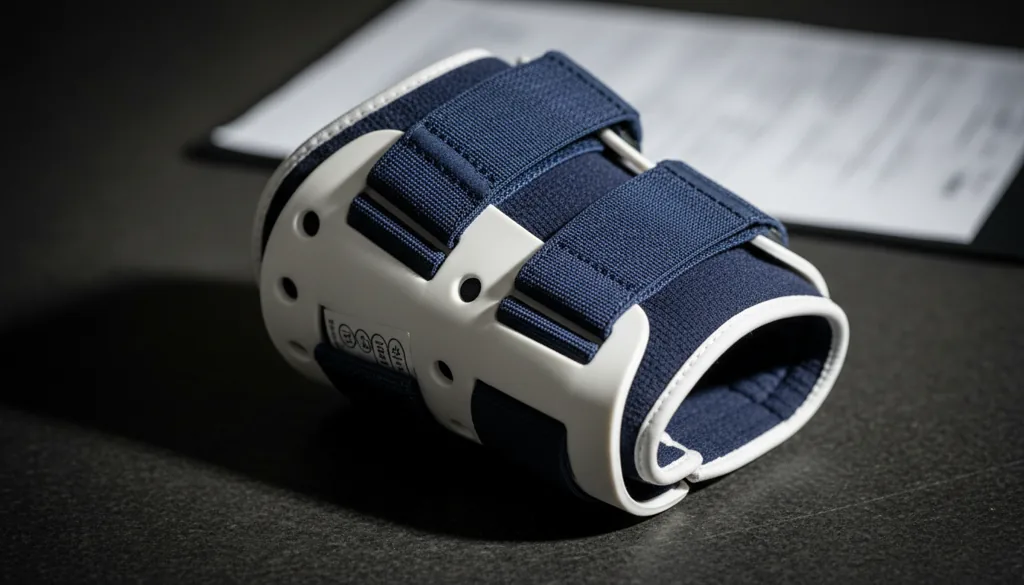
United Kingdom published Tariff Notice 5 on April 7, 2026, classifying universal-size rigid ankle bandages under CN code 6307 90 98 following a regulation that entered into force on March 22, 2026.
HM Revenue & Customs has classified universal-size rigid ankle bandages under customs code 6307 90 98, following a European Union regulation that took effect on March 22, 2026.1
The ruling covers a support made from rigid plastic shells, foam padding, textile fabric and fastening straps. It places the product among other made-up textile articles rather than orthopaedic appliances or fracture splints.1
The measure is intended to settle which tariff code applies when the bandages enter the United Kingdom. The importer remains responsible for declaring the correct code and paying any customs duty due under it.
What the ankle bandage contains
The product is a universal-size article about 26cm long, with two shaped plastic shells covering the ankle and part of the calf. Soft foam covered with woven fabric is attached inside each shell, while a textile bridge links the shells around the heel.1
Two inelastic hook-and-loop straps hold the article at calf level. There is no fastening that tightens around the ankle itself, although the bridge at the heel can be adjusted. The bandage is presented for wear inside a shoe after damage to the ankle joint or its ligaments.
That construction matters because the customs decision treats the article as a composite good. Its plastic shells and textile parts are both important to the stabilising effect, rather than one material clearly giving the product its essential character.1
The ruling therefore looks beyond the product’s medical purpose. A support marketed for an injured ankle does not automatically enter under a medical-device or orthopaedic tariff heading. Its physical design controls the classification.
Why medical headings were rejected
HMRC ruled out code 9021 10 10, which covers orthopaedic appliances, because the universal-size bandage cannot be adjusted to the needs of a particular user. Its rigid shells have one general shape, and the straps tighten only around the calf.1
Why the medical headings fail
| Test | 9021 10 10 | 9021 10 90 | 6307 90 98 |
|---|---|---|---|
| Heading covers | Orthopaedic appliances | Splints, fracture appliances | Made-up textile articles |
| Bandage meets the test? | No — one general shape | No — cannot immobilise | Yes — final code |
| Rule applied | Adjustable to a particular user | Full restraint of movement | Composite goods rule |
The decision also excludes code 9021 10 90 for splints and other fracture appliances. The bandage cannot fully prevent unwanted movements in every situation, including sideways tilting, and cannot immobilise a fractured ankle joint.1
That distinction separates support from immobilisation. The article may help stabilise an ankle, but the notification says it cannot be shaped to a patient’s specific disability or provide the complete restraint expected of an orthopaedic appliance.
The reasoning draws on the European Union’s Combined Nomenclature, the system used to classify goods for customs purposes. It also refers to a Court of Justice judgment from Nov. 7, 2002, in the Lohmann and Medi Bayreuth cases.1
Why plastics and textiles lead to 6307
After rejecting the medical headings, the ruling classifies the bandage according to its materials. It applies the rules for composite goods made from different components, including the rule that deals with products whose materials are equally important.1
From composite good to final code
The two materials are treated as equally essential because the plastic shells and textile straps contribute together to the bandage’s intended effect. The decision then compares headings 3926 for plastics and 6307 for made-up textile articles.
Because heading 6307 comes later in numerical order, the product is placed under that heading when both options merit equal consideration. The final code is 6307 90 98, described as other made-up articles of textile fabric.1
For customs teams, the practical effect is a settled classification for goods matching the described design. A different ankle support may still require separate analysis if its adjustment system, materials or ability to immobilise the joint differs materially.
The March 22 regulation
The notice was published by HMRC on April 7, 2026, after a regulation published on March 2 entered into force 20 days later. That makes March 22, 2026 the date from which the underlying European Union measure applied.1
Publication, force, notice
The notice identifies the regulation as 2026/333. It also says the ruling is not considered a change in Northern Ireland practice, limiting the immediate regional significance of the classification.1
That timing gives the decision a retrospective quality for businesses reviewing declarations made after the regulation took effect. The public notice arrived more than two weeks after the legal change began, so the published classification is important for aligning records with the operative date.
The tariff notice is guidance published for information purposes, rather than a new product-safety rule or a licensing requirement. Its direct function is to explain the customs treatment of a particular article and support consistent declarations.1
Where it sits in the 2026 notices
The ankle-bandage ruling was one of three HMRC tariff notices added to the 2026 collection on April 7. The same update included guidance on back supports and back bandages, and on liquid food preparations dominated by fats and oils.2
Of 7 notices reached by April 7
The wider collection shows that HMRC uses these notices for goods ranging from inverters and animal feed to swim spas and ballot-box partitions. The 2026 list had already reached tariff notice 7 by April 7, with later notices covering additional subjects.2
The neighbouring notice on back supports and back bandages is commercially relevant because it concerns a related class of support products. It does not, however, change the ankle-bandage ruling or turn the two product groups into one tariff category.
HMRC’s tariff-notice collection says the notices explain how goods should be classified for import and export purposes.2 That makes the ankle decision useful beyond the specific model described, while its conclusions remain tied to the product’s construction and use.
The decision’s clearest commercial boundary is therefore not the word “bandage” on packaging. It is the combination of universal sizing, rigid side shells, calf-only tightening and the inability to immobilise a fractured ankle. Goods built around those features fall into the textile heading, with April 7, 2026 marking the date the guidance was published.1
Sources
- ↩ Tariff Classification of Ankle Bandages https://www.gov.uk/guidance/ankle-bandages-tariff-notice-5
- ↩ Tariff notices https://www.gov.uk/government/collections/tariff-notices