
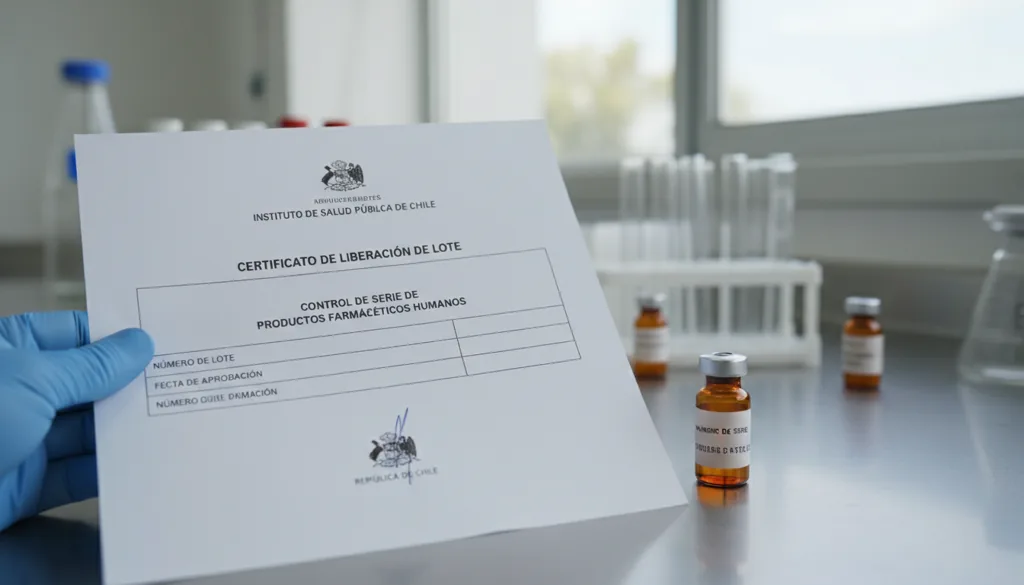
Chile has approved a user instruction for the control of serial numbers in human pharmaceutical products, reinforcing quality and safety measures through mandatory risk-based evaluations before distribution and use ****.
Chile Mandates Risk Checks for Pharma Serial Numbers
Manufacturers must conduct risk-based evaluations before products can be distributed.
What changed
Mandatory risk-based evaluation required for each lot or sublot before distribution and use.
Documentation review of manufacturing and control records is now mandatory.
Analytical evaluations must be conducted for every lot, especially for biological products.
Specific lot release rules apply to vaccines and blood products.
Who it affects
Human pharmaceutical manufacturers must replace the previous resolution with the new serial control framework.
Biological product producers must adhere to specific control subprocesses for vaccines and blood products.
What to do
Review manufacturing and control documentation for each lot.
Conduct analytical evaluations based on risk assessment.
Ensure independent checks are completed before distribution.
Summary
The question addresses Chile’s regulatory framework for serial number control and batch release of human pharmaceutical products, focusing on mandatory risk-based evaluations before distribution and use.
- Scope & Applicability: Mandatory for all biological products and other pharmaceuticals deemed necessary by the health authority, covering both imported and domestically manufactured lots1.
- Process & Documentation: Requires submission of manufacturer certificates, local laboratory testing (for imports), and risk-based analytical evaluations by Chile’s National Control Laboratory1.
- Exceptions & Timelines: Includes provisions for partial exemptions (e.g., urgent public health needs) and sets resolution deadlines of 20–40 business days under Supreme Decree 3/20101.
Jurisdiction(s): Chile
Subject matters: Pharmaceutical Compliance — mandatory pre-distribution batch controls for biological and high-risk products; Risk-Based Evaluation — analytical and documentary requirements for lot authorization
Regulation Analysis
Chile has established a risk-based control system for serial numbers and batch release of human pharmaceutical products, governed by the Instructivo para el Usuario de Control de Biológicos y Liberación de Lotes de Productos Farmacéuticos de Uso Humano (hereafter "the Instruction"). The framework mandates pre-distribution evaluations for all biological products and other pharmaceuticals designated by the health authority, ensuring compliance with quality and safety standards1.
1. Core Requirements
The Instruction outlines two sub-processes for batch control:
- Control de Biológicos (CB): Applies to biological products other than vaccines and hemoderivatives. Requires documentary review (e.g., manufacturer’s certificate of analysis) and risk-based laboratory testing by Chile’s Subdepartamento Laboratorio Nacional de Control (National Control Laboratory)1.
- Liberación de Lotes (LL): Mandatory for vaccines and hemoderivatives, involving additional steps such as physical inventory verification and protocol summaries of production/control1.
Key Documentation
For all products subject to control (CB/LL), the following documents must be submitted:
- Manufacturer’s Certificate of Analysis: Issued by the product’s origin laboratory, certifying quality parameters1.
- Local Laboratory Testing (for imports): Conducted in Chile per Article 184 of Supreme Decree 3/2010, with results required before authorization1.
- Protocol Summary of Production/Control (LL only): Approved during the product’s sanitary registration stage1.
- Batch Release Certificate (ARN): For imports, issued by the regulatory authority of the country/region of origin, with traceability to the submitted lot1.
Risk-Based Evaluation
The National Control Laboratory determines whether laboratory testing is required for each lot based on a risk assessment1. For LL, this includes reviewing the protocol summary of production/control1.
2. Process Workflow
| Step | Action | Authority | Citation |
|---|---|---|---|
| 1. Submission | Holder of sanitary registration (or importer/CENABAST) files request for CB/LL. | Titular de registro sanitario/importador | 1 |
| 2. Documentary Review | National Control Laboratory evaluates certificates, protocols, and local test results. | Subdepartamento Laboratorio Nacional de Control | 1 |
| 3. Sampling (if applicable) | Physical/electronic inventory verification and sample collection (per Resolución Exenta 2481/21). | Unidad de Muestreo y Liberación | 1 |
| 4. Laboratory Testing | Risk-based analysis (e.g., viral markers for hemoderivatives). | Subdepartamento Laboratorio Nacional de Control | 1 |
| 5. Authorization | Issuance of resolution (CB) or certificate (LL) for distribution/use. | Departamento Agencia Nacional de Medicamentos | 1 |
3. Exceptions & Timelines
Exceptions
- Exclusión (EX): Exemption for low-volume imports (e.g., <20 units)1.
- Exención Parcial (EP): Partial release of a quarantined lot for urgent public health needs, requiring justification and a Certificado de Uso y Disposición1.
Deadlines
- Resolution timelines align with Supreme Decree 3/2010: 20–40 business days from submission of complete documentation1.
- Local testing for imports may proceed in parallel with CB/LL but must conclude before authorization1.
4. Responsible Parties
- Sanitary Registration Holders: Primary applicants for CB/LL1.
- Importers: May apply under Article 99 of the Sanitary Code (Supreme Decree 3/2010) or for direct imports via CENABAST1.
- National Control Laboratory: Executes testing, risk assessments, and issues authorization resolutions/certificates1.
Summary Answer
Chile’s Instructivo para el Usuario de Control de Biológicos y Liberación de Lotes mandates pre-distribution risk-based evaluations for all biological products and designated pharmaceuticals, requiring submission of manufacturer certificates, local laboratory testing (for imports), and analytical reviews by the National Control Laboratory1. The process includes two sub-paths—Control de Biológicos (CB) and Liberación de Lotes (LL)—with exceptions for low-volume imports or public health emergencies1. Resolution deadlines are 20–40 business days under Supreme Decree 3/2010, and local testing must be completed before authorization1. Compliance is enforced by the Departamento Agencia Nacional de Medicamentos, with the National Control Laboratory serving as the reference entity1.
Sources
- ↩ WTO TBT notification 26-03516 — Chile https://members.wto.org/crnattachments/2026/TBT/CHL/26_03516_00_s.pdf