
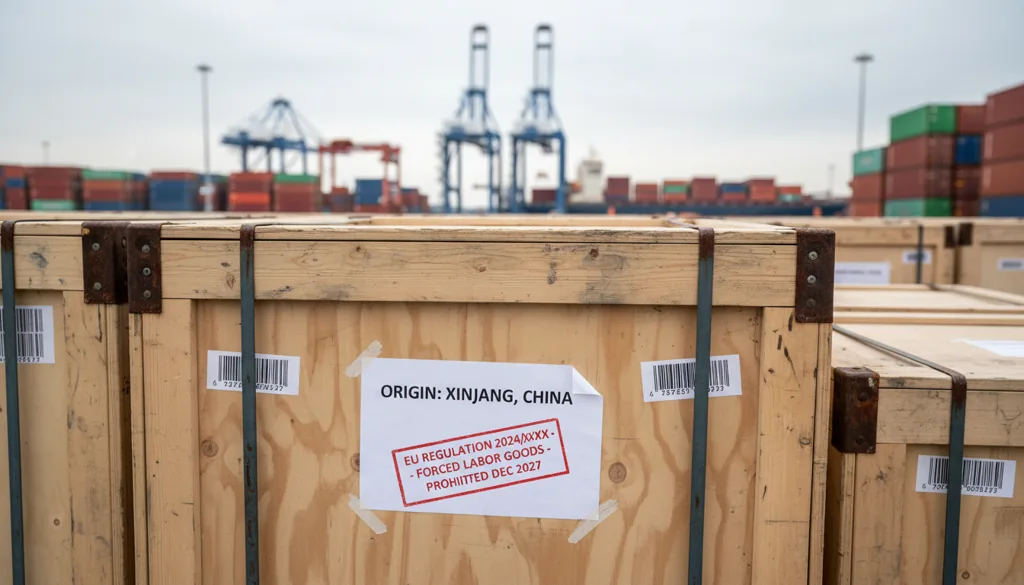
European Union will ban all goods made with forced labor from being placed on or exported to the EU market, with full application scheduled for December 2027.
EU bans all goods made with forced labour from December 2027
The European Union will prohibit all products made with forced labour from being sold or exported in its market from 14 December 2027, under a regulation adopted in November 2024. The measure covers every sector, from electronics to textiles, and applies to companies of all sizes, including small and medium enterprises (SMEs). The delivered cost of goods linked to forced labour will rise to zero, as shipments found to violate the rules must be withdrawn or destroyed1.
The ban targets an estimated 27.6 million people trapped in forced labour worldwide, whose output reaches EU markets. It follows growing trade tensions with China, where excessive overtime and state-imposed labour in regions like Xinjiang have drawn scrutiny. The EU’s trade deficit with China reached roughly $1 billion a day last year, driven partly by weak labour protections that suppress domestic demand and push Chinese producers into export markets2.
The regulation does not name specific countries or companies. Instead, it sets a blanket prohibition on any product made with forced labour, defined as work performed involuntarily under threat or coercion. Examples include unpaid labour, excessive overtime to repay debt, and shifts lasting from 05:00 to 23:00 without rest1.
Who must comply and how
Every company selling goods in the EU must ensure its supply chains are free from forced labour. The obligation applies regardless of where production occurs, and companies may be asked to share information during investigations. If forced labour is confirmed, the goods must be removed from the market, and any shipments already in transit will be barred from entry1.
National authorities in EU member states will lead investigations, working with customs and market surveillance agencies. They can request documents, conduct site visits, and order the disposal of non-compliant goods. Companies found in violation will face reputational and financial risks, as well as potential legal consequences under national laws1.
Support for SMEs is available through guidelines, checklists, and a dedicated portal launched on 30 June 2026. The EU has also published a risk database to help businesses identify high-risk regions and products. Traceability tools are provided to assess supply chain exposure, though the database does not name specific companies1.
How enforcement will work
The EU’s approach differs from the US Uyghur Forced Labor Prevention Act (UFLPA), which presumes goods from Xinjiang are made with forced labour unless proven otherwise. Under the EU regulation, authorities must prove forced labour occurred before banning a product. This places the burden of proof on investigators, rather than on companies to demonstrate compliance3.
EU rule vs US UFLPA, compared
| Question | EU regulation | US UFLPA |
|---|---|---|
| When it takes force | 14 Dec 2027 | 2022 |
| Burden of proof | Investigators must prove it | Presumed; importer must disprove |
| How high risk is flagged | Regions and products, no firms | Entity list: 187 banned firms |
| Shipments held so far | None — not yet in force | 24,300+, near $1bn |
Since the US law took effect in 2022, customs agencies have detained over 24,300 shipments linked to Xinjiang, worth nearly $1 billion. The EU’s risk database, expected to be published before December 2027, will guide initial enforcement efforts. Unlike the US entity list, which names 187 banned companies, the EU database will have a recommendatory character, listing high-risk regions and products without targeting specific firms3.
Enforcement will begin on 14 December 2027, with national authorities responsible for investigations and decisions. The EU Commission will coordinate through a Union Network against Forced Labour Products, facilitating information exchange and monitoring. Civil society organisations can submit evidence of forced labour through a Single Information Submission Point, which will also open on the same date1.
High-risk sectors and products
The regulation covers all goods, but certain sectors face higher scrutiny due to their reliance on forced labour. Xinjiang, China’s largest region, produces around 10% of the world’s polyvinyl chloride (PVC), 20% of its cotton, and 70% of its solar modules. The EU’s solar industry, which installed Chinese-made panels in 89% of new projects in 2022, has welcomed the ban as a way to level the playing field for European manufacturers3.
Xinjiang’s share of world output, %
Other high-risk sectors include textiles, electronics, agri-food, automotive, and fisheries. The EU has scheduled sector-specific webinars between September and November 2026 to help businesses prepare. Topics will include supply chain visibility, supplier engagement, and compliance strategies for industries like solar, textiles, and semiconductors1.
The regulation’s broad scope means even small importers must review their supply chains. For example, a European retailer sourcing cotton T-shirts from a supplier in Bangladesh must now verify that no forced labour was used at any stage, from farming to manufacturing. Failure to do so could result in shipments being blocked at the border1.
What happens if a shipment is flagged
If authorities suspect forced labour, they can open an investigation and request evidence from the company. During this process, the shipment may be held at the border. If forced labour is confirmed, the goods must be withdrawn from the market, and any costs associated with disposal or re-export will fall on the importer1.
From suspicion to outcome
Companies can challenge decisions through national legal systems, but the regulation does not provide a formal appeals process at the EU level. The lack of a rebuttable presumption, as in the US system, means authorities must gather sufficient evidence before banning a product. This could slow enforcement but may also reduce the risk of false positives3.
The regulation does not impose fines or criminal penalties, leaving those to national laws. However, the reputational damage from being linked to forced labour could be severe, particularly for consumer-facing brands. Companies may also face legal action under the EU’s Corporate Sustainability Due Diligence Directive (CS3D), which will apply from 2029 and requires businesses to address human rights risks in their operations3.
The road to December 2027
Preparation for the ban began in November 2024, when the regulation was adopted. On 30 June 2026, the EU launched a preparedness package, including guidelines, a risk database, and a Single Portal for reporting suspected cases. Businesses, authorities, and civil society organisations must now build capacity and establish procedures before enforcement begins1.
Key dates to enforcement
| Date | Milestone | What falls due |
|---|---|---|
| Nov 2024 | Regulation adopted | Preparation window opens |
| 30 Jun 2026 | Preparedness package launched | Guidelines, risk database, Single Portal |
| 28 Sep 2026 | Traceability tender closed | Commission pilots tools for three years |
| 14 Dec 2027 | Enforcement begins | No forced-labour goods on the EU market |
A tender for supply chain traceability and risk detection services closed on 28 September 2026, with contracts expected to run for three years. These services will help the EU Commission pilot tools for investigations, though their full deployment will depend on funding and staffing levels1.
The regulation’s success will hinge on cooperation between national authorities, businesses, and civil society. While the EU’s approach is less prescriptive than the US model, its broad scope and emphasis on supply chain transparency could reshape global trade. For importers, the message is clear: from 14 December 2027, no product made with forced labour will be allowed on the EU market, and the cost of non-compliance will be borne by those who fail to act in time.
Sources
- ↩ Forced Labour Regulation https://single-market-economy.ec.europa.eu/single-market/goods/forced-labour-regulation_en
- ↩ Some Chinese workers see an ally in Brussels as EU trade tensions mount https://www.devdiscourse.com/article/international/3968026-some-chinese-workers-see-an-ally-in-brussels-as-eu-trade-tensions-mount?amp
- ↩ How far can the EU’s forced-labor import ban help restore fair trade? https://www.mayerbrown.com/-/media/files/news/2026/08/mlex_how-far-can-the-eus-forced-labor-import-ban-help-restore-fair-trade_.pdf%3Frev=-1