
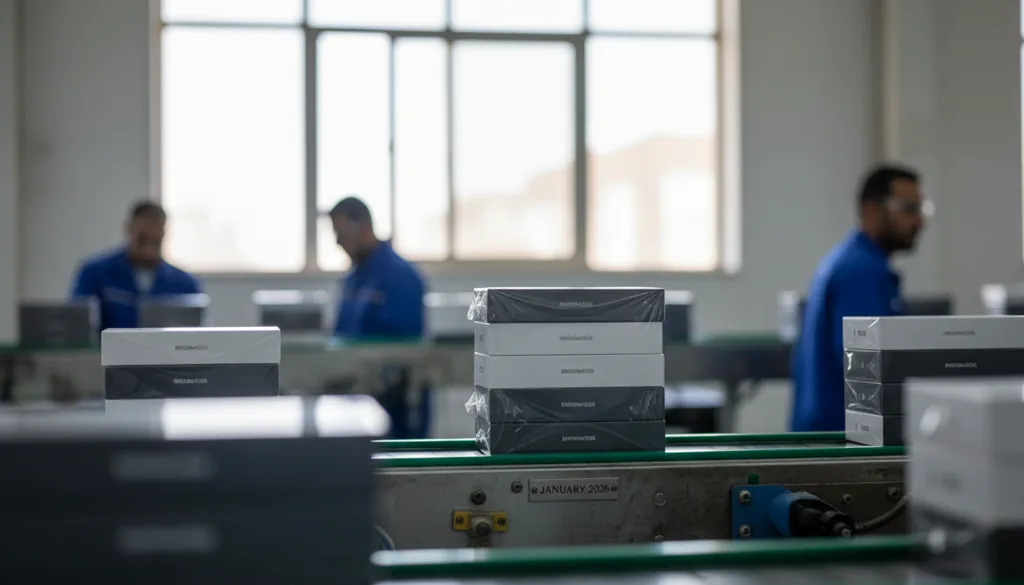
Egypt announced that the exceptional customs exemption for mobile phones imported with a passenger will end on January 21, 2026.
Egypt will end the customs exemption for mobile phones brought into the country by passengers at midday on 21 January 2026, the customs authority and the National Telecommunications Regulatory Authority said in a joint statement. The change removes a temporary waiver that has allowed travellers to carry one phone without paying import taxes since January 2025.
The measure is designed to support local manufacturing after 15 global phone makers set up production lines in Egypt, lifting annual output to 20 million devices1. That volume now exceeds domestic demand, the statement said, and the latest models are sold at competitive prices through official retail networks. From next January every phone carried across the border will be subject to the same duties and taxes as commercial shipments.
The delivered cost of a mid-range smartphone will rise by roughly a third. Egypt’s import taxes on electronics combine a 20 % customs duty, a 14 % value-added tax applied to the duty-inclusive value, and a 1 % development fee, producing an effective rate of 36.8 % on the declared value2. A phone valued at $300 will therefore attract about $110 in taxes, payable through digital wallets or the government’s “Telephony” app within 90 days of first use.
The exemption that is ending
The waiver was introduced in January 2025 as part of a “mobile-phone governance system” that aimed to curb grey-market imports while local production ramped up1. It allowed each passenger to bring one phone free of duty, provided the device was for personal use. The rule did not apply to commercial shipments, which have always faced the full tax schedule.
Life of the passenger waiver
Egyptian residents returning from abroad and tourists were given a separate 90-day exemption that remains in place. That concession is capped at one phone per person and is not affected by the January deadline. The customs authority said the distinction is intended to avoid disrupting tourism and to ease the transition for citizens who travel frequently.
How the tax is calculated
Egypt uses a 12-digit national tariff code to classify every import. Mobile phones fall under HS chapter 85, where the standard duty rate is 20 %2. The taxable value is the cost of the phone plus international freight and insurance (CIF), even if the purchase was made on FOB terms. Importers who declare only the invoice value without adding freight and insurance face penalties and cargo holds.
The parts of the 36.8% tax burden
Value-added tax is then applied to the sum of the CIF value and the customs duty. At 14 %, this produces an effective VAT rate of 16.8 % on the original goods value when the duty is 20 %2. A development fee of 1 % is added for most electronics, bringing the total tax burden to 36.8 % of the CIF value.
Who pays and how
The passenger is responsible for paying the tax before the phone can be activated. Payment can be made through the “Telephony” app, bank transfers, or digital wallets within 90 days of first use1. The authorities have also introduced an instalment plan that will be rolled out in the coming months. Failure to pay within the grace period will trigger regulatory action, including possible disconnection.
Passenger and commercial importer
| Question | Passenger | Commercial importer |
|---|---|---|
| When paid | Within 90 days of first use | At the border |
| How | “Telephony” app, bank transfer, digital wallet | Standard customs declaration |
| Extra paper | None | Certificate of origin for preferential rates |
| Relief tools | None | Advance rulings, classification inquiries |
Commercial importers face the same tax schedule but must also submit a certificate of origin to claim preferential rates under trade agreements. Egypt is a member of the Greater Arab Free Trade Area (GAFTA), the EU-Egypt Association Agreement, and the Common Market for Eastern and Southern Africa (COMESA). Each agreement requires a specific certificate—GAFTA, EUR1, or COMESA—to activate the lower or zero duty rate2.
What the change signals
The end of the passenger exemption marks the final step in a two-year plan to shift Egypt’s phone market from imports to local assembly. The government said the policy has already attracted $1.2 billion in investment and created 12,000 manufacturing jobs1. With production now exceeding demand, the authorities see no further need for the waiver.
The move also aligns with broader customs reforms that aim to simplify classification and reduce under-declaration. Egypt has recently introduced advance rulings and non-binding classification inquiries to help importers avoid disputes. Those tools are available to commercial traders but not to passengers, who must rely on the published tariff schedule.
What remains unchanged
The 90-day exemption for returning residents and tourists is not affected. Neither is the personal-effects allowance of up to EGP 40,000 for citizens returning after long stays abroad2. Diplomatic and official shipments continue to be exempt under international conventions, and goods imported into free zones for re-export remain outside the domestic tax regime.
What stays exempt
Capital goods for approved industrial projects can still qualify for duty exemption, although VAT remains payable in most cases. The General Authority for Investment (GAFI) must approve the exemption before the machinery arrives; retroactive applications are not accepted2.
The next deadline
The customs authority said it will review the impact of the change in the first quarter of 2026. If local production continues to meet demand, the government may extend the policy to other consumer electronics. For now, the only firm date is 21 January 2026, when the passenger exemption for mobile phones will end.
Sources
- ↩ End of Special Exemption Period for Imported Mobile Phones in Egypt https://customs.gov.eg/Home/NewsDetail/161
- ↩ Import Duties Egypt 2026: Rates, Calculation & Exemptions Complete Guide https://seagateexpress.com/import-duties-egypt/