
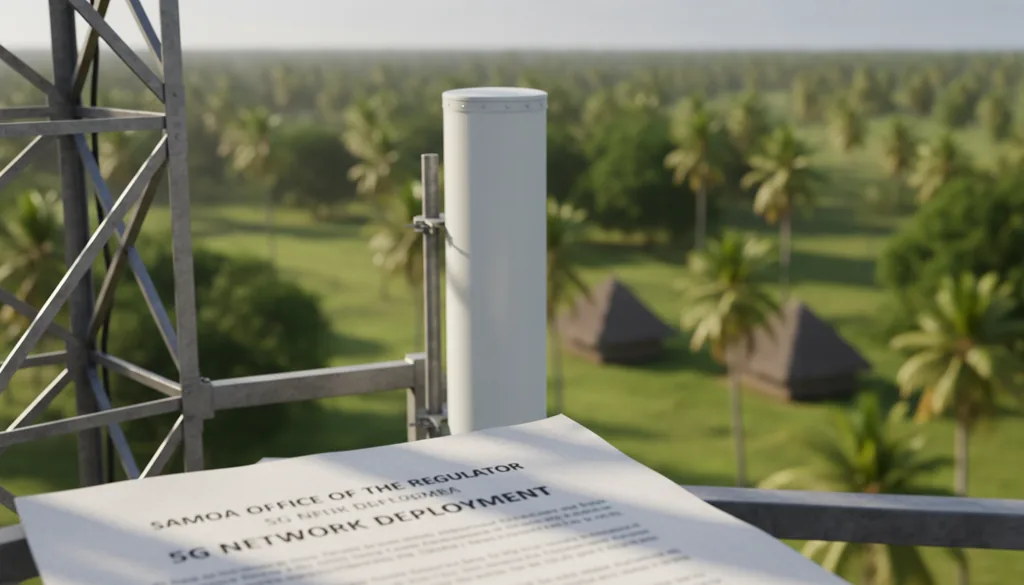
Samoa has issued updated regulatory notices covering 5G deployment, online safety guidelines, and the analog TV switch-off date, signaling a broader digital infrastructure shift
Samoa sets digital deadlines for importers and telecoms firms
Samoa’s Office of the Regulator has published three regulatory notices that set deadlines for the country’s analog television switch-off, 5G network deployment, and online safety compliance, reshaping the rules for importers of broadcasting equipment, telecoms hardware, and digital services.
Three notices, five deadlines
| Deadline | Who it catches | What falls due |
|---|---|---|
| 17 Apr 2026 | Digital service providers | National ICT Policy and Cybersecurity Strategy take effect; SamCERT registration |
| 31 Dec 2026 | Importers of TV receivers and set-top boxes | Analog switch-off; every shipment meets digital standards |
| 30 Jun 2027 | Telecoms firms | 5G networks deployed in Apia |
| 31 Mar 2028 | Telecoms firms | First spectrum fee payment, 1.5% of gross 5G revenue |
| 31 Dec 2028 | Telecoms firms | 5G coverage extended to all district centres |
The measures cover transmitters, set-top boxes, and mobile base stations, with delivered costs rising for any shipment that misses the new testing and approval windows. The first deadline bites on 17 April 2026, when the National ICT Policy and Cybersecurity Strategy take effect.
It comes after years of gradual digital migration. The government first proposed a digital television channel in September 2019, and the Office of the Regulator—established in 2006 under the Telecommunications Act—has since expanded its mandate to include broadcasting, postal services, and electricity.
The analog switch-off date
Samoa will end analog television broadcasts on 31 December 2026, forcing importers of television receivers and set-top boxes to ensure every shipment meets digital standards before that date. The Office of the Regulator said in a statement that the switch-off is part of a global trend in broadcast technology, and that the government’s digital channel has already been used to broadcast live parliamentary sessions since December 20191.
The date that binds importers
The regulator has not yet published a list of approved digital receivers, but the notice requires every shipment to carry a certificate of conformity issued by an accredited testing laboratory. Importers must pay for the tests, and any shipment that arrives without the certificate will be held at the border until the paperwork is complete2.
The move follows a 2020 cabinet proposal to re-establish the government’s television channel on the digital platform, aiming to improve public access to information on education, health, and economic developments. The channel was offered to the government by digital platform operators during the 2020-2021 financial year, as part of the broader transition from analog to digital broadcasting1.
5G deployment rules
Telecoms firms must deploy 5G networks in Apia by 30 June 2027 and extend coverage to all district centres by 31 December 2028. The Office of the Regulator’s notice requires every base station to undergo type approval before installation, and importers must submit technical specifications for any new 5G equipment at least 90 days before shipment2.
Minimum 5G download speeds
The regulator has set a minimum download speed of 100 megabits per second for urban areas and 50 megabits per second for rural districts. Firms that miss the deadlines will face fines of up to 50,000 Samoan tālā (US$18,500) per unmet site, and the regulator can suspend import permits for any equipment that fails the tests2.
The notice also introduces a spectrum usage fee, payable annually at a rate of 1.5% of gross revenue from 5G services. The fee is designed to fund the regulator’s monitoring and enforcement activities, and firms must submit their first payment by 31 March 20282.
Online safety compliance
From 17 April 2026, all digital service providers—including internet cafes, e-commerce platforms, and social media operators—must register with the Samoa Computer Emergency Response Team (SamCERT) and implement cybersecurity controls outlined in the new National Cybersecurity Strategy. The strategy, launched alongside the ICT Policy, requires providers to conduct annual risk assessments and report any data breaches within 24 hours3.
What every digital service provider must do from 17 April 2026
The controls include mandatory encryption for financial transactions, two-factor authentication for user accounts, and regular vulnerability scans. Providers must also display a cybersecurity poster in any physical premises, detailing reporting pathways for online threats1.
SamCERT, established in 2020, will oversee compliance and can issue fines of up to 100,000 tālā (US$37,000) for repeated violations. The regulator said in a statement that the measures are designed to protect users from fraud, identity theft, and cyberbullying, and that the first National Cybersecurity Awareness Week in February 2021 laid the groundwork for the new rules1.
Who pays for the changes
Importers of broadcasting and telecoms equipment will bear the upfront costs of testing, certification, and spectrum fees. The regulator estimates that type approval for a single 5G base station will cost between 5,000 and 10,000 tālā (US$1,850 to US$3,700), depending on the complexity of the tests2.
Digital service providers will face recurring costs for cybersecurity compliance, including annual risk assessments and staff training. The regulator has not set a fee for SamCERT registration, but providers must budget for encryption software, vulnerability scanning tools, and incident response measures3.
The government has allocated 2 million tālā (US$740,000) to support the transition, including subsidies for low-income households to purchase digital set-top boxes. The funding was approved in the 2025-2026 budget and will be distributed through a voucher scheme starting in June 20261.
The next review
The Office of the Regulator will review the 5G deployment rules in December 2028, six months after the final coverage deadline. The review will assess whether the minimum speed requirements and spectrum fees remain appropriate, and whether any adjustments are needed to support rural connectivity2.
The National ICT Policy and Cybersecurity Strategy will be reviewed every two years, with the first assessment due in April 2028. The reviews will evaluate the effectiveness of the cybersecurity controls and consider updates to reflect emerging threats, such as artificial intelligence and quantum computing3.
The regulator said in a statement that the measures are designed to position Samoa as a regional leader in digital infrastructure, while ensuring that the benefits of connectivity are accessible to all citizens. The analog switch-off, 5G deployment, and online safety rules mark the most significant regulatory shift in Samoa’s telecommunications sector since the establishment of the Office of the Regulator in 2006.
Sources
- ↩ Annual Report 2020-2021 https://mcit.gov.ws/wp-content/uploads/2024/03/ANNUAL-REPORT-2020-2021_ENGLISH.pdf
- ↩ regulator.gov.ws — telecommunications / application forms https://regulator.gov.ws/index.php/telecommunications-regulation/telecommunications/application-forms?id=88
- ↩ Official Launch of National ICT Policy and Cybersecurity Strategy https://mcit.gov.ws/official-launch-of-the-national-ict-policy-national-cybersecurity-strategy/