
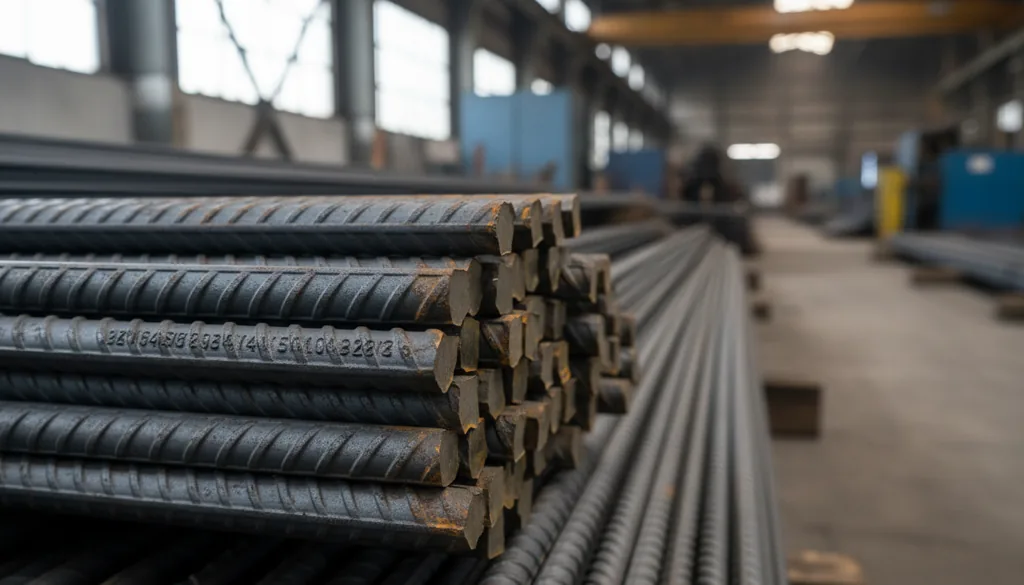
Philippines has issued supplemental guidelines to strengthen oversight of iron and steel products by mandating adherence to the latest technical standard for deformed steel bars.
Philippines tightens steel standards with new certification deadline
The Philippines has set a 30 April 2027 deadline for all deformed steel bars to meet the latest national technical standard, replacing an older certification that will expire on the same date. The new rules, issued by the Department of Trade and Industry’s Bureau of Philippine Standards (BPS), apply to both locally produced and imported steel bars used in construction. Importers and manufacturers must now ensure their products comply with PNS 49:2026, the updated standard, or face removal from the market.
The measure targets deformed steel bars—reinforcement bars with surface ridges to improve bonding with concrete—used in buildings, bridges and infrastructure projects. Under the previous standard, PNS 49:2020, steel bars could be sold until the new deadline, but from 30 April 2027, only those certified under the 2026 version will be permitted for manufacture, sale or use1. The delivered cost of compliance will fall on manufacturers and importers, who must cover testing, certification and any product redesign needed to meet the stricter requirements.
It comes after years of complaints about inconsistent steel quality in the Philippines, where substandard bars have been linked to structural failures in buildings and bridges. The BPS said in a statement that the update was necessary to align with international best practices and reduce safety risks in construction1. The new standard introduces tighter limits on chemical composition and mechanical properties, including yield strength and elongation.
What the new standard changes for steel bars
The new standard, PNS 49:2026, replaces the 2020 version and introduces stricter requirements for deformed steel bars. Key changes include lower permitted levels of impurities such as sulphur and phosphorus, which can weaken steel, and higher minimum tensile strength for certain grades1. The standard also expands testing requirements to cover more mechanical properties, including bend and rebend tests, which assess a bar’s ability to withstand deformation without cracking.
PNS 49:2020 to PNS 49:2026
Manufacturers and importers must now submit samples for third-party testing and approval before their products can be sold in the Philippines. The BPS will conduct market monitoring and enforcement starting on 30 April 2027, when all non-compliant products must be removed from circulation1. Companies found selling steel bars that do not meet the new standard after this date will face penalties under existing BPS regulations, including fines and product seizures.
The transition period allows manufacturers to voluntarily adopt the new standard before the mandatory deadline. Local and foreign producers may begin using PNS 49:2026 as soon as the circular takes effect, which is 15 days after publication in a national newspaper1. However, all Product Standard (PS) licences issued under the old standard will be automatically cancelled on 30 April 2027, forcing companies to reapply for certification under the new rules1.
Who pays for the certification and testing
The cost of compliance will be borne by manufacturers and importers, who must cover the expenses of testing, certification and any necessary product adjustments. Under the Philippine Standard (PS) licensing system, companies must pay for third-party conformity assessment, including laboratory tests and factory inspections, before their products can be certified2. The fees vary depending on the scope of testing and the number of product grades, but industry estimates suggest certification costs can range from ₱50,000 to ₱200,000 per licence, excluding testing fees.
Estimated certification cost per PS licence
Importers face additional costs if their shipments are produced in factories abroad that are not already PS-licensed. While products from licensed overseas factories may qualify for streamlined clearance, importers must still secure an Import Commodity Clearance (ICC) for each shipment, which involves further testing and documentation2. The BPS has not specified whether the new standard will increase testing costs, but the expanded requirements for mechanical and chemical testing suggest higher expenses for companies.
The financial burden will be heavier for small and medium-sized enterprises (SMEs), which may lack the resources to quickly adapt their production processes. The Department of Trade and Industry (DTI) has not announced any subsidies or financial assistance for affected businesses, leaving companies to absorb the costs themselves. Industry groups have previously warned that sudden regulatory changes can disrupt supply chains, particularly for imported steel, which accounts for roughly 40% of the Philippine market3.
How the rules affect imported steel
The new standard applies equally to locally produced and imported deformed steel bars, with no exemptions for foreign manufacturers. Importers must ensure their products comply with PNS 49:2026 by the 30 April 2027 deadline or risk having their shipments rejected at customs1. The rules do not introduce new tariffs or quotas, but the stricter certification requirements could slow down clearance times for imported steel, particularly if testing backlogs develop.
The import exposure
Steel bars are classified under HS subheading 7214.20 (bars and rods of iron or non-alloy steel, hot-rolled, in irregularly wound coils) and 7214.99 (other bars and rods of iron or non-alloy steel). The Philippines imported ₱42.3 billion ($760 million) worth of iron and steel products in 2023, with major suppliers including China, Japan and South Korea3. The new standard could shift trade flows if some foreign producers struggle to meet the updated requirements, potentially benefiting suppliers with established PS licences.
The BPS has not indicated whether it will recognise foreign testing reports or certifications, which could further complicate compliance for importers. Under the current system, overseas manufacturers must still undergo local testing and certification, even if their products are already certified in their home markets2. The lack of mutual recognition agreements means importers may face redundant testing, increasing both costs and delays.
What happens after the 2027 deadline
From 30 April 2027, all deformed steel bars sold, distributed or used in the Philippines must comply with PNS 49:2026. The BPS will begin market monitoring and enforcement on the same date, with non-compliant products subject to seizure and penalties1. The agency has not specified how frequently it will conduct inspections, but previous enforcement actions have targeted hardware stores, construction sites and ports.
What falls due, and when
| Date | Who it catches | What happens |
|---|---|---|
| 30 April 2027 | All deformed steel bars, local and imported | Old PS licences cancelled; non-compliant bars removed, seized or penalised; BPS market monitoring begins |
| As early as 2032 | The standard itself | Possible next revision, on the BPS’s usual five-to-seven-year cycle |
The new standard does not include a review clause, meaning there is no set date for another update. However, the BPS typically revises standards every five to seven years to keep pace with technological and safety developments. The next update could come as early as 2032, depending on industry feedback and emerging risks in construction materials.
For now, the focus is on ensuring a smooth transition before the deadline. The DTI has not announced any extensions or grace periods, leaving companies with less than 18 months to complete certification. The lack of clarity on enforcement priorities—whether the BPS will target large manufacturers first or conduct random inspections—adds to the uncertainty for businesses. What is clear is that after 30 April 2027, the Philippine market will only accept steel bars that meet the new standard, making compliance a prerequisite for continued trade.
Sources
- ↩ WTO TBT notification 26-03885 — Philippines https://members.wto.org/crnattachments/2026/TBT/PHL/26_03885_00_e.pdf
- ↩ Importer of Mandatory Certified Product Under Philippine Standards https://standardsph.dti.gov.ph/portal/Faqs/forms/0cf8a8cb203a82ff3af9a0c13491d1370b31c2fb7aee6267d101cb70z8x4qjhuu~XkxcMYBdrJSg–
- ↩ Bakal Lokal Connects Farmers, Micro Entrepreneurs, and Consumers https://region6.dost.gov.ph/2020/08/05/bakal-lokal-to-link-farmers-micro-entreps-and-consumers-in-western-visayas/