
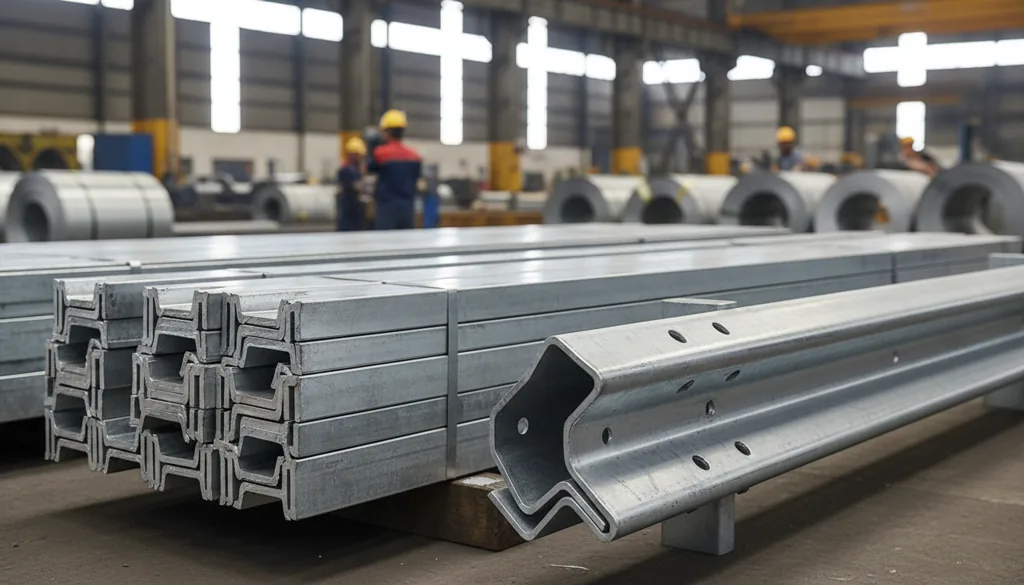
Ecuador is proposing a third revision of its technical regulations for steel panels and guardrail components to update safety and performance requirements, covering cold-formed steel panels, corrugated steel sheets, and steel guardrail posts ****.
Ecuador has published a third revision of its technical regulations for steel panels and guardrail components, setting new safety and performance standards for cold-formed steel panels, corrugated steel sheets and steel guardrail posts that take effect on 1 March 2027.
The measure covers 1,463 tariff lines across construction and infrastructure sectors, with delivered costs rising by an estimated 3-5% for every tonne of imported or locally manufactured product. The Ministry of Production, Foreign Trade and Investment said in a statement that the update aligns Ecuador’s rules with international seismic-resistance codes and closes gaps in earlier versions that placed the same steel component in multiple, conflicting categories.
It comes eleven months after the last revision and follows a year-long consultation with domestic steelmakers, importers and the Ecuadorian Construction Standard (NEC) committee. The new rules apply to every company selling the products in Ecuador, whether the steel is rolled in Guayaquil or shipped from China, Turkey or the United States.
What the new rules require
Every shipment of cold-formed steel panels and guardrail posts must now carry a pre-issued import permit and a certificate of conformity issued under ISO/IEC 170671. The certificate can be obtained through one of two schemes: either a type-1b batch test on a representative sample of each lot, or a full factory audit that remains valid for three years1. Products already bearing the INEN quality seal are exempt from the conformity certificate requirement1.
Paperwork every shipment must carry
Testing must now verify that welds meet 16 ml of diffusible hydrogen per 100 g of deposited metal, a threshold drawn from AWS A4.32. Steel used in seismic-resistant frames must also pass a Charpy V-notch test to confirm it can absorb 27 joules at -20 °C2. Both tests add roughly US$120 (€110) per container to the delivered cost of imported material.
The rules also tighten the documentation that must accompany every shipment. Importers must now file procedures for non-conformity, welding qualification records and calibration certificates for all measuring instruments with the fiscalisation authority before the shipment clears customs2. The ministry said in a statement that the extra paperwork is intended to reduce the risk of structural failure in earthquakes, which account for 60% of Ecuador’s declared natural disasters over the past decade.
Who pays the compliance bill
The cost of testing, certification and additional documentation falls entirely on the company selling the product in Ecuador. For a typical 20-foot container of corrugated steel sheets, the new requirements add between US$800 and US$1,200 (€730-€1,100) to the delivered cost, depending on whether the importer opts for batch testing or a factory audit1.
Extra cost per container, US$
Local manufacturers face the same costs, but can spread them across larger production runs. The ministry estimates that domestic mills will see compliance costs rise by 2-3% of revenue, while importers—who typically bring in smaller, specialised lots—will see costs rise by 4-6%1. Neither group can pass the increase on to public-sector buyers under Ecuador’s public procurement law, which caps price adjustments for infrastructure projects at 2% per year.
The rules also impose new obligations on construction sites. Every steel structure must now be erected under the supervision of an engineer with a third-level degree in civil engineering or a fourth-level degree in structural engineering2. The engineer must sign off on the installation of every seismic-resistant connection, adding roughly one week to the construction schedule for a typical mid-rise building2.
What the old rules left out
The previous version of the regulation, published in 2020, covered only hot-rolled steel and left cold-formed panels and guardrail posts in a separate, less stringent category. It also allowed the same steel component to be classified under multiple NEC chapters, creating confusion over which testing standard applied. The new text removes that overlap and brings all steel products under a single, unified set of seismic-resistance requirements2.
2020 rules versus the third revision
| Requirement | 2020 rules | New rules |
|---|---|---|
| Product coverage | Hot-rolled steel only | Cold-formed panels and posts too |
| NEC classification | Multiple, conflicting chapters | Single unified set |
| Hydrogen limit in welds | No threshold | 16 ml per 100 g (AWS A4.3) |
| Low-temperature toughness | No threshold | 27 J at −20 °C (ANSI/AISC 341-10) |
| Certificate scope | Country of origin sufficed | Plus site-specific installation plan |
The 2020 rules also lacked specific thresholds for hydrogen content in welds and for low-temperature toughness. Those gaps meant that some imported steel that met US or European standards still failed Ecuadorian seismic tests, leading to costly rejections at the border. The new revision closes that loophole by adopting the same thresholds used in ANSI/AISC 341-102.
Another change tightens the link between factory testing and on-site installation. Under the old rules, a certificate issued in the country of origin was sufficient for customs clearance. The new text requires that every certificate be accompanied by a site-specific installation plan signed by the supervising engineer2. That plan must detail how the steel will be connected, bolted and welded on site, and must be filed with the ministry before construction begins.
What happens next for steel panels and guardrail components
The new rules take effect on 1 March 2027, giving importers and manufacturers twelve months to clear existing stock and adjust supply chains1. The ministry said in a statement that it will publish a detailed implementation guide by 1 September 2026, including sample forms for the new documentation requirements.
The dates that bind
A review clause in the text requires the ministry to reassess the rules within five years, with the next scheduled update due in 20321. That review will consider whether to extend the rules to other construction materials, such as aluminium panels and composite guardrails, which are currently outside the scope of the regulation.
The ministry has also signalled that it intends to use the new conformity assessment framework as a template for future technical regulations. A separate WTO notification published in January 2026 outlines plans to introduce similar certification requirements for concrete, timber and glass products by 20281. For steel importers, the current revision is therefore both a compliance deadline and a preview of a broader shift toward stricter, more standardised product testing across Ecuador’s construction sector.
Sources
- ↩ WTO TBT notification 26-03851 — Ecuador https://members.wto.org/crnattachments/2026/TBT/ECU/26_03851_00_s.pdf
- ↩ NEC-SE-AC Steel Structures https://www.mit.gob.ec/wp-content/uploads/downloads/2026/03/6.-NEC-SE-AC-Estructuras-de-Acero.pdf