

 Aug 11,2026
  By Alice
Claimed as one of the healthiest and most versatile cooking oils, the demand for olive oil is consistently high from time to time. Olive oil global trade is, however, dependent on Mediterranean production. If you are trying to obtain a license to import or export olive oil, mastering how to classify the HS code for olive oil can be your entry ticket.
What is olive oil?
Before diving further into the HS code for olive oil, let’s make an agreement about the definition of olive oil. As the name suggests, olive oil is an oil extracted from a plant with the Latin name Olea europaea. The plant is known as an olive tree that produces green fruit, which is classified as a drupe (stone fruit), similar to a cherry or peach. Olives are abundant in the Mediterranean basin, with some subspecies found in West Asia and Africa.
When olives are processed into oil, they are divided into several variants based on the grade or quality.
- Extra virgin olive oil (EVOO): the highest quality of all olive oil variants in the market. It is obtained from the cold-extracting method without heat or chemicals. The fruit has to be fresh, harvested by hand to ensure zero sensory defects, and cleaned thoroughly with clean water to remove any debris. This process will produce olive oil with a high content of antioxidants, low acidity (below or equivalent to 0.8%), and a stronger flavor.
- Virgin olive oil (VOO): the second-grade olive oil with a similar method as EVOO. The difference lies in the tolerance of sensory defects. The acidity is a bit higher as well, which is above 0.8% but no more than 2%. Virgin olive oil has a lighter taste compared to EVOO, but there is not much difference in the antioxidant content.
- Regular olive oil: this variant is often simply labeled as olive oil. It is generally made by putting olive fruits into a refinery machine, which means there is heat and chemicals involved in the extracting process. The refined oil obtained from that method is then blended with extra virgin/virgin olive oil to produce third-grade olive oil.
- Olive pomace oil: claimed as the low-quality olive oil, this variant is made by extracting leftover pulp. Heat and chemical solvents derived from crude oil are also used in the process. They are often labeled as budget-friendly olive oil.
Each variant has its own trait and target users. Extra virgin olive oil and virgin olive oil, for example, are popular for making healthy salads. Meanwhile, regular olive oil and pomace are more likely to be used to sauté and cook with the heat involved.
List of HS codes for olive oil and derivatives
Olive oil is really popular, particularly in the countries that have higher purchasing power and health consciousness. If you are considering becoming actively involved in olive oil global trade, you can simply check the World Customs Organization document Chapter 15 to determine the HS code for olive oil and its derivatives. The chapter regulates animal and vegetable fats/oils in general; check headings 1509 and 1510 to get more details on olive oil.
| HS code | Olive oil products |
| 1509.20 | Extra virgin olive oil |
| 1509.30 | Virgin olive oil |
| 1509.40 | Other virgin olive oils |
| 1509.90 | Other olive oils |
| 1510.10 | Crude pomace olive oil (needs more processing to get a consumer-grade label) |
| 1510.90 | Other oils obtained from olives, including the blend of these oils and oils from heading 1509 |
It is particularly easy to determine the HS code for olive oil as WCO has already classified them into detailed categories based on the popular variants circulated in the market. However, you may need to look at the products you trade to see if they are fitted into “other” categories. Usually it is about the grade and particular specification, such as first-pressed virgin olive oil or refined olive oil that do not meet the criteria of usual EVOO or VOO.
Largest olive oil exporters & importers
Now, who are the prominent actors of olive oil export/import? Let’s check the data on export and import of extra virgin olive oil with HS code 1509.20 in 2025 below.
| Exporting Countries | Trade Value (USD) |
| Spain | 3,791,302,591 |
| Italy | 2,335,449,520 |
| Greece | 916,713,490 |
| Portugal | 913,659,718 |
| Turkiye | 139,908,693 |
Source: UN Comtrade 2025, accessed at 4th August 2026
| Importing Countries | Trade Value (USD) |
| Italy | 2,431,640,112 |
| United States of America | 1,906,747,268 |
| Germany | 551,657,734 |
| Brazil | 538,510,749 |
| France | 517,533,596 |
Source: UN Comtrade 2025, accessed at 4th August 2026
Aligned with the historical records, Mediterranean countries still dominate the exporting activity of olive oil in 2025. Meanwhile, countries with high purchasing power such as the USA and Germany have become one of the top importers. The cuisine culture plays a part as well, and you can see Italy, Brazil, and France are within the list of largest importers of extra virgin olive oil.
How to classify HS code for olive oil
In order to classify the HS code for olive oil is actually not that complicated according to the WCO publication document. However, you must understand that a 6-digit HS code is only the initial process, and you need to determine the national variation of the HS code in each country before exporting olive oil.
Then, it is time to classify an accurate HS code for olive oil using the HSCodeMatch app. This app provides a simple and quick way to classify HS codes for all products with the help of AI technology. Here is the step-by-step guide for classifying an HS code for olive oil with the HSCodeMatch app.
Step 1: Find the HS Code Search feature
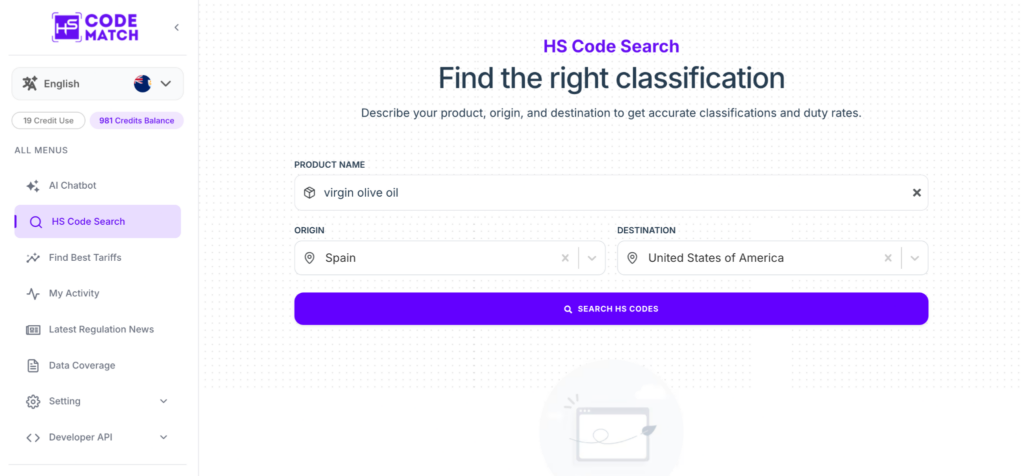
Before searching HS Code Search, you need to log in to the HSCodeMatch app. On the dashboard, you can find the HS Code Search on the right sidebar. Just type the product name, extra virgin olive oil, origin country, and destination country. In this example, just choose export from Spain to the United States.
Step 2: Check the HS code results
You can check the results directly to find the best-match HS code for your olive oil products. Then, click Full Details to find the details of regulations and tariff rates on olive oil products in the United States.

Step 3: Find out the HS code for olive oil in the US
On the HS Code Details, you can find the full description of the HS code for extra virgin olive oil under the code 1509209090 in the US, together with tariff rates and applicable regulations.

Step 4: Ask the AI Chatbot Assistant to find the latest tariffs and regulations
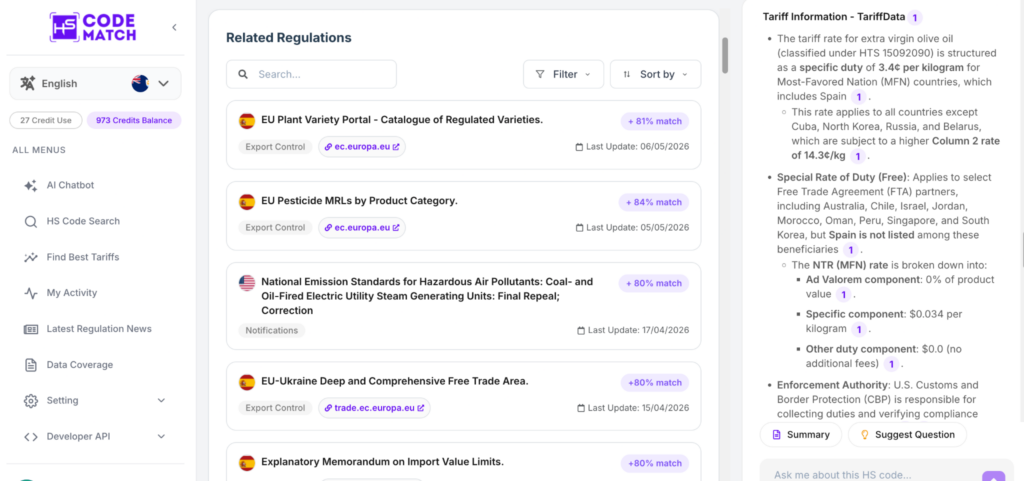
If you find any confusion while searching tariffs and regulations, do not hesitate to ask the AI Chatbot Assistant on the left-hand side of the page.
What is the tariff rate for exporting extra virgin olive oil from Spain to the US?
In order to export extra virgin olive oil under HS code 1509209090 from Spain to the United States is 3.4 cents per kg, and this is covered under the Most Favored Nation (MFN) regime. This applicable tariff rate because Spain and the US have no preferential free trade agreement (FTA). However, Spain may benefit from the AGOA or other trade programs if it is mentioned under that program to be eligible for exporting to the US with a preferential tariff. Check the following table to get a full insight into the tariff rate of extra virgin olive oil from Spain to the United States.
| Regulation | Requirement | Deadline | Authority |
| NTR (MFN) based on duty calculation | 3.4 cents per kg to all non-FTA countries | During importation | US Customs and Border Protection (CBP) |
| Special Duty Rate under FTA | Free for all countries that have an FTA with the US | During importation | International Trade Commission |
| Column 2 Rate of Duty | 14.3 cents per kg for olive oil imports from Cuba, North Korea, Russia, Belarus | During importation | CBP |
What are the grade standards for importing extra virgin olive oil from Spain into the US?
To import extra virgin olive oil (EVOO) from Spain in the US, there are requirements of standardised grade classifications, standard of identity, as well as tariff requirements. All importers must meet the US food safety standards and trade laws, including specific chemical and sensory criteria for grade and tariff obligations. The following table shows a summary of requirements of food safety standards and tariff rates for importing EVOO from Spain to the US.
| Regulation | Requirement | Threshold | Authority |
| US Standard for Grades of Olive Oil and Olive – Pomace Oil | 3.4 cents per kg to all non-FTA countries | Free acidity more than or equal to 0.8% | USDA or AMS |
| Standard of Olive Oil and Olive Pomace Oil | Free for all countries that have an FTA with the US | Free acidity more than or equal to 0.8% | FDA |
| Tariff Information | 14.3 cents per kg for olive oil imports from Cuba, North Korea, Russia, Belarus | 3.4 cents per kg under MFN rule | CBP |
| Foreign Supplier Verification Programs (FSVP) | Importers are required to verify foreign suppliers to comply with the US food safety standard | Compliance | FDA |
What is the Agricultural Marketing Service (AMS) for exporting olive oil from Spain to the US?
The Agricultural Marketing Service (AMS) has a prominent role in regulating the export of olive oil from Spain to the US. Through this regulation, the US established a grade standard and ensured the authenticity and food safety requirements of imported olive oil from Spain. In practice, all exporters from Spain must ensure their olive oil products meet the grade, including acidity levels and purity, as well as avoid mislabelling that is potentially rejected by CBP. All exporters and importers need to adhere to the following standard in the table below.
| Regulation | Requirement | Deadline | Authority |
| US Standard for Grades of Olive Oil | Requirement for grade classification of olive oil, including extra virgin olive oil and pomace olive oil. | N/A | USDA |
| Foreign Supplier Verification Programs (FSVP) | All importers need to verify foreign suppliers to comply with the US food safety standards | Ongoing compliance | FDA |
Conclusion
Olive oil is one of the hot commodities in agro-industrial sectors. The demand is relatively consistent, and it is not hard to find the HS code for olive oil if you work in logistics and shipping. Chapter 15 of the WCO document can be your guide, particularly headings 1509 and 1510. Mastering the variants of shelved olive oils can also be your entry point, as understanding the product that you handle is highly important.
Frequently Asked Questions (FAQs): HS Code for Olive Oil
1. What is the main classification of olive oil HS code?
The main element of olive oil classification is its quality division. There are 4 most popular variants of olive oil, which are extra virgin, virgin, regular, and pomace. All four variants are mentioned separately in the WCO document, chapter 15, headings 1509 and 1510.
2. What is the HS code for cold-pressed olive oil?
All virgin olive oils are made with cold-pressed methods, as heat and chemical solvents are not allowed to maintain certain nutritional content (acidity and antioxidants). However, you need to check whether your cold-pressed olive oil is classified as extra virgin olive oil (EVOO), simply virgin olive oil (VOO), or other virgin olive oils. Check the specifications agreed by experts to determine it.
3. What is the national variation of HS code for not certified extra virgin olive oil in the US?
Not certified organic extra virgin olive oil in the US, also known as the HTSUS code, is 1509.20.90.90. This code is derived from the universal HS code for extra virgin olive oil covered under 1509.20.
4. What is the national variation of HS code for certified extra virgin olive oil in the US?
The national HS code for certified extra virgin olive oil is based on the HTSUS code, which is 1509.20.90.30. This HS code is based on the general HS code for extra virgin olive oil that is mentioned under 1509.20.
5. What is the tariff rate for exporting extra virgin olive oil from Spain to the US?
In order to export extra virgin olive oil, there is a tariff of 3.4 cents per kg, and this tariff is based on the MFN regime. Unfortunately, there is no preferential tariff rate for exporting extra virgin olive oil from Spain to the US.
Find and Match the Right HS Code for Your Products.
Try Our App