


 Aug 06,2026
  By Alice
Have you ever wondered how your favorite action figures are made? 3D printer might be the answer. For the past decade, 3D printers have gained popularity. They allow everyone to create custom 3D objects. However, exporting 3D printers is not simple. First, you need to classify the HS code for 3D printers as one of the requirements. In this article, we will explain the HS code for 3D printers, its major trading partners, and how to classify the accurate HS code for 3D printers.
What are 3D printers?
As the name implies, 3D printers are printing machines that enable printing three-dimensional objects. The concept of a 3D printer comes from 3D printing, which is a process of making 3D objects automatically from digital files. In contrast to conventional printers that are used for scanning, copying, and printing paper, 3D printers are made to make prototypes layer by layer.
The ability of a 3D printer to make physical objects makes this machine beneficial for industries that need prototyping, especially in medicine, architectural models, and automotive parts. Materials used to construct prototypes or objects using a 3D printer consist of several materials, including:
- Filament: Filament is similar to wire that is specifically made for 3D printing. This is the most common material because affordable and easy to melt into 3D physical objects. Most of the filament is made from plastics or nylon.
- Resin: This is also a common material for 3D printing and uses UV light to harden to make 3D objects. This material is used widely to make miniature and medical models.
- Powder: The powder nylon has become a material to make the structure of 3D objects using a 3D printer. Powdered nylon can transform into hardened objects by heating or laser.
- Metal: Powdered metal is also commonly used in 3D printing and can be hardened into a more robust 3D object. This material is used in engineering applications that require long-lasting and robust performance prototypes.
List of HS codes for 3D printers and related products
From the explanation above, you know the definition of 3D printing. Then, we will explain the list of HS codes for 3D printing and related products in this section. As we mentioned in the introduction, an HS code is an important part of international trade as an identification number to classify traded products, including 3D printers. Due to its importance, all 3D printer importers and exporters need to understand the classification and correctly classify their products into the accurate HS codes.
It requires thorough research to categorize into the World Customs Organization (WCO) classification and determine the 3D printer HS code. HS codes for 3D printing machines fall under Chapter 84, which regulates machinery and mechanical equipment. To be precise, it falls under Heading 8485. Nevertheless, the identification of 3D printer filament, metal powder, and others is under a different Chapter. The following table will show you the list of HS codes for 3D printers and related products.
| HS code | Description |
| 8485.10 | Machine with additive manufacturing with metal deposit (e.g 3D printer machine with metal deposit) |
| 8485.20 | Machine with additive manufacturing with plastic or rubber deposit. (e.g 3D printer machine with plastic and rubber deposit) |
| 8485.30 | Machine with additive manufacturing with cement, ceramic, glass, and other materials |
| 8485.80 | Machine with additive manufacturing with other materials. |
| 8485.90 | Part of 3D printing machine |
| 8108.90 | Other titanium, including titanium substrate for 3D printing |
| 3916.90 | Monofilament of other plastics, including plastic filament for 3D printing |
As you can see in the table, 3D printers are covered in heading 8485. Before the 2022 HS code revision, the HS code for 3D printers was scattered in various headings, including 8477, 8479, and other headings. Despite this, exporters and importers need to classify further into the national-level HS code in the destination country.
Top major 3D printer trading partners
From the HS code for 3D printers above, we can uncover the trade route between the largest exporters and importers of 3D printers. However, 3D printers are classified under several HS codes, and we can narrow it down to the most used, which is a 3D printer with rubber and plastic deposit (HS: 8485.20). Let’s see the list of the largest 3D printing machine exporting countries below.
| Country | Total Value (million USD) |
| China | 1,470.62 |
| Germany | 143.78 |
| Czech Republic | 114.19 |
| United States of America | 61.2 |
| Netherlands | 47.55 |
Source: International Trade Centre, accessed July 29, 2026
As shown in the data above, China is the largest 3D printing machine exporter with more than 1.4 billion USD. As we can see together, the remaining largest exporting countries predominantly come from developed countries, including Germany, the Czech Republic, the United States, and the Netherlands.
| Country | Total Value (million USD) |
| United States of America | 238.37 |
| Germany | 141.2 |
| Netherlands | 94.85 |
| United Kingdom | 74.12 |
| Belgium | 46.9 |
Source: International Trade Centre, accessed July 29, 2026
On the other hand, as displayed in the table above, the biggest 3D printing machine importing country is the United States with more than 230 million USD in 2025. As we expected, the other largest importing countries come from developed countries across Europe, such as Germany, the Netherlands, the United Kingdom, and Belgium.
How to classify HS code for a 3D printer
Classifying HS codes for products and 3D printers is not an easy thing to do. It is a required and meticulous process to find the most accurate HS code. If not, you will face penalties if the products are not accurately classified into the correct HS code.
In this section, we will give you instructions to classify the HS code for 3D printers quickly and accurately using the HSCodeMatch app. Let’s see how HSCodeMatch can help you to classify the accurate HS code for 3D printers and its regulations below.
Step 1: Determine search criteria on the HSCodeMatch app
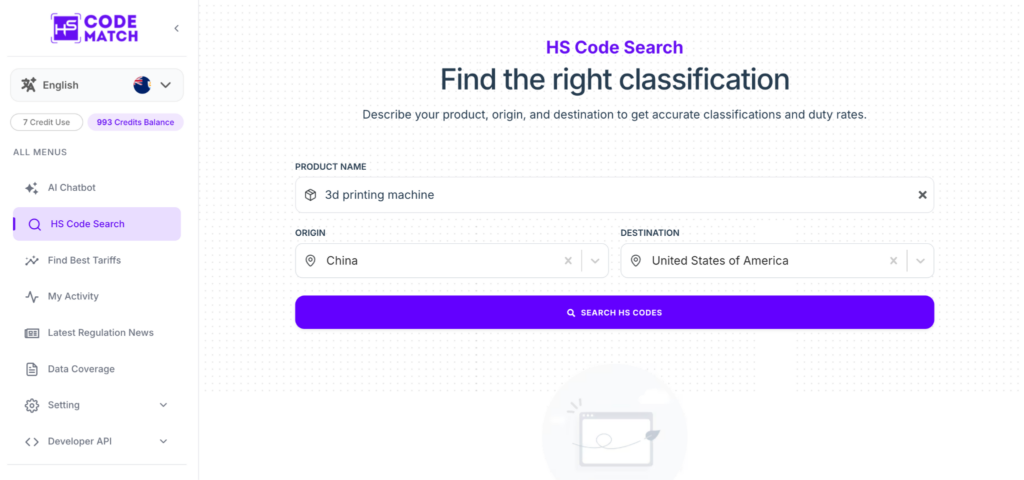
Open your account on app.hscodematch.com and select HS Code Search. For this example, we can use the largest exporter and importer of 3D printers under HS code 8485.20, China and the United States. So, set the product name to “3D printing machine”, origin country to China, and destination country to the United States.
Step 2: Find the most accurate HS code for a 3D printer
Check the most accurate HS code for a 3D printer in the United States. All of the results on the HSCodeMatch app are based on the national variation of HS code or HTSUS. In this section, click the HTSUS code 8485.20.00.00.

Step 3: Check tariff rate and regulation on HS Code Details
Not only to find the HS code, but HSCodeMatch also provides insights about applicable tariff rates and regulations. Click on the HS Code Details to find that information about exporting 3D printers from China into the United States.

Step 4: Ask AI Chatbot to search for relevant tariffs and regulations
If you encounter any confusion in finding relevant tariffs and regulations. Please ask directly on the AI Chatbot Assistant on the right-hand side of the page. This chatbot will give you a clear answer based on the related regulations.
Using the AI Chatbot Assistant is very easy, and it is similar to using a usual chatbot. We will give you three example questions and answers for exporting a 3D printer (8485.20) from China to the United States below.

What is the tariff rate for exporting a 3D printer from China to the United States?
The tariff rate for 3D printers with rubber and plastics deposits from China into the United States is 3.1% ad valorem. China and the US do not have any FTA or trade agreement, which means there is no preferential tariff for exporting 3D printers. However, if the 3D printers are included in List 1-3, then they are supplemented with a 25% Section 301 tariff, making the total duty 28.1%. To ensure the applicable tariff rate, importers must verify whether the products are listed in the USTR tariff schedules.
| Regulation | Requirement | Threshold | Authority |
| Tariff Data | Ad valorem duty for 3D printers | 3.1% under MFN regime | US International Trade Commission |
| HTSUS | Classification based on HTS code for trade compliance | HTS duty calculation | Office of Tariff Affairs and Trade Agreements |
What do you need to do to export 3D printers under HS code 8485200000 from China to the US?
Exporting 3D printers under HS code 8485.20.00.00 from China to the US requires compliance with the classification in the US with a 3.1% duty rate. There is a potential export licensing requirement for sensitive technologies from China and export control if the printers are considered dual-use items. However, there are no nuclear-related restrictions, but all exporters need to classify correctly and ensure compliance with licensing requirements under Chinese and US laws.
What documents are necessary to get a customs clearance for 3D printers from China in the US?
In order to clear customs in the US for 3D printers originating from China, exporters and importers need to prepare a formal entry from CBP. Then, accompany the products with a commercial invoice, packing list, and bill of lading. However, there is no de minimis exclusion for low-value shipments of 3D printers, which means it is still subject to a 3.1% ad valorem duty. In addition, there is no mandatory pre-clearance certification, and it must comply with the voluntary safety standard.
| Regulation | Requirement | Deadline/Threshold | Authority |
| Modernization of Custom Broker Regulations | All imported products enter | Upon arrival | US Customs and Border Protection (CBP) |
| Tariff Data | 3D printers for plastics and rubber deposits incur a 3.1% duty rate | At the time of entry | US Customs and Border Protection (CBP) |
| Suspension of De Minimis Exemption | De minimis for low-value shipments is suspended | Effective since June 24, 2026 | US Customs and Border Protection (CBP) |
Conclusion
Unlike the previous classification. HS code for 3D printers is not that difficult to find based on the HS code classification in 2022. This is because all types of 3D printers are covered under Heading 8485 for machines with additive manufacturing. Then, 3D printers can be differentiated based on their additive materials, such as metal powder, plastics or rubbers, cement, resin, and others. However, filaments or spools and other materials for 3D printers fall under different chapters than the machine that cover specifically the materials themselves.
FAQs about HS Code for 3D Printer
1. What is the HS code for a 3D printer with rubber and plastic additive in the United States?
HS code for a 3D printer with rubber and plastic additive materials in the US follows the HTSUS code, which falls under 8485.20.00.00. This code is derived from the 6-digit HS code from the WCO, 8485.20.
2. What is the HS code for a 3D printer with metal additive materials in the United States?
HS code for a 3D printer with metal deposition materials in the US must align with the HTSUS code, and it is covered in the code 8485.10.00.00. This code is based on the 6-digit HS code from the WCO, 8485.10.
3. What is the tariff rate for exporting a 3D printer into the United States?
As we explained above, exporting a 3D printer into the United States incurs a tariff rate of 3.1% based on the Most Favored Nation (MFN) regime.
4. What are the main factors to classify the HS code for a 3D printer under the new WCO standard?
The main factors to classify the 6-digit HS code for a 3D printer are the materials additive or deposits. According to the new HS classification, HS codes for 3D printers are covered in the codes 8485.10, 8485.20, and 8485.30. Additionally, parts or equipment of 3D printers are covered in the code 8485.90.
5. What is the HS code for 3D printing filament made from plastics?
Of course not, as we mentioned above, the HS code for filament in 3D printers is classified differently from 3D printing machines. HS code for filament plastics is covered under code 3916.90, that are mentioned for monofilament plastic products.
Find and Match the Right HS Code for Your Products.
Try Our App