


 Sep 15,2026
  By Alice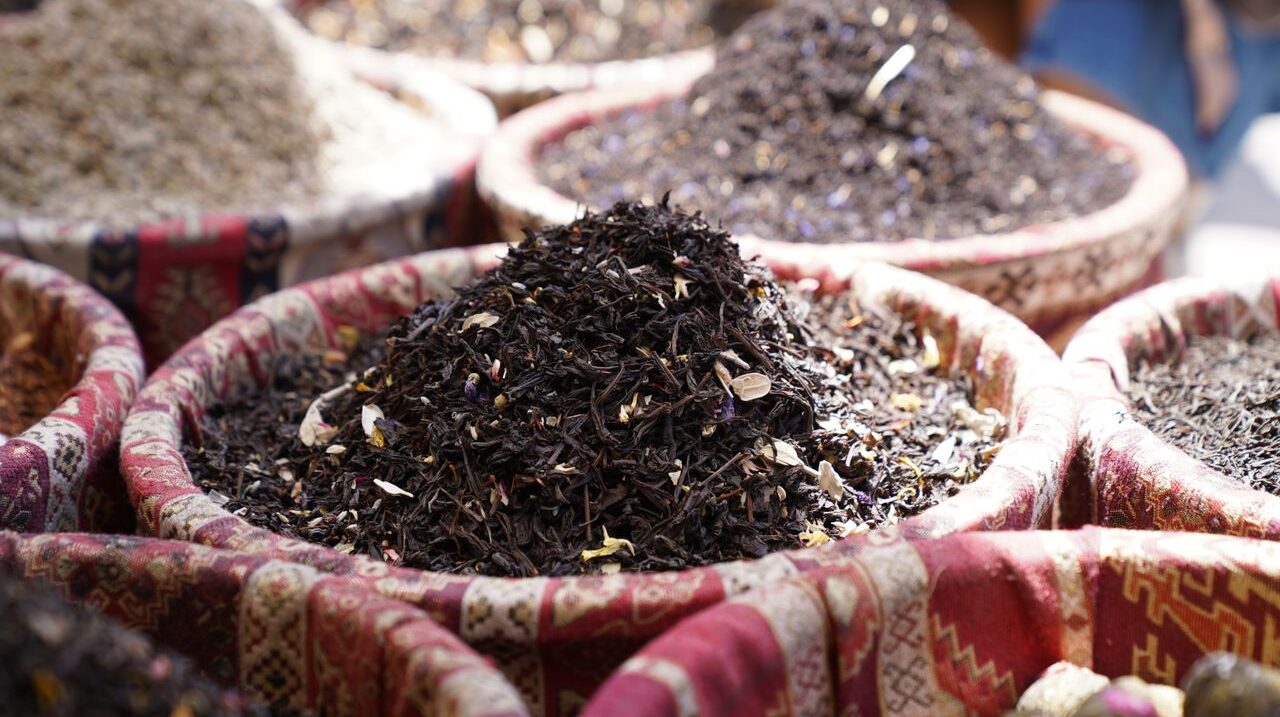
Tea is a non-alcoholic beverage that has existed for centuries. You can serve it as both a cold and hot drink, modify it with milk, creamer, sweetener, or drink it plain. Extracted from plants, tea is high in antioxidants and may boost heart health. The caffeine content is modest compared to coffee, making it safe for those with sensitive stomachs. However, tea has several common types. Scroll ahead to learn how to classify them and determine the accurate HS code for tea.
Varieties of Tea
Similar to coffee, tea has several varieties that have been sold commercially for many years. It is generally extracted from the leaves of the Camellia sinensis plant. These are the most common varieties you can find in the market.
| Tea varieties | Significant features |
| Black tea | Most common tea in the market. It has a high content of caffeine, extracted from tea leaves that have undergone the oxidation process, turning dark after steeping. It tastes stronger and maltier. |
| Earl grey tea | Earl Grey is basically black tea with additional bergamot extract to add flavor |
| Oolong tea | Oolong is commonly categorized as black tea. However, unlike ordinary black tea, it is only partially oxidized and this process creates a rich flavor combining floral and malty taste. |
| Green tea | Green tea is often deemed the healthiest variant of tea. The manufacturers preserve the green color by avoiding oxidation using heat. It has less caffeine, is rich in antioxidants, and generally has a lighter taste and is slightly bitter compared to other variants. |
| Matcha | Matcha is a particular green tea variant that has high content of chlorophyll and amino acids due to its harvesting process. Instead of being planted under direct sunlight, matcha plants are usually covered under shade. This process also creates tea variants with higher caffeine and antioxidants. |
| Herbal tea | Herbal tea is a variety of tea made with specific plant extracts such as chamomile, peppermint, ginger, lavender, etc. Herbal tea generally has a lower caffeine level. |
| Yerba mate | Yerba mate is not ordinary herbal tea. It has higher levels of caffeine and antioxidants and is specifically made from the species Ilex paraguariensis that native to South America. |
| White tea | White tea is a variety of tea with minimal processing. It is extracted from the youngest buds of Camellia sinensis plants. This makes white tea lighter, fruity, and delicate in taste. |
Classifying Tea According to the Harmonized System
According to the Harmonized System (HS) by the World Customs Organization (WCO), tea is regulated within Chapter 9 along with coffee and spices. Check heading 0902, and you will find the specific tea classification below.
| HS code | Products |
| 0902.10 | Green tea, without fermentation, packed as 3 kg or less |
| 0902.20 | Other green tea that is not fermented |
| 0902.30 | Black tea, both fermented and partly fermented, packed as 3 kg or less |
| 0902.40 | Other black tea, fermented or partly fermented |
| 0903.00 | Mate or yerba mate |
| 0910.12 | Herbal tea made of crushed or ground ginger |
However, you can see that those HS codes for tea do not cover herbal tea that is not made of Camellia sinensis leaves, such as chamomile or citrus. Here are additional HS codes for herbal plants.
| HS code | Products |
| 0805.50 | Herbal tea made of dried lemon and limes |
| 0805.90 | Herbal tea made of other dried citrus fruits |
| 2106.90 | Other food preparation not specified elsewhere (can be used to classify herbal tea made of other plants such as chamomile, butterfly pea, mint, lemongrass, etc.) |
| 2101.20 | Extracts, essences and concentrates for tea or mate |
If we should conclude, as long as your tea is made from Camellia sinensis and Ilex paraguariensis (yerba mate), you can use heading 0902. The task will be a little tricky if you are handling herbal tea made from other particular plants such as lime, chamomile, ginger, mint, etc. You need to check for other headings in different chapters that mention your plants, or if there is none mentioned, simply use subheading 210690 that classifies products of other edible plants not yet mentioned in other subheadings. Please also consider subheading 210120 that classifies extracts, concentrates, and essences for tea and mate. This subheading is ideal if you handle a substance prepared for infusion tea, such as jasmine, lemongrass, etc.
Top Global Actors in Tea Trade
Tea trade has lasted for centuries, and Asian countries have been the traditional powerhouse while Europe is the loyal market region. This includes green tea with HS code 090210, which, for the past few years, has gotten a sales boost from social media. Let’s check the trade data from 2024 below.
| Exporting Countries | Trade Value (millions USD) |
| China | 549,039,958 |
| Japan | 140,565,118 |
| Poland | 64,346,375 |
| Germany | 60,259,992 |
| Sri Lanka | 54,242,179 |
Source: UN Comtrade 2024, accessed 28th August 2026
Despite often being identified as a Japanese delicacy, China and Sri Lanka are actually massive production hubs of green tea and matcha. This is proven by the data above. The interesting part is Poland and Germany, which are by no means ideal locations to grow green tea. However, they handle further processing and packaging steps.
| Importing Countries | Trade Value (millions USD) |
| United States of America | 118,691,322 |
| France | 63,376,683 |
| Netherland | 44,740,181 |
| Canada | 38,465,811 |
| Spain | 22,255,071 |
Source: UN Comtrade 2024, accessed 28th August 2026
How to classify the accurate HS Code for Tea
After comprehending the largest exporting and importing countries, it’s time to learn how to classify the HS code for tea. Classifying the HS code for green tea is not simple; even when we know the 6-digit HS code, we should know the extension code that is administered by the destination country. On the other hand, the declaration of the HS code is crucial to ensure that the green tea products can be exported seamlessly.
In this section, we will help you to classify the HS code for green tea quickly using HSCodeMatch. For this step, we will use the trade route between one of the largest exporters and an important destination, such as from Japan to the United States.
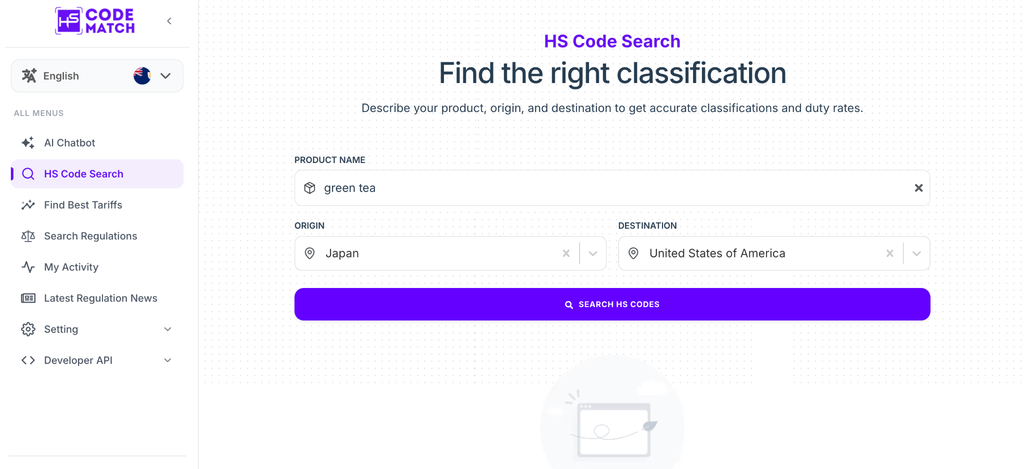
Step 1: Set the green tea search criteria on HSCodeMatch
Go to app.hscodematch.com and set the search criteria: product name “green tea”, origin country Japan, and destination country United States.
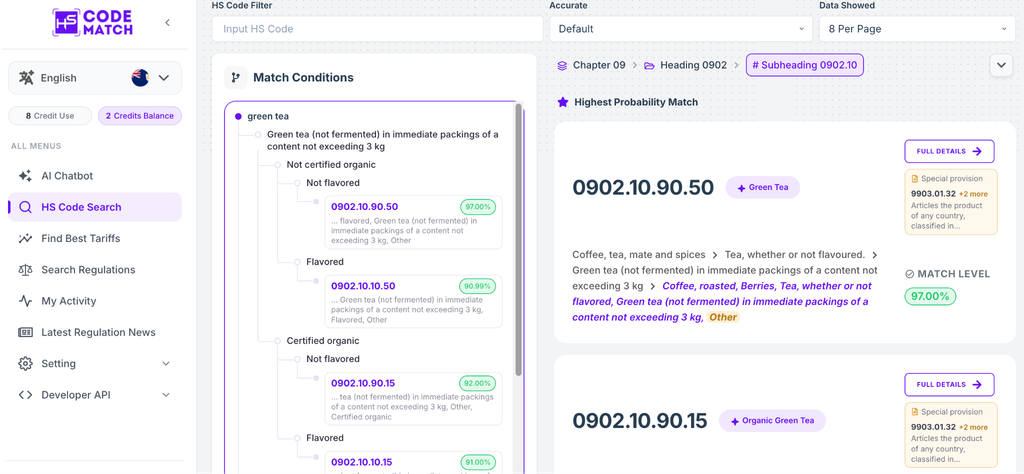
Step 2: Find the most accurate HS code for green tea
If you have submitted the criteria, then just find the best-match HS code for green tea. For instance, we can choose the HS code for green tea under 0902.10.90.50 and click Full Details.
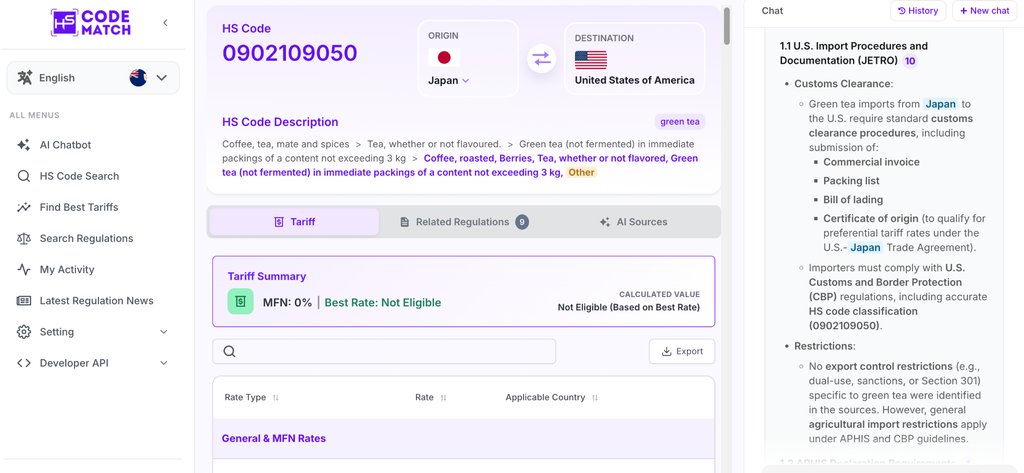
Step 3: Check the applicable tariffs and regulations
On this page, you can find the applicable tariffs and regulations for green tea under HS code 0902.10.90.50 in the US.
Step 4: Ask AI Chatbot Assistant to find tariffs and regulations
We know that finding regulations and tariffs are not simple. Then, you can use AI Chatbot Assistant to uncover the procedures and other regulations to export green tea from Japan to the US.
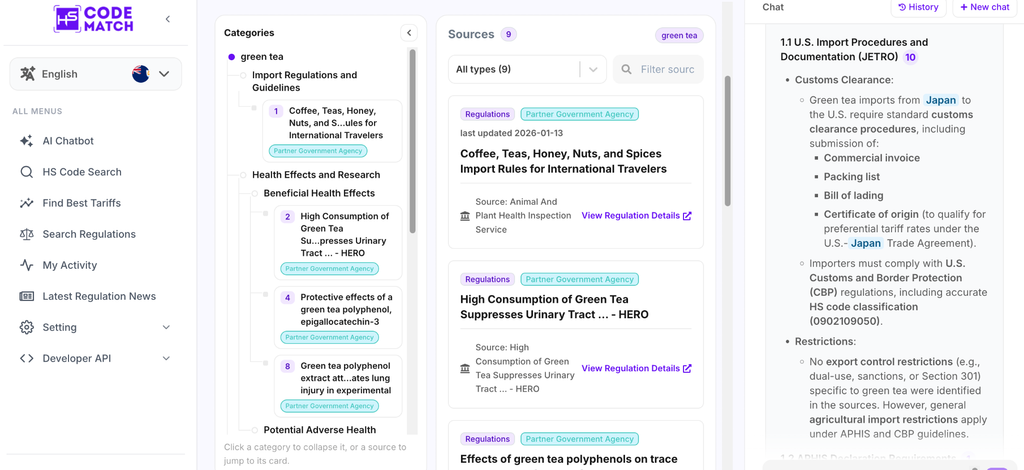
To give you clarity about HSCodeMatch Chatbot, we will give you three examples of questions and answers from AI Chatbot Assistant about exporting green tea from Japan to the US.
What is the tariff rate for exporting green tea and matcha from Japan to the US?
The tariff rate for exporting green tea from Japan to the US follows the Most Favored Nation (MFN) regime of 0%. This is because there is no preferential tariff rate between Japan and the US. Here is a summary of the tariff rate for exporting green tea from Japan to the US.
| Tariff Type | Rate | Applicable Country | Legal Basis |
| Customs Duty | 0% | All countries, including the United States. Exceptions for countries such as Cuba, North Korea, Russia, and Belarus. | Non-preferential rule |
| Preferential Duty | 0% | United States and other countries that have an FTA agreement with the US, such as Singapore, South Korea, Colombia, Mexico, Canada, and others. | US and Japan do not have a Free Trade Agreement |
What are the import procedures to export green tea from Japan to the US?
For exporting green tea from Japan to the US, there are procedures you need to comply with. However, exporting these food products from Japan to the US requires standard customs procedures, such as:
- Commercial Invoice
- Packing List
- Bill of Lading
- Certificate of Origin
On the other hand, there are two other procedures that are required by the US Customs and Border Protection (CBP), including APHIS Declaration and Record Keeping for Manufacturing.
What are the certification requirements for exporting green tea from Japan to the US?
The certification requirements for exporting green tea from Japan to the US required some certification as follows:
- JAS (Japanese Agricultural Standards): This certification ensures the quality and traceability according to Japanese agricultural standards, including green tea and matcha.
- FDA Prior Notice: This certificate is required for all food imports, such as green tea. This is crucial to ensure compliance with US food safety laws.
Conclusion
Tea is relatively easy to classify according to the Harmonized System by WCO. There is a specific heading that regulates it. However, you need to take more attention when handling particular varieties of tea such as white tea, matcha, oolong, and herbal tea. For these variants, you need to check whether the plant extracts contained in your tea are mentioned directly in other chapters as dried fruit. In the case of white tea, matcha, and oolong, they are generally still categorized as either green or black tea depending on the process they have gone through. Therefore, understanding how your product is made is necessary during this classification process.
Frequently Asked Questions (FAQs): HS Code for Tea
1. What is the HS code for white tea and oolong tea?
White tea is commonly categorized as part of green tea, as it does not undergo oxidation. Meanwhile, oolong is a semi-oxidized tea, which means it is often classified as black tea.
2. Is matcha the healthiest variety of tea?
Matcha is a variety of tea with the highest level of nutrients and antioxidants (catechins), amino acids, and chlorophyll, but to call it the healthiest is still debatable. Matcha has a high content of caffeine, which may be dangerous if it is consumed without a proper portion.
3. What is the national variation HS code for green tea in the US?
The national variation HS code for green tea under 3kg in the US is 0902.10.90.50. This is based on the 6-digit universal code from the World Customs Organization (WCO).
4. What is the HS code for yerba mate according to the WCO?
The HS code for yerba mate is under the same umbrella as tea in Chapter 09. But they are classified under different headings: 0903, and the full 6-digit HS code for yerba mate is 090300.
5. What is the largest importer of green tea and matcha in the world?
The largest importer of green tea under HS code 090210 is the United States. This is followed by France in second position as the second-largest green tea importer in the world.
Find and Match the Right HS Code for Your Products.
Try Our App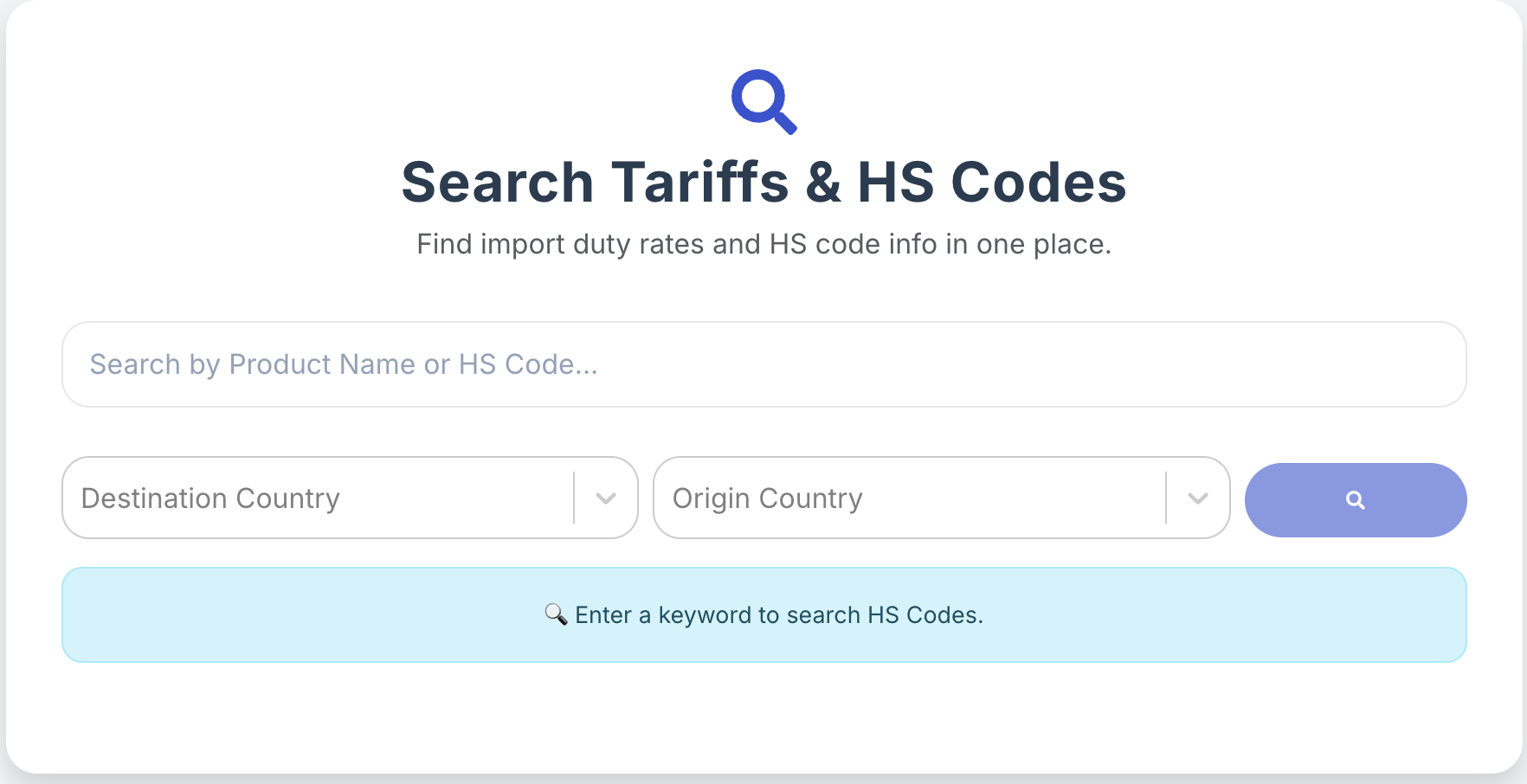

 Sep 17, 2026

