

 Sep 08,2026
  By Alice
If you work in a logistics or shipping company, it is more likely that you will handle documents. Whether it is legal documents or diploma certificates, official papers are common to be shipped internationally. What is the HS code for documents, and how to determine the ones that fit your package? Scroll ahead to read our guide.
What is considered a document?
A document is a record of information that can be used as proof or evidence. Way before digital form was introduced, humans stored data on paper using ink. Some special ink and paper are used to create more durable documents, mostly for official papers such as education certificates, licenses, cheque forms, medical records, and other legal documents. There is also a tradition of adding watermarks or specialized stamps as proof of genuineness, as well as an effort to reduce forgeries.
As humans mobilize and migrate over time, so do the documents. At some point in your life, you might need to ship documents, for example, to send college applications abroad, earn international licenses, or expand your business. That is why knowing the HS code for documents can be a handy skill you did not know you needed.
HS code for document
As most of the document is paper-based, you can check Chapters 48 and 49 of the World Customs Organization (WCO) Harmonized System nomenclature. In general, the HS code for most of the document falls under headings 490700 and 491199. To get to know how to classify them in detail, check the table below.
| HS code | Products |
| 490700 | Banknotes, cheques, share or bond certificates, postage stamps, revenue stamps |
| 491199 | Other printed matter that is not pictures or photographs. This may include diploma certificates, award certificates, licenses, |
However, if you are working in paper manufacturing sectors and intend to ship certificate papers internationally, try these HS codes instead. Depending on the paper you use to print a certificate or official papers, these are the most common variants.
| HS code | Products |
| 481013 | Coated paper used for writing, printing, and graphic purposes in rolls |
| 481014 | Coated paper for writing and printing in sheets (with maximum size 435 x 297 mm) |
| 480591 | Uncoated paper 150 g/m2 or thinner |
| 480592 | Uncoated paper >150 g/m2, but < 225 g/m2 |
| 480593 | Uncoated paper 225 g/m2 or thicker |
Do not forget to also include the protective covers that are often attached to the document. They are usually made of either plastic or synthetic/genuine leather. This should be included in your shipping label. Here are additional HS codes you might need to consider.
| HS code | Products |
| 420500 | Other leather or composition of leather not yet mentioned in other headings. This may include protective covers for books or documents. |
| 420292 | Similar products as trunks, briefcases, bags, with plastic or textile sheets as the outer surface. |
| 420299 | Other similar products such as trunks, briefcases, cases, traveling bags covered with leather or a composition of leather |
| 392610 | Plastics for office and school supplies |
The main point is that documents are quite simple to classify in WCO’s ruling system. They either fall under HS code 490700 or 491199. However, you might need to add more if protective covers are included in the shipping process.
Top actors in global document handling
Is it true that document handling is promising as a business? Let’s check the global overview of document shipments below. Using the HS code for documents 491199, we can see who the global actors are in this particular sector.
| Exporting Countries | Trade Value (USD) millions |
| United States of America | 1,008.26 |
| China | 492.08 |
| Netherlands | 464.47 |
| Germany | 374.3 |
| Belgium | 304.51 |
Source: ITC Trade Map 2025, accessed 24th August 2026
| Importing Countries | Trade Value (USD) millions |
| United States of America | 738.02 |
| Germany | 393.47 |
| Singapore | 335.03 |
| France | 311.98 |
| Netherlands | 274.1 |
Source: ITC Trade Map 2025, accessed 24th August 2026
As you can see in the tables above, the main actors of specialized documents regulated under HS code 491199 are very predictable. This classification includes diploma/education certificates, language proficiency proofs, and other administrative documents. As many educational institutes are based in those locations, this trajectory of global document-handling business is not surprising at all.
How to find HS code for documents
Once you know where the largest exporters and importers of documents are, we can give you a tutorial to find an accurate HS code for documents. As we mentioned earlier, the HS code is an integral part of export and import, which means the HS code can’t be neglected for all businesses involved in international trade.
However, we know that finding the HS code and all documentation needed for export and import is complicated, requires a huge effort, and takes a lot of time. Thus, we recommend that you use dedicated tools for export and import, such as HSCodeMatch. Now, we will give you instructions to use HS codes for documents with HSCodeMatch below.
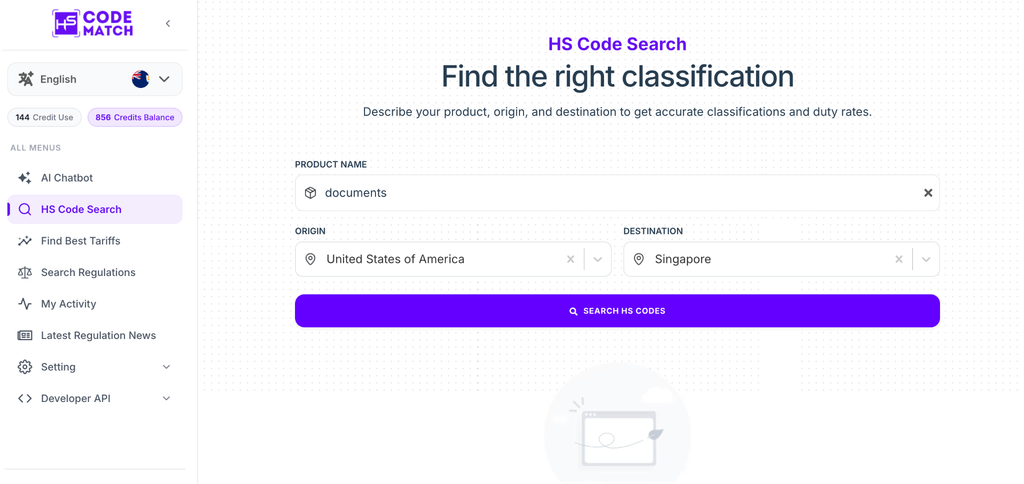
Step 1: Fill in search criteria on HS Code Search
First things first, open your HSCodeMatch account on app.hscodematch.com. Fill out the search criteria on HS Code Search. For this example, we will use the largest exporting and importing countries, such as the United States and Singapore.
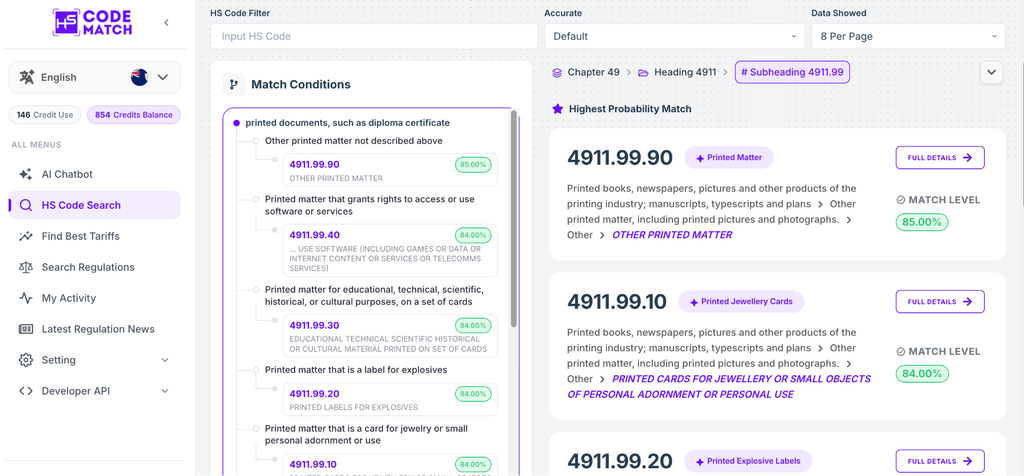
Step 2: Find the most accurate HS code for documents
Once you’ve submitted, you can find the list of HS codes for documents under HS code 41911.99. Then we can choose the highest match level under code 4911.99.90.
Step 3: Check the applicable tariffs and regulations in Singapore
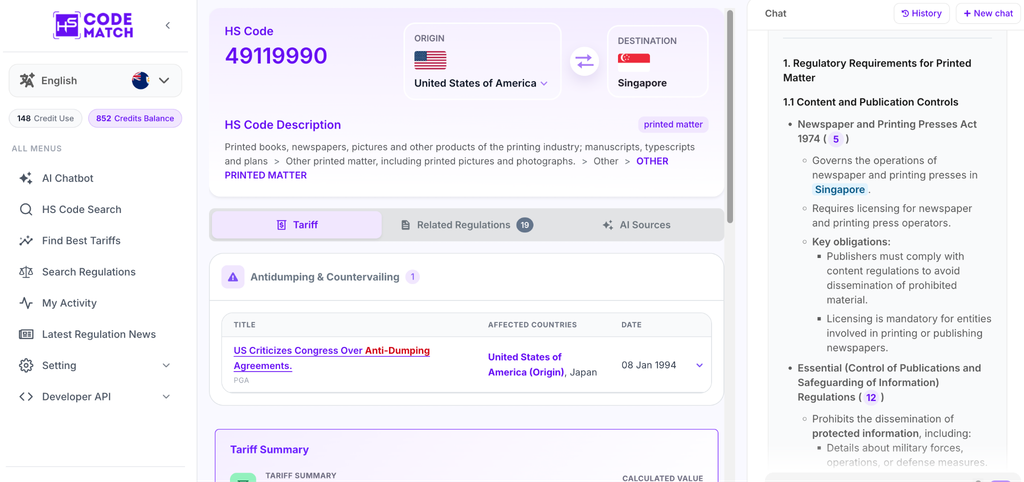
Click Full Details to see the full regulations and tariffs to export printed documents from the US to Singapore. Here, you can see all of the applicable regulations for products under HS code 4911.99.90.
Step 4: Ask AI Chatbot Assistant for export procedure in Singapore
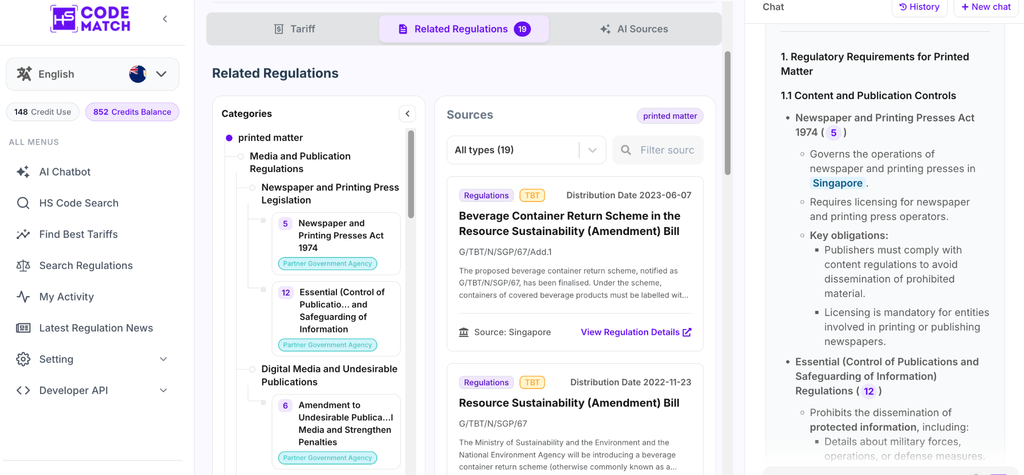
If you encounter any confusion in finding the relevant tariffs and regulations, just ask the AI Chatbot Assistant. This feature will help you to find export procedures and other relevant export and import regulations in Singapore.
Are there any additional tariff rates for exporting documents from the US to Singapore?
No, there are no additional tariffs, surcharges, or other costs to export documents or other printer matters under HS code 49119990 from the US to Singapore. Here is the list of summarization of tariff rates from the US to Singapore.
| Tariff Type | Rate | Applicable Country | Legal Basis |
| Customs Duty | 0% | All countries, including the United States. Exceptions for countries such as Cuba, North Korea, Russia, and Belarus. | Non-preferential rule from Singapore |
| Excise Duty | 0% | All countries, including the United States. Exceptions for countries such as Cuba, North Korea, Russia, and Belarus. | Non-preferential rule from Singapore |
| Preferential Duty (USSFTA) | 0% | United States | US – Singapore Free Trade Agreement |
Are there any restrictions on export documents under HS code 49119990 from the US to Singapore?
Even though the tariff rate is 0%, in order to export documents under HS code 49119990 from the US to Singapore, there are some requirements. All of the requirements relate to the regulations for exporting printed materials in Singapore. We have summarized all of the export documentation requirements from the US to Singapore below.
| Requirement | Legal Basis | Details |
| Customs Export Permit | Regulation of Imports and Export Act, Singapore Customs | Compulsory for all exports of printed materials from Singapore |
| Controlled Goods Check | Singapore Customs, HS/CA Product Code Checker | Printed materials are not mentioned under controlled or prohibited products for export |
| Content Restrictions | Newspaper and Printing Presses Act 1974, Undesirable Publications Act, Essential Regulations | Prohibition for disseminating obscene, seditious or protected information, such as military, defense, or other sensitive information. |
| Licensing for Publishing | Infocomm Media Development Authority (IMDA) | Permits for publishing and distributing magazines or other periodical media in Singapore |
| Prohibited Goods | Singapore Customs | Printer matters are not mentioned under prohibited products for export |
What is the list of documentation to export documents under HS code 49119990 from the US to Singapore?
In order to export documents from the US to Singapore, documentation needs to be prepared. We have summarized the required documents in the following table.
| Document | Purpose | Issuing Authority |
| Commercial Invoice | Detailed information about the transaction between exporter and importer | Exporter in the US |
| Packing List | Displays the content, weight, and dimensions of the products | Exporter in the US |
| Bill of Lading | Evidence of the whole shipment and contract of shipment | Shipping service or air cargo service |
| Customs Export Permit | Infocomm Media Development Authority (IMDA) | Singapore Customs (via TradeNet) |
| Certificate of Origin (USSFTA) | Need to claim preferential tariff rate under US-Singapore FTA | US Chamber of Commerce or authorized body |
| Publishing Permit | Required publishing and distributing magazine and periodical media in Singapore | Infocomm Media Development Authority |
| Content Compliance Declaration | Declaration that printed matters do not contain sensitive information. | Exporter in the US |
Other than those documents, there may be a phytosanitary certificate needed or a fumigation certificate if the documents are shipped under wood-based packaging materials.
Conclusion
Classifying documents to be shipped across borders is not that complicated. Depending on the type of your document, it either falls under HS code for document 490700 or 491199. There can be further considerations if you intend to ship them as blank paper or with protective covers. Hence, you might need to check other chapters such as chapter 48 (for blank papers, coated or uncoated), 42 (for leather), and 39 (for plastic).
Frequently Asked Questions (FAQ) on HS codes for documents
1. What is the main difference between HS code for documents 490700 and 491199?
It could be a little tricky at first, but if you look closely, HS code 490700 targets commercial documents such as banknotes, cheques, and bond certificates. Commercial licenses for software, known as Certificates of Authenticity (COA), also fall under this classification. On the other hand, HS code 491199
2. What is the applicable tariff to export documents from the US to Singapore?
Fortunately, there is no tariff for exporting documents from the US to Singapore. So, if an individual or business needs to export documents and other printed materials to Singapore, they are not obliged to pay any duty.
3. What is the national standard HS code for documents in Singapore?
The national standard HS code for documents in Singapore is 4911.99.90. This includes printed matter, such as printed books, newspapers, pictures, and other products of the printing industry.
4. Do you need an HS code to send non-commercial documents?
Not mandatory, but the postal service can add an HS code. This is because printed materials have no commercial value. However, if the document has commercial value, then it must be mentioned in the applicable HS code.
5. Is it still relevant to send the printed documents?
Yes, it is, because we cannot rely only on digital cloud storage. Sometimes, we should use printed documents, particularly for more important documents, as an archive for safety reasons, rather than the digital counterparts.
Find and Match the Right HS Code for Your Products.
Try Our App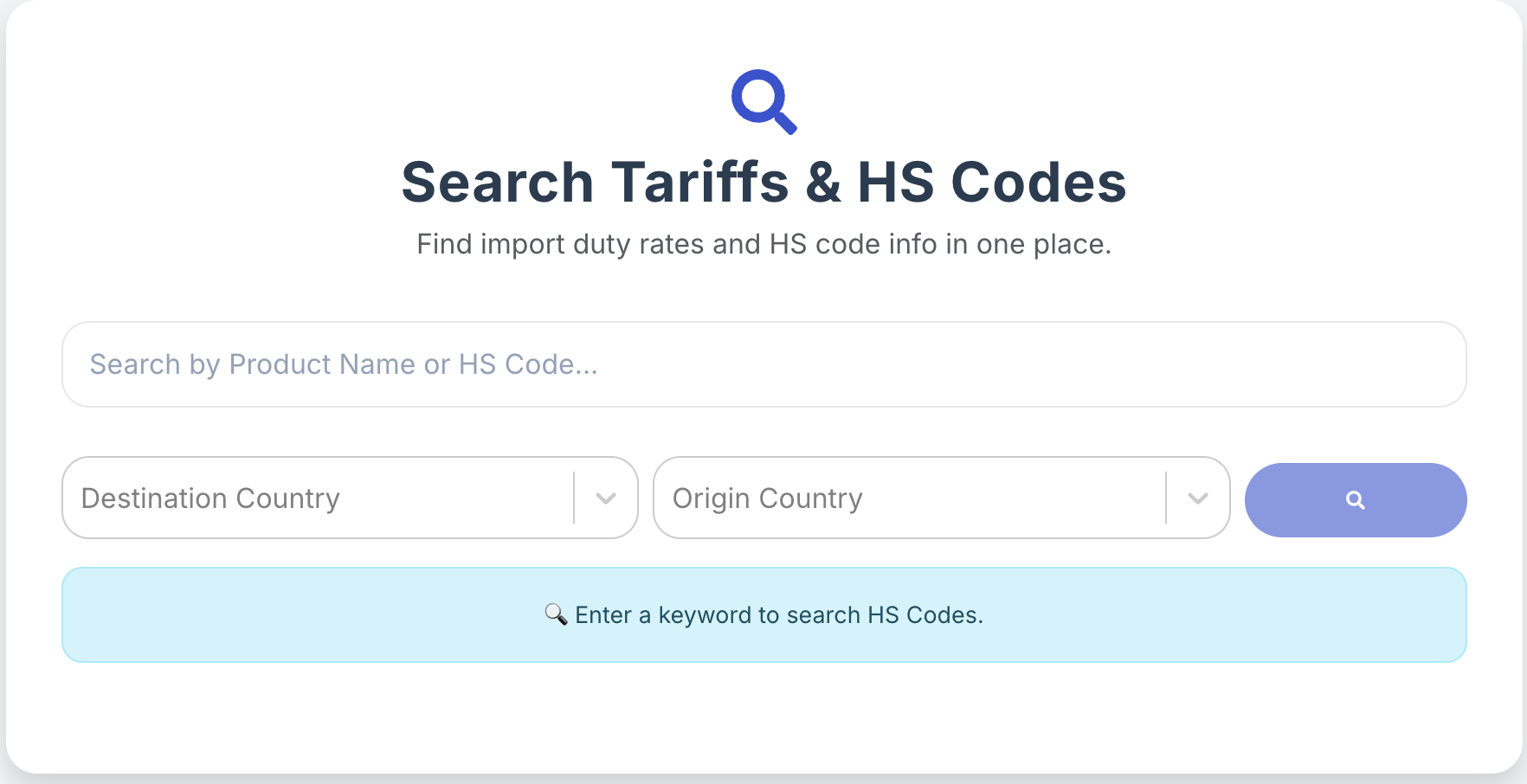

 Sep 10, 2026