


 Aug 13,2026
  By Alice
Some of us may have never heard of ICD 10. Yup, ICD 10 is unfamiliar to regular people who are not involved directly in the medical field. Despite that, ICD-10 is useful for all medical practitioners to identify diseases. However, medical doctors need help from medical equipment to diagnose and treat patients’ diseases. If you want to know about ICD 10 and medical equipment, then you have come to the right place. On this page, we will discuss HS codes for ICD 10 devices, their export and import, the medical supply chain, along with how to classify HS codes for ICD 10 medical equipment.
What are ICD 10 codes? What is the correlation with the medical supply chain?
ICD 10 codes are an abbreviation of the International Classification of Diseases, 10th Revision, which was published and administered by the World Health Organization (WHO). This is a universal code system used specifically to identify diseases and medical conditions, also known as morbidity data. Thus, understanding the classification of ICD-10 codes is crucial for all health professionals to ensure that they diagnose the correct diseases or injuries in patients.
For identifying pneumonia, GERD, reflux disease, urinary infection, or other diseases, medical doctors need to classify them into ICD-10 codes. ICD 10 codes are ultimately important to support the condition of health and cause of death worldwide and make it into the international statistical records. Therefore, no direct impact of ICD 10 codes on the Harmonized System (HS) code for export and import.
What is the role of ICD 10 codes in the supply chain?
Although ICD 10 is not directly related to export and import, this code is an important part of and closely related to the medical supply chain. By understanding the precise ICD 10 codes, hospital management will easily predict and manage their inventory. Here are the main roles of ICD 10 codes in the medical supply chain.
Demand planning
As we mentioned earlier, health facilities and manufacturers use ICD 10 data to predict the medical equipment, drugs, and other medical supplies to meet demand. This is important to predict and plan the demand for some medical equipment to eliminate the risk of supply disruption.
Medical procurement reimbursement
In many cases, health facilities use ICD 10 as valid evidence to reimburse medical equipment, drugs, and medical supplies. The reimbursement system is shaped by how the medical facilities develop their own management to restock their equipment and supplies.
Simplify preconditions for medical equipment imports
Transferring medical equipment and supplies across borders requires some restrictions. By understanding the ICD 10 code diagnosis, there is a justification to help minimize customs checks and preconditions or complex documentation to enter the country.
Impact on classification of HS code
By identifying the accurate ICD 10 code, it can help to align with the importation of medical equipment needed by hospitals to treat their patients. Then, they can classify the list of products into the accurate HS codes for medical equipment and calculate applicable tariffs.
List of HS codes for ICD 10 medical equipment for diagnosing disease
Once we know the correlation between ICD 10 codes and the export/import of medical equipment, then we can move on to understanding the list of common HS codes for medical equipment in hospitals. Medical devices are necessary for helping all patients, whether they are treated in hospitals or they are just treated at home.
According to the World Customs Organization (WCO), HS codes for medical equipment fall under different chapters. However, most of the medical equipment used for monitoring and diagnostic disease are covered under Chapter 90. This is because Chapter 90 focuses on optical, photography, medical, and surgical equipment. Here is the list of HS codes for diagnostic devices.
| HS code | Description | Device |
| 9018.11 | Electrocardiograph equipment | Electrocardiograph (ECG) machine |
| 9018.12 | Ultrasonic scanning equipment | Cardiovascular ultrasound system, General imaging ultrasound system, and others |
| 9018.13 | Magnetic Resonance Imaging (MRI) equipment | MRI machine to scan organs within the human body |
| 9018.14 | Scintigraphic equipment | Gamma camera |
| 9018.19 | Other equipment used in medical settings | Blood pressure monitoring devices and others |
| 9018.20 | Ultraviolet and infrared ray equipment | PUVA machine, Vein visualization system machine, and others |
| 9018.31 | Syringe | Regular syringe for medical purposes |
| 9019.20 | Medical equipment for ozone therapy, oxygen therapy, and others | Oxygen concentrator, Ventilator machine, and others |
| 9022.21 | Equipment that uses alpha, beta, gamma, and other ionised radiation | CT scanners, X-ray machines, and others |
| 9027.89 | Other instruments and equipment for physical or chemical analysis | Blood glucose meter, Blood ketone monitoring device, and others |
Medical devices trade partners
Before diving deep into steps to find the HS code for medical equipment for diagnosing diseases according to ICD 10, we need to know where the major trade routes are for one of the medical devices. We have assembled the largest exporting and importing countries of medical equipment in 2025, but we narrowed it to Magnetic Resonance Imaging (MRI) equipment under the code 9018.13 below.
| Country | Total Value (Thousand USD) |
| Germany | 1,852,381 |
| China | 883,831 |
| Netherlands | 837,381 |
| United Kingdom | 536,937 |
| United States of America | 404,589 |
Source: ITC Trade Map 2025, accessed at 5th August 2026
As shown in the table, the largest exporters of other medical equipment, including blood pressure devices, most of them come from developed countries, including Germany, China, the Netherlands, the United Kingdom, and the United States.
| Country | Total Value (Thousand USD) |
| United States of America | 705,920 |
| Germany | 674,234 |
| Netherlands | 468,423 |
| China | 455,906 |
| France | 352,300 |
Source: ITC Trade Map 2025, accessed at 5th August 2026
On the other hand, the three largest importers are the United States, Germany, and the Netherlands. Meanwhile, the 4th and 5th positions were held by China and France.
How to classify HS codes for medical devices to diagnose according to ICD 10
Classifying HS codes for medical devices may be quite tempting because we need to correctly align with the WCO standard. As we mentioned above, medical equipment is mostly mentioned under Chapter 90, but they are different from each other according to the 6-digit classification. There are potential penalties if you misclassify the HS code for medical equipment.
Fortunately, there are many options for simplifying the classification process of HS codes for medical equipment to align with ICD 10 codes. We recommend you use the HSCodeMatch app to classify all products to all countries’ standard HS codes. So, let’s check the step-by-step instructions to classify HS codes for medical equipment below.
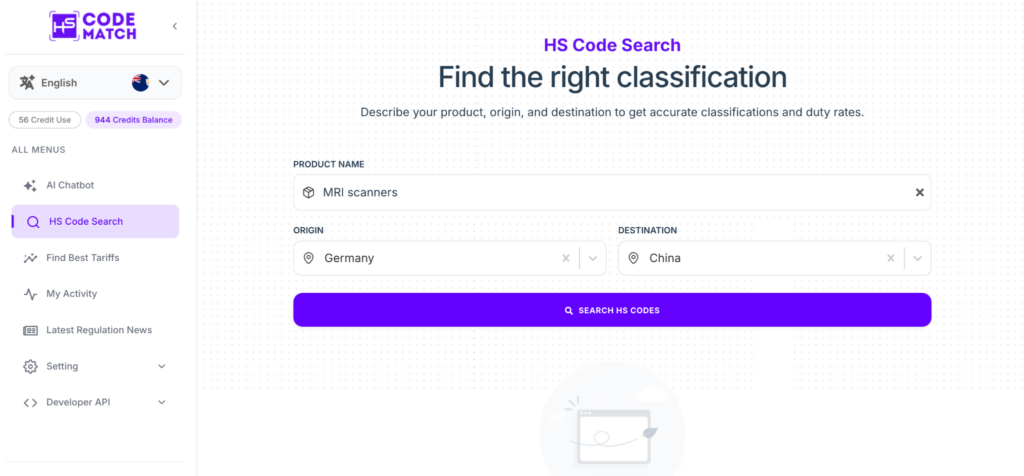
Step 1: Set the search criteria on HS Code Search
First, visit app.hscodematch.com to access the HSCodeMatch app and then find HS Code Search. Just type the search criteria in the black spaces, and for this example, we can use the largest trade partners, including Germany and China.
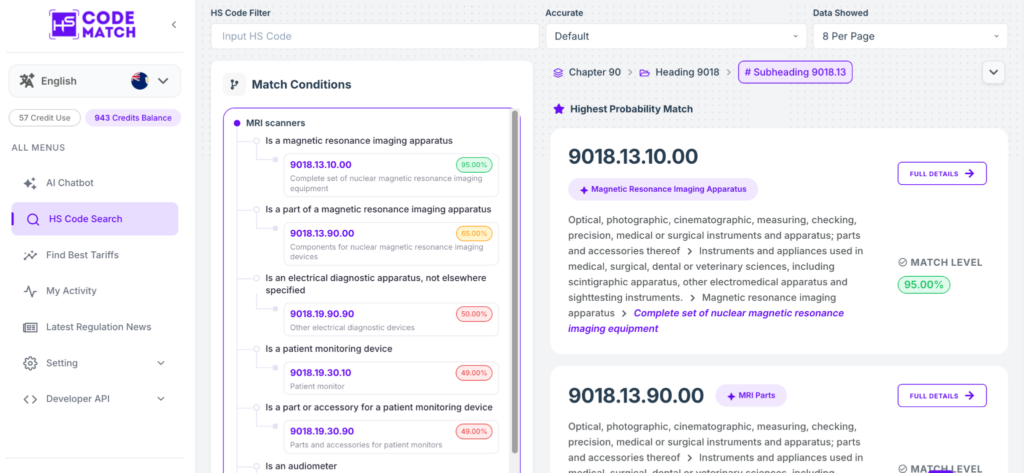
Step 2: Find the most relevant HS code for MRI scanner
If you have submitted the credentials, then just wait until the system shows the most relevant HS code for MRI scanners. Choose the first row as it is considered the highest match code for MRI scanners from Germany to China.
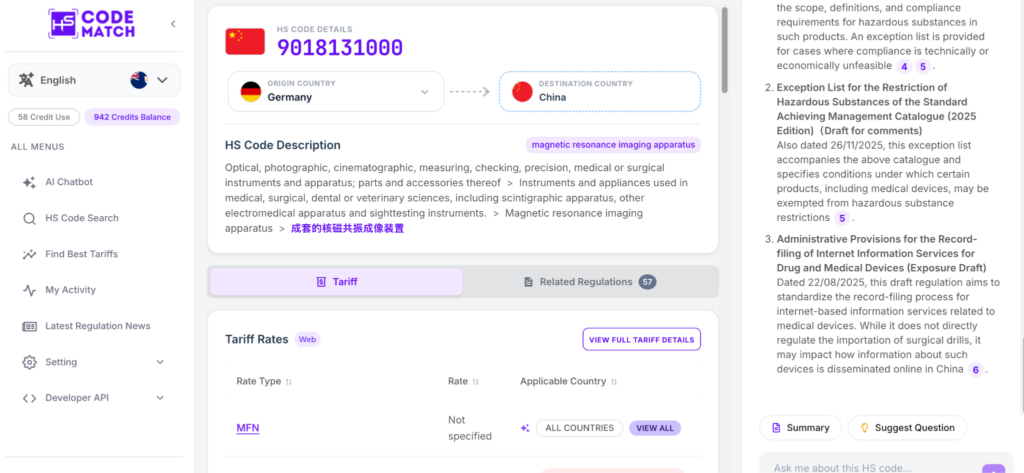
Step 3: Find the relevant regulations and tariff rates in China
Once you click Full Details, you will be redirected to the HS Code Details page to understand more about the regulations and tariff rates on MRI scanners in China.
Step 4: Ask AI Assistant to find regulations and tariffs on MRI scanners
If you find any confusion, do not hesitate to ask the AI Chatbot Assistant directly, as it is created to help you find the relevant regulations.
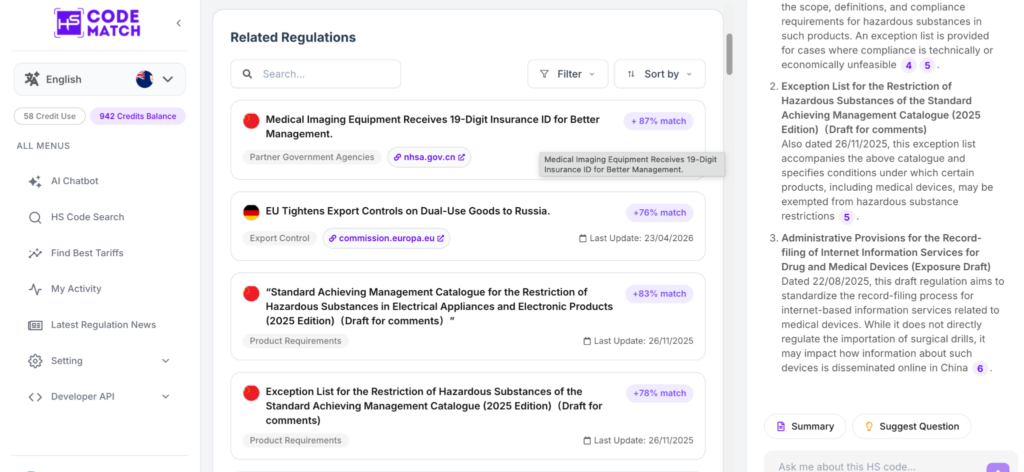
We will give three examples of questions and answers from the AI Chatbot Assistant from HSCodeMatch. Kindly check the answers about exporting MRI scanners from Germany to China below.
What is the tariff rate for exporting MRI scanners from Germany to China?
In order to export MRI scanner machines from Germany to China, there is no import tariff (0%), and this is based on the Most Favored Nation (MFN) rule. Unfortunately, there is a 13% value-added tax (VAT) for the shipment of MRI scanners from abroad to China. There are no other preferential tariff rates for exporting medical equipment from Germany. To be precise, check the list of tariff rates for MRI scanners in China in the table below.
| Regulation | Requirement | Tariff | Agency |
| General Tariff Rate | Applicable to all countries, excluding Cuba, North Korea, Russia, and Belarus | 17% | Ministry of Commerce PRC (MOFCOM) |
| MFN Tariff | Applicable for all WTO member countries and applies to Germany | 0% | MOFCOM |
| Import VAT | 13% VAT for imported goods from abroad, including MRI scanners | 13% | State Administration of Taxation |
| Special Tariff Rates | 0% for least developed countries (LDCs) and this is not applicable for Germany | 0% | MOFCOM |
Are there any specific requirements for exporting MRI scanners from Germany to China?
In order to export MRI scanners from Germany to China, there are multiple layers of regulation to meet. MRI machine manufacturers need to register with the Chinese NMPA and assign local agents. This ensures the MRI scanners adhere to the hazardous substance limits and confirms the medical products are correctly classified based on the Chinese medical catalog. The import process in China is strict, and there is a liability resting on exporters and their local agents to prepare early to meet the requirements and easily engage with local partnerships.
| Regulation | Requirement | Deadline | Agency |
| Provision for Medical Devices | Mandatory approval for filing medical devices before entering the Chinese market | Pre-marketed in China | National Medical Products Administration (NMPA) |
| Supervision and Regulation of Medical Devices | Mandatory to assign Chinese agents to ensure compliance and legal liability | Pre importation | NMPA |
| National Standard of PRC to restrict use of hazardous substances in electrical and electronic products | Set the limitation of hazardous substances within the products. This includes the labeling and conformity assessment. | Pre-marketed in China | State Administration for Market Regulation |
| Catalog on Medical Devices Classification | Determines the risk classification, including MRI scanners and other products | Pre-registration | NMPA |
What documentation is required for customs clearance of MRI scanners in China?
In order to get customs clearance in China, importers need to provide several crucial documents. We have assembled several documents you need to provide to ensure the MRI scanner is able to enter the Chinese market.
1. Medical Device Registration: Need proof of NMPA registration or to complete the MRI scanner import documents, including compliance with the manufacturing and business regulations in China.
2. Hazardous Substance Compliance: Documents need to be verified to adhere to Chinese hazardous substance limitations and conformity assessment.
3. Agent Representation: Assign a Chinese agent for overseas manufacturers to get authorization.
4. Tariff and Tax Document: Need to provide proof of payment of 13% VAT and 0% MFN tariff rate.
5. Prohibition of Secondhand Device: Provide evidence that MRI scanners are not secondhand and are new devices.
Conclusion
From all the explanations above, we can conclude that HS code and ICD 10 code are basically two distinct codes. HS code is established by the WCO to identify traded products, whereas ICD 10 codes are administered by the WHO to identify diseases. Even though the two codes are different, they have a correlation regarding the medical supply chain in hospitals. Therefore, understanding ICD 10 codes for identifying patient diseases can be useful for knowing the stock of hospital inventory. Additionally, ICD 10 codes are very beneficial for knowing the demand for local medical equipment that needs to be imported from other countries.
Frequently Asked Questions (FAQs) about HS code and ICD 10 code
1. What is the difference between HS code and ICD 10 code?
HS code and ICD 10 code are different in terms of functionality. HS code is created to facilitate the export and import of goods across borders that are managed by the WCO. Meanwhile ICD 10 code is established to identify the disease from patients according to the system from the WHO.
2. What is the relation between HS code and ICD 10 code?
HS code and ICD 10 code are different, but the two codes have a relation, especially in terms of the medical supply chain. The identification of ICD-10 codes allows hospitals or local health authorities to identify the necessity to import medical equipment that is mentioned in the HS code.
3. What is the national HS code for MRI scanner machines in China?
The national variation of the HS code for MRI scanners in China is 9019131000. This code comes from the 6-digit general HS code from the WCO, 9019.13.
4. Are there any FTAs with China and European countries?
Yes, China has an FTA with Switzerland and provides a preferential tariff for exporting medical products from and to China and otherwise. However, China does not have an FTA with Germany and other European Union member countries.
5. What is the tariff rate for exporting MRI scanner machines to China?
The tariff rate for exporting MRI scanners from Germany to China is 0% under the Most Favoured Nation (MFN) regime. However, there is a 13% value-added tax on this medical equipment once it enters Chinese territory.
Find and Match the Right HS Code for Your Products.
Try Our App