


 Aug 04,2026
  By Alice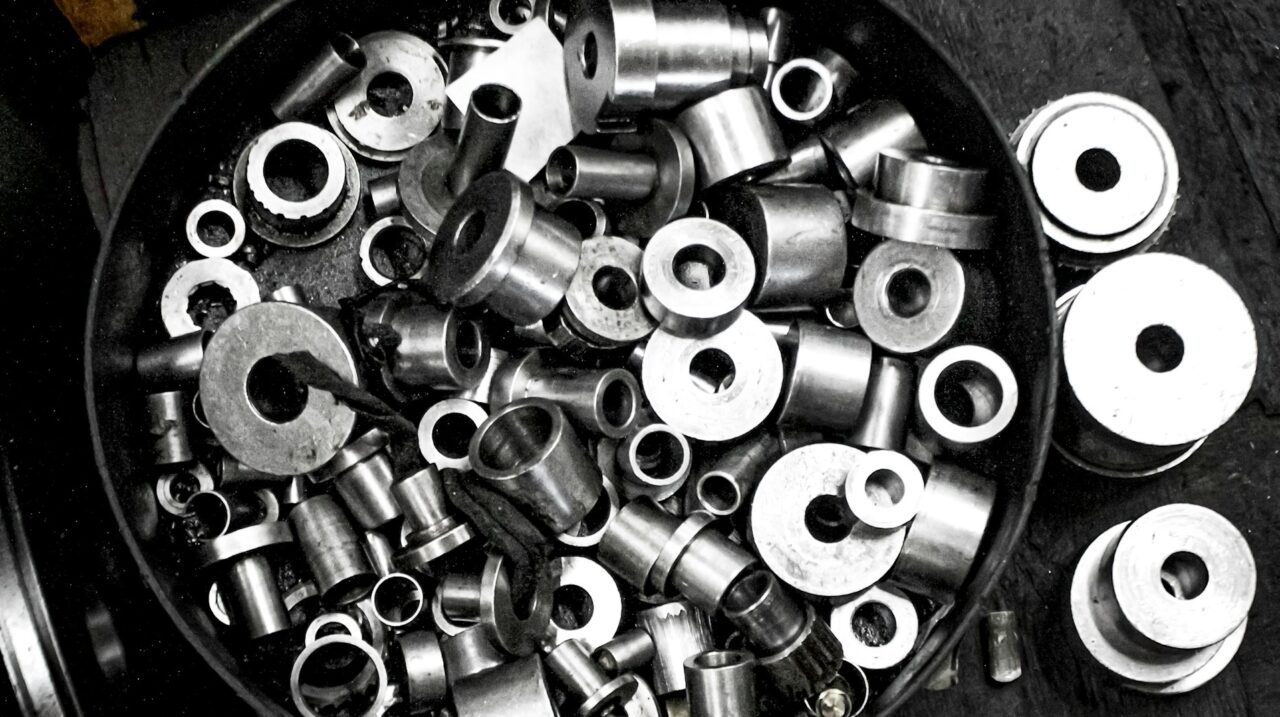
Bushing may not be a well-known product, particularly for someone who does not know about machinery. This product is crucial for the machine industry and has a similar function to a bearing that helps the metal surface rotate appropriately. Bushing is commonly used in the automotive and other manufacturing industries, which makes this product presented as one of the pivotal commodities in the international market. In this article, we will discuss the structure and list of popular HS codes for bushings and their largest international trading players, as well as how to accurately and quickly classify the HS code for bushings.
What is the definition of bushings and why are they important?
Bushings are known as plain bearings and are small cylindrical components in industrial machinery. The main function of bushings is to facilitate the smooth rotation of the two moving parts in the machine. By using bushings, machines or vehicles can operate effectively and make the machine move with less noise and vibration. Unlike bearings that use rollers or balls, bushings work by sliding contact.
A bushing is located inside the shaft and housing or enclosure to protect them from damage in a short time. This is because shafts are generally expensive and bushings are not, so people prefer to buy bushings if they are worn out rather than shafts. Bushings are made from various materials comprising plastics, rubbers, aluminium, bronze, and others. To get to know more about bushings, we will give several common types of bushings below.
| Type of Bushing | Shape and materials |
| Plain bushing | A type of bushing that has a simple cylindrical shape to minimize friction between shaft and enclosure. Plain bushing can be made from various materials, including plastics, nylon, bronze, and others. |
| Flanged bushing | A type of bushing that has a hollow in the middle with a flat rim at the end. It helps the shaft that sits against the housing to avoid the shaft moving too far. A flanged bushing can be made from a wide range of materials, such as metals, plastics, or polymers. |
| Spherical bushing | A bushing type that has a self-adjusting inner and outer with a sliding surface. This bushing is mostly used for automotive suspensions, aircraft control, and other applications. Spherical bushings are commonly made from stainless steel, Teflon, bronze, and others. |
| Thrust bushing | A type of bushing that has a flat and thin design similar to a disc. A thrust bushing is generally applied to automotive gear systems and other automotive parts. It is commonly made from bronze and Teflon. |
| Split bushing | Unlike other types of bushing, split bushing, as its name implies, is designed to split into two or more pieces. It is made to make it easy to install, and it is commonly made from plastics, bronze, brass, and other materials. |
List of HS codes for bushings
In this section, we will explain the HS code for bushings. As you know, the Harmonized System (HS) code is an essential part of international trade to identify imported products. Thus, the accurate declaration of the HS code for bushings or other products is required to streamline the export and import process and get customs clearance faster.
HS code for bushings is not classified in one Chapter in the World Customs Organization (WCO) classification. Instead, they are classified into different Chapters according to their materials and applications. To get to know more, we have assembled six common 6-digit HS codes for bushings in the table below.
| Heading | Description | HS code | Description |
| 3926 | Other articles for plastics or plastics made products | 3926.90 | Other plastics, including plastic bushing and nylon bushing |
| 4016 | Other articles for products made from vulcanized rubber. | 4016.99 | Other rubbers, including rubber bushing |
| 7115 | Other articles for products made from metals and precious metals. | 7115.90 | Other precious metals, including platinum-rhodium alloy “bushing |
| 7326 | Other articles for products made from iron and steel. | 7326.90 | Other iron and steel products including Inner and outer bushing sleeves |
| 7616 | Other articles for products made from aluminium. | 7616.99 | Other articles of aluminium, including Inner and outer bushing sleeves made from aluminium |
| 8708 | Automotive components and accessories for motor vehicles under the code 8701 to 8705. | 8708.99 | Hydraulic bushing as part of an automotive component |
Largest bushing trade partners
After understanding the lists of HS codes for bushings, it’s time to grasp the largest bushing trade partners. By knowing the trade partners, we understand what countries are the largest exporters and importers as well as the route of the bushing supply chain. However, bushings are made from a wide range of materials, and we can choose bushings made from vulcanized rubber under HS code 4016.99.
| Country | Total Value (million USD) |
| Germany | 2,555.95 |
| China | 1,590.83 |
| United States of America | 1,272.99 |
| Poland | 925.93 |
| Italy | 818.72 |
Source: UN Comtrade Database, accessed July 23, 2026
As displayed in the table above, the largest rubber bushing exporter is Germany with a trade value of slightly more than 2.5 billion USD. The remaining major rubber bushing exporters include China, the United States, Poland, and Italy.
| Country | Total Value (million USD) |
| United States of America | 2,064.48 |
| Germany | 1,844.9 |
| Mexico | 835.05 |
| China | 740.72 |
| France | 599.25 |
Source: UN Comtrade Database, accessed July 23, 2026
As shown in the data above, the biggest other rubber products importer is Germany with a trade value of more than 2 billion USD. The other major rubber products importers in 2025 are the United States, Thailand, France, and Mexico.
How to classify HS code for bushing
Now, we will teach you how to classify HS code for bushings. As we mentioned above, classifying HS code for bushings is complicated and needs a meticulous process because there is no specific chapter covering these products. Instead, these products fall under various chapters based on the materials and application of the bushing.
To solve the difficulty of classifying bushings, we recommend using HSCodeMatch to find the HS code for bushings. With this app, you just need to be specific in mentioning the products to find the most accurate HS code for bushings. Check the step-by-step instructions to classify the HS code for bushings made from rubber with HSCodeMatch below.
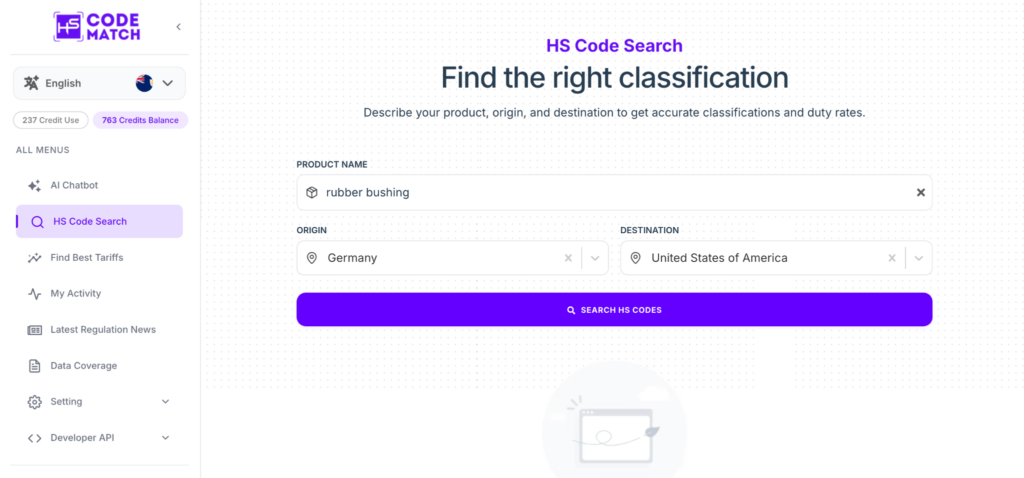
Step 1: Determine the product name, destination, and origin countries
Open app.hscodematch.com and select HS Code Search to uncover the HS code for bushings. Determine the product name, steel bushing, and we can use the largest importer, Germany, and the largest exporters, China, as examples.
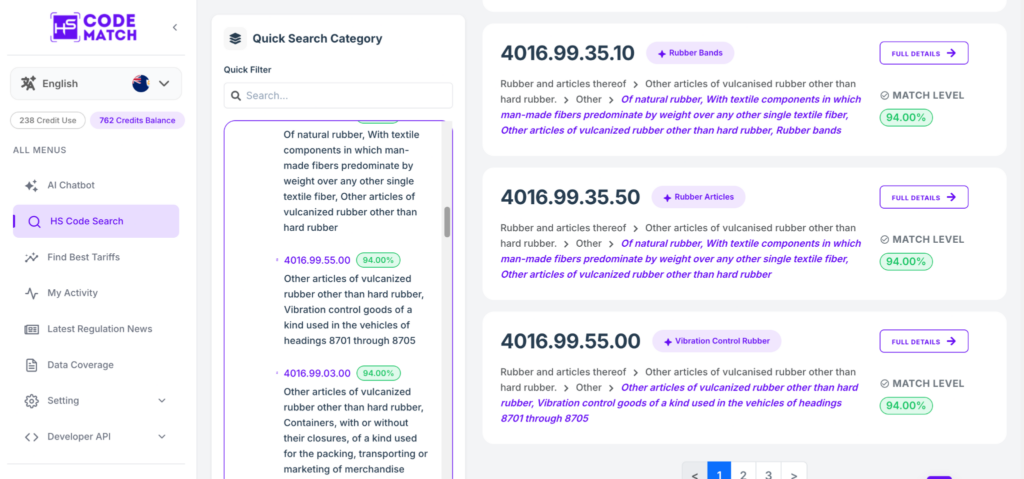
Step 2: Choose the most relevant HS code for steel bushing
Choose the most accurate HS code for steel bushing. If you need to find a product under the chapter, you can find it in the Quick Search Category on the left-hand side of the page. In this example, we will choose the HS code for rubber bushing that specifically controls vibration under 4016.99.55.00.
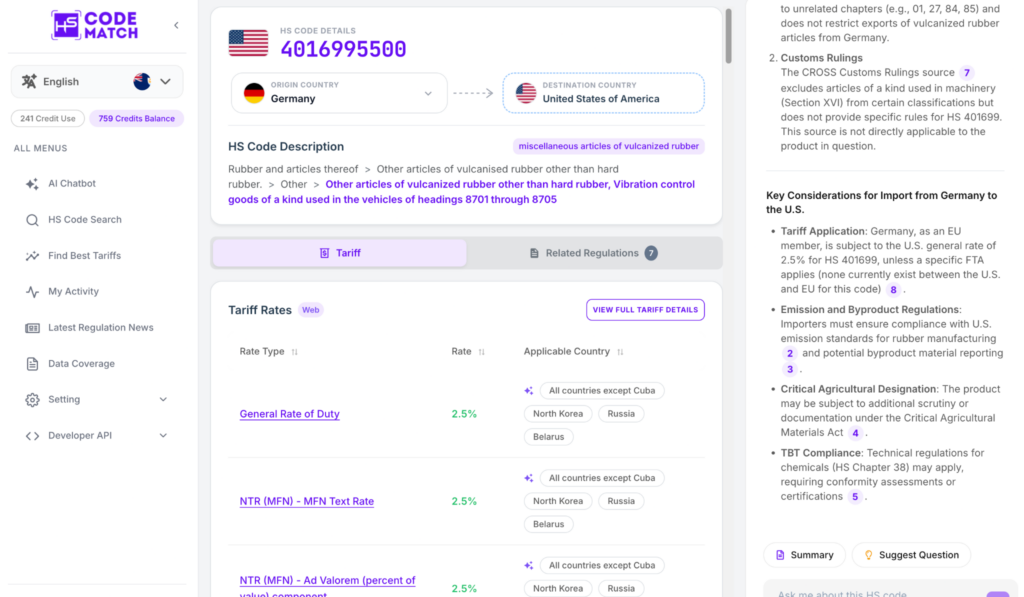
Step 3: Find more on tariff and regulation for bushing in Germany
Once you click Full Details, you will find the complete information about tariff rates and product regulations on the HS Code Details page. You can check the description of the HS code for the product to check whether it matches or not.
Step 4: Request AI Chatbot for tariff and regulations
If you are confused about finding tariffs and regulations for bushing under the HS code 4016.99.55.00, you can ask the AI Chatbot Assistant on the right-hand side of the HS Code Details page.
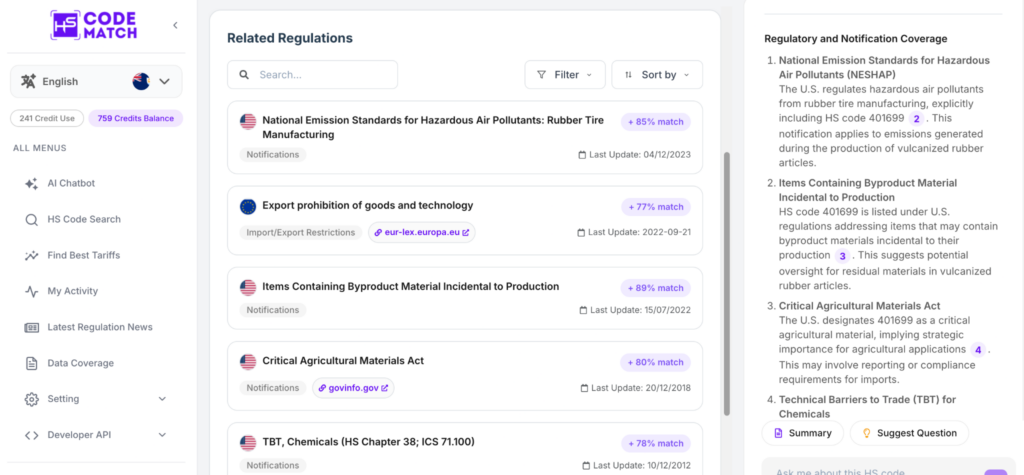
In this section, we will give three inquiry examples from the AI Chatbot about the exportation of rubber bushings from Germany to the United States below.
What is the applicable tariff rate for exporting rubber bushings from Germany to the United States?
To export rubber bushings from Germany to the US, the applicable duty rate is based on the Most Favored Nation (MFN) regime because there is no Free Trade Agreement between the two countries. The tariff rate for exporting rubber bushings to the US is 2.5% ad valorem, and it depends on the declared value of the goods. In addition, importers also need to classify correctly in order to comply with the customs authority in the US. Here is the list of tariff information in the United States.
| Regulation | Requirement | Deadline | Authority |
| Tariff information | 2.5% ad valorem duty for rubber bushing used to control vibration from Germany | At the import | US Customs and Border Protection (CBP) |
| Tariff information | Free tariff rate for countries under the FTA with the US | N/A | US Customs and Border Protection (CBP) |
| Tariff information | The calculation of the duty rate 2.5% based on the shipment value. | During importation | US Customs and Border Protection (CBP) |
Are there any environmental restrictions or safety certifications on exporting rubber bushing under HS code 4016995500 from Germany to the US?
Yes, the US regulatory landscape focuses on emission control and finished products certifications. Those regulations apply to rubber components, especially products used for vehicles. All rubber bushing imports must comply with the EPA hazardous air pollutant (HAP) emission standard during production. Compliance focuses on how the products are manufactured rather than the product, and importers must follow the trade regulations in the US. The following table is the requirement for exporting rubber bushings in the US.
| Regulation | Requirement | Deadline | Authority |
| National Emission Standards for Hazardous Air Pollutants, including Rubber Tire Manufacturing | Limitation of HAP emissions for rubber-made products under HS code 401699 | Major sources of more than 10 tons per year single HAP or more than 25 tons per year combined HAP | EPA |
| Tariff Information | Rubber bushings for vibration control are subject to a 2.5% general duty rate | All imports | CBP |
| Tariff Information | Only countries with an FTA are qualified for tariff reduction. | Ongoing | CBP |
What documentation is required by U.S. Customs for rubber bushing imports under HS 4016995500?
The required documentation for exporting rubber bushings in the US is only standard entry procedures, including duty classification and compliance with environmental compliance under the EPA’s National Emission Standard for Hazardous Air Pollutants (NESHAP). The following table depicts the list of required documentation for exporting rubber bushings to the US.
| Regulation | Requirement | Deadline | Authority |
| Tariff Classification | Document declaration of HS code 4016995500 | At time of entry | CBP |
| Duty payment | General duty rate of 2.5% | Within 10 working days | CBP |
| Certificate of Origin | Required if the country is under FTA with the US | 5 years post-import | CBP |
| Commercial Invoice, Packing List, and CBP Form 7501 | Must mention the product description, HS code, origin, and value of goods | At time of entry | CBP |
| Environmental Compliance Record | Record of manufacturing compliance according to the NESHAP | Request by CBP or EPA | EPA, CBP |
Conclusion
Classification of HS code for bushing is indeed complicated and requires a thorough process. Unlike the classification of HS code for bearing, bushing is not under the umbrella of a specific heading. Therefore, exporters need to understand their products because this product’s classification depends on their materials and applications. Bear in mind that the 6-digit code from the WCO is only the initial code, and there is a further classification to find the HS code for bushings issued by the authority in the destination country.
Frequently Asked Questions (FAQs): HS Code for Bushing
1. What is the HS code for exporting rubber bushings to control vibration in the US?
HS code for exporting rubber bushings to control vibration in the US follows the HST code, which is under the code 4016.99.55.00. This code is derived from the WCO-issued 6-digit HS code for other rubber products, 4016.00.
2. What is the HS code for exporting plastic and nylon bushings in the United States?
HS code for exporting plastic or nylon bushings in the United States is classified using the US classification code called HTSUS. The code falls under HTSUS 3926.90.99.89, and you can find it quickly using the HSCodeMatch app.
3. What is the tariff rate for exporting rubber bushings from Germany to the US?
The tariff rate for exporting rubber bushings from Germany to the US is 2.5% ad valorem under the MFN regime. It means that the US government does not implement a preferential tariff for importing rubber bushings originating in Germany.
4. What are the main factors for classifying the HS code for bushings?
The main factor for classifying the HS code for bushings is material composition because bushings are made from various materials, which are under different chapters. In addition, the classification also depends on the application of the bushing, whether it is for vehicles or aircraft components.
5. Are there any preferential tariffs between Germany and the United States for exporting rubber bushings?
No, there is no FTA between Germany, as a member of the European Union, and the United States. Therefore, exporting products, including rubber bushings, from Germany to the US is mostly subject to the general duty rate.
Find and Match the Right HS Code for Your Products.
Try Our App