


 Jun 11,2026
  By Alice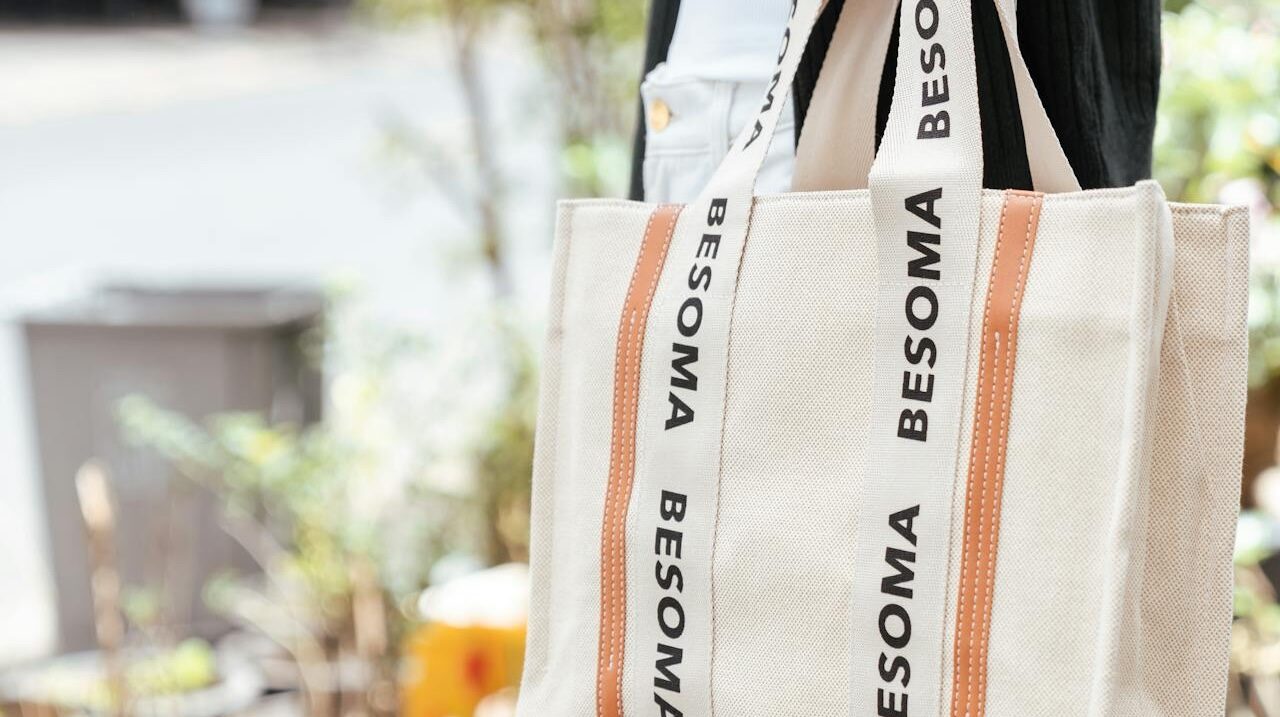
Since the wave of environmental awareness, the tote bag has been seen as a better alternative. The usage of tote bags is mostly seen as an act to reduce the reliance on single-use plastic bags. No surprise that the demand for tote bags in the international market has grown dramatically in recent years. For exporting tote bags, the indispensable requirement is the declaration of the HS code. In this article, we will learn about the classification of HS code for tote bags across borders, major tote bags exporters and importers, as well as the simple way to find the HS code for tote bags.
What is a tote bag, and why is it different from other types of bags?
Before moving to the HS code for tote bags, we must know what a tote bag is. A tote bag is basically similar to other bags in terms of usage for carrying personal belongings. However, the striking difference between a tote bag and other bags is based on the unique structure, which has two parallel loose handles attached to the main compartment. They are worn on the shoulder.
Tote bags are mostly made from various lightweight fabric materials, including canvas, cotton, and jute. The lightweight materials make the tote bags foldable, versatile, and suitable for packing goods. Although tote bags are known for their light materials, some tote bags are made of sturdy materials, including leather, and have a function akin to handbags as a fashion statement.
What is the list of HS codes for tote bags?
After comprehending the definition of tote bags, we can move to the classification of the HS code for tote bags. The classification of HS code or Harmonized System code is an essential part of international trade. Without an accurate classification of standardized code created by the World Customs Organization (WCO), the customs process in the destination country won’t be seamless, and there are some consequences if there is a misclassification.
The classification of tote bags might be more unique than other types of bags, because they can be made from diverse materials, from lightweight to durable materials. Tote bags made from leather are covered under Chapter 42, whereas the HS code for tote bags made from paper falls under Chapter 48, and the tote bags or sacks specifically for groceries are included in Chapter 63. However, the categorization of HS code for tote bags for personal use mostly covers Subheading 4202.92. We have collected the list of several 6-digit HS codes for tote bags below.
| HS code | Description |
| 4202.91 | Other bags, including tote bags with the surface made from leather or not patent leather |
| 4202.92 | Other types of bags, including tote bags with the surface made from plastic sheeting and textile materials. |
| 4819.40 | Paper shopping bags and sacks |
| 6305.10 | Sacks and bags for packing goods made from jute |
| 6305.20 | Sacks and bags for packing goods made from cotton |
Top 5 tote bag exporters and importers
After understanding the list of HS codes for tote bags, we might need to understand the biggest exporting and importing countries of tote bags. From the list above, we can narrow it to the common classification of tote bags for personal use, which falls under HS code 4202.92. The following table shows the biggest exporters of tote bags made from textile materials in 2024.
| Country | Total Export Value (USD) |
| China | 10,167,640,500 |
| Germany | 1,002,114,649 |
| France | 960,582,902 |
| Indonesia | 776,656,547 |
| Netherlands | 600,848,812 |
Source: UN Comtrade Database, retrieved June 2, 2026
As depicted in the table, China is the biggest exporter of tote bags in 2024 with an amount of more than 10 billion USD. Germany is in second place with an export value of slightly more than 1 billion USD in 2024. The remaining prominent exporters are France, Indonesia, and the Netherlands. Then, we can move to the list of the largest importing countries of tote bags under HS code 4202.92 in 2024.
| Country | Total Import Value (USD) |
| United States | 4,605,513,007 |
| Japan | 2,617,658,938 |
| Germany | 1,504,136,741 |
| France | 1,150,789,692 |
| United Kingdom | 762,195,583 |
Source: UN Comtrade Database, retrieved June 2, 2026
The biggest importer of tote bags under HS code 4202.92 is the United States, with a value of more than 4.6 billion USD. This country is followed by Japan in the second position with an amount of more than 2.6 billion USD. The other biggest tote bags importing countries are coming from the European continent, including Germany, France, and the United Kingdom.
How to find an accurate HS code for a tote bag
Finding the HS code for a tote bag is indeed complicated and requires a thorough process. You need to comprehend your tote bag materials and classify them based on the national standard HS code instead of the universal 6-digit HS code from the WCO.
In order to simplify the process of finding the HS code for a tote bag, you can use an intermediary application to assist the export and import process, namely HSCodeMatch. This app is really simple and easy to use, even for a person or users that has never used it before. These are the step-by-step guides for classifying the national standard of HS code for tote bags under the code 4202.92 from China to Japan.
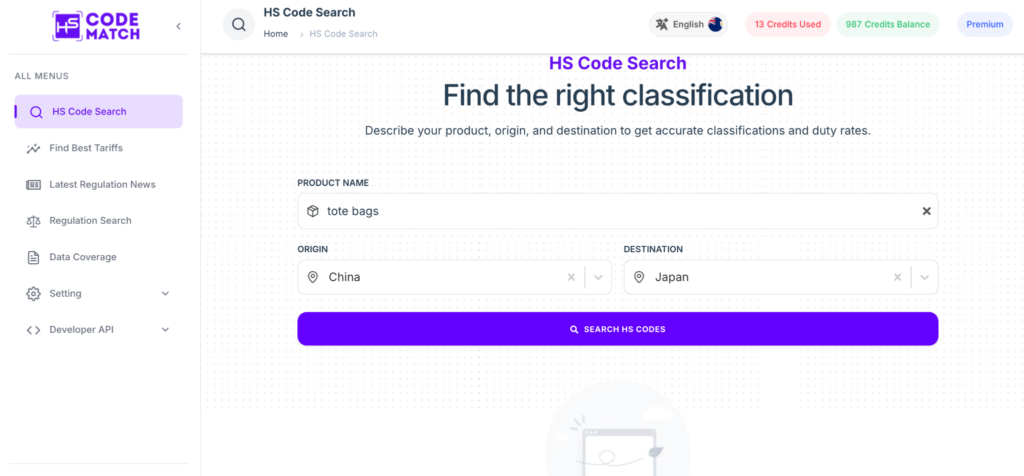
Step 1: Log in to the HSCodeMatch app
Log in to the HSCodeMatch app or access it directly at app.hscodematch.com, or sign up if you do not have an account. Then, set the product name, tote bags, origin country, China, and destination country, Japan, on the HS Code Search tool.
Step 2: Check the list of HS codes for tote bags
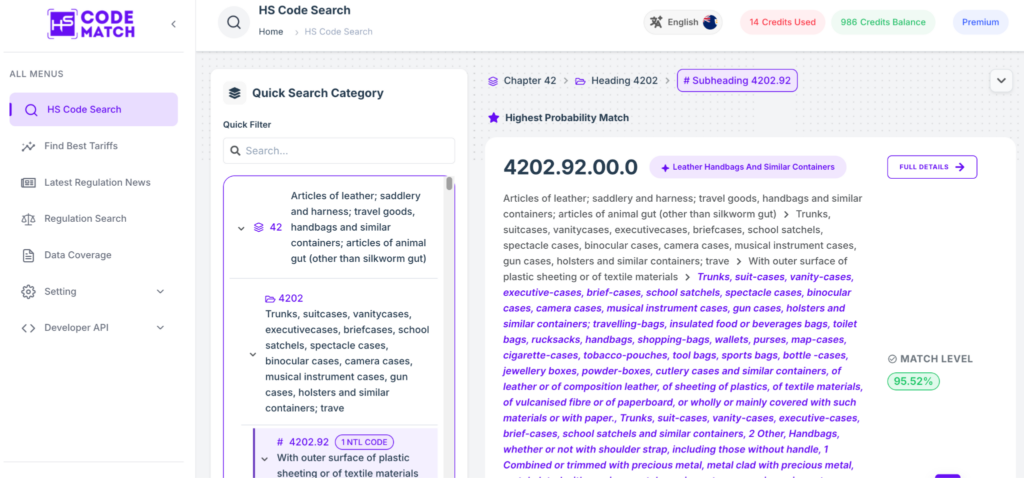
Check the list of HS codes for tote bags on the HSCodeMatch app. For example, the highest percentage match of HS code for a tote bag in Japan is 4202.92.000. Then, choose HS code 4202.92.000 or tap Full Details to redirect to the HS Code Details page.
Step 3: Review a detailed description of the HS code and regulations for tote bags
Find the detailed description of the HS code for tote bags under the code 4202.92.000 on the HS Code Details page. You can also find the regulations related to exporting tote bags from China to Japan.
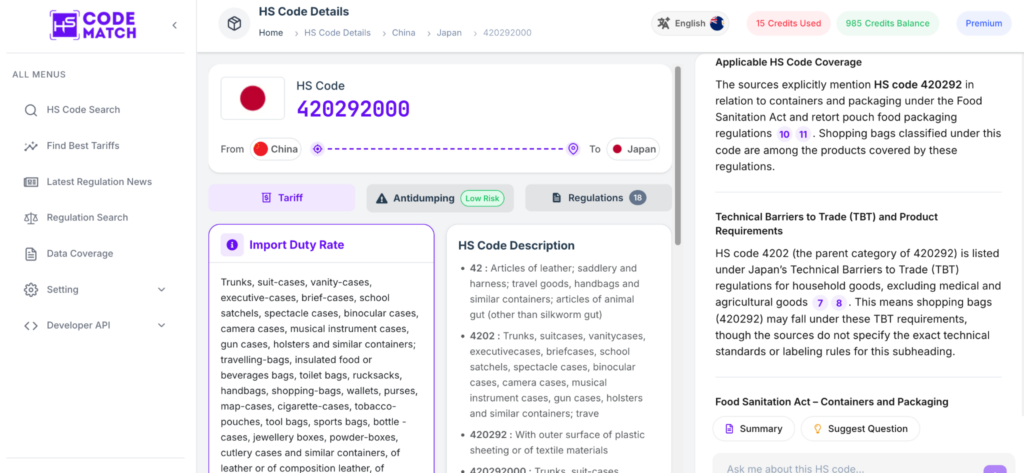
Step 4: Ask the AI Assistant to understand the regulations for exporting tote bags
If you have any confusion in finding the regulations and tariffs, just ask the AI Chatbot Assistant in the HS Code Details. Please note that you can ask anything related to the exportation of tote bags under HS code 420292000 from China to Japan.
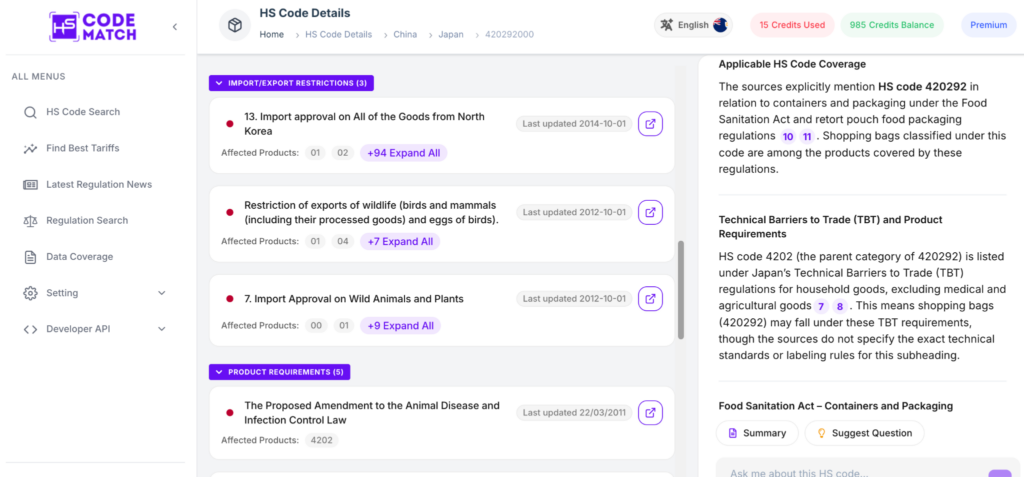
AI Chatbot Assistant is one of the advanced features from HSCodeMatch to help users find the insights of regulations from the official documents. We have provided three examples of questions and answers from the AI Chatbot Assistant on HSCodeMatch below.
What is the tariff rate for exporting tote bags under HS code 420292000 from China to Japan under the preferential rule?
Exporting tote bags from China to Japan is eligible to obtain preferential tariff under the Regional Comprehensive Economic Partnership (RCEP) agreement. The preferential tariff rate for exporting from China to Japan is 5.7%. The following table is the list of applicable tariff rates under RCEP. agreement.
| Tariff Type | Rate (%) | Applicable Countries |
| China (RCEP) | 5.7 | All China’s products exported to RCEP member countries |
| RCEP (Preferential) | 6.1 | General rate of RCEP member countries |
What is the document required to be eligible for obtaining a preferential tariff under the China-Japan FTA?
For obtaining a preferential tariff under the free trade agreement (FTA) between China and Japan, particularly under the Regional Comprehensive Economic Partnership (RCEP). There are requirements to comply with this FTA, including rules of origin and document requirements. To obtain the document is a Certificate of Origin, which is proof that the products meet the specific criteria in the FTA.
What are the restrictions on exporting tote bags under HS code 420292000 from China to Japan?
For exporting tote bags under HS code 420292000 into Japan, there are some restrictions on measurement, such as animal quarantine, environmental restrictions on plastic bags, and quality labeling regulations. These restrictions are related to the bags and might be applied to the tote bags before entering Japan.
In order to address animal disease control laws, Japanese authorities require inspection, cleaning, and disinfecting of the luggage and personal effects, including the products under HS Heading 4202, if necessary, after the interview process. In addition, there is a potential regulatory scrutiny for materials in contact with food under the revision and restrictions on plastic bags in other countries.
From recent updates, there is a Partial Revision to Miscellaneous Manufactured Goods Quality Labeling Regulation published on 03/10/2024. From the recent update, the products on the list include HS codes 420221, 420229, and 420222, which typically cover some types of bags.
Conclusion
Classifying the HS code for tote bags is quite tricky because tote bags can be included in several chapters. Based on the WCO classification, the HS code for tote bags is still similar to other types of bags, under Heading 4202. However, the HS code for tote bags made from paper, or called paper shopping bags, is covered under Heading 4819. Additionally, the tote bags or sacks for bulk groceries and agricultural products fall under the HS Heading 6305. Thus, the main factors to categorize the HS code for a tote bag depend on the material composition.
Frequently Asked Questions (FAQs)
1. What is the tariff rate for exporting tote bags under HS code 4202.92 from China to Japan?
The tariff rate for exporting the HS code for tote bags under HS code 4202.92 from China to Japan is 5.3%. The two countries have an agreement, called the Regional Comprehensive Economic Partnership (RCEP), to reduce the import duty rate of tote bags into Japan from the general rate 10% to 5.3%.
2. What is the national variation of the HS code for tote bags in Japan?
The national standard or variation of HS code for tote bags in Japan is 4202.92.000. This classification for all shopping bags for personal use is covered under Subheading 4202.92 and made from all types of textile materials, including jute.
3. What are the key factors to define the accurate HS code for tote bags?
The key factors to determine the HS code for tote bags from the WCO standard are the material composition. For tote bags mostly covered under HS Heading 4202, and for tote bags made from textile materials, such as cotton, canvas, and jute, under HS code 4202.92, and for leather under HS code 4202.91.
4. Are HS codes for tote bags and sacks made from jute material different?
Yes, the HS code for sacks is different from the tote bags for personal use, which are covered under Chapter 42. HS code for sacks made from jute is under Chapter 63, and the full HS code is 6305.10. Sacks are commonly used for packing goods, especially agricultural products, to make them easy to carry during shipment.
5. Is the HS code for tote bags from leather and cotton different?
Yes, of course. This is because the HS code for tote bags can be distinguished by the material composition. HS code for tote bags made from leather is 4202.91, whereas HS code for tote bags made from cotton is 4202.92; this not only applies to cotton, but also to other textile materials.
Find and Match the Right HS Code for Your Products.
Try Our App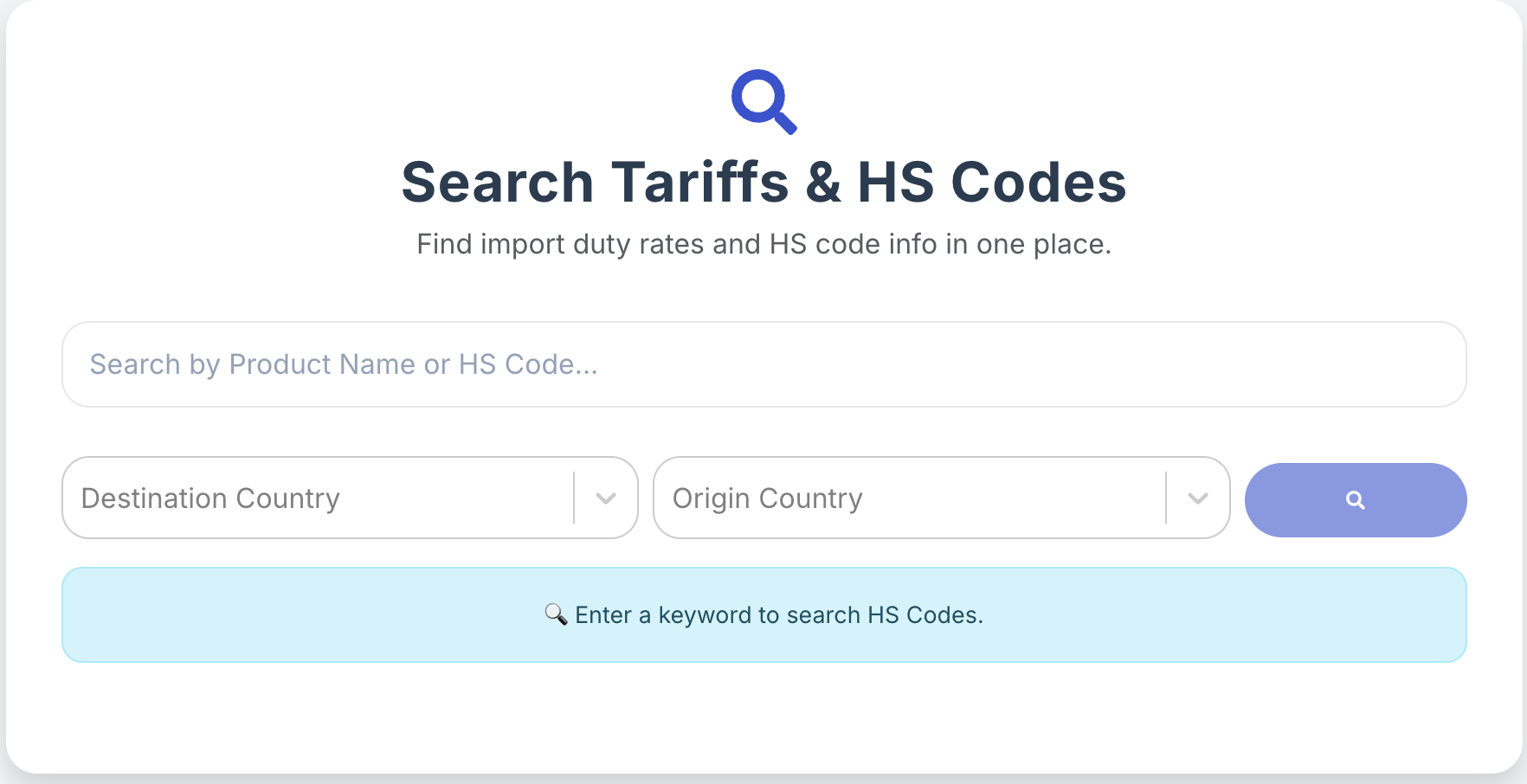

 Sep 10, 2026

