

 May 21,2026
  By Alice
Hats are one of the fashion apparel items that are used to cover the head. People wear hats on some special occasions or to complement their daily outfits. Not only for fashion items, but hats also play a critical role as head protection. Due to their importance, hats are one of the most coveted items in the global market. In this article, we will look into the required procedure of importing and exporting hats, particularly the HS code for hats. We will guide you to find the HS code for hats, and give you insights into hats’ largest trading partners.
What are the types of hats?
Hats and caps are basically headwear that are mostly used only as fashion accessories. However, the role of hats and caps goes beyond fashion symbolism. They can be used as a protective tool from the ultraviolet radiation, extreme heat waves, dust, and they fit for sports and everyday wear. However, hats and caps tend to be used for special occasions, including ceremonies, religious identity, or even for important events. We have assembled five common types of hats and caps.
1. Baseball Cap
A baseball cap might be one of the most popular hats. It is well known as the iconic hat with the curved style on the brim. The baseball cap is commonly worn by baseball athletes as well as by some people as a regular fashion style.
2. Snapback Cap
Different from a baseball cap, the snapback cap has a flatted brim. This cap is an iconic piece for streetwear and a fashion staple for some people. A snapback cap is mostly used by young people and is considered a modern style of hats.
3. Beannies
Beannie is a seasonal headwear that is specifically for winter. This hat provides warmth and comfort to the head to protect from cold weather. Not only for comfort, but a beanie also plays a crucial role as a fashion accessory that accentuates the whole outfit.
4. Bucket Hat
A bucket hat is a well-known hat for fashion style and has gained popularity these days. This hat is unique in the form of a bucket. This hat is made of many types of lightweight fabrics, such as cotton, nylon, and other fabric materials.
5. Fedora
Fedora is a popular hat that seems very classic, but it is actually timeless. The main characteristic of a fedora is that it has a medium-narrow brim. This hat is made from many types of materials, including wool, straw, and other materials.
List the Common HS Code for Hats
After getting an insight into the types of hats and caps, what is the HS code for hats? In this section, we will provide the list of HS codes for hats and all types of caps. As we stated in the intro, the Harmonized System (HS) code is a universally accepted code administered by the World Customs Organization (WCO) to facilitate the export-import process. Hence, the HS code is a fundamental component in global trade and determines whether your product can enter the destination country seamlessly.
The classification of HS code for hats and caps falls under Chapter 65 based on the WCO code system. This Chapter contains all types of headwear and headgear, whether they are knitted or crocheted. HS code for hats can further be subcategorized into Heading 6501 to 6505, depending on their shape and design, as well as materials. These are the list of HS codes for hats.
| HS code | Description |
| 6504.00 | Hats and other headwear are made by assembling strips of any material, not trimmed. |
| 6505.00 | Hats and other headwear, whether knitted or crocheted, or made with textile fabrics, including cotton. |
| 6505.90 | Other types of hats and other headwear, knitted or crocheted, made of textile fabrics. |
| 6506.91 | Other headwear or headgear made of plastics or rubber. |
| 6506.92 | Other headwear or headgear made of fur or animal hair. |
Top 5 Hats Exporters and Importers
After understanding the list classification of HS codes for headwear, we can move to the largest hat-exporting and importing countries worldwide. These insights are important to know who the largest producers and consumers of hats in the world are. The following table is the list of the biggest hat exporters under the HS code 650500 in 2024.
| Country | Total Export Value (USD) |
| China | 3,624,989,431 |
| Italy | 418,178,665 |
| Germany | 410,736,729 |
| Netherlands | 362,443,769 |
| France | 251,376,507 |
Source: UN Comtrade Database, accessed May 6, 2026
As the data showed above, China is no doubt the largest exporter of hats in the world, with an amount of more than 3.6 billion USD. Italy is the second biggest exporter of hats with a value of more than 418 million USD. The remaining biggest hat producer countries are Germany, the Netherlands, and France. Then, we might need to know where those hats are exported to. The table below shows the biggest hat importers under HS code 650500 in 2024.
| Country | Total Import Value (USD) |
| United States of America | 2,213,511,577 |
| Germany | 507,129,553 |
| Japan | 506,831,057 |
| France | 389,196,133 |
| Netherlands | 277,842,126 |
Source: UN Comtrade Database, accessed May 6, 2026
As the figure shows in the table, the United States is the largest importer of hats in 2024, with a value of more than 2.2 billion USD. The following country is Germany, as the second biggest importer with an amount of more than 507 million USD. The remaining largest hat consumers are Japan, France, and the Netherlands.
How to Find HS Code for Hats
Finding the HS code for hats is not a simple task. It actually needs a meticulous and patient process to look up the accurate HS code. If we missclassify the HS code, there are consequences, including delayed shipping, seizure, and even legal charges, which impact on financial loss.
To ease the complexity of finding HS codes, many tools can be used to simplify the journey to classify HS codes. One of the tools is HSCodeMatch, which is designed to simplify product classification with the help of an AI machine. Without further ado, we will provide the step-by-step guide to find the HS code for hats under code 650500 below.
Step 1: Sign in to the HSCodeMatch application
First things you should do is open the app.hscodematch.com and log in to your account. Then, choose the HS Code Search tool to find the HS code for hats and baseball caps. For the importation, we can use one of the largest exporters and importers, such as Italy and Japan. So, we can just set the product’s name, baseball caps, origin country to Italy, and destination country to Japan.

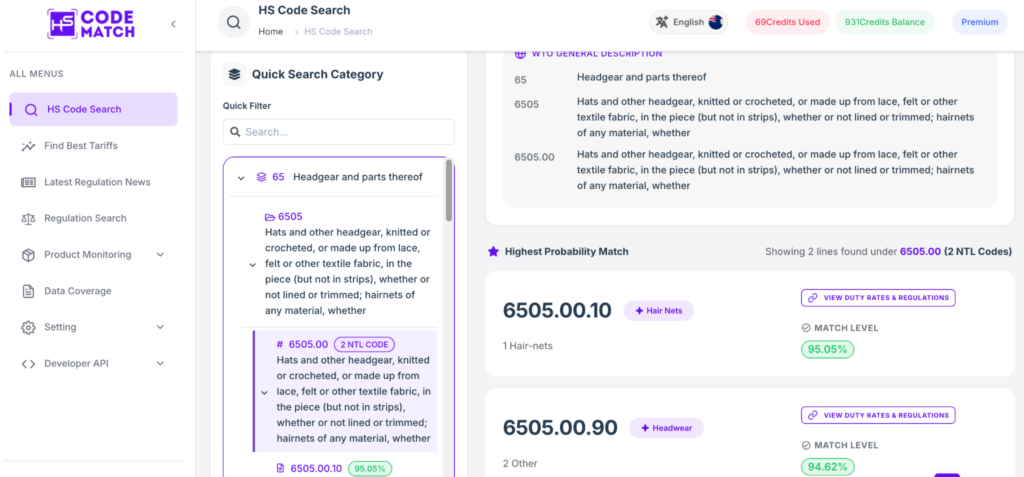
Step 2: Check the list of HS codes for the hats
The system will automatically match the best HS code for baseball caps. Then, choose the most relevant HS code for the baseball caps you are looking for. In this example, we can choose HS code 6505.00.90 and find out more information about the product under this code.
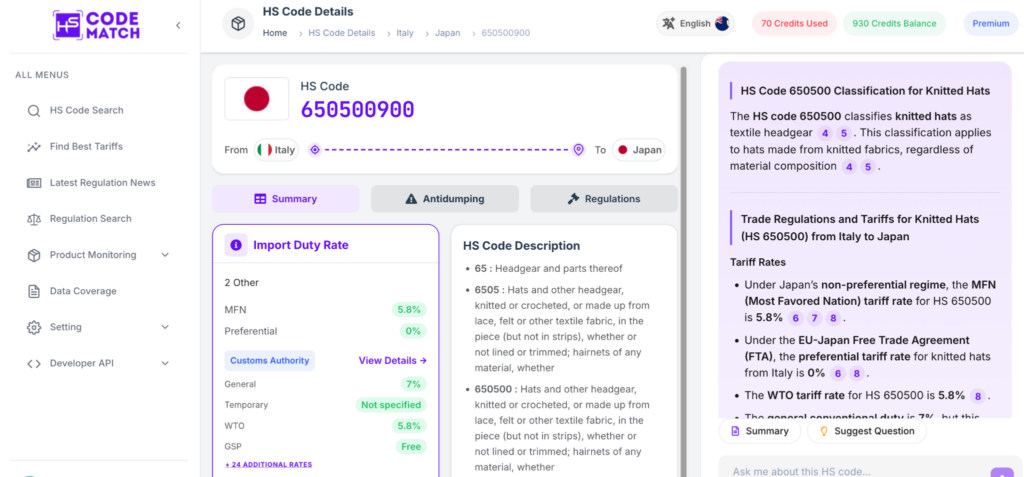
Step 3: Find the applicable tariff and the latest regulation on hats
Inside HS Code Details, you can find the full description of the HS code for baseball caps under the code 650500900 in Japan.
Step 4: Ask the AI Chatbot Assistant about the latest regulation on hats
If you find confusion to find the latest regulations or tariff rate for baseball caps under HS code 650500900, just ask the AI Chatbot Assistant.
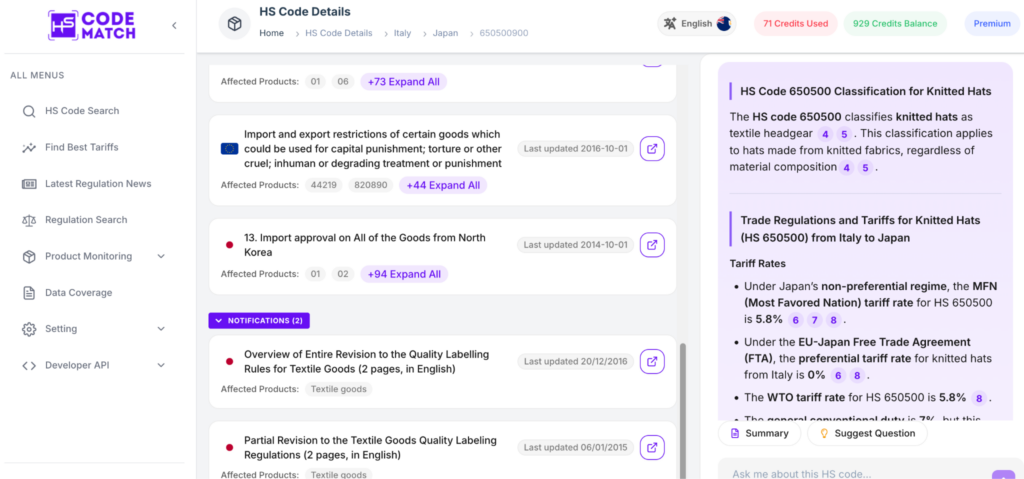
For more clarity about the AI Assistant on HSCodeMatch. We will provide three examples of questions and answers related to the exportation of hats under HS code 650500900 from Italy to Japan below.
Are there any tariffs for exporting baseball caps from Italy to Japan?
For exporting baseball caps from Italy to Japan, the products are eligible for a 0% preferential tariff rate. The preferential tariff rate between Italy and Japan is based on the EU-Japan Economic Partnership Agreement (EPA). However, if the baseball hats are not eligible for the EPA requirement, the eligible tariff rate must be under the Most-Favoured Nation (MFN) for textile products, which is 5.8%.
The EPA is a free trade agreement for all EU countries, including Italy and Japan, for reducing tariffs on almost all traded goods, including textile products. This FTA has been effective since February 1, 2019, as a promotion to increase the economic relationship between the two parties.
| Trade Scenario | Tariff Rate | Applicable Agreement |
| Baseball caps under preferential | 0% | EU-Japan EPA |
| Baseball caps (MFN) | 5.8% | Non-preferential regime |
What documentation is required for the duty-free entry of baseball caps under the EU-Japan EPA?
For baseball caps to be eligible under the EU-Japan Economic Partnership Agreement (EPA), a proof of origin is needed to reduce the tariff. Before exporting baseball caps, a certificate of origin or other similar document is mandatory. When the exporter can obtain the proof of origin for the baseball cap from Italy, they are able to get the zero-tariff rate in Japan.
What labeling requirements apply to textile imports in Japan under the Quality Labeling Rules?
The Japanese Quality Labeling Rules are a specific policy for imported textile products, including baseball caps, in Japan. There are key components to be included under the Quality Labeling Rules. Here is the list of important components.
| Requirement | Details |
| Fiber content | All of the fibers contained in the textile products must be shown by their percentage in descending order, and using the generic name. |
| Country of origin | All of the textile products entering Japan must display the origin country. |
| Care instruction | All of the textile products must include detailed care instructions, such as washing, ironing, and cleaning symbols. |
| Manufacturer or distributor name | The company name and address must be provided in the product. |
| Size or dimension | All of the textile products must include size and dimensions to make it easier for the consumer to |
| Label placement | All of the textile products must be attached in the area that is easily visible and durable manner. |
The Japanese textile importers must comply with this regulation, and the local government may conduct audits. The local institution supervising the Textile Goods Quality Labeling Regulation is the Ministry of Economy, Trade, and Industry (METI).
Conclusion
All types of hats are classified under HS Chapter 65. Not only hats or caps, but this chapter also covers other headwear and headgear, including helmets. The further categorization of the HS code for hats depends on the construction and materials, whether they are knitted or made from textile fabrics or assembled from strips. If the hats are knitted or made from fabrics it can be included in HS Heading 6505, and if the hats are assembled from strips, they are classified under HS Heading 6504. They can categorize more with the subheadings. However, the 6-digit HS code is only the initial code and is subdivided further into local variations of the HS code.
Frequently Asked Questions (FAQs) about HS Code for Hats and Caps
1. What is the tariff rate for exporting baseball caps made of cotton from Italy to Japan?
The tariff rate for exporting baseball caps is included in the EPA and is eligible for 0% tariff reduction. The elimination of tariff rates for products from Italy or other EU countries to Japan is also applicable to other textile products.
2. What is the general tariff rate or MFN for exporting hats in Japan?
The general tariff rate, or called Most Favored Nations (MFN) regime, for exporting hats or caps in Japan is 5.8%. This tariff rate applies to traded goods from countries that do not have any Free Trade Agreement (FTA) with Japan.
3. What is the national variation of the HS code for baseball caps in Japan?
The national variation of the HS code for baseball caps in Japan is 650500900. This HS code applies to baseball caps made of textile fabrics, and the further subheading classification is based on the Japanese customs regulations.
4. How to determine the HS code for hats and caps?
In order to determine the HS code for hats and caps, you need to understand the type of hats, including the shape of hats and the composition of materials. Most of the hats or caps are included in HS Heading 6505. You can use a specific application, such as HSCodeMatch, to ease the process of finding the HS code for caps and the latest regulations.
5. What is the structure of the HS code for military berets?
Military headwear or berets are under the classification of HS code 6505.00. Thus, it is similar to other types of hats that are made from textile fabrics or knitted, but if the product is safety headwear is under the HS code 6506.10.
Find and Match the Right HS Code for Your Products.
Try Our App

 Sep 10, 2026