


 Jan 22,2026
  By Alice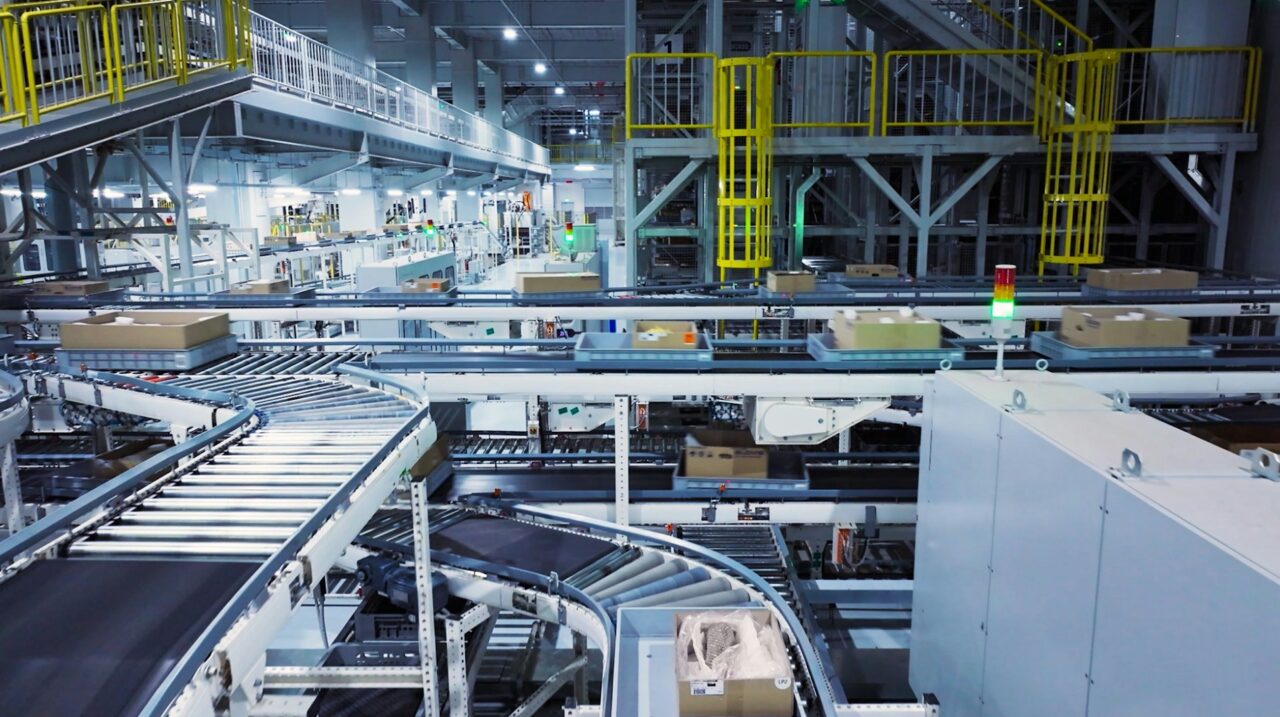
Belt might be one of the most overlooked products in the market. Without us noticing, these products are being used everywhere, from fashion apparel to the manufacturing industries. The existence of a belt is crucial for our lives, especially in the manufacturing and mining industries, also known as conveyor belts; therefore, the global demand for conveyor belts is persistent. To facilitate smooth cross-border trade of belts, exporters and importers need to understand the HS code for belts. In this article, we will learn about the accurate HS code for belts, the major international trade players in the conveyor belt industry, and how to find the correct HS code for belts.
What is the meaning of conveyor belts?
Belts are elastic straps that are made from various materials, such as leather, vinyl, nylon, rubber, and other synthetic materials. Belts are important because they can be used for fashion, as a belt that we wear daily, machinery, and in the manufacturing industry. The function of a belt in fashion is to hold up the pants, while the function for industry is to transfer or convey goods, also known as a conveyor belt.
Conveyor belts are typically connected to the roller and pulleys, which are made from a metal plate, and they are moved by the drive motor. Conveyor belts are crucial for a wide range of modern industries, such as manufacturing, mining, food processing, packaging, and others. These belts have a function to make the operation of the industry more efficient without the need to use humans or animals to move the bulk materials from one place to another.
Conveyor belts are made from several common materials with high durability and long-lasting properties. This is because the main purpose is to transport goods or products, bulk materials, and others smoothly. To grasp more about the materials, please take a look at the variety of materials of conveyor belts as follows.
- Metal conveyor belts: Made from woven metal or plate conveyor to ensure durability for transferring goods. This type of conveyor belt is commonly for food processing industry.
- Leather conveyor belts: These conveyor belts are still being used today for transferring goods, especially in the manufacturing industry.
- Rubber conveyor belts: These conveyor belts are the most popular material for conveyor belts because of their durability and elasticity. A conveyor belt made of rubber can be used for many types of manufacturing industries, as well as for the mining industry, to carry bulk materials.
- Plastic conveyor belts: Conveyor belts made of plastic are commonly used as an alternatif of metal and fabric. The conveyor belts from plastics have an advantage over other materials due to their lightweight and easy bending.
- Fabric conveyor belts: Fabrics are common materials for conveyor belts because of their elasticity and lower cost. The types of fabrics that are commonly used are nylon, polyester, and other synthetic materials.
The structure of the HS code for belts
As mentioned above, the HS code for belts varies depending on the materials. Therefore, the classification of HS code for belts include in several chapters, such as 40, 42, 62, 87, and others. After the chapter, the additional code to make a full sequence of HS code is called heading and subheading. These two codes are crucial to categorize the conveyor belts into different characteristics and functions. Here is the list of common HS codes for belts, especially for conveyor belts.
| HS code | Description |
| 392690 | HS code for buckets, pails and others, including conveyor belts from plastics. |
| 401011 | HS code for conveyor belts made from rubber and reinforced with metal materials. |
| 420500 | HS code for other articles of leather or other products made from leather, including conveyor belts. |
| 591000 | HS code for transmission or conveyor belts made from textile. |
| 732620 | HS code covers any products made from iron and steel wire, including conveyor belts. |
For example, the HS code for a conveyor belt machine made from rubber is 401011. This is the breakdown of the HS code for vulcanized rubber conveyor belts.
- 40: Chapter of HS code for rubber and other similar products.
- 10: Heading of HS code for conveyor belt or transmission belt made from vulcanized rubber.
- 11: Subheading of HS code conveyor belt ot transmission belt reinforced with metal and only 25% rubber.
Top 5 biggest vulcanized rubber conveyor belts exporters and importers
For a better comprehension of the HS code for belts, we need to know who the major players are in the conveyor belts global trade. However, the materials for making conveyor belts vary. Thus, we can narrow it to specify only for vulcanized rubber conveyor belts under the HS code 401011. Here is the list of leading exporting countries for conveyor belts under HS code 401011 in 2024, based on the UN Comtrade Database.
| Country | Total export value (USD) |
| China | 248,126,800 |
| Poland | 83,422,060 |
| Germany | 53,800,216 |
| Netherlands | 26,787,047 |
| United States | 19,524,337 |
Source: UN Comtrade Database, accessed January 19, 2026
From the table above, China is the leading exporter of vulcanized rubber conveyor belts in the world with a value of more than 248 million USD. Meanwhile, Poland is in the second position, followed by Germany in the third position as the biggest seller of these products. The Netherlands and the United States are the fourth and fifth-largest exporters of vulcanized rubber conveyor belts.
| Country | Total import value (USD) |
| Chile | 45,940,497 |
| Australia | 39,775,159 |
| Germany | 28,532,965 |
| United States | 28,522,935 |
| Indonesia | 20,305,229 |
Source: UN Comtrade Database, accessed January 19, 2026
Different from the exporters, the biggest importer of vulcanized rubber conveyor belts is Chile due to its large mining companies, especially copper. This South American country is followed by Australia, Germany, the United States, and Indonesia. All of the largest importing countries are known to have large manufacturing and mining company which need conveyor belts for transporting bulk materials easily.
Finding the accurate HS code for belts in the industry
Before utilizing the HS code for belts, it is better to understand how to find it. As you know, finding the accurate HS code is challenging. Also, the penalties for the incorrect declaration of HS code are significant impact on your business. Those penalties are based on several degrees, including fines, shipment delay, seizure of goods, and even criminal charges for allegedly evading tariffs.
In order to ease and simplify the process of finding the HS code for belts. We can use the help from HSCodeMatch, an AI-powered search engine, to find the HS code and latest trade regulations for your products. Here is the step-by-step guide to look up the HS code for conveyor belts on HSCodeMatch.
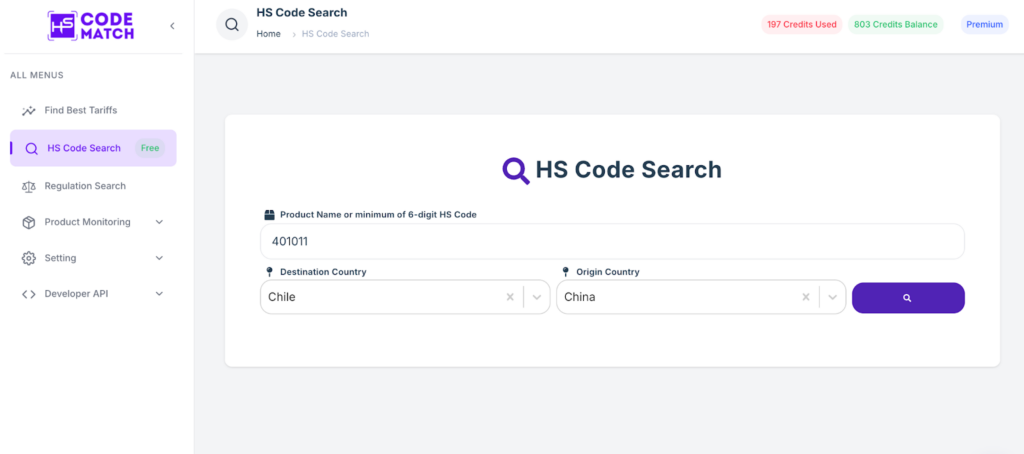
- First step: Open the HSCodeMatch application on your browser by entering hscodematch.com. Input the product’s name or HS code if you already know, along with the origin and destination countries. For this example, we can use the largest exporter and importer of products under HS code 401011, which are China and Chile.
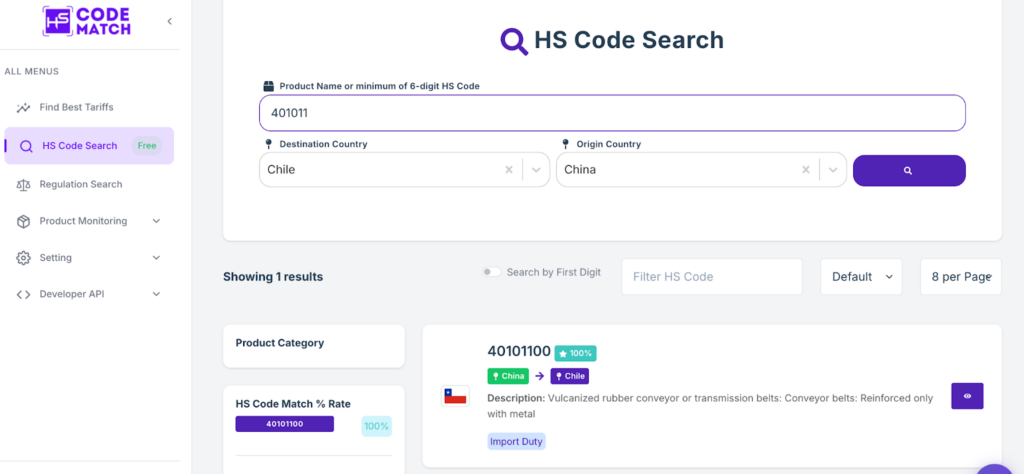
- Second step: After you click the search icon on HSCodeMatch, it will redirect to a new page. Then, you can choose the list of HS codes for conveyor belts that are closest to your criterion. For this example, there is only one HS code 40101100.
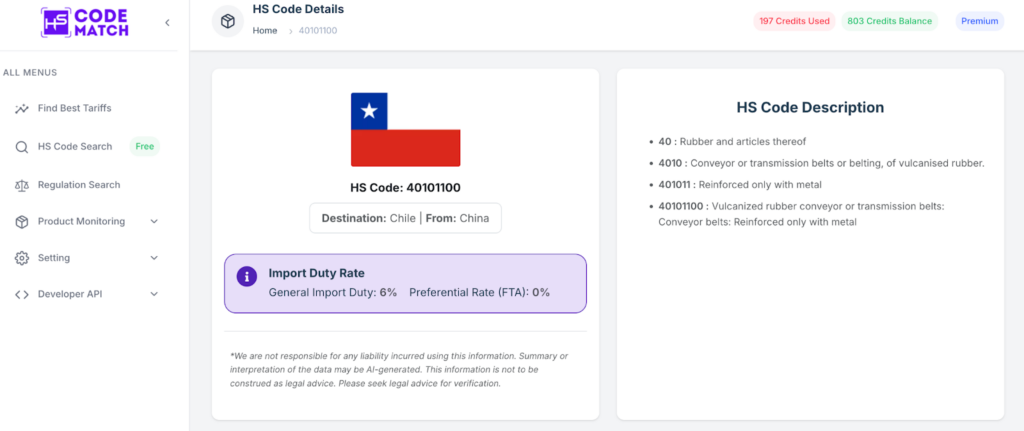
- Third step: After selecting the HS code, you will enter the HS Code Details, which provide the tariff rate and HS code description. This page allows you to correct the HS code and check whether your product’s HS code is correct or not.
- Fourth step: On the bottom section of the page, you can see the description of the regulations and tariff rate. On the right corner, you will find an AI chatbot assistant that allows you to ask anything related to the export under the HS code 40101100 from China to Chile.
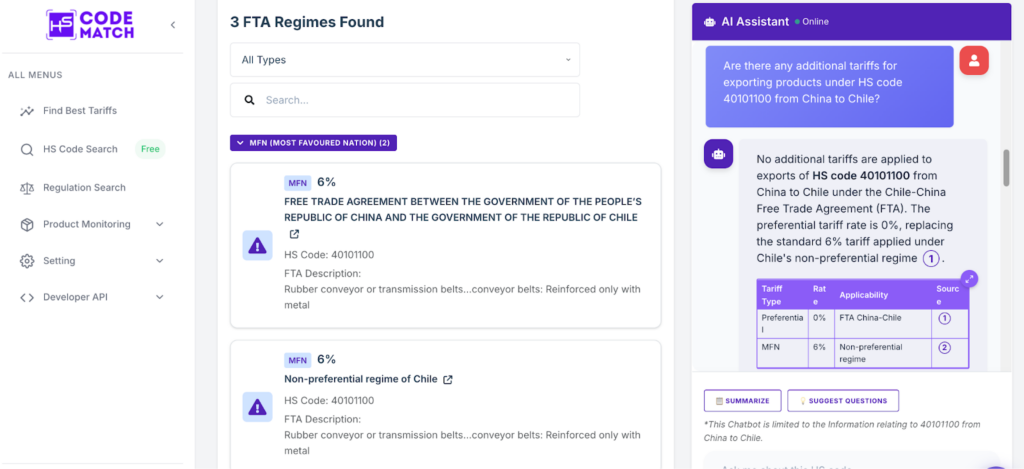
For more information about the AI chatbot assistant, we will give the explanation and examples of the answers. Here are the examples of the answers from the AI chatbot assistant about exporting products under HS code 40101100 from China to Chile.
Are there any additional tariffs for exporting products under HS code 40101100 from China to Chile?
There are no additional tariff rates applied for exporting vulcanized rubber conveyor belt products under the HS code 40101100 from China to Chile. The exportation of these products is subject to a Free Trade Agreement (FTA) between Chile and China. Therefore, an exporter or importer who wants to send these products does not need to pay any tariff, or 0%. This FTA will replace 6% general import tariff based on the Most Favoured Nations (MFN) from Chile’s authority.
| Type of Tariff | Tariff Rate | Implementation |
| Preferential Tariff Rate based on FTA | 0% | FTA China-Chile |
| MFN or non-preferential tariff rate | 6% | A non-preferential regime applies to all countries, excluding those under an FTA. |
What documentation is required to claim the 0% tariff under the Chile-China FTA for HS code 40101100?
In order to claim 0% tariff based on the Chile-China FTA, the exporter must provide a Certificate of Origin (COO) that is issued by the Chinese government. Then, the COO can submit to the Chilean customs during the exportation time. Please note that the COO must include detailed information regarding the code of the product, description of the products, criteria of origin, and the formal signature from the certifying body in China. The importer must guarantee that the products comply with the rules of origin based on the Chile-China FTA, which might include the production process and percentage of regional content.
| Document Requirements | Description |
| Certificate of Origin | This document must be authorized by the local authority in China before exporting to Chile. |
| HS Code and Product Description | The declaration of HS code 40101100 must be included along with the detailed description of the goods. |
| Origin Criteria | The origin criteria must be met to ensure that the products meet the criteria or origin under the Chile-China FTA. |
What are the rules of origin that apply to HS code 40101100 under the Chile-China FTA?
The rules of origin for the products under HS code 40101100 from China to Chile need to be met to ensure that the FTA can be applied. This is one of the requirements to obtain the 0% tariff rate to export vulcanized rubber conveyor belts to enter Chilean territory. This preferential treatment includes the substantial transformation and regional value content threshold, where the products are made and assembled. If the products do not meet the rules of origin from China, they will be subject to 6% MFN tariff under the Chilean non-preferential regime.
Conclusion
Before utilizing the HS code for belts, especially for conveyor belts, you initially need to understand what the product materials are. The HS code for the conveyor belt machine can be included in various chapters because it only differentiates by the materials. If your products are made from rubber, then you have to look at the chapter of HS code for rubber belts instead of plastic belts or conveyor belts from other materials. However, rubber is the most used material for conveyor belts due to its durability and long life, as well as its elasticity compared to other materials, particularly in heavy-duty tasks in manufacture and mining industries.
Frequently Asked Questions (FAQ) about the HS code for belts in the industry
Are there any Free Trade Agreements between Chile and China?
Yes, China and Chile agreed FTA in 2006. Hence, many products originating from China and Chile can be subject to the elimination of tariff rates.
What is the general tariff rate for exporting products under HS code 40101100 from China to Chile?
The general tariff rate for exporting products under HS code 40101100 from China to Chile is 0% due to the FTA between the two nations. However, the general tariff rate or non-preferential tariff rate is 6%.
What is the correct structure of the HS code for conveyor belts?
The structure of the HS code for conveyor belts varies depending on their materials. Hence, for the classification of the HS code for belts, you need to understand the products made from. It can be under Chapter 40, 39, 42, 59, and others.
What is the documentation to meet the Chile-China FTA requirement?
The list of required documentation to export products under HS code 40101100 from China to Chile in order to meet the FTA criteria includes a certificate of origin, HS code and products description, and origin criteria.
Are there any applications to find the latest tariff, HS code, and regulation easily?
Of course, you can use HSCodeMatch. This application can be used to find accurate tariff rates, HS codes, and current regulations easily to reduce your administrative tasks for the export and import process.
Find and Match the Right HS Code for Your Products.
Try Our App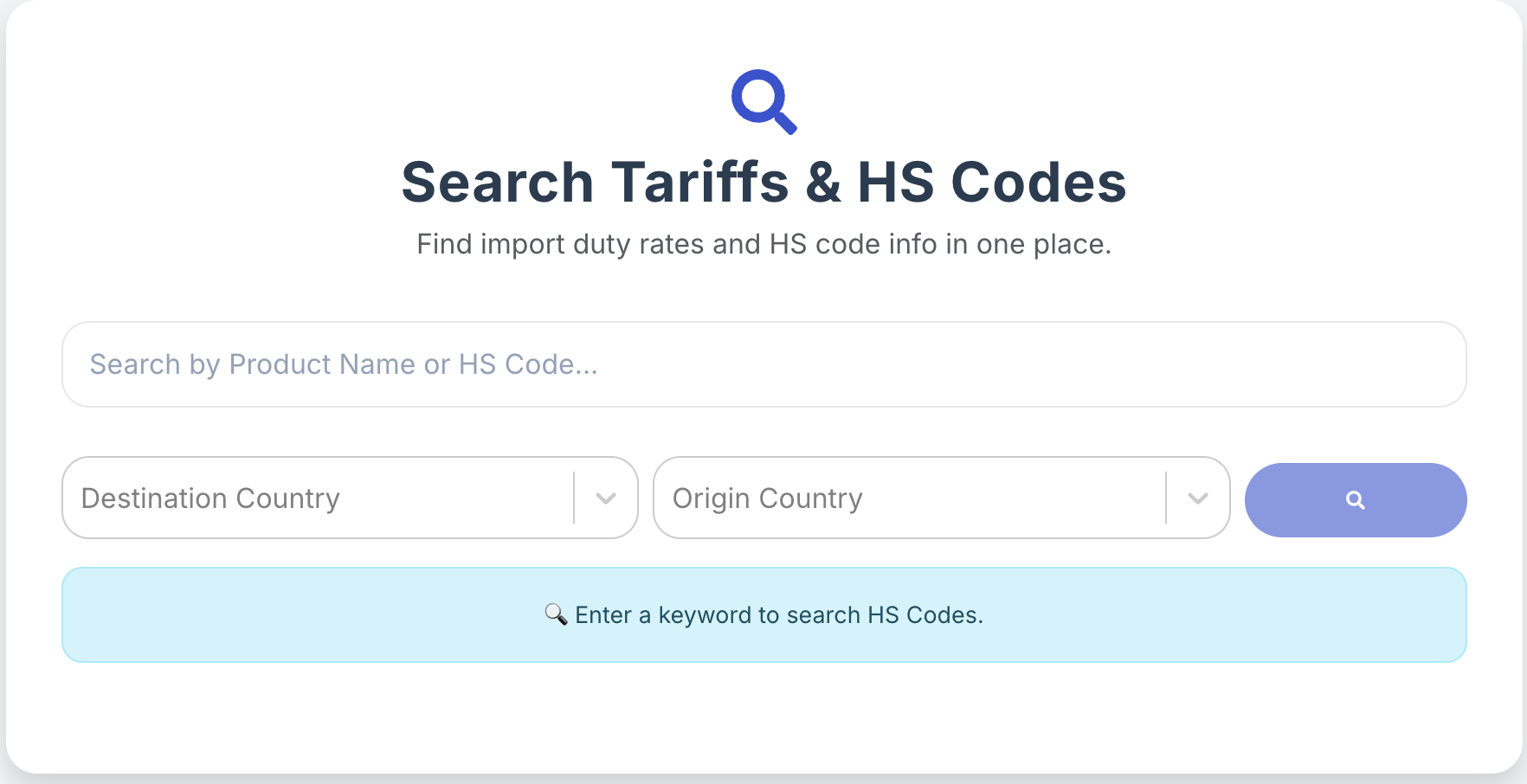

 Sep 10, 2026

