

 Nov 28,2025
  By Alice
Books are one of the common commodities in international trade. According to Statista, the revenue from this sector is relatively stable. The other intriguing fact is that the disruption of electronic and audio versions of books does not affect printed books’ sales. In fact, it is projected to stay intact by 2030, in contrast with audiobooks that show a plummeting trend years ahead. Considering that fact, it is essential for international traders to learn the Harmonized System Code (HS Code) for books. In this article, we will learn the meaning of the HS code for books and how the international trade of books works.
Understanding the structure of the HS code for books
HS code or Harmonized System code is a globally recognized system used to classify traded commodities in export-import schemes. HS code was developed and controlled by the World Customs Organization (WCO) to determine the tariffs or duties on traded products, including books. Therefore, when books are traded internationally, they will need a specific HS code.
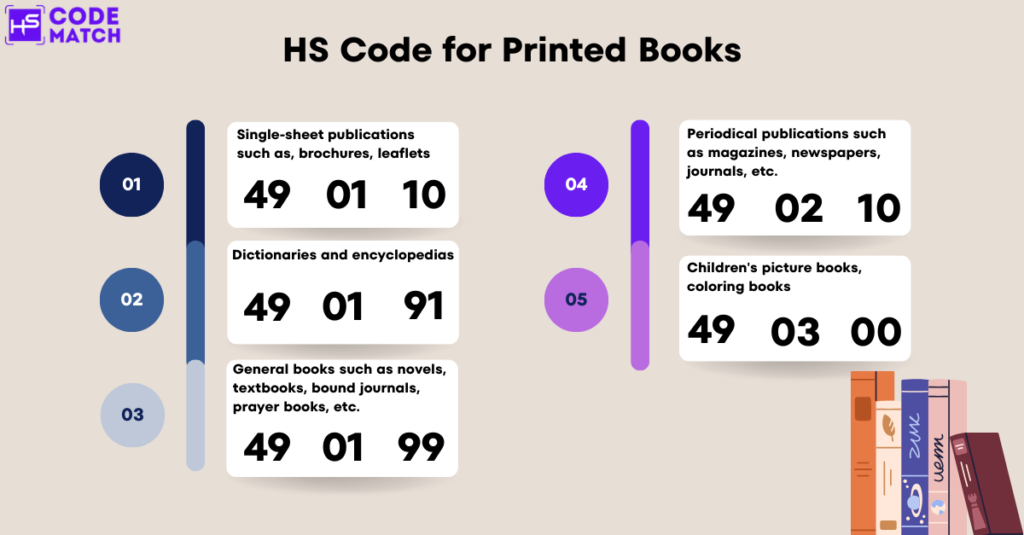
HS Code for printed material generally consists of 6 digits. The first 2 digits are 49, indicating all types of printed material. It is then followed by another 2 digits to separate it from periodical publications such as magazines and newspapers, which is identified with code 02. There will be an additional 2 digits separated by a dot (.), which indicates more specific categories, such as encyclopedia, dictionary, fiction/novel, brochures, picture books, and other similar printed goods. To make it clearer, if you find HS 4901.01 or 4901.99, it could mean as follows:
- The first 2 digits, which are 49, mean it is printed material
- The second 2 digits, which are 01, indicate that it is a non-periodical publication
- The last 2 digits, which are 99, are the more specific category. In this case, it means general printed books such as novels, memoirs, textbooks, etc.
There are common HS codes for printed books you can use as a guide.
| Types of printed material | HS code |
| Single-sheet publications such as brochures, leaflets | 4901.10 |
| Dictionaries, encyclopedias | 4901.91 |
| General books such as novels, textbooks, bound journals, prayer books, etc. | 4901.99 |
| Periodical publications such as magazines, newspapers, journals, etc. | 4902.10-99 |
| Children’s picture books, coloring books | 4903.00 |
However, each country can apply this code in a different manner. Thus, it is necessary to pay attention to the national standard HS code and other import regulations of the country in which your business partner is based.
HS code for books in digital formats (electronic and audio)
At the same time, we live in the digital era where books are not only produced as printed goods. Publishers introduce us to digital formats, either e-books (epub, pdf, mobi) or audiobooks. These digital formats are not considered physical products, so they do not require specific treatments such as shipping. Thus, these types of books usually fall under digital trade laws.
Why are HS codes for books important in international trade?
HS code is essential in international trading, including those that include books as commodities. It is used as an identifier when your goods cross borders. By complying with universal regulations, your export-import procedures will be smooth, faster, and more efficient. Besides, it is important to ensure that the tariffs you pay are correct in order to control your account balance.
You will also need HS codes for printed books to avoid unnecessary delays and penalties, which could be destructive for your business.HS codes for books are usually found in invoices, certificates of origins, shipping documents, and customs declarations.
5 Top Countries in Global Books Trade
Before utilising the HS code for books, you may need to know the trajectory of the global books market. Based on 2024 data from the UN Comtrade Database, here are the biggest global exporters of books under HS code 4901.99
| Country | Trade export value (USD) |
| United States | 2,279,004,969 |
| Germany | 1,179,035,223 |
| Canada | 902,876,308 |
| United Kingdom | 880,543,157 |
| France | 821,124,773 |
Source: UN Comtrade Database, accessed November 10, 2025
As it is shown above, the United States and Germany are the biggest exporters of general printed books. Those countries can be the largest exporters in accordance with the number of book publishers based in those countries. Interestingly, Germany dominates neighboring German-speaking countries’ markets, such as Austria, Switzerland, Poland, the Netherlands, and France.
Canada surprisingly surpassed the United Kingdom as the 3rd biggest global book exporter. They dominated the North American markets. France, on the other hand, is one of the main book traders in several European countries and Canada, as they share a common language.
What about the importers? According to the same source, here are the biggest global importers of books in 2024.
| Country | Trade import values (USD) |
| United States | 2,107,987,494 |
| Germany | 1,097,282,714 |
| Canada | 866,093,216 |
| United Kingdom | 805,891,615 |
| France | 740,357,539 |
Source: UN Comtrade Database, accessed November 10, 2025
The data shown above indicates that the United States has a role as both the largest producer and consumer of books. Followed by Germany, Canada, the United Kingdom, and France, respectively, as the largest exporters as well as consumers. Surprisingly, China is in 12th position of global book importer, which is not bad compared to other countries that claim to be democratic.
Challenges for classifying the HS code for books
Understanding the structure of the HS code for books is quite challenging due to its complexity in the materials. Therefore, the international trade parties sometimes face confusion in finding the right HS code for their book products. There are some challenges in identifying the HS code for books.
- Identifying the multiple functions of a book. For example, the book that has audio or video material in it. This should be included as a consideration.
- Some countries have their own regulation for importing books. Therefore, the exporter or importer should identify carefully the latest standard regulations based on the destination country.
- The classification of a book is quite challenging for an E-book or other digital products. Some trade parties mistakenly insert the HS code for a printed book for the E-book or digital book. The digital products, including E-books, can be classified based on the material of the storage medium.
How to find the HS code for books using HS Code Match
Finding the HS code for books requires an understanding of the structure of the HS code itself. In order to understand the HS code, you need to look at your product’s material and functions. On the other hand, you also need to look at the HS code based on the recipient country. Now, you can use HS Code Match to find the HS code for books easily. These are the steps to find the HS code for books using HS Code Match.
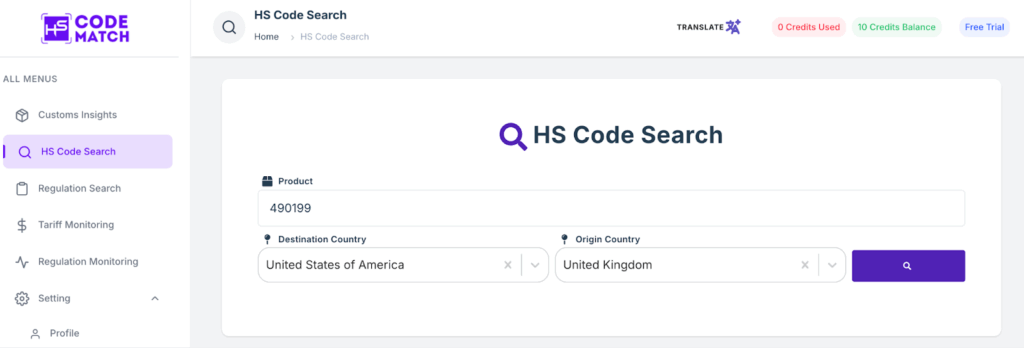
Step 1: Open the HS Code Match by clicking hscodematch.com. You can set the product’s name and the country of origin, as well as the recipient country, on HS Code Search. For instance, of the trade lanes, we can use one of the largest exporters and importers of books, such as sending books under HS code 490199 from the United Kingdom to the United States.
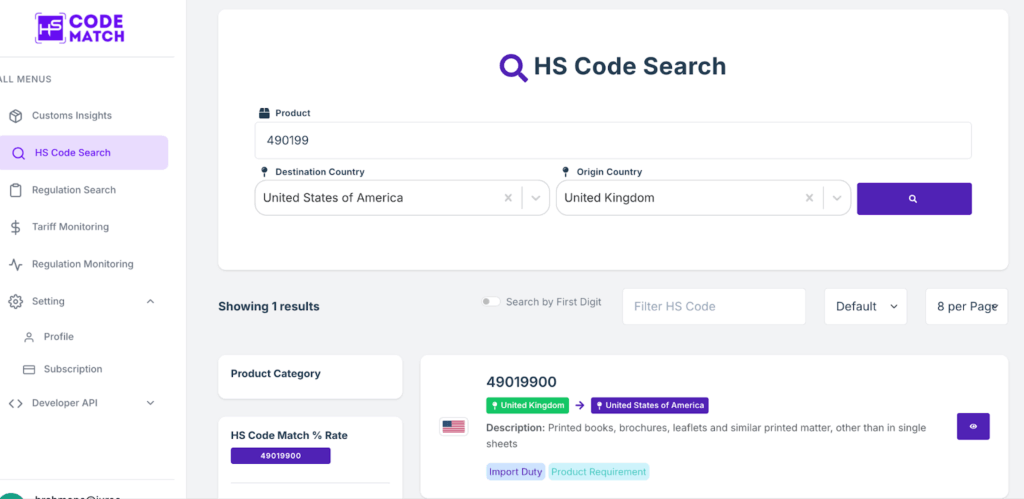
Step 2: After selecting the HS code and the countries, you can see the results below. There is only one HS code for 49019900. The breakdown of this code is printed books, brochures, leaflets, or other materials other than a single sheet.
Step 3: Click the HS code to find out more about the HS code description. You can also see that there are zero tariff rates for exporting books from the United Kingdom to the United States.
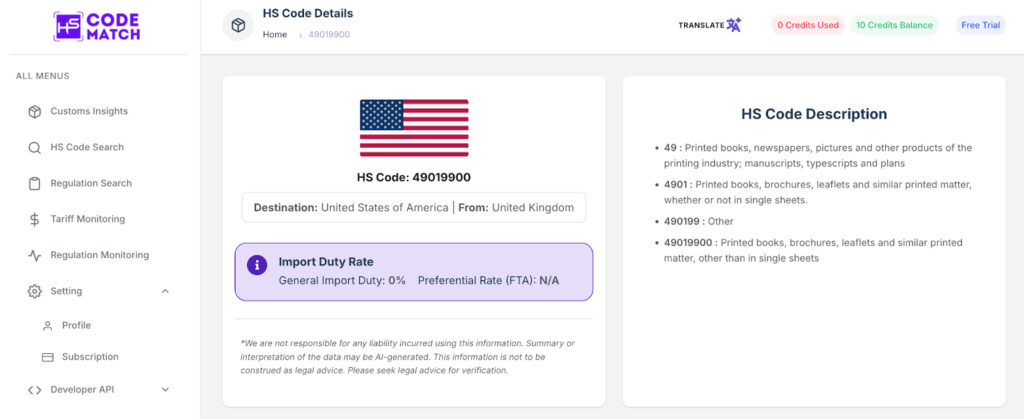
Step 4: In order to find more about the trade regulations, you can move to the bottom part of the page to use the AI Assistant on HS Code Detail. The AI chatbot on HS Code Match will help you find the specific parts of the trade regulation to export books from the United Kingdom to the United States.
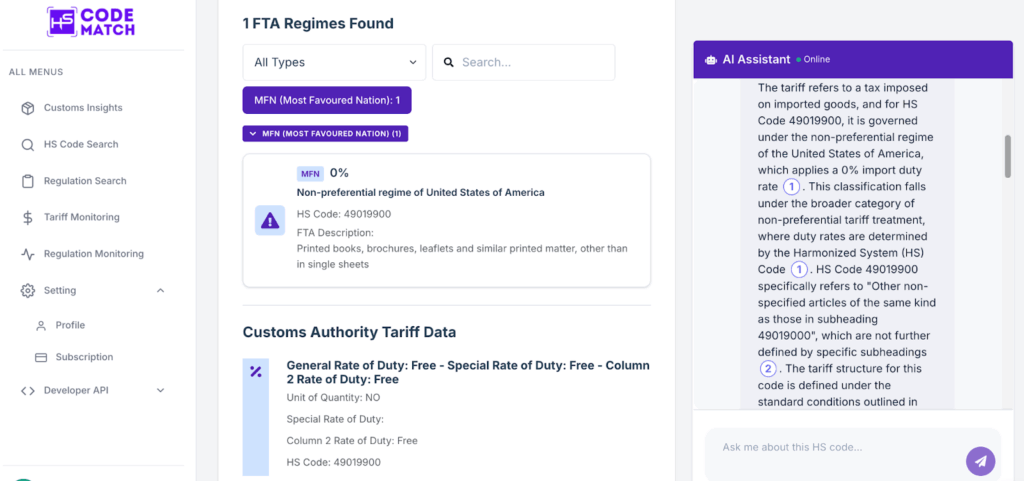
Based on the answer from the chatbot, we can see that there is no import duty for exporting products under HS code 49019900. This code is also under the non-preferential regime in the United States or Most Favoured Nations (MFN). This means that this duty is also implemented for other similar books from other countries in the United States.
These are examples of prompts on the AI chatbot on HS Code Match:
First question: What is the import requirement for HS code 49019900?
Answer: HS code 490199 covers books, maps, and periodical publications that are used for education or common information. Based on the United States Information and Educational Exchange Act of 1948, the import requirements for this code should be accommodated with the standard of labelling, documentation, and stating that it is for educational purposes as well. Besides, the material of the books or publication should be the same as the marketing claims. The international actors should pay attention to the potential misclassification for other similar HS codes, such as 490110 and 490191.
Second question: Do all countries agree to put bound journals within HS code 490199?
Answer: No, despite HS Code 490199 being widely recognized in global trade regulation to classify bound printed materials such as books, records, and documents, there are no binding international standards for the usage of the code. The European regulators, as well as similar institutions in the US, do not specify this. Thus, the specific inclusion of bound journals under this HS code remains a national interpretation instead of a global treaty.
Third question: What is a non-periodical journal that can be included within this category?
Answer: A non-periodical journal is considered a publication that does not have a regular schedule, such as monthly or annually. Based on the Newspaper Preservation Act in the United States, this publication includes newspapers and other news publications. Meanwhile, this law is developed to protect and facilitate journalistic content. Therefore, the materials related to the historical material can be included in the HS code 490199 in the United States.
Conclusion
Understanding the role of HS code for books in global trade for importers and exporters is both a crucial tool and knowledge. It will help you prepare for what to expect in the trade process, such as documents, tariffs, other costs, etc. However, finding and identity HS code is only the beginning of the process. You will need to check the regulations in each specific country as they may have varied customs, tariffs, and classifications. Thus, meticulous research is still needed, other than knowing the HS code for printed books.
Frequently Asked Questions (FAQs)
1. What is the HS code for books?
HS code for books generally starts with the number 49 in accordance with the chapter in the World Customs Organization (WCO) official documents that revolves around printed materials. Yet, for general books such as novels and textbooks, the HS code is 4901.99. There are slightly different codes for other common books you find at the bookstores, such as children’s and picture/coloring books. Their HS code is 4903.00.
2. Do e-books and audiobooks have an HS code?
No. HS codes only regulate the physical traded goods. E-books and audiobooks are not considered physical goods as they are transferred digitally. In conclusion, the HS code for books applies to printed versions of the books. However, the E-book that is stored in the physical medium is still subject to the HS code.
3. Where can I find the right HS code for the book?
You can find the right HS code for a book through the World Customs Organization (WCO) database. You can also check each country’s tariff database. Also, you can use a credible third-party website, such as HS Code Match, to find the HS code and latest regulations in a destination country.
4. Why are the HS codes for printed books important?
HS code is crucial for the main identifier of products in the shipping and customs clearance process. It will also determine import/export duties and will be useful for trade statistics in the future.
5. How much imported book duties cost?
It is different for each country or jurisdiction, but many countries exempt books from duties.
Find and Match the Right HS Code for Your Products.
Try Our App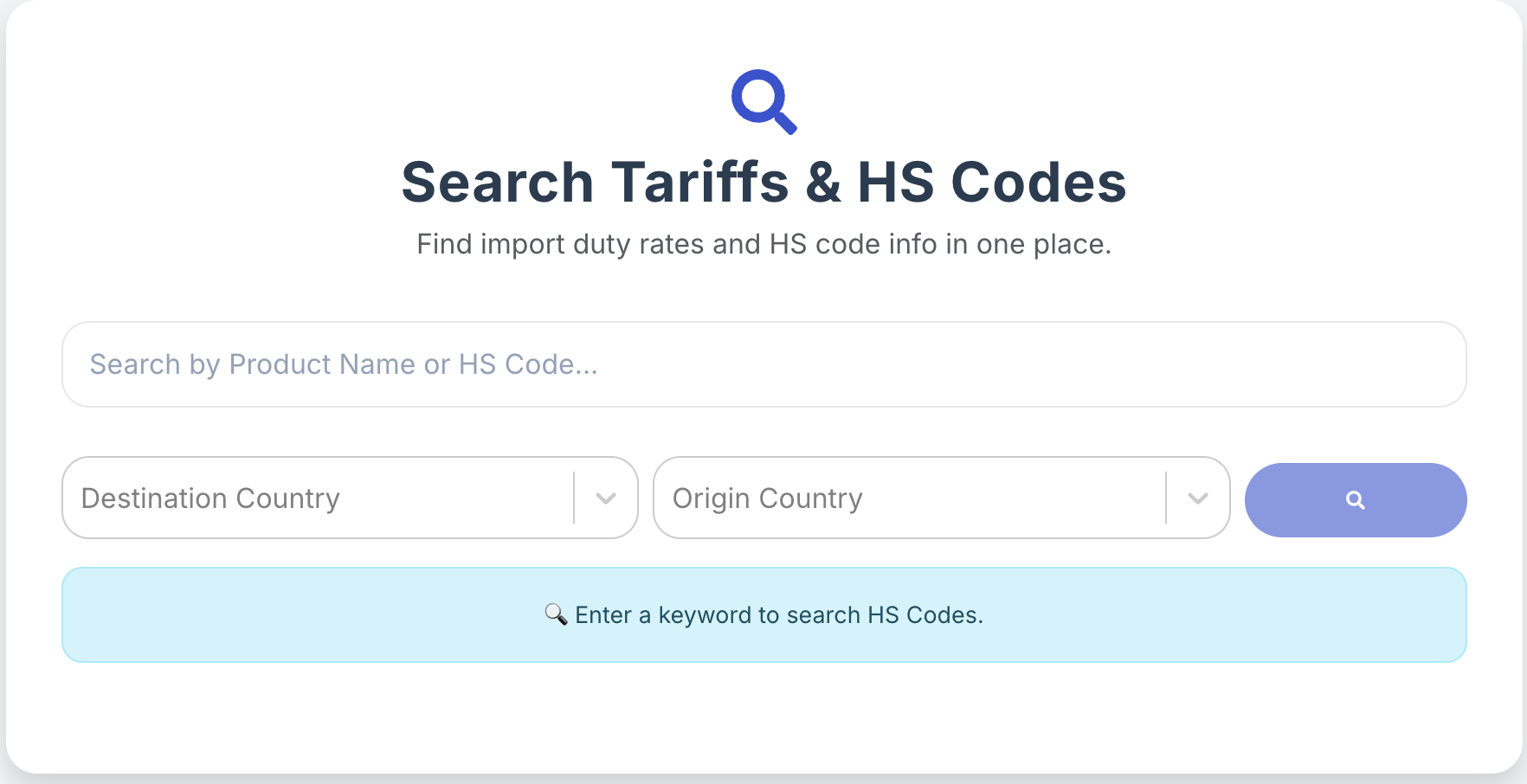

 Sep 10, 2026