


 Nov 28,2025
  By Alice
Similar to clothing, footwear is one of the most demanded fashion or apparel products these days. This is because the footwear is used widely by people all over the world to protect their feet when walking or running. One of the favorite footwear products is shoes. Shoes are universal and can be used for many occasions. No wonder the demand for shoes worldwide is increasing from time to time. Therefore, the inclusion of the Harmonized System (HS) codes for shoes in international trade is crucial. This article will delve deeper into the meaning of the HS code for shoes, its importance, and the details of the main actors in the international shoes trade.
Understanding the structure of the HS code for shoes
HS code is the standardized code specifically for international trade. This code was developed and updated by the World Customs Organization (WCO) and has a function for the identification of some products based on their characteristics. This code is useful for customs processes to determine the duties and taxes, as well as other import regulations.
HS code for shoes or other footwear falls under Chapter 64, which covers many types of footwear, gaiters, and other similar items. This chapter is followed by a 2-digit Heading and a 2-digit subheading to complete the 6-digit HS code that is recognized internationally. This is the list of common HS codes for shoes.
| HS code | Description |
| 640110 | A type of waterproof shoe that incorporates a protective metal toe cap. |
| 640230 | A type of footwear with outer soles made of rubber or plastic, and incorporate with metal toe cap for protection purposes. |
| 640340 | A type of shoe that has outer soles of rubber and is equipped with a metal toe cap. |
| 640411 | A type of sports shoe for tennis, basketball, or other sports and exercises. |
| 640510 | A type of other footwear that is made from leather on the upper side or has a leather composition. |
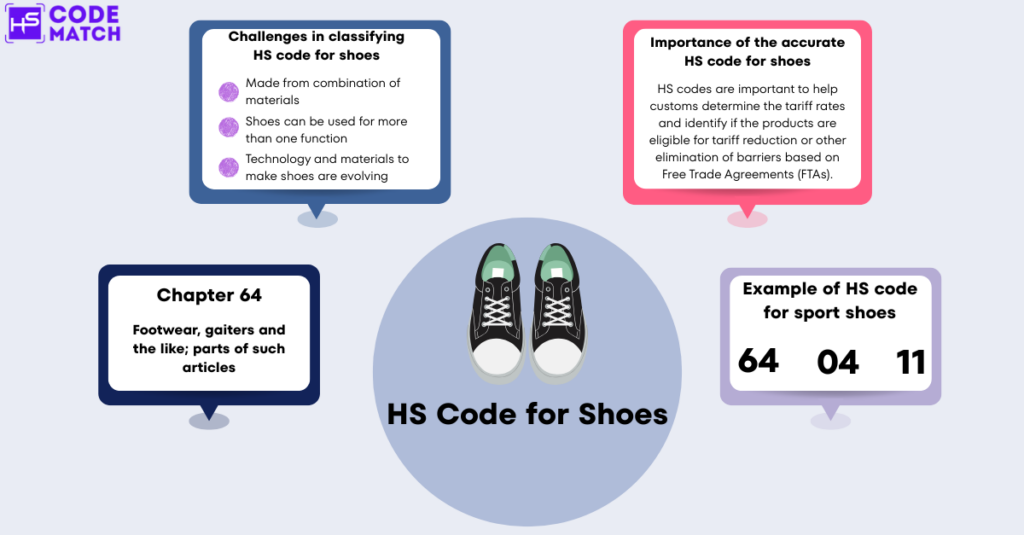
In order to understand and dive deeper into the HS code for shoes, here is the breakdown of the structure of the HS code for shoes. For example, the HS code for sports shoes is 6404.11, based on its classification by material and function.
- 64: Chapter on footwear products in general.
- 04: Heading for a footwear product with the outer sole materials of plastic, rubber, and leather. The composition of upper and leather from textile materials.
- 11: Subheading for shoes that are specifically for sports activities, including tennis shoes, gym shoes, basketball shoes, outdoor shoes, etc.
However, the 6-digit HS code is only the initial form of the national code. Meanwhile, all countries in the world have their own national standard code to classify products for statistical purposes. Therefore, you need to understand the national code as well to ensure the products meet the requirements based on the regulations in the destination country.
Top 5 Largest shoe exporters and importers in the world
Before utilizing and understanding how important the HS code for shoes is, you perhaps need to know the track record of the international trade for shoes or footwear in general. This is the largest global exporter of footwear under Chapter 64 and sports shoes under the HS code 640411.
HS code for footwear: 64
| Country | Total export value (million USD) |
| China | 50,980 |
| Italy | 13,250 |
| Germany | 11,624 |
| Indonesia | 7,084 |
| Netherlands | 6,445 |
Source: UN Comtrade Database, accessed November 12, 2025
As shown in the table above, China is the largest exporter of footwear in the world with a valuation of more than 50 billion US dollars. Italy and Germany hold positions as the second-largest and third-largest exporters of footwear globally, respectively.
HS code for sports shoes: 640411
| Country | Total export value (million USD) |
| Indonesia | 2,115 |
| Germany | 1,105 |
| China | 979.4 |
| Netherlands | 809.2 |
| France | 653.8 |
Source: UN Comtrade Database, accessed November 12, 2025
The country that has become the largest exporter of sports shoes worldwide is Indonesia. This is because Indonesia has many shoe factories and is supported by cheap labor. It was followed by Germany and China consecutively. The Netherlands is the fourth largest exporter of sports shoes.
Then, what about the most significant importers? The table below shows the list of the largest importing countries under HS codes 64 and 640411 based on the UN Comtrade Database in 2024.
HS code for footwear: 64
| Country | Total import value (million USD) |
| United States | 28,387 |
| Germany | 13,427 |
| France | 9,109 |
| Italy | 8,240 |
| Netherlands | 6,561 |
Source: UN Comtrade Database, accessed November 12, 2025
Interestingly, the largest importer of footwear in general and sports shoes is dominated by the developed countries in North America and Europe. This is because the developed countries have high purchasing power and play a role as consumers of many products, including footwear. The United States is crowned as the largest consumer of footwear, with a valuation of more than 28 billion US dollars.
HS code for sports shoes 640411
| Country | Total import value (million USD) |
| United States | 3,937 |
| Germany | 1,476 |
| France | 1,239 |
| Italy | 776.9 |
| Netherlands | 761.5 |
Source: UN Comtrade Database, accessed November 12, 2025
The United States also plays a major role as a major importer of sports shoes in the world, with a valuation of nearly 4 billion US dollars. The second to fifth largest consumers of footwear are Germany, France, Italy, and the Netherlands. Meanwhile, the largest importing countries of sports shoes are the same as those of footwear.
Importance of the correct HS code for shoes
HS code has become a requirement for international trade. It is a standard identifier code based on the typicality and the function of products. HS codes are important to help customs determine the tariff rates as well as to identify if the products are eligible for tariff reduction or other elimination of barriers based on Free Trade Agreements (FTAs). Thus, for international business actors, they should understand the structure of the HS code for their products, including shoes.
Without the inclusion or failure to identify the HS code for sneakers or shoes, it will harm your business. The consequences vary based on the degree of failure in inserting the correct HS code for shoes or other footwear products. The penalties range from shipment delay to fines that will affect your business financially.
Challenges in classifying HS code for shoes
Due to the complexity of the HS code structure, finding the HS code for shoes is somewhat complicated and takes time. There are some challenges you will face in order to classify the HS code for shoes or other footwear.
- Some shoes are made from a different combination of materials. This will affect the different classification of the HS code.
- Some shoes can be used for more than one function, such as shoes for sports and for daily activities or school.
- The technology and materials used to make a pair of shoes are evolving, which makes the identification of the HS code somewhat challenging.
How to find the HS code for shoes with the HSCodeMatch
We know that finding the accurate HS code is quite complicated. Therefore, HS Code Match is providing the HS Code Search tool to assist you in order to find the right HS code for shoes or other products. These are the steps for finding the trade lanes based on the HS code for shoes on HS Code Match. For instance, we can use the largest importing and exporting countries of sports shoes listed above, such as Indonesia and the United States.
- First step: Open the HS Code Match by tapping hscodematch.com. Choose the sports shoes product name or HS code 640411. Then, change the origin country to Indonesia and the destination country to the United States.

- Second step: You can find the list of product categories along with the HS codes on the HS Code Search results. For this, we can choose the HS code 64041120 to look up the detailed descriptions. However, you can choose the HS code that is closest to your products’ material and function.
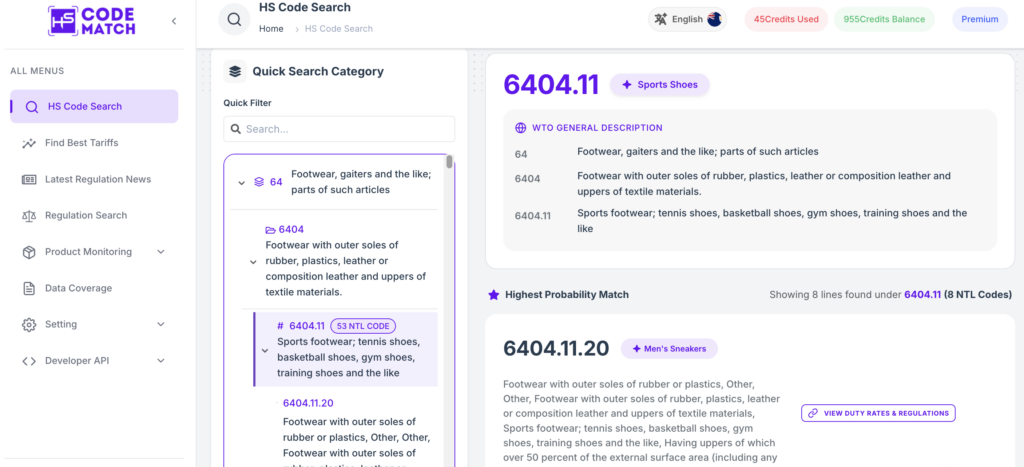
- Third step: On the HS Code Details page, we can see the HS code description, which will help you to identify your products. On this page, we can see that there is a general import duty rate of 10.5 percent for exporting sports shoes from Indonesia to the United States.
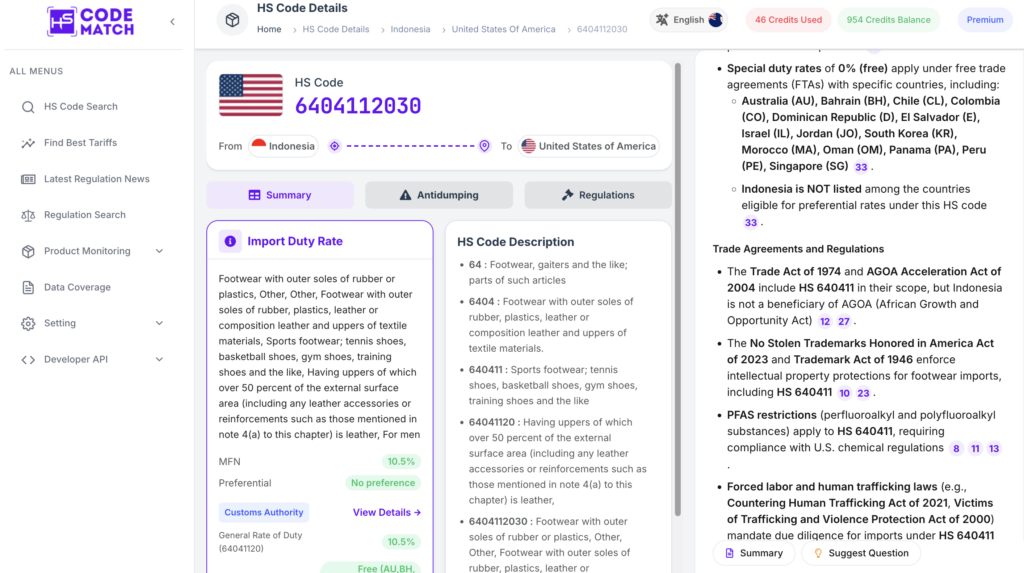
- Fourth step: Bottom part of the HS Code Details, there is information on the import regulations of sports shoes under the HS code 64041120 in the United States. The list includes information about Partner Government Agencies (PGAs), import/export restrictions, product requirements, legislation, and notifications of recent regulations.
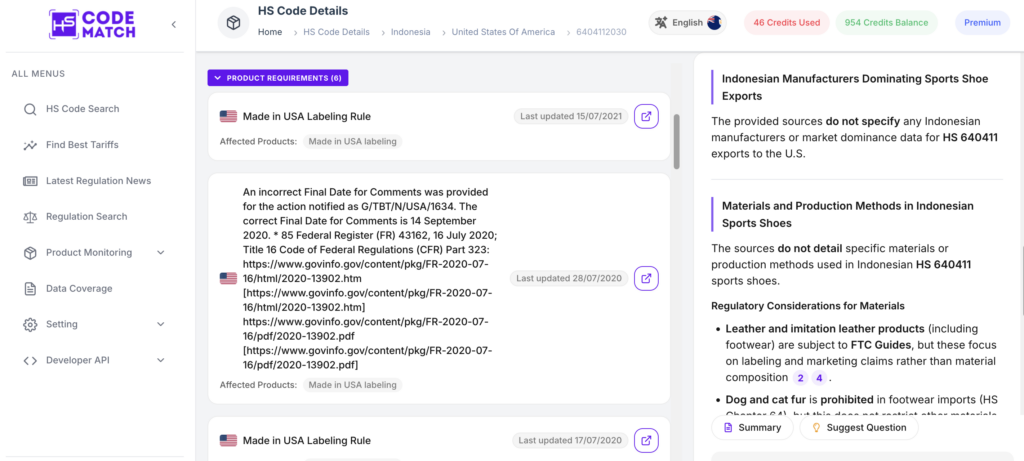
You can also use the AI Assistant to help you find the parts of the regulations. You can ask anything and request a summary of the regulations under this HS code. These are the details of the answer from the AI chatbot.
First question: What documents are required to export shoes from Indonesia to the United States?
Answer: The HS code 64041120 includes many shoes, such as sneakers, boots, etc. Then, the required documents are an invoice including the country of origin, price, quantity, description of the product, and packing list. The customs also required the origin marks, and there are other specific regulations for leather shoes; all of the materials in shoes should be documented as well.
Second question: What are the penalties of misclassifying shoes under HS code 64041120?
Answer: It shows that writing HS code for shoes incorrectly could cause a huge impact for the customs officers, such as the miscalculation of tariff and other restrictions. It also mentions that the common rate for footwear products in the United States is 20 percent, but this is only for the right one. Everyone will face punishment for inserting an incorrect HS code, and the punishments are fines, seizure, or even legal consequences.
Third question: What are the exact products under the HS code 64041120?
Answer: This code contains the shoes or footwear made of imitation leather or real leather. This also includes the shoes, boots, or closed or semi-closed shoes. The functions within this code are for working boots, hiking, party, and outdoor shoes. Meanwhile, the products under this code are different than the leather for making wallets, rucksacks, or backpacks, or other products.
Conclusion
The grasp of the HS code for shoes is crucial for international trade actors. The accurate HS code will help the traded goods or products pass through the customs process smoothly. Even though inserting the right HS code is simple, this process has a huge impact and should be done meticulously to avoid the threat of punishment from customs authorities. In order to alleviate the consequences of the failure of the HS code, you can use HS Code Match to find the accurate HS code based on the identification of your products. Not only assisting in finding HS code for shoes, but HS Code Match also provides the information and insights of the latest regulations, such as tariff rates, restrictions, product requirements, etc, in the country where your business partner is based.
Frequently Asked Questions (FAQs)
1. What is the structure of the HS code for shoes or footwear?
The structure of the HS code for footwear or shoes is under Chapter 64. This code can be classified with more specific additional codes after the Chapter, including headings and subheadings.
2. What are the consequences of inserting an incorrect HS code for shoes?
There are consequences of inserting incorrect HS code, such as shipment delay, seizure, and even fines. Therefore, many parties should pay attention to the correct HS code for shoes or every product.
3. Where can I find the HS code for shoes easily?
You can find the HS code using HS Code Match. This application has many features that can help you in order to find the correct HS code and other trade regulations.
4. What are the challenges to finding the HS code for shoes or other footwear?
The challenges include the identification of the combination of two or more materials in shoes, the evolution of shoemaker technology, and shoes that have two functions.
5. Why is the inclusion of the HS code for shoes important?
HS code for shoes is one of the requirements for international trade. Without an HS code, the products will be rejected and will face some consequences.
Find and Match the Right HS Code for Your Products.
Try Our App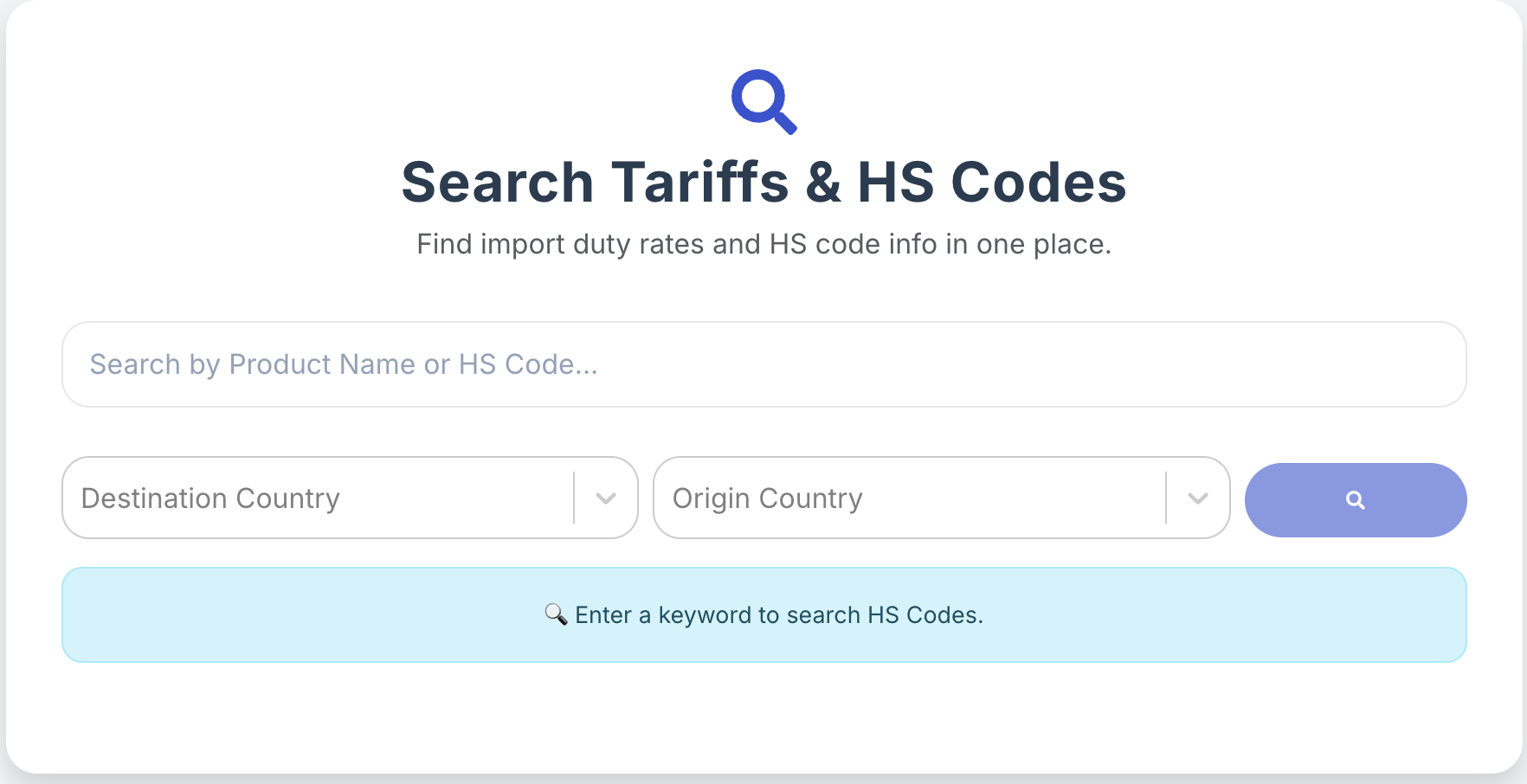

 Sep 10, 2026

