
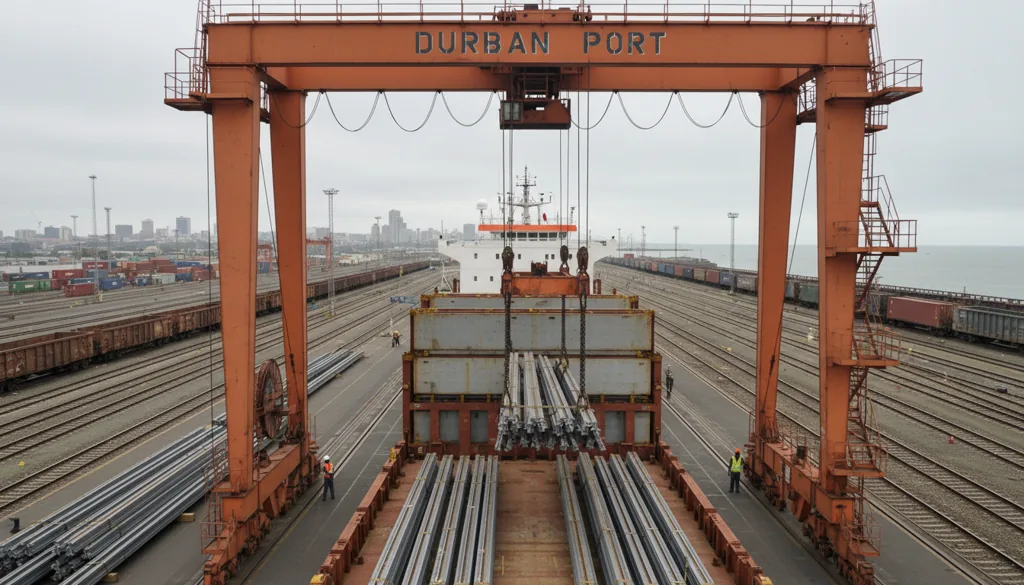
South Africa increased the rate of customs duty on rails from 5% to 10% under Part 1 of Schedule No. 1 following ITAC Report 751, effective 28 May 2026.
South Africa has doubled the customs duty on imported rails to 10%, with the change taking effect on 28 May 2026 under an amendment linked to International Trade Administration Commission (ITAC) Report 751.1
The increase applies to rails classified under tariff subheading 7302.10. Rails are used in railway tracks and related infrastructure, so the change affects the cost of bringing those products into South Africa rather than a broad range of steel goods. The importer pays the additional customs duty at the border. At 10%, the duty is twice the previous rate.
The measure is for changing the customs charge on imported rails. It does not create a new product approval system or a new shipment document. For an importer, the direct obligation is payment of the 10% customs duty on covered rails from the effective date.
The 28 May rail increase
The amendment substitutes the wording for tariff subheading 7302.10 in Part 1 of Schedule No. 1. That schedule is the part of South Africa’s customs tariff that sets ordinary import duties for listed goods. The notice describes the change as an increase from 5% to 10%, rather than the introduction of a separate surcharge.1
Duty on a R1m rail shipment
The legal vehicle is the Customs and Excise Act, 1964. The notice is dated 28 May 2026 and concerns amendments scheduled for publication in the Government Gazette. Publication details were to be made available later, according to the tariff amendment material.1
That timing matters for shipments moving through the border around the changeover. A rail shipment entered under the relevant tariff line after the effective date faces the higher rate, while the old rate applied before the measure took effect. The documents identify the legal start date but leave publication details to a later announcement.1
The amount payable will rise in proportion to the customs value used for the entry. A shipment valued at R1m would attract R100,000 in duty at 10%, compared with R50,000 at 5%, before any other taxes or border costs. That calculation is an illustration of the rate change, not a new valuation rule.
For customs brokers, the immediate classification issue is narrow but important. Rails must be entered under tariff subheading 7302.10 where the goods meet that description. The amendment changes the rate attached to that subheading, so a classification error could affect both the duty amount and the accuracy of the customs declaration.
A request from the steel sector
The rail increase appears in a wider ITAC record of tariff amendment investigations and requests. The record identifies AMRAS, a division of ArcelorMittal South Africa, as the applicant for rails and describes the request as an increase from 5% to 10%.2
The published record places the rail request alongside applications covering unrelated products. Those include aluminium chlorohydrate, transformer cores, steel drums, complete trackers and frozen mixed vegetables. The grouping shows that the rail decision came through the tariff investigation system rather than through a general rise in customs duties on all steel products.
The request was therefore product-specific. It targeted rails under 7302.10, while other steel items in the record were associated with different tariff lines and different proposed rates. A higher rail duty does not, on the material provided, change the rates for steel drums, stainless-steel tubes or transformer cores. The measure reaches the rail line and not the entire steel chapter.
ITAC’s broader policy material describes reciprocal commitments as part of tariff amendment investigations. Under that approach, a firm receiving tariff support can make commitments linked to production, investment, employment or other national objectives.2 The documents do not set out such a commitment for the rail increase itself, so the tariff change must be read on its stated terms: a higher duty on the specified rail classification.
That distinction is significant for businesses that import several kinds of steel products. A company bringing in rails and steel components cannot assume that the same rate applies across its purchases. The customs treatment remains tied to the tariff line, with the rail line moving to 10% from 5%.
The higher duty raises the delivered cost of imported rails unless the importer absorbs the increase or passes it through the supply chain. The effect will be most direct on contracts priced around a fixed border cost, especially where the goods are imported for infrastructure projects. The documents do not provide a forecast of volumes, prices or the total revenue effect.
ITAC’s tariff investigation framework
The rail decision sits within a policy framework dating back to an April 2016 trade policy directive. That directive was issued to ITAC by the then minister responsible for economic development and is now associated with the minister of trade, industry and competition.2
The framework behind the rail increase
The framework is also read alongside the 2021 Trade Policy for Industrial Development and Employment Growth. The policy material says tariff support should not blunt competitive pressure on firms and should help build capabilities, competitiveness and alignment with national interests.2
That language explains why tariff amendments can be assessed as more than simple revenue measures. A duty can shield local production from imported competition, but it also adds a cost to companies that buy the protected product. In the rail case, the policy balance is concentrated between support for local rail production and the higher border cost faced by rail importers.
The same material says reciprocal commitments are intended to align a private benefit with the national interest. It describes duties as economic rents that can benefit one firm while spreading costs across a wider group of economic actors.2 That is the central trade-off created by the increase: the benefit is concentrated in the covered product’s domestic supply chain, while the cost is paid at import and may travel into project budgets.
ITAC’s 2023-24 Annual Performance Plan included work on commitment studies in strategic sectors. The commission’s documents also refer to monitoring and evaluation of the effects of these arrangements.2 The rail amendment therefore forms part of a process in which tariff support can be examined against wider industrial outcomes, rather than being treated as an isolated customs-code edit.
For compliance teams, that context does not change the entry requirement. The operative event remains the substitution of the rail tariff line and the effective date. Policy objectives may shape later reviews, but the current customs declaration must reflect the rate that applies when the goods are entered.
Confidentiality and public scrutiny
The records also set out limits on the information ITAC can publish during tariff investigations. The commission is required not to disclose confidential business information, including material on plans, production costs and other commercially sensitive matters, under section 33(1) of the International Trade Administration Act, 2002.2
What the public record shows, and what it withholds
That restriction helps explain why the public record can identify the applicant and the tariff request without setting out every commercial argument behind it. It also means that the published materials provide only a partial view of the evidence considered in the investigation. The customs outcome, however, is public because it is implemented through a tariff amendment.
The legal framework gives informants a right to claim confidentiality for information that is confidential by nature or that they otherwise want treated as confidential.2 This protects sensitive submissions but limits the detail available to businesses trying to reconstruct the case for a rate change.
The same parliamentary material says reciprocal commitments are formalised through an Irrevocable Undertaking and monitored through reports submitted twice a year after implementation.2 That monitoring process matters if the rail increase is connected to commitments made during the underlying investigation, although the sources provided do not identify a rail-specific undertaking.
The result is a clear tariff change with a less complete public account of the commercial evidence behind it. Importers can see the product line, the old rate, the new rate and the start date. They cannot use the published material alone to quantify how the change will affect domestic output, project costs or import demand.
What the new rate reaches
The new duty is limited to rails classified under 7302.10, rather than every product made from steel. Other entries must continue to be tested against their own descriptions and tariff provisions. That makes product classification the dividing line between the 10% rate and the rates applying elsewhere.
One tariff line each: what was requested
| Product | Tariff line | Rate move |
|---|---|---|
| Rails | 7302.10 | 5% to 10% |
| Steel drums | 7310.10.90 | Duty-free to 15% |
| Transformer cores | 8504.90 | 5% to 15% |
| Aluminium chlorohydrate | 2827.32 | Duty-free to 10% |
| Frozen mixed vegetables | 0710.90 | Tariff structure review |
The wider investigation list includes a request for steel drums under tariff code 7310.10.90, seeking an increase from duty-free treatment to the World Trade Organisation bound rate of 15%. It also includes a request for transformer cores under 8504.90, seeking an increase from 5% to 15%.2 Those requests are separate from the rail amendment and do not alter the rate announced for rails.
The list also contains a request involving aluminium chlorohydrate under 2827.32, from duty-free treatment to 10%. Frozen mixed vegetables under 0710.90 were listed for a review of their tariff structure rather than as part of the rail increase.2 The variety of applications underlines why a company cannot infer a general tariff policy from one product decision.
For exporters selling rails into South Africa, the commercial effect is a higher import charge on the receiving side. For South African buyers, the increase may change the comparison between imported rails and locally supplied alternatives. The strength of that effect will depend on contract terms, customs value and whether the additional duty is passed through.
The duty applies from 28 May 2026.1 That date is the next fixed point for shipment planning, customs entries and contract calculations. It is also the point at which the rail tariff amendment begins to produce a different border cost, while the wider questions about industrial performance remain subject to the review and monitoring processes described in the ITAC material.
Sources
- ↩ Tariff Amendments 2026 – Customs Duty on Rails Increased to 10% https://www.sars.gov.za/latest-news/legal-counsel-secondary-legislation-tariff-amendments-2026-26/
- ↩ Reciprocal Commitments and Tariff Amendment Investigations in South Africa https://www.thedtic.gov.za/wp-content/uploads/PQ-711.pdf