
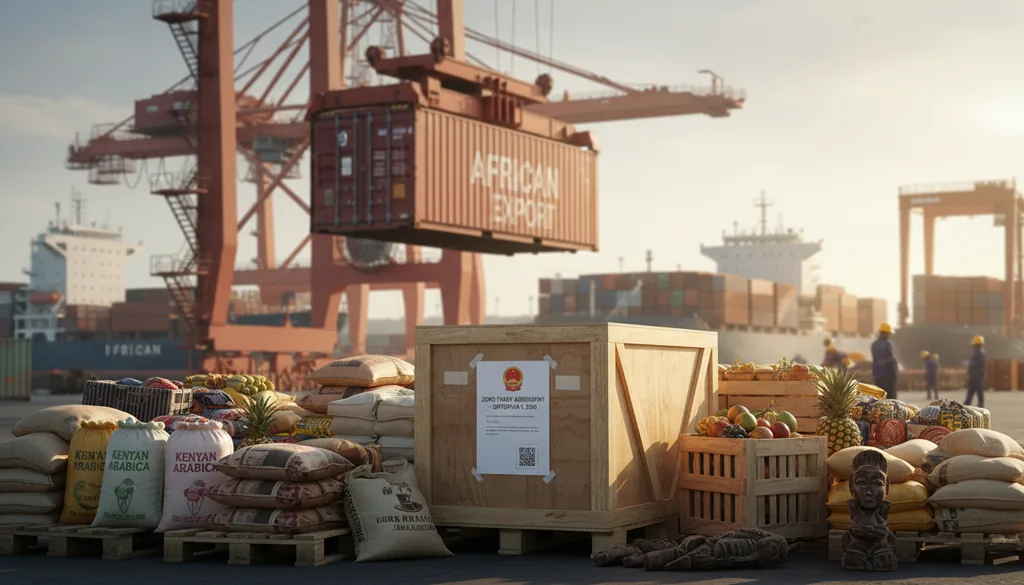
China announced that it would implement a zero-tariff policy on all tariff lines for products from 53 African countries with diplomatic ties with China from May 1, 2026.
China will remove all import tariffs on goods from 53 African countries with diplomatic ties from 1 May 2026, the commerce ministry said in a statement1. The measure covers every tariff line and will run for two years for the 20 African nations that are not classified as least-developed2. It follows a December 2024 decision to grant duty-free access to all products from the 33 least-developed African states that recognise Beijing1.
The policy targets everything from cocoa and coffee to machinery and processed foods, cutting delivered costs for African exporters by up to 30 % on some lines2. Senegalese groundnut oil, previously taxed at 10 %, and South African wine, which carried a 14-20 % duty, will now enter China duty-free if they meet origin and health rules2. The ministry estimates the change will save African exporters roughly $1.2 billion a year in tariffs3.
It comes as China’s trade with Africa hit a record $348 billion in 2025, up 23.7 % in the first quarter of 20264. The move is timed to mark the 70th anniversary of diplomatic relations and to align with the Forum on China-Africa Cooperation (FOCAC) Beijing Action Plan for 2025-20273.
The countries and the clock
The 53 nations include every African state that recognises Beijing: 33 least-developed countries already enjoyed full duty-free access, and the new measure extends the same treatment to the remaining 202. Among them are Algeria, Egypt, Kenya, Morocco, Nigeria, South Africa and Tunisia2. The zero-tariff window for these 20 runs until 30 April 2028, after which the duty-free status will depend on the completion of bilateral economic partnership agreements1.
Two groups, one tariff line
| Question | 33 least-developed states | 20 other states |
|---|---|---|
| Duty-free since | December 2024 decision | 1 May 2026 |
| Zero-tariff window | Ongoing | Until 30 April 2028 |
| After the window | — | Bilateral partnership agreements |
| Examples | — | Algeria, Egypt, Kenya, Morocco, Nigeria, South Africa, Tunisia |
The ministry published the detailed tariff schedule on 28 April 20262. Importers must still present a certificate of origin issued by the exporting country’s customs authority; without it, the shipment reverts to the standard most-favoured-nation rate1. Health and safety certificates remain mandatory for food, plants and live animals5.
What the tariff cut changes
Before May 2026, duties on African goods ranged from 0 % to 50 %, with most agricultural products taxed at 8-22 % and manufactured goods at 5-15 %2. The new schedule sets every line at 0 % for qualifying shipments1. Cocoa from Côte d’Ivoire and Ghana, previously taxed at 8-22 %, and Kenyan avocados, which carried a 20 % duty, now enter duty-free2. The ministry calculates that a 100-tonne shipment of sesame saves $11,000 in tariffs, while Nigeria’s annual export of 7,000 tonnes of cattle bone granules saves $450,0003.
Tariff saved on a qualifying shipment
The change is unilateral: China does not require reciprocal tariff cuts from African partners1. It also does not remove non-tariff barriers such as testing, labelling or quarantine rules5. Senegalese exporters report that sending samples to European laboratories for required tests adds weeks and thousands of dollars to each order5.
Who gains and who still pays
The biggest beneficiaries are exporters of processed and semi-processed goods. Senegal’s groundnut oil exports to China rose 313 % in the first half of 2026, while groundnut shipments climbed 169 %5. Nigerian sesame and cashew exports have also surged, with monthly growth exceeding 40 % in May and June3. Small and medium-sized processors, however, still bear the cost of compliance: product testing, packaging upgrades and certification fees remain unchanged5.
Where the benefit and the burden land
Chinese importers pay nothing; the tariff cut is absorbed by China’s customs revenue1. African governments and exporters must still fund the infrastructure, testing and logistics needed to meet Chinese standards4. A Senegalese trade official noted that zero tariffs “open the door, but we must walk through it with products that are competitive, compliant and processed”5.
The next two years and beyond
The zero-tariff window for the 20 non-least-developed countries closes on 30 April 20282. After that, duty-free access will depend on the completion of bilateral economic partnership agreements that cover goods, services, investment and digital trade1. China and Nigeria signed a framework agreement in March 2026, and negotiations with Kenya, Egypt and South Africa are expected to start in late 20263.
The clock on duty-free access
The ministry said it will open “green channels” for African exports, establish commodity exhibition centres in China and expand cross-border e-commerce platforms3. Training programmes on Chinese market-access rules have already begun in Senegal and Nigeria5. Without these agreements, the 20 countries will revert to the standard tariff schedule on 1 May 2028, losing the duty-free advantage1.
What the policy does not change
The measure does not alter China’s health, safety or origin rules. Every shipment must still carry a plant-health certificate for plants, a veterinary certificate for live animals and a certificate of analysis for processed foods5. Senegalese exporters report that some required tests are not available in-country and must be performed in Europe, adding cost and delay5. The policy also does not cover services, digital trade or government procurement3.
What the zero-tariff policy does not cover
It is not permanent: the two-year window is designed to give African nations time to negotiate the longer-term agreements that will lock in duty-free access2. Until those agreements are signed, the zero-tariff status remains temporary and unilateral1.
Sources
- ↩ China Implements Full-Scale Zero Tariff Measures for 53 African Diplomatic Partners https://www.mofcom.gov.cn/syxwfb/art/2026/art_18ff89e6cb2e43b7b2e76066a270c8ee.html
- ↩ China Implements Zero Tariff Measures for 53 African Countries Effective May 1 https://www.mofcom.gov.cn/xwfb/sjfzrfb/art/2026/art_eb89a23715fa49cf87c245c1d0710842.html
- ↩ Keynote Speech by Chinese Consul General in Lagos Mrs. Yan Yuqing at the Seminar on China’s Zero-Tariff Measures and Africa’s Economic Structural Transformation https://lagos.china-consulate.gov.cn/eng/zlgxw/202608/t20260820_12007025.htm
- ↩ China and Africa in the Zero-Tariff Era https://ly.china-embassy.gov.cn/lbyyw/202606/t20260602_11923088.htm
- ↩ Senegal eyes more processed exports to China under zero-tariff policy http://www.focac.org/eng/zfgx_4/jmhz/202608/t20260827_12011278.htm