
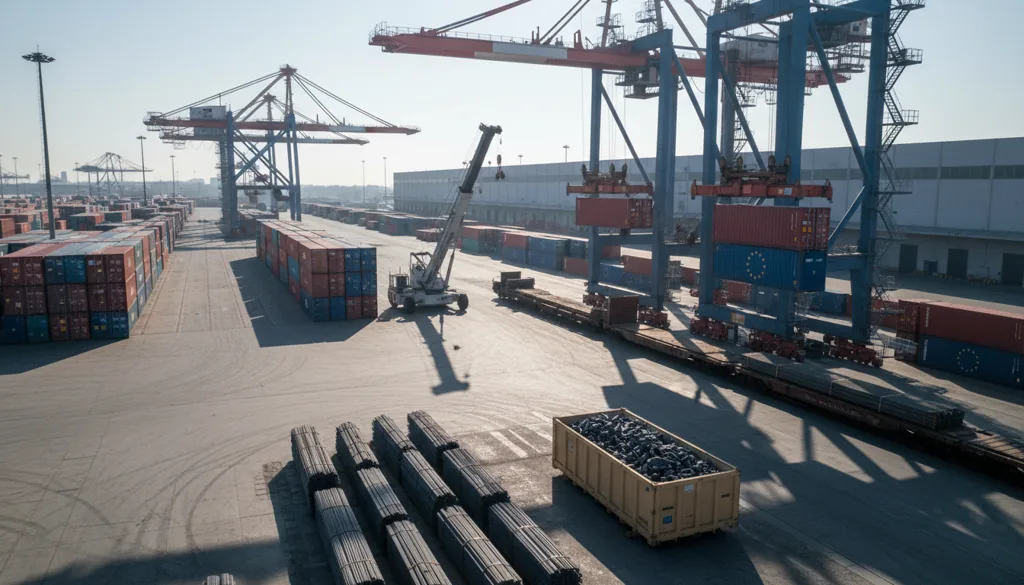
The European Union distributed country-specific tariff quotas for steel imports under Implementing Regulation (EU) 2026/1457, complementing the new permanent Steel Overcapacity Regulation that took effect on 1 July 2026.
The European Commission has shared out the EU’s duty-free steel import quotas among trading partners, under a regulation covering 30 types of steel products from 1 July 2026.
The rules sit in Commission Implementing Regulation (EU) 2026/1457 of 29 June 2026, published in the EU’s Official Journal on 30 June 20261. The regulation spreads out the quotas opened by a new steel law, Regulation (EU) 2026/13841.
In short, only a fixed amount of foreign steel can now enter the EU each year without extra tax. Once a country uses up its share, its steel pays a 50% duty at the border.
How much steel can enter the EU duty-free?
The steel law caps duty-free steel imports at 18\.3 million tonnes per year2. A tariff quota is a limited amount of goods that can enter at a low or zero duty during a set period3. Above that amount, the normal or higher duty applies.
The new cap is about 47% lower than the 2024 quota volumes4. The European Parliament gave the same 47% figure when it approved the law5. The law covers 30 categories of steel products, up from 28 under the old rules4.
Two new categories were added at Parliament’s request4. They are stainless wire rod and forged bars, both non-alloy and other alloy4. Each category is listed by customs code (CN code) in Annex I of the steel law4.
What happens to steel above the quota?
Steel that arrives after a quota is full pays an out-of-quota duty of 50%2. The old safeguard, a temporary protection measure in place since 2018, charged 25%5. So the extra tax on steel beyond the limit has doubled.
Duty on steel above the quota, %
The Parliament’s press release says the 50% duty also applies to steel goods not covered by a quota5. For a buyer, this means the price of a late shipment can rise sharply. The date a shipment clears customs can decide whether it pays zero or 50%.
Most EU tariff quotas work on a first-come, first-served basis3. Customs uses up the quota in the order that import declarations arrive3. Once the quota is reached, no further imports are allowed under it3.
How does the 2026/1457 regulation share out the quota?
The Commission’s factsheet says two rules matter most2. The first is past trade with the EU. Any country with at least 5% of EU imports of a steel product in 2022 to 2024 gets its own country quota2.
Countries below that level share a common pool, called the residual quota2. The factsheet says this system is the same as under the old steel safeguard2.
The second rule favours countries with a free trade agreement (FTA) with the EU. Half of the 18\.3 million tonnes, or 9\.15 million tonnes, is kept for FTA partners only2. Most of that half goes to named FTA partners in line with their past trade2. A smaller part is open to FTA partners on a first-come, first-served basis2.
Which countries get better treatment under the steel quotas?
The factsheet says the method gives FTA partners a higher quota volume2. It also considers the security of supply and deals reached at the World Trade Organization2. The results differ by group:
- FTA partners above 5% get a country quota, then a shared FTA quota.
- FTA partners can also use the residual quota, competing with all others.
- Some FTA partners get a secured volume in certain categories.
- Non-FTA partners above 5% get a country quota open on normal terms.
- Non-FTA partners below 5% use only the residual quota.
Outside the quotas and the 50% duty
The factsheet does not list the tonnes given to each named country. Those figures are in the 2026/1457 regulation itself6. Each supplier country’s share can differ from one product category to the next.
Iceland, Liechtenstein and Norway are outside the quotas and the 50% duty4. They belong to the European Economic Area, a wider single market with the EU4. Goods from countries with their own bilateral safeguard under an FTA are also excluded4.
What changes for Russian and Ukrainian steel?
The law ends an old exemption for steel slabs from Russia4. No steel melted or cast in Russia or Belarus may use any quota4. Such steel therefore faces the full out-of-quota duty.
Old safeguard and new steel law
| Question | Old safeguard | New steel law |
|---|---|---|
| Steel product categories | 28 | 30 |
| Duty above the quota | 25% | 50% |
| Russian steel slabs | Exemption | No quota access |
| Ukrainian steel | Exemption | Considered in country quotas |
Ukraine had an exemption under the old safeguard that was due to last until summer 20284. The new law says Ukraine’s situation must be considered when country quotas are shared out4. Parliament’s lead negotiator, Karin Karlsbro, said in the press release that Ukraine "must not be punished" by the measures5.
What proof of steel origin must importers show?
At import, buyers of quota steel must give clear and checkable proof of the "country of melt and pour"4. This is the country where the iron or steel was first made liquid and then cast solid4. One accepted example is a mill certificate, a document from the steel plant4.
The Commission says this proof does not directly decide how quotas are shared out4. Its aim is to show where the steel really comes from4. Parliament said the rule limits attempts to avoid the quota through small processing steps in other countries5.
The Commission ran a public consultation on the type of evidence importers must give6. Shipments without this proof risk delays at the border.
Can unused steel quota move to the next quarter?
Quotas run by quarter, and unused amounts can move forward in the first year. In the first year only, unused volume in one quarter moves to the next quarter of the same year4. This gives buyers some room to finish existing supply contracts4.
Key dates for the steel quotas
After the first year, the Commission may change these carry-over rules4. Carry-over is also allowed when average use of a category’s quota passes 80% in the first three quarters4.
The steel law may also grow. By 30 June 2027, the Commission will assess whether to add products made from or containing much steel4. That review could bring more goods, not just raw steel, under the 50% duty.
Sources
- ↩ Commission Implementing Regulation (EU) 2026/1457 of 29 June 2026 on the distribution of tariff quotas opened under Regulation (EU) 2026/1384 https://eur-lex.europa.eu/eli/reg_impl/2026/1457/oj/eng
- ↩ Factsheet: EU steel measure – Trade and Economic Security https://policy.trade.ec.europa.eu/enforcement-and-protection/protecting-eu-steelmaking/factsheet-eu-steel-measure_en
- ↩ Tariff quota database (QUOTA) – Taxation and Customs Union. https://taxation-customs.ec.europa.eu/online-services/online-services-and-databases-customs/tariff-quota-database-quota_en
- ↩ New EU safeguards on steel imports from third countries https://trade.ec.europa.eu/access-to-markets/en/news/new-eu-safeguards-steel-imports-third-countries
- ↩ Steel overcapacity: MEPs approve new measures to protect EU … https://www.europarl.europa.eu/news/en/press-room/20260513IPR43305/steel-overcapacity-meps-approve-new-measures-to-protect-eu-steel-market
- ↩ Protecting EU steelmaking – Trade and Economic Security https://policy.trade.ec.europa.eu/enforcement-and-protection/protecting-eu-steelmaking_en