
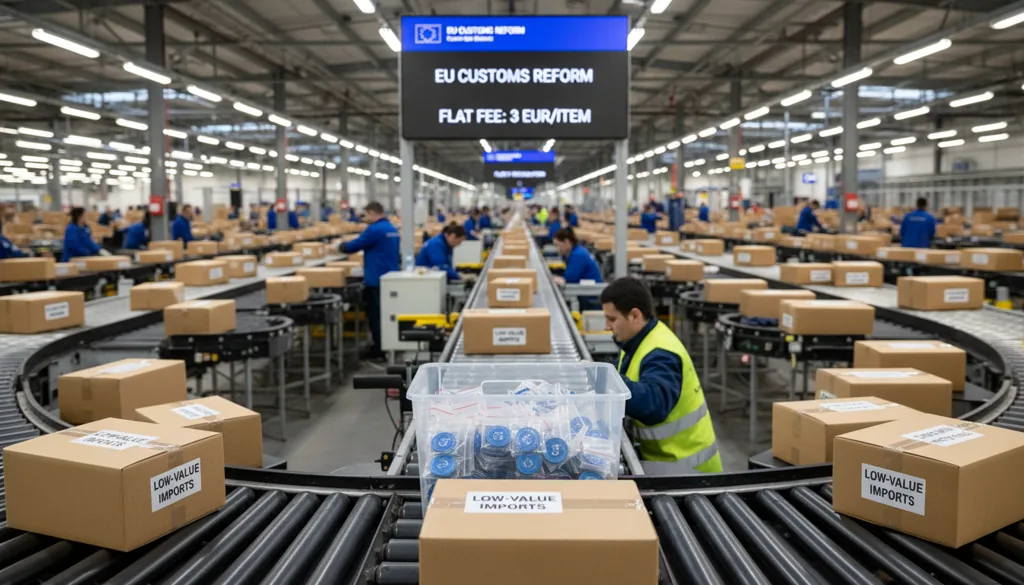
The European Union applies a temporary €3 customs duty per item on low-value consignments up to €150 starting from 1 July 2026.
The European Union will replace its duty-free treatment of low-value imports with a temporary €3 customs duty per item from 1 July 2026.1
The charge will cover goods worth up to €150 arriving from outside the EU, including clothing, toys, electronics and other consumer products sold online. It will apply until 1 July 2028, when the EU plans to move to normal customs duties based on the type of goods.2 The change removes the low-value customs exemption that has allowed qualifying imports to enter without a duty.
The measure is designed to bring small online imports into the same customs system as other goods and to improve checks on unsafe or wrongly declared products. The seller, platform, carrier or customs agent acting as declarant will be responsible for declaring and paying the charge, rather than the consumer in the normal case.3 That places the immediate administrative and cash-flow burden on businesses moving low-value goods into the EU.
The €150 parcel threshold
The new duty covers distance sales, meaning goods sent from a non-EU country to a customer in an EU member state as part of an online or other consumer transaction. It applies regardless of whether import VAT is handled through the Import One Stop Shop, a special arrangement or the standard VAT procedure. The existing VAT schemes remain in place, so the customs change is separate from the way VAT is collected.4
The scale of it
The scope reaches beyond the most familiar online parcels. The rules also cover products that had previously been outside the tariff exemption, including alcohol, perfumes and tobacco, where the shipment qualifies as a distance sale and has an intrinsic value of €150 or less. The charge is therefore tied to the value and nature of the transaction, not simply to whether a parcel is sent directly to a private home.2
The EU says the change responds to the scale of e-commerce imports and to concerns about safety, fraud and competition. Almost 5.9 billion low-value items were shipped directly from third countries to EU consumers in 2025, according to the Commission material. Checks across cosmetics, personal protective equipment, food supplements, toys and electronics found more than 60% of the products examined failed EU standards.1 The figures explain why a rule created to reduce paperwork for small imports is being replaced by a charge and more detailed data requirements.
How customs will count an item
The duty is described as a charge per item, but its practical operation depends on the declaration. An item is defined by a shared tariff classification, description and, where provided, origin. In current customs systems, the amount is automatically calculated by declaration line, so a line covering the same classification can attract one €3 charge even when it contains several units.4
Duty per parcel, by declaration line
That distinction makes the form used for entry commercially important. Five T-shirts in one qualifying classification would generate a €3 duty, while three T-shirts and a watch would generate €6 because the goods fall under two classifications. The result is based on classification rather than the number of physical products in the parcel.1 A shipment containing several types of goods can therefore produce a higher duty even when its total value remains below €150.
The difference is sharper between declaration formats. H1 declarations require a 10-digit TARIC classification, while H6 and H7 declarations use a less detailed classification level. Three goods that could share one line in an H6 or H7 declaration might produce three lines in H1 if their more detailed TARIC codes differ, resulting in €9 rather than €3.2 This is a customs-data issue as much as a tariff issue, because the structure of the declaration determines how the temporary duty is calculated.
Sellers carry the customs debt
The declarant is the main party responsible for the charge. That can be the seller, an online platform using a VAT scheme, a carrier or an indirect customs representative acting for the importer. Consumers can declare goods only in limited cases where a member state offers a free web-based declaration system, making household payment the exception rather than the normal route.1
Who declares and pays
Customs authorities must have the duty paid or covered by a guarantee before the goods are released under the ordinary rule. The guidance also allows customs to require a comprehensive guarantee where the goods are declared for free circulation and the customs debt has not been settled. This gives the new charge a direct effect on the release process, rather than leaving it as a later accounting adjustment.4
The responsibility follows the goods even when they are handled in bulk. Shipments sold to EU consumers before being placed in a customs warehouse can still qualify as distance sales, and the temporary duty can apply when those goods are later released. Bulk storage therefore does not by itself remove the charge from a sale that began as an import transaction for an EU customer. That matters for fulfilment models that combine online orders, warehouse storage and later delivery.
The practical effect is to put low-value parcels into a more structured customs workflow. The cost falls first on the business that makes the declaration, although commercial arrangements can determine whether it is absorbed, passed into a delivery charge or reflected in the price. The law identifies the customs debtor; it does not dictate the final retail price paid by the customer.
Product identifiers arrive in November
The customs reform also adds a traceability obligation for online imports. Product identifiers, or PIDs, are intended to connect a declared product with information supplied by its manufacturer, producer or seller. The Commission says the data will help customs and market-surveillance authorities identify unsafe goods and extend checks from one suspect product to others with a similar risk.4
Product identifier deadlines
PIDs can be submitted voluntarily from the day the €3 duty begins, but they become mandatory on 1 November 2026.1 The voluntary period is meant to give customs systems and supply chains time to begin exchanging the information. Enforcement of the requirement starts in November, with no sanction during the initial voluntary period for missing or incorrect PID data.4
The identifier rules add a second operational deadline to the tariff change. Businesses handling H1, H6 or H7 declarations will need to connect product records with the appropriate customs data, including cases involving personalised textiles or customised goods. The requirement is aimed at enforcement as well as paperwork, because it gives authorities a way to trace a product across sellers and shipments.
The customs declaration will also identify the VAT procedure used for the import. Codes for the Import One Stop Shop, special arrangements and standard VAT treatment are available in the relevant data field, with some combinations becoming mandatory where prohibitions and restrictions apply.2 VAT therefore remains a separate system, but its use must still be represented in the import data surrounding the new duty.
The temporary period ends in 2028
The €3 rate is not intended to become the EU’s permanent tariff for low-value goods. It will apply from 1 July 2026 to 1 July 2028, after which normal customs rates are scheduled to apply according to tariff classification. The transition is linked to the planned launch of the EU Customs Data Hub for e-commerce.2
Low-value imports, three regimes
| Question | Before 1 Jul 2026 | 1 Jul 2026 – 1 Jul 2028 | From 1 Jul 2028 |
|---|---|---|---|
| Duty on ≤€150 goods | None — exemption | €3 per declaration line | Normal duties by classification |
| Product identifiers | Not required | Voluntary, then mandatory from 1 Nov 2026 | Part of the Data Hub system |
| Handling system | Low-value exemption | Existing national systems | EU Customs Data Hub |
That timetable gives the measure a defined interim role. It removes the duty-free threshold immediately while the EU builds a system capable of handling more detailed product and transaction information. If the infrastructure is not operational by the scheduled date, the temporary arrangement may be extended, according to the material explaining the regulation.
The legal framework was completed through Council Regulation (EU) 2026/382 and Commission Implementing Regulation (EU) 2026/1200. The implementing regulation, published on 8 June 2026, adjusts declarations, customs processing, guarantees and product-identification requirements so the duty can operate through existing national systems.2 The guidance is consequently focused not only on the rate, but on how customs systems will recognise and collect it.
A separate Union handling fee remains under discussion and is not the same as the customs duty. Its amount and start date were still to be determined in the material describing the scheme, with a possible introduction later in 2026. Keeping the two measures separate is important for cost calculations: the €3 charge is a customs duty already fixed for 1 July, while the handling fee would cover customs-processing costs.
For importers, exporters, platforms and customs brokers, the immediate change is therefore both financial and digital. Low-value shipments will carry a €3 duty per declaration line, businesses will bear the primary payment responsibility, and product data will become mandatory in November. The EU’s longer-term objective is to replace the temporary system with normal tariffs and a customs data hub from 1 July 2028.4
Sources
- ↩ Temporary €3 Flat Fee on Low-Value EU Imports https://taxation-customs.ec.europa.eu/news/guidance-and-legal-text-temporary-flat-fee-low-value-imports-which-will-apply-until-1-july-2028-2026-06-08_en
- ↩ EU imposes €3 customs duty per item on low-value e-commerce shipments https://trade.ec.europa.eu/access-to-markets/en/news/eu-applies-eu3-customs-duty-item-low-value-e-commerce-consignments
- ↩ €3 customs duty for low-value parcels from 1 July 2026 https://commission.europa.eu/news-and-media/news/ensuring-fairness-and-safety-eur3-customs-duty-low-value-parcels-2026-06-29_en
- ↩ IMPORTATION AND EXPORTATION OF LOW VALUE CONSIGNMENTS – The EUR 3 temporary customs duty ‘Guidance for Member States and Trade’ https://taxation-customs.ec.europa.eu/document/download/053e5b4e-f0be-4f20-9a23-3e3b659a6676_en?filename=Customs%20Guidance%20on%20EUR%203%20customs%20duty.pdf