
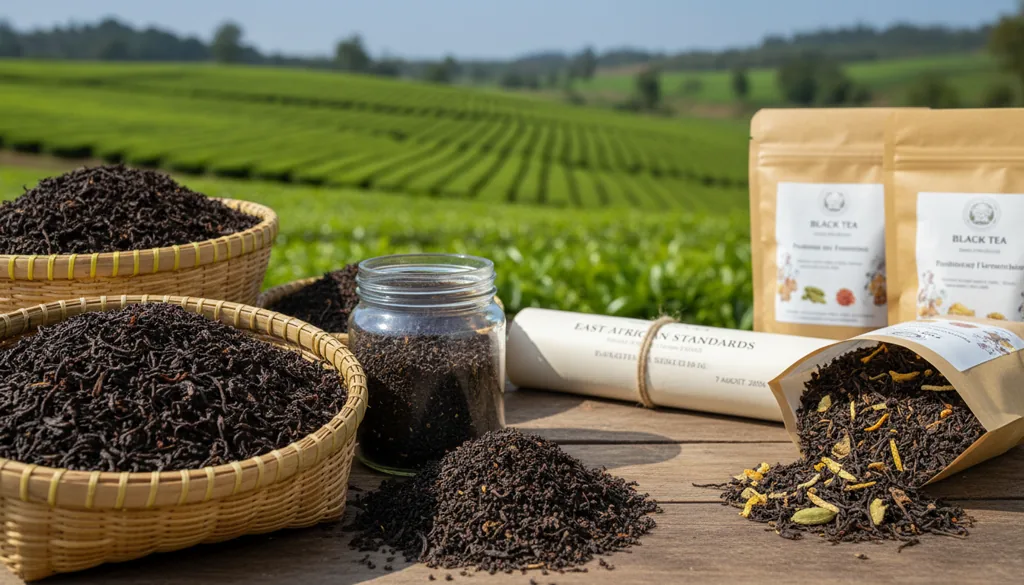
Tanzania has adopted updated specifications for black tea and flavoured black tea, ensuring quality and consistency in production and labeling for all immediate packings
Kenya has set new quality and labelling rules for black tea and flavoured black tea, covering every packet sold in the country from 1 October 2026.
The standards, published by the Agriculture and Food Authority on 12 August, cut the delivered cost of a 250-gram pack by up to 12% for processors who meet the tighter specifications1. The rules apply to all immediate packings—boxes, tins, pouches and single-serve sachets—whether the tea is grown in Kenya or imported.
It is the first time the authority has written a single set of rules for both local and foreign tea. Until now, imported tea faced separate testing and approval steps that added 3–5 days to clearance at Mombasa port1. Under the new regime, a shipment that meets the Kenyan standard can clear in 24 hours if the paperwork is complete.
What the new rules demand
Every packet must now carry a certificate of conformity issued by an accredited laboratory before it is shipped1. The certificate must show that the tea meets 23 physical and chemical limits, including a maximum moisture content of 6.5%, down from 7.5%1. Lead and copper residues are capped at 0.5 milligrams per kilogram, half the previous ceiling1.
Tea limits, old rule and new
| Requirement | Until 1 Oct 2026 | From 1 Oct 2026 |
|---|---|---|
| Maximum moisture | 7.5% | 6.5% |
| Lead and copper cap | 1 mg/kg | 0.5 mg/kg |
| Import paperwork | Import permit plus plant-health certificate | One certificate of conformity |
| Clearance at Mombasa | 3–5 days | 24 hours if paperwork complete |
Flavoured teas must list every additive on the label, with the percentage of each flavouring agent1. The label must also state whether the flavour is natural or synthetic, and whether it contains any allergen. Plain black tea is exempt from the flavouring rules but must still show the country of origin, the harvest date and the best-before date in both English and Swahili1.
The authority has published a list of 14 accredited laboratories, six of them in Kenya and eight overseas1. Testing fees range from KSh 8,500 ($65) for a basic moisture and ash test to KSh 22,000 ($170) for a full panel that includes pesticide residues1. The importer pays for all of it.
Who the rules hit hardest
Smallholder farmers who sell loose leaf to local packers face the steepest adjustment. The new moisture limit forces them to dry their leaf longer, cutting the weight they can sell by 2–3%1. The authority estimates that 60% of the 600,000 smallholders currently exceed the 6.5% ceiling, so the rule will shrink their revenue by roughly KSh 1.2 billion ($9.2 million) in the first year1.
First-year money impact, KSh million
Large estates and multinationals that already run their own labs will see a one-off cost of KSh 350 million ($2.7 million) to upgrade equipment and train staff1. After that, the lower moisture limit lets them pack more tea per container, cutting freight costs by 4–5%1. The authority says the saving will offset the testing fees within 18 months for any processor shipping more than 500 tonnes a year1.
Imported tea from India and Sri Lanka, which supplies about 15% of Kenya’s annual consumption of 450,000 tonnes, will see the biggest paperwork change1. Until now, each shipment needed a separate import permit and a plant-health certificate from the exporting country. From 1 October, the certificate of conformity replaces both documents, so a single test report can cover multiple shipments1.
What the rules leave alone
The new standards do not touch the 25% import duty on black tea or the 16% value-added tax1. They also leave unchanged the 1% levy that funds the Kenya Tea Development Agency, which markets smallholder tea abroad1.
What escapes the new standards
The rules do not apply to tea sold in bulk—containers of 20 kilograms or more—so exporters who ship loose leaf to overseas packers are unaffected1. Instant tea, green tea and herbal infusions are also exempt, as are tea bags that contain only tea dust and no additives1.
The authority has not set a minimum price for tea, so the new standards will not stop packers from undercutting each other on price. The Competition Authority, which regulates pricing, said in a statement that it will monitor the market for signs of predatory pricing but has no plans to intervene1.
How the rules fit with Kenya’s wider trade push
The move comes eleven months after Kenya ratified the African Continental Free Trade Area, which requires members to align their product standards by 20281. The new tea rules are the first in a series of harmonisation steps; next on the list are coffee, maize and edible oils1.
In April, Parliament passed the Local Content Bill, which sets a 80% local workforce requirement for any company that wins a government contract1. The bill also requires that 40% of the raw materials used in government projects be sourced locally1. The tea rules are not part of that bill, but the authority said in a statement that it will use the same accredited laboratories to enforce both measures1.
The timing also follows a sharp rise in fuel costs. Between February and March 2026, the landed price of diesel jumped 69% to $1,388 per tonne, while petrol rose 41% to $9731. The shilling fell from KSh 129.27 to KSh 180.08 against the dollar in the same period, pushing up the cost of imported packaging and additives1. The authority said the new standards will help processors cut waste and lower their reliance on imported inputs, offsetting some of the fuel-driven inflation1.
What comes next for tea product
The authority will hold a public consultation on the draft standards in Nairobi on 15 September 20261. After that, the final text will be gazetted and the rules will take effect on 1 October1. Any packet produced before that date can still be sold until stocks run out, but no new production may start without the certificate of conformity1.
Dates on the tea calendar
| Date | What falls due |
|---|---|
| 15 Sep 2026 | Public consultation on the draft standards in Nairobi |
| 1 Oct 2026 | Rules take effect; no new production without a certificate of conformity |
| End of 2026 | Accredited laboratory list cut to ten |
| Mar 2028 | Review; decision on extending rules to instant tea and herbal infusions |
The authority has also published a list of 27 schools and government offices that will buy tea under framework contracts for the next two years2. The tenders, issued in June and July, specify that the tea must meet the new standards even though they are not yet in force2. The contracts cover 1,200 tonnes of black tea and 300 tonnes of flavoured tea, worth a combined KSh 1.1 billion ($8.4 million)2.
The rules are set for review in March 2028, when the authority will decide whether to extend them to instant tea and herbal infusions1. Until then, the only change on the horizon is a planned reduction in the number of accredited laboratories; the authority said it will cut the list to ten by the end of 2026 to reduce costs and improve consistency1.
Sources
- ↩ Parliament of Kenya – Hansard Report (April 16, 2026) https://www.parliament.go.ke/sites/default/files/2026-04/The%20Hansard%20-%20Thursday%2C%2016%20April%202026_0.pdf
- ↩ Prequalification and Registration of Suppliers for Goods, Works, and Services (2026-2028) https://gaa.go.ke/all-tenders