
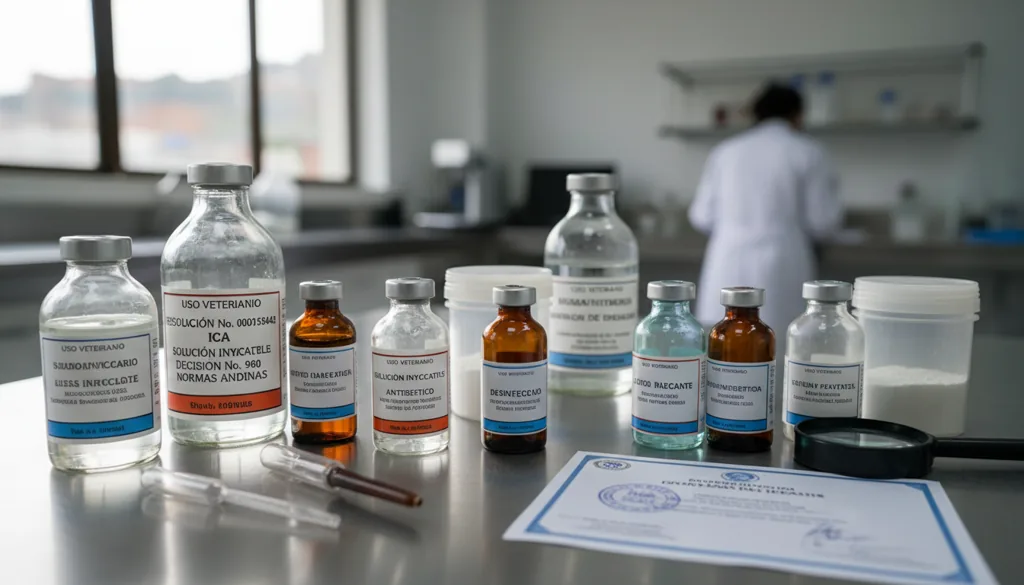
Colombia has implemented comprehensive regulatory requirements for veterinary and pharmaceutical products, including antiseptics, disinfectants, and insecticides, to ensure compliance with Andean Community standards and safeguard animal health through enhanced quality control and good practices.
Colombia tightens rules for veterinary medicines in Andean trade overhaul
Colombia has issued a sweeping new regulation that forces every company selling veterinary medicines, vaccines or animal-care products in the country to update its registrations by 6 August 2027, aligning domestic rules with the Andean Community’s Decision 960 of 2025. The measure, ICA Resolution 00015843, published on 6 August 2026, covers 1,463 tariff lines—from antibiotics and vaccines to flea collars and disinfectants—and imposes a single set of good-manufacturing and storage standards across the four-nation bloc. The delivered cost of compliance will fall on the importer or local producer; the government will not subsidise testing or inspections.
It comes after a decade in which Colombia, Ecuador, Peru and Bolivia each ran its own registration system, creating duplicate paperwork and divergent safety thresholds. The new regime replaces Decision 483 of 2000, which the Andean Technical Committee on Animal Health recommended scrapping in 2011. Until now, the same vaccine could be registered in Lima under one set of clinical trials and in Bogotá under another, leaving importers to navigate two sets of dossiers for a single product. The harmonised rules remove that redundancy, but they also introduce tighter deadlines and stricter penalties for incomplete filings.
The resolution is the first major overhaul of veterinary-product regulation since Colombia joined the Andean Community in 1969. Under the old system, a company could keep selling a product for years without updating its registration; the new rules require every registration to be renewed every five years, and every existing registration must be re-filed within twelve months of the resolution’s publication1. That timetable is split into three waves: vaccines and biologicals must be updated by 6 February 2027, pharmaceuticals by 6 May 2027, and disinfectants, insecticides and repellents by 6 August 20271. A company that misses its deadline will see its registration cancelled and must start the process again from scratch.
Who must comply, and what they must file
The rules bind any company—domestic or foreign—that manufactures, imports, stores or sells veterinary medicines, vaccines, insecticides, antiseptics or disinfectants in Colombia. That includes contract manufacturers, third-party laboratories that test products for other firms, and even small clinics that mix their own autogenous vaccines2. Each company must appoint a regulatory affairs officer who will be personally responsible for submitting the updated dossier and for reporting any adverse events after the product is on the market3.
What goes in the electronic dossier
The dossier itself is a single electronic submission through the ICA’s document-management system. It must include: a certificate of good manufacturing practices issued by the competent authority in the country of origin; stability-test results covering the product’s entire shelf life; a full list of ingredients and their suppliers; and a risk-assessment report for any contaminants that could enter the product during production1. For imported goods, the importer must also provide a certificate of free sale from the exporting country’s veterinary authority4. If any document is missing or incomplete, the ICA will grant a single fifteen-day grace period to correct it; after that, the registration is cancelled1.
The new safety net: pharmacovigilance and on-site inspections
Beyond the initial registration, the resolution embeds a national pharmacovigilance system that requires every company to monitor and report adverse events—any unexpected reaction in an animal or human handler—for the entire life of the product. Reports must be filed within seventy-two hours of an incident, and the ICA can demand additional data or suspend a product if the risk-benefit balance shifts3. The system mirrors the one Colombia already runs for human medicines, but it is the first time the same rigour has been applied to veterinary products across the Andean Community.
Clocks the safety net sets, in days
On-site inspections are now mandatory for every company that manufactures or stores veterinary products. The ICA will visit each facility within forty-five working days of receiving a complete dossier; if the inspection finds deviations from good manufacturing or storage practices, the company has twenty days to fix them or face cancellation1. The same forty-five-day window applies to third-party laboratories that test products for other firms. Inspectors will check everything from air-filtration systems to pest-control logs, and they can take samples for independent testing at any time.
The timetable and the cost
The first wave of updates—vaccines and biologicals—opens on 6 August 2026 and closes on 6 February 2027. Pharmaceuticals follow, with a deadline of 6 May 2027, and the final group—disinfectants, insecticides and repellents—must be filed by 6 August 20271. Companies that already hold registrations under the old rules can continue selling until their deadline passes, but they may not introduce new products or new formulations until the updated registration is approved. New products can be registered at any time, but they must meet the same standards as the updates and will be subject to the same inspection regime.
Three waves, three deadlines
| Deadline | Products caught |
|---|---|
| 6 Feb 2027 | Vaccines and biologicals |
| 6 May 2027 | Pharmaceuticals |
| 6 Aug 2027 | Disinfectants, insecticides, repellents |
The ICA has not published a fee schedule, but the resolution states that every application must be accompanied by proof of payment for the “current tariff”5. Under the old system, a single-product registration cost roughly 1.5 million Colombian pesos (about $375); the new rules require separate registrations for each manufacturing site and each laboratory that tests the product, so a company with three factories and two external labs could face five separate fees. Storage facilities are also subject to registration, adding another layer of cost for distributors.
What happens if a company misses the deadline
A company that fails to update its registration by the assigned deadline will see its licence automatically cancelled. The ICA will publish a list of cancelled products on its website, and any sale of a cancelled product after the deadline is treated as an illegal import, subject to fines of up to 100 million pesos (about $25,000) and confiscation of the shipment3. The company can reapply, but it must start the process from the beginning, including paying the registration fee again and waiting up to forty-five days for an inspection.
The resolution also introduces a new ground for cancellation: failure to report adverse events. If a company receives three or more reports of serious adverse events and does not investigate or take corrective action, the ICA can cancel the registration without further notice3. That provision is retroactive, meaning it applies to products already on the market as well as new ones.
The wider trade picture
The measure is part of a broader push by the Andean Community to create a single market for veterinary products. Decision 960 of 2025, which Colombia is now implementing, sets identical registration requirements for all four member states, so a product approved in Bogotá should be automatically accepted in Lima, Quito and La Paz. The manual that accompanies the decision runs to 187 pages and includes templates for every document, from the certificate of free sale to the stability-test protocol1. If the system works as intended, an importer will need only one dossier to sell the same product across the entire bloc, cutting compliance costs by up to 75 % for companies that currently register in each country separately.
Registering one product, old rules and Decision 960
| Question | Before (Decision 483 era) | Under Decision 960 |
|---|---|---|
| Dossiers per product | One per country, up to four | One for the whole bloc |
| Acceptance abroad | Registered country-by-country | Bogotá approval valid in Lima, Quito, La Paz |
| Compliance cost | Separate fee in each country | Up to 75% lower |
Colombia’s move also brings it into closer alignment with the World Organisation for Animal Health (OIE) standards, which the ICA has cited as a reference point for the new rules1. That alignment could smooth future trade negotiations, particularly with markets that demand OIE-level safety guarantees. The resolution does not, however, remove the need for separate sanitary certificates for each shipment; those will still be issued by the ICA on a case-by-case basis.
What the rules leave unchanged
The resolution does not alter the list of prohibited substances. Antibiotics that are already banned in Colombia—such as chloramphenicol and nitrofurans—remain banned, and the ICA has not added any new compounds to the prohibited list4. It also does not change the maximum residue limits for veterinary drugs in food-producing animals; those limits are set by a separate Andean regulation and have not been updated since 2018.
The rules also leave intact the existing system for autogenous vaccines—custom-made vaccines produced from a pathogen isolated on a single farm. Those still require a separate authorisation, and the ICA has not shortened the thirty-day processing time for those applications4. What has changed is that the company producing the autogenous vaccine must now hold a full manufacturing registration under the new rules, whereas previously it needed only a one-off permit.
The next milestone
The ICA has promised to publish a detailed guidance document by 6 November 2026, ninety days after the resolution took effect. That document will include step-by-step instructions for each type of product, sample forms, and a list of accredited laboratories that can perform the required stability and safety tests5. Until then, companies are expected to use the templates in the Andean manual, which the ICA has posted on its website in Spanish and English.
The first test of the new system will come in February 2027, when the first wave of updates is due. If the ICA processes those filings on time, the remaining deadlines should hold; if it falls behind, the agency has the power to extend the deadlines by resolution, but it has not signalled any intention to do so. For now, the clock is running, and every company that sells veterinary products in Colombia has exactly twelve months to bring its paperwork into line.
Sources
- ↩ WTO SPS notification 26-04227 — Colombia https://members.wto.org/crnattachments/2026/SPS/COL/26_04227_00_s.pdf
- ↩ Veterinary Medicines Registration Requirements and Procedure https://www.ica.gov.co/areas/pecuaria/servicios/regulacion-y-control-de-medicamentos-veterinarios/registro-de-medicamentos-de-uso-veterinario
- ↩ Institute of Colombian Agriculture – ICA https://www.ica.gov.co/noticias/pecuaria/el-ica-establece-el-sistema-nacional-de-farmacolog
- ↩ Registry of Veterinary Medicines and Biologicals in Colombia https://www.ica.gov.co/areas/pecuaria/servicios/regulacion-y-control-de-medicamentos-veterinarios.aspx
- ↩ Application for Registration or Sales License of Veterinary Products https://www.ica.gov.co/archivo-tramites/tramites/pecuaria/insumos-pecuarios/solicitud-del-registro-o-licencia-de-venta-de–med