
What is ESG?
ESG (Environmental, Social, and Governance) is a regulatory framework that emphasizes sustainability elements. Businesses, most importantly big corporations, have a big impact on the environment, and as time progresses, this framework is not merely a decorative requirement but a crucial one. We witness much destruction and change in our living space. It is certainly not an instant transformation, but a slow and inevitable one. Therefore, many countries have made ESG compliance an obligation for businesses. To get an overview of ESG, let’s break it down into these four pillars.
Environment
Environmental pillars examine institutions’ impact on the planet, both direct and indirect. Normally, they measure these aspects through carbon footprints, gas emissions, and total energy usage. Not only that, the way they manage resources matters as well, including waste management, water usage, and recycling initiatives. The other indicators are their commitment to pollution reduction and nature preservation.
Social
These pillars measure how companies work with stakeholders, employees, suppliers, customers, and communities in their vicinity. The indicators are pretty broad, but generally focus on fair wages and salaries, working conditions, equal opportunities (non-discriminatory policies), product safety, privacy and data security, as well as social contributions (feedback to communities).
Governance
Governance in this context focuses on the internal management of the company or institution. Indicators of these particular pillars include transparency reporting, board members’ diversity, anti-corruption practices, and equal treatment in conflict resolutions.
Economic sustainability
The key elements in this pillar are a long-term strategy for aligning economic interests with biodiversity conservation. Generally, the indicators revolve around resource efficiency, circularity, and ethical management (both for stakeholders and the environment).
ESG regulations have emerged as a tool implemented by countries or regional organizations, such as the European Union (EU). One of the examples of ESG regulations is the Carbon Border Adjustment Mechanism (CABM), which was enacted recently and aims to regulate imported products that directly affect carbon emissions. This regulation includes specific tariffs for products, including steel, aluminium, cement, fertilizers, hydrogen, and electricity equipment.
Benefits of understanding ESG regulations
Understanding and implementing ESG regulations is proven to be advantageous. Particularly when environmental crises are looming like this. This is not about mere greenwashing where you only claim to be compliant, but in real life, you do not factually care about the ESG framework. In the long-run, ESG compliance may allow you to access a handful of benefits.
Cost efficiency
ESG will encourage you to care about cost efficiency. This is because you train and force yourself to be ready for potential rare risks. By considering ESG compliance, you need to do research and execute on several aspects that may lead to cost reduction, such as energy efficiency measures, alternative energy options, diversification of supply sources, waste management, etc.
Wider reach, access to capital
Broader access to capital, as many investors now consider ESG as part of their primary considerations. Therefore, understanding of ESG regulations in specific countries will help the company’s credibility, build trust among investors, and expand possibilities to scale up your business.
Risk mitigation
ESG compliance encourages you to be more aware of potential penalties and both financial and non-financial risks. As governments are getting stricter in the light of looming environmental crises, you may prepare for future-proof policies, and ESG might be one of them.
Brand reputation and market value
Complying with ESG regulations will give your brand a better public image. This could also attract better talent and investors who share identical concerns. Also, by making early preparations, this is a step forward from your competitors.
Enhance strategic decision-making
ESG regulation is critical for sustainability; understanding this regulation will help the company strategize long-term plans. Therefore, by comprehending the ESG regulations, a company can make better decisions for the future of its company rather than just focusing on recent trends. Derived from the sustainability concept, you might also want to see your business experience consistent growth even in the harshest situations.
Our Service:
HSCodeMatch provides comprehensive information about trade, customs regulations, and tariff data on our app and API service. For ESG regulations, we offer an API service specifically developed to extract these types of regulations worldwide. With our API service, you can integrate with our server to retrieve the information you need to track ESG regulations. We will explain the details of the query parameters and the output of our API service for ESG regulations.
1. Input parameters
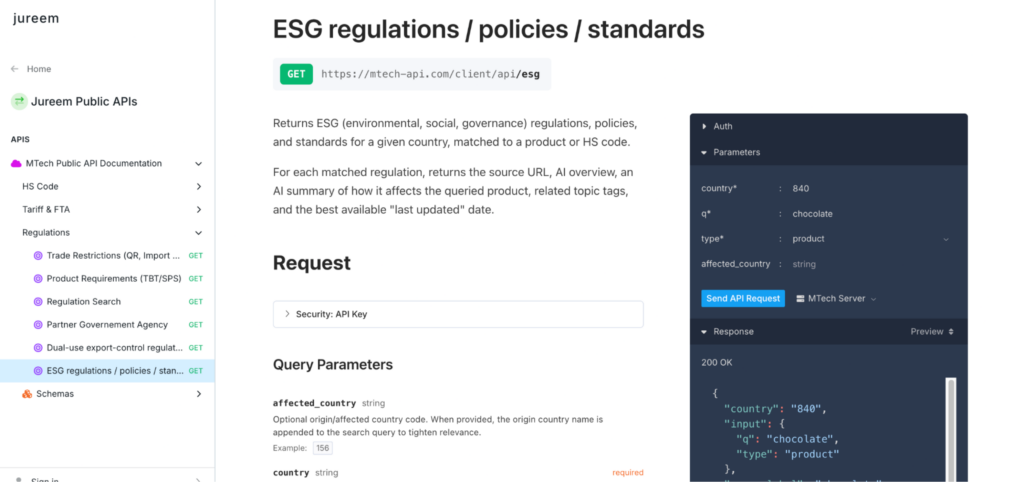
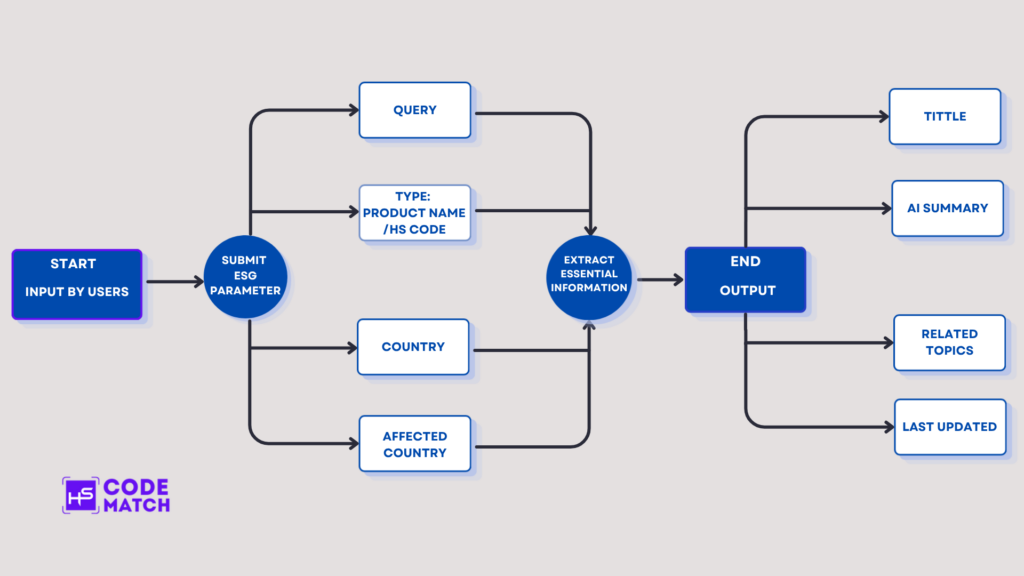
Similar to other API parameters on HSCodeMatch, ESG regulations require the country of origin and the product name or HS code. With the help of our AI system, it will match the specific product to the applicable ESG regulations in a certain country. Let us explain the details of the query parameters for ESG regulations below.
- Country: This is a country code for all countries. You can check Data Coverage or this link:https://mtech-api.com/client/api/country-list
- Affected country: This is an optional parameter to check if there is a specific regulation from the first country that affects the second country.
- Query: Type the specific inquiries, including the 6-digit HS code or product name, to check the ESG regulation. For example, you can choose “chocolate” or “sugar”.
- Type: This is a search mode for the query you want to submit to our API service. So you can either choose the HS code or the product.
2. Output
If all of the required parameters are filled in, you can send API requests to the MTech Server to retrieve ESG regulation data. The affected country parameter is optional, so you can skip it to request an API. You will get the JSON format response including the title, summary, related topic, and the last update of the regulations.
Benefits of using our API service for ESG regulations
Using the HSCodeMatch API service for ESG regulations is useful for businesses and professionals who are involved in international trade. As we know, ESG regulations act as trade barriers enacted by regional organizations and countries to strictly enforce environmental standards and ensure it does not violate human rights standards. We will demonstrate the benefits of our service for ESG regulation to help you below.
AI-enabled match by HS code or products
Our API endpoint is able to automatically generate responses by matching the HS code or product name to the specific ESG regulation in a given country. You can get precise responses about the affected regulation on the products you need to trade with.
Get information from verified government domains only
HSCodeMatch is an AI-assisted regulatory app that only stores verified government data from all countries. This is a crucial aspect for your research, as the accuracy of regulations is the top priority for better decision-making process.
Get an instant summary of ESG regulatory updates
HSCodeMatch allows you to get real-time, summarized regulatory updates, which will be beneficial in this dynamic global setting. You can also directly target ESG regulations based on certain jurisdictions where they belong. In a fast-paced work environment, this will be a time-efficient plus point.
To check our API service for ESG regulations, please visit our public API documentation to know the details of the parameters and how to use it here: https://jureem.stoplight.io/docs/public/1d300669e2ce7-esg-regulations-policies-standards