
What is a dual-use export control regulation?
Dual-use regulation is a specific set of rules that governs the export and import of products classified as dual-use items. Unlike regular products, the items, which are considered dual-use items have two functions at the same time: civilian and military applications. Therefore, the dual-use regulation is established to protect against the potential harm or danger from the export or import of dual-use items, whether to a second or a third country.
The existence of dual-use regulation is not only in the interest of a specific country, but it also requires compliance with international security treaties. The implementation of dual-use regulations must be supported in all countries to ensure the export and import process. It is used to prevent the flow of some products, software, and technologies that can contribute to the assembly of illegal weapons or other lethal weapons for terrorist acts.
Dual-use regulatory frameworks can be divided into three levels: international, regional, and national. To better understand the international or multilateral security agreements, we will explain the list of export control frameworks for dual-use items below:
- Wassenaar Arrangements
This export control agreement is used to regulate the transfer of conventional weapons and dual-use products and technologies in 42 countries. It was established in 1996 to promote responsibility and monitor dual-use goods across national borders.
- Nuclear Suppliers Group (NSG)
This agreement was established in 1975 to control the export and import of nuclear materials and equipment. It aims to hinder the rapid development of nuclear weapons. The NSG has 48 member countries that provide the nuclear components and raw materials.
- Australia Group
This informal forum was founded in 1985 to coordinate the export and import of chemical and biological weapons. The goals of the Australia Group are to ensure that dual-use goods and technologies are not shifted from civilian to military use.
- Missile Technology Control Regime (MTCR)
This is an informal political understanding among 35 countries to coordinate export and import control of missiles and missile technology. The reason behind the establishment of the MTCR was to hinder the massive development of nuclear weapons.
On the regional level, there is the European Union (EU) Dual-Use Regulation that controls the export and import of dual-use items in the EU. On the national level, all countries have their own national security regulations to regulate dual-use items, such as the Export Administration Regulations (EAR) in the United States and the Export Control Law in China.
Mechanism of dual-use export control regulations
To implement dual-use regulations, there are mechanisms to ensure the security framework and prevent the misuse of risky materials or technologies that can be used in military and intelligence applications, including:
- Control List: Dual-use items cover a wide range of products from chemical materials to communication devices. There are ten categories of dual-use items, which can be further subcategorized into 5 types.
- Licensing Requirements: Before exporting dual-use items, exporters must submit the licensing requirements according to the local regulations. This also helps to know where being exported, who the end users are, and what the end use of the materials is.
- Catch-All Controls: This mechanism is established to give the authority to halt the export of non-dual-use items if there is an indication or suspicion that they can be used for a military purpose.
- Re-export Controls: This mechanism is important to control dual-use items even after the products leave the country’s territory or extraterritorial control. For example, the US under EAR has the right to control the products that originate from its country before being re-exported to a third country.
Benefits of understanding dual-use regulation
A better understanding of dual-use regulation is a must for all businesses or professionals involved in international trade. The reason behind it is that dual-use items cover numerous physical products, software, and technologies, most of which are demanded internationally. These are the benefits of understanding dual-use export control regulations.
Streamline the international trade process
Exporting dual-use items requires classification of the types of products to the control list or export-specific code, export licensing, and other requirements before shipment. By understanding the details of dual-use export control regulations, companies know what they should do to streamline the export-import procedure of dual-use items.
Better mitigate supply chain risks
Dual-use items are subject to re-export control from the country of origin, which makes them vulnerable to supply chain disruptions that cause financial loss. By comprehending and staying updated on dual-use products, companies can assess the potential risks from the origin country and help them to find alternative sources.
Enhance business reputation
As businesses involved in global trade, maintaining a reputation for complying with regulations is a prominent aspect. Knowing the dual-use regulations will avoid companies being out of compliance and maintain trust with the local authority, investors, customers, and other parties.
Preventing regulatory change
Dual-use products are mostly critical and technology-tied products, such as semiconductors, biotechnological materials, computers, and others. These products are monitored strictly by the government authority, and the regulations change constantly. Thus, tracking dual-use regulations will help to be aware of recent changes.
Avoid potential penalties and sanctions
The most significant benefit of getting a better understanding of dual-use items is to avoid potential penalties, including fines, legal charges, and financial loss. Staying ahead of dual-use regulations will help you to avoid unintentional violations while exporting dual-use products.
Our Service:
As a trade regulatory compliance app, HSCodeMatch provides an API service for dual-use export control regulations. This API is useful for businesses or individuals who need to retrieve data about dual-use regulations in all countries. We will explain more about our API service and the dual-use export control regulations below.
1. Input parameters
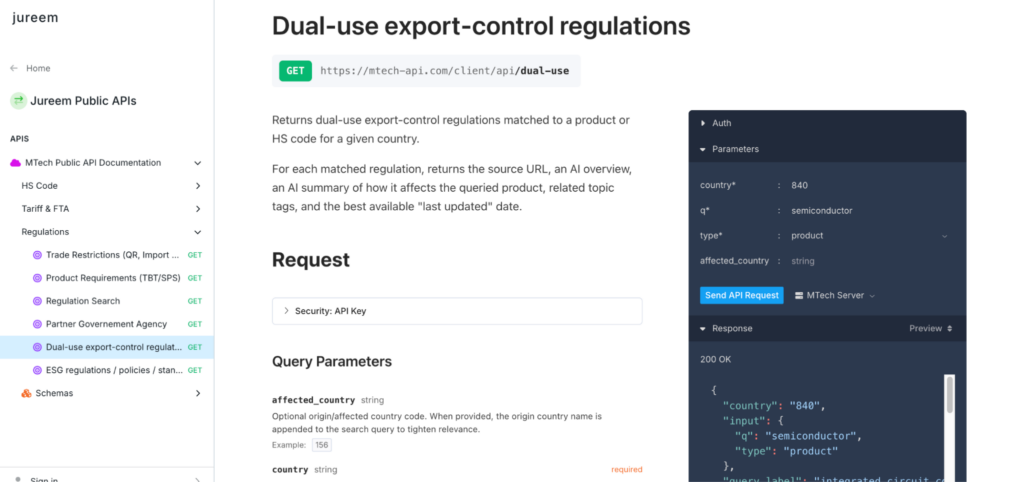
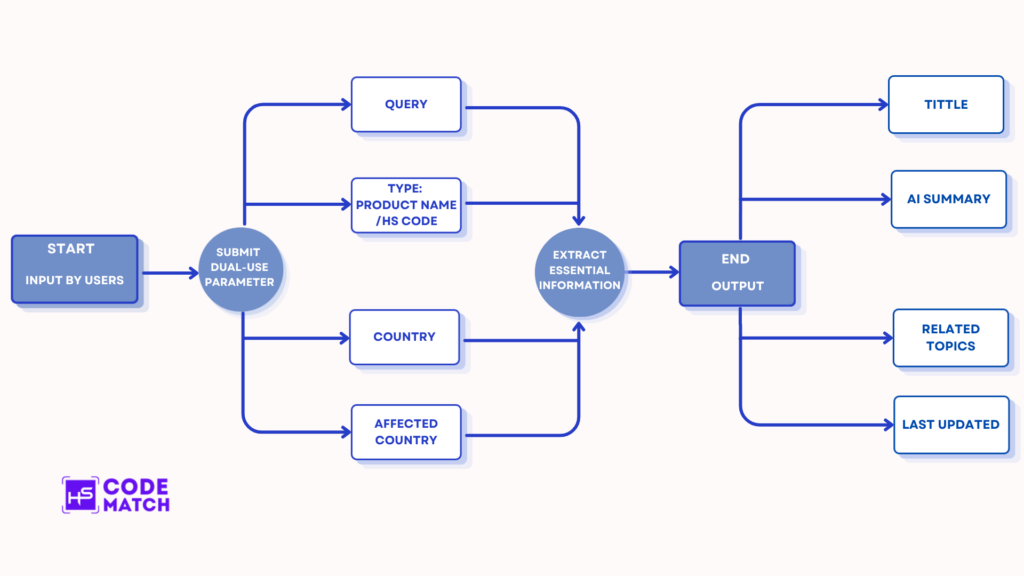
The dual-use export control regulation API endpoint is under the Regulations API category. This API endpoint is useful for retrieving dual-use regulations according to the product’s name or HS code. It also depends on the specific regulations in the given country. Here are the API query parameters:
- Country: This is a parameter to retrieve dual-use regulations in certain jurisdictions.
- Affected country: Give the specific country that is affected by the regulation in the primary country.
- Query: Give a search value based on the type you have chosen, whether it is an HS code or a product name.
- Type: This is the search mode for looking up the dual regulations.
2. Output
Once you have filled in all of the required parameters, you will get the full information on dual-use regulations. The matched regulations include the title, summary, the explanation of how the regulations affect the products, related topics, and the latest updates.
Benefits of using our API service:
Using the API for dual-use regulation has lots of features, and you will get information on dual-use regulations instantly. To be specific, these are the benefits you will get by considering using our API service for dual-use regulations below.
AI-enabled match by HS code
Our API service uses AI to automatically match HS codes to given products or product names. Thus, you can find the applicable dual-use regulations in all countries without effort.
Information from verified government domains only
As tariff regulatory compliance assistants, we invariably cite verified government domains. You do not have to worry about the retrieved data from our database using API requests.
Visit our public API documentation to get to know more about our API service for dual-use regulation here: https://jureem.stoplight.io/docs/public/1d300669e2ce7-esg-regulations-policies-standards