


 Sep 01,2026
  By Alice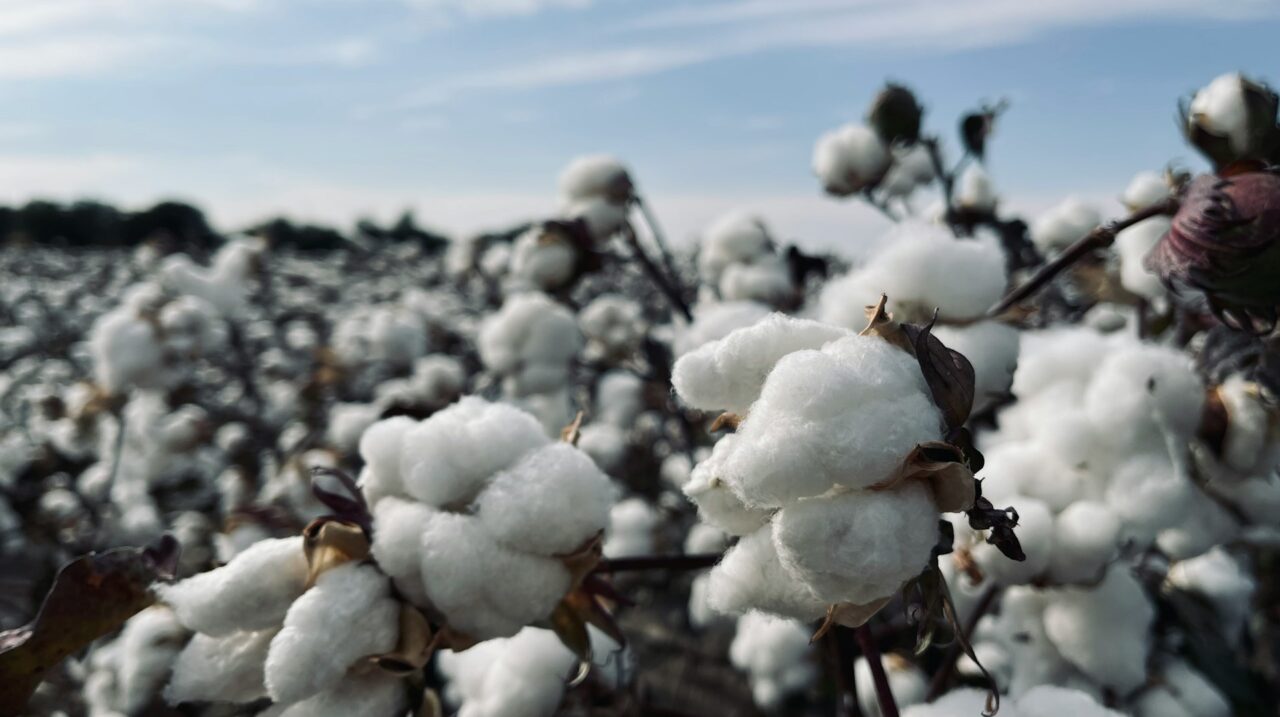
Cotton is one of the strategic agricultural products with so much potential. Not only in the textile industry, but cotton is widely used in medical supplies, cosmetic and hygiene products, banknotes, and even as animal feed. Do you think it is the right time to hit the cotton trade scene and make an impact? First, let’s start with understanding the HS code for cotton.
What is cotton?
Cotton is the common name of a plant from the genus Gossypium. It is divided into more than 50 different species, but only 4 species of cotton are sold commercially as commodities. Check the table below to get to know about those species.
| Species | Natives to | Common use |
| Gossypium hirsutum | Central America, Caribbean, parts of North and South America | Garments, cottonseed oil, medical supplies |
| Gossypium barbadense | Tropical parts of South America | Soft garments, herbal medicine, specialty products (coffee filters, archival paper, fishnets) |
| Gossypium arboreum | South Asia | Heavy-duty garments, livestock feed, stuffing materials |
| Gossypium herbaceum | Sub-Saharan Africa, Southern Africa, Western Asia | Herbal medicine, edible oil, cosmetics/skincare ingredients |
List of HS codes for cotton and derivatives
As a versatile plant with various benefits and roles, the World Customs Organization (WCO) dedicated a chapter to this commodity. In general, the classification was based on the final form of the cotton, whether it is raw cotton, waste, yarn, combed, or else. Let’s check chapter 52 about cotton and make a recap out of it.
| HS code for cotton | Products/commodities |
| 5201.00 | Raw cotton, not through the combing or carding process |
| 5202.10 | Cotton yarn/thread waste |
| 5202.91 | Garnetted cotton fiber made of cotton waste or yarn or fabric scraps |
| 5202.99 | Other cotton waste |
| 5203.00 | Combed or carded cotton |
| 5204.11 | Sewing thread made of at least 85% of cotton |
| 5204.19 | Other cotton thread |
| 5204.20 | Cotton thread for retail sales |
| 5205.11 | Uncombed single cotton yarn with 85% weight of cotton, not for retail, with 714.29 decitex (subheadings indicate specific thickness) |
| 5206.11 | Uncombed single cotton yarn with less than 85% cotton weight, not for retail sales measuring 714.29 decitex (subheadings indicate thickness) |
| 5207.10 | Cotton yarn for retail sale with minimum 85% cotton weight |
| 5208.11 | Unbleached woven fabric made of at least 85% cotton weighing maximum 100g/m2 (subheadings indicate specific weight per square meter) |
| 5212.13 | Dyed other woven cotton fabric with not more than 200 g/m2 |
As we see in the table above, cotton is regulated under specific classifications based on its final form. Whether it is shipped as woven fabric, yarn, or raw materials may affect the HS code for cotton. If you sell it as raw materials, the HS code for cotton is rather simple; however, the complication may come if you have processed cotton as fabric or yarn. The thickness, composition, and weight might also be taken into consideration.
Cotton global trade overview
After learning the HS code of cotton, it is obligatory to check the global overview of cotton trade. Let’s narrow it down to raw cotton (not carded or combed) with HS code 5201.00. Brazil was on top of the exporter list, followed by the United States, Australia, India, and Turkiye. The last two countries also made the largest importer list, with the addition of China, Pakistan, and Indonesia. The importing countries of raw cotton are the producers of cotton finished products, including clothing, other fabrics, wovens, and others.
| Exporting Countries | Trade Value (USD) millions |
| Brazil | 4,928.62 |
| United States of America | 4,828.79 |
| Australia | 2,319.21 |
| India | 544.31 |
| Turkiye | 501.08 |
Source: ITC Trade Map 2025, accessed 14th August 2026
| Importing Countries | Trade Value (USD) millions |
| India | 1,946.37 |
| China | 1,933.91 |
| Turkiye | 1,711.74 |
| Pakistan | 1,494.61 |
| Indonesia | 709.08 |
Source: ITC Trade Map 2025, accessed 14th August 2026
How to find the HS code for raw cotton
Once we know the largest exporters and importers, it’s time to find the HS code for raw cotton. As a heads-up, the HS code is an integral part of export and import that is used to identify traded products. No wonder that HS code identification must be a consideration for all businesses involved in international trade.
In order to complete your understanding of the HS code for cotton, we will give you clarity on finding the HS code for raw cotton under code 5201.00. To simplify the challenges to classify HS code for cotton or other products, you can use an application dedicated to assist export import process called HSCodeMatch. See the full steps for finding the HS code for raw cotton below
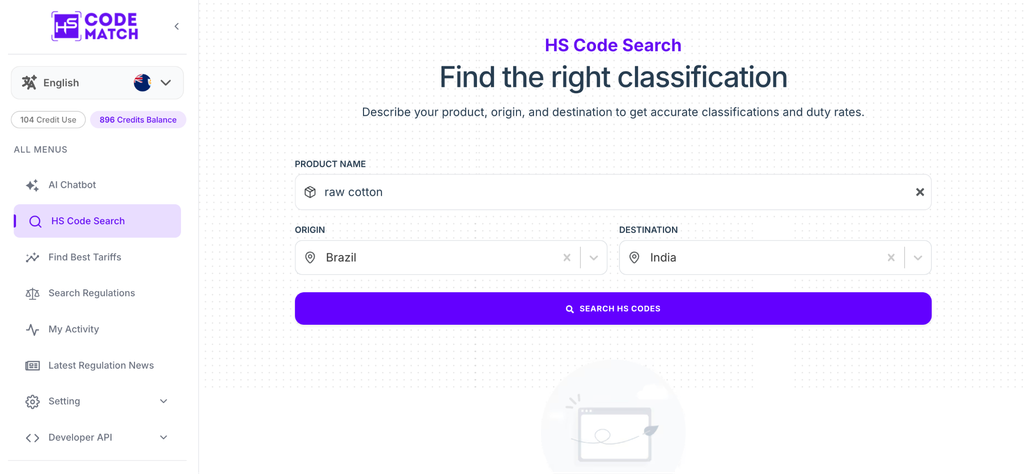
Step 1: Set search criteria on HS Code Search
Open app.hscodematch.com and log in to your account, then find HS Code Search on the left side of the page. For this example, we can try exporting and importing from the largest importer and exporter of raw cotton, from Brazil to India.
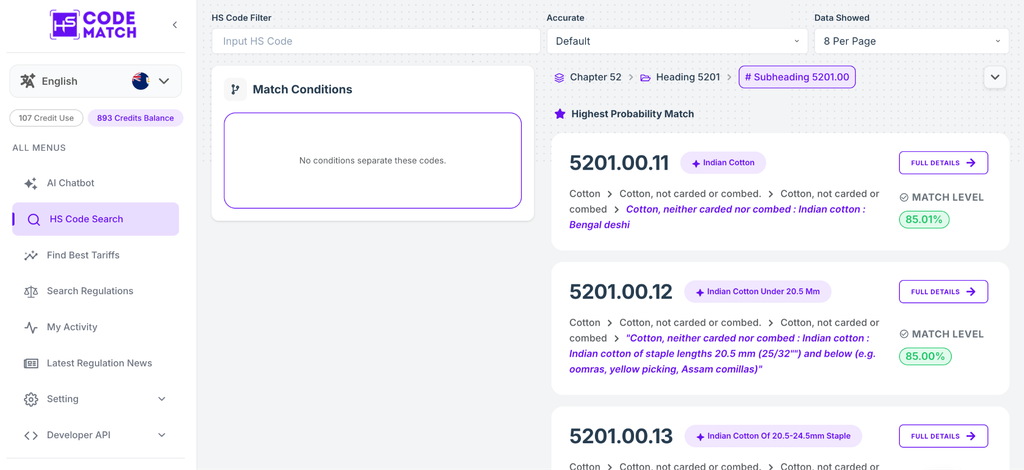
Step 2: Select the most relevant HS code for raw cotton
Once all criteria are submitted, the HSCodeMatch system will show the most relevant and suitable HS codes for raw cotton. For example, we can select the first row as the highest percentage of HS code that matched with your criteria.
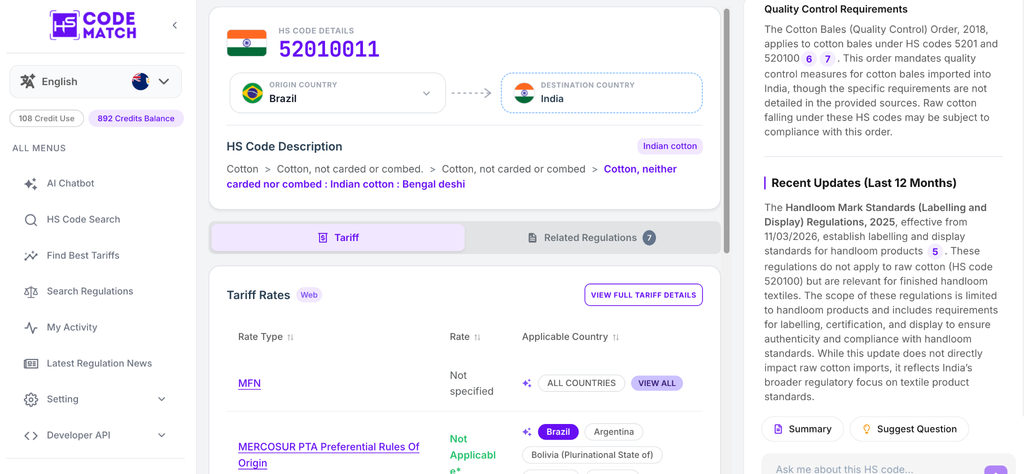
Step 3: Check tariffs and regulations on HS Code Details
To check the description of the HS code for raw cotton. Just click Full Details to get to know about the applicable tariffs and regulations on HS Code Details
Step 4: Ask the AI Chatbot Assistant to clarify the regulations and tariffs
Just ask the AI Chatbot Assistant if you are confused about finding specific regulations and tariff rates for exporting raw cotton from Brazil to India.
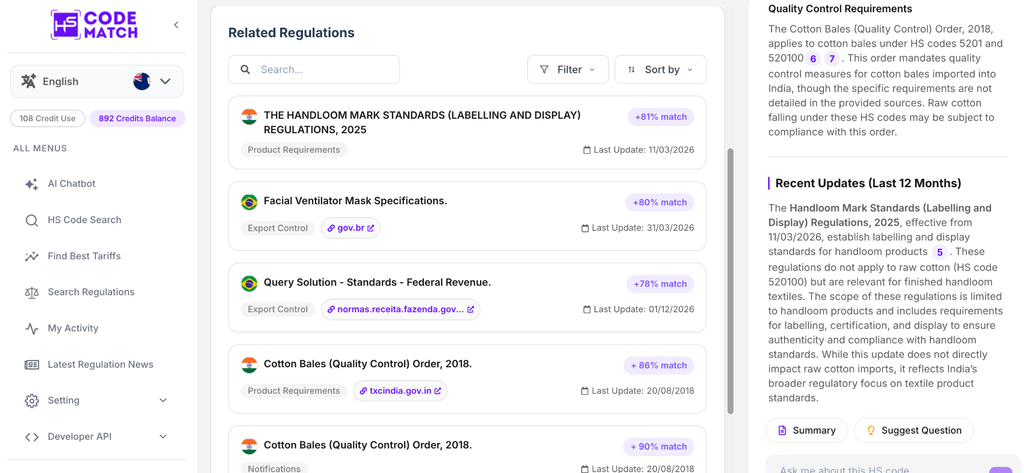
To clarify the AI Chatbot Assistant, we can give you three examples of questions and answers about the exportation of raw cotton from Brazil to India.
What is the tariff rate for exporting raw cotton under HS code 52010011 from Brazil to India?
The tariff rate for exporting raw cotton from Brazil to India under HS code 52010011 is 5% under the Most Favored Nation (MFN) regime. This duty rate is confirmed under the Indian non-preferential tariff schedule, the agreement between MERCOSUR and India, and the GSTP. Nonetheless, there is a temporary government exemption to reduce the duty rate from 5% to 0%. All raw cotton importers need to confirm the current status to be eligible to get the exemption according to Indian customs authorities before shipping to India.
| Regulation | Requirement | Deadline | Authority |
| Non-preferential regime | 5% | Ongoing | Government of India |
| MERCOSUR-India PTA | 5% | Ongoing | Government of India |
| GSTP | 5% | Ongoing | GSTP Member States |
| Custom Duty Exemption | Temporary 0% duty for cotton imports | Temporary | Government of India |
What are the requirements to export raw cotton from Brazil to India?
In order to export raw cotton from Brazil to India, exporters must submit documentation to confirm compliance with applicable duties in India 5% whether it is based on the MERCOSUR-India and GSTP regime. On the other hand, there are quality control standards under the Cotton Bales (Quality Control) Order, 2018. This shipment is required pre shipment certification. However, there is no preferential tariff reduction for raw cotton imports from Brazil to India.
What are the specific quality standards under the Cotton Bales (Quality Control) Order, 2018?
The Cotton Bales (Quality Control) Order, 2018 sets mandatory quality standards for cotton bales in India, which are enforced by the Bureau of Indian Standards (BIS). These standards set the quality of raw cotton imports from other countries, encompassing packing, marking, and technical specifications. This specification is applied to all cotton bales under HS code 5201, including 520100. Thus, all importers must ensure compliance with the standard to avoid penalties and maintain market access to the Indian market.
| Regulation | Requirement | Deadline | Authority |
| Cotton Bales (Quality Control) Order, 2018 | Packing and marking to meet conformity with Indian standards | Upon production or import | UNTIL |
| Cotton bales must meet the technical requirements based on Indian standards | Continous | UNTIL |
Conclusion
As one of the most lucrative commodities in the world, cotton has a dedicated Chapter in the WCO Harmonized System (HS). In Chapter 52, you can check the accurate HS code for several cotton products in the form of raw materials, thread, or fabric. Subheadings may indicate thickness, composition, and weight of the cotton component. However, cotton that has been processed into clothing, textiles, cosmetics, or medical supplies has its own dedicated chapter.
Frequently Asked Questions (FAQs): HS Code for Cotton
1. Does the HS code for cotton T-shirts involve Chapter 52 of the WCO document?
No, cotton T-shirts are considered finished products, and products under Chapter 52 are raw or semi-finished products made of cotton, encompassing cotton yarn and cotton fabrics. Even though the T-shirts are made from cotton, finished and raw products are classified as different things according to the WCO classification.
2. What is the national variation of HS code for raw cotton in India?
The national standard HS code, or ITC code, for raw cotton in India is 5201.00.11. This is the code for cotton not carded or combed in India, and it is derived from the 6-digit HS code for raw cotton, 5201.00.
3. How do you classify the HS code for cotton thread?
Cotton thread HS codes vary depending on their sales option, thickness, weight, and particular specifications such as combed, single yarn. Therefore, you need to ensure what the shape of your products is before classifying them into the HS code in the WCO standard.
4. What is the HS code for combed cotton yarn bleached?
Cotton yarn bleached, is mentioned under Chapter 52, and all of the cotton yarn is covered under Heading 5205. The full 6-digit HS code for combed cotton yarn, bleached, is 5205.48.
5. What is the tariff rate for exporting raw cotton from Brazil to India?
The tariff rate for exporting raw cotton from Brazil to India is 5%. Even though Brazil and India have a preferential tariff agreement, the two countries are not considering reducing the tariff rate to 0%; they are still imposing a 5% duty rate.
Find and Match the Right HS Code for Your Products.
Try Our App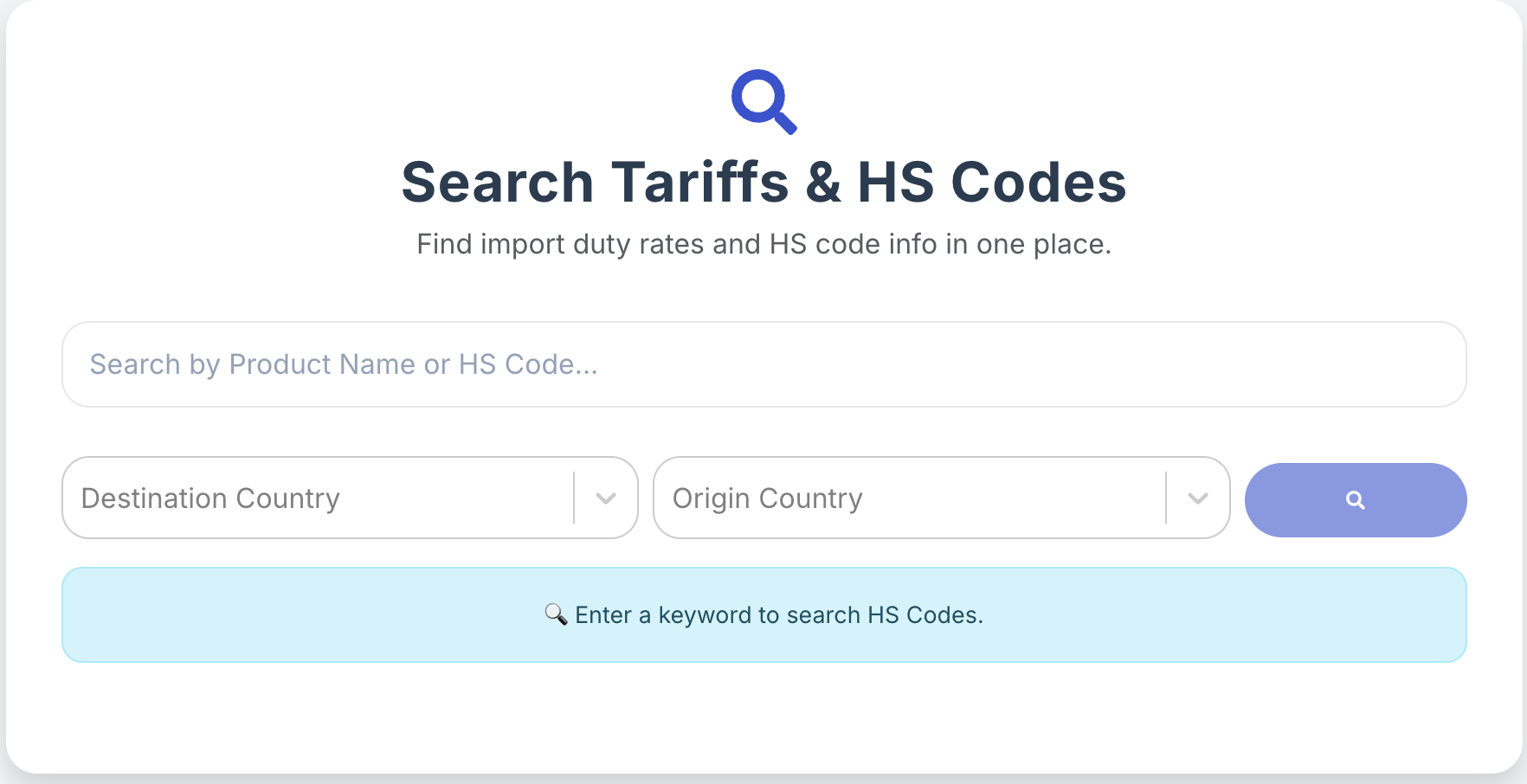

 Sep 10, 2026

