


 Aug 18,2026
  By Alice
Printed goods never leave the market regardless of the digital disruption. Physical book sales remain strong, but do people still get drawn into magazines? Magazines are a particular printing product. Unlike books, magazines are periodical publishing products, which means there is a stricter deadline for the publishing period. This can be a challenge, but also an opportunity at the same time. Are you considering selling magazines globally? Here are some tips and essential information for you, including the HS code for magazines.
What is a magazine?
Magazines are often defined as regular publications that contain stories, photos, pictures, and newsworthy articles. Before the internet and social media took over the reign as the major publication hub of pop culture, entertainment, and other niche topics, magazines were the first thing people checked to get that type of information.
Magazines are often designed to cover specific topics rather than general ones. For example, there are NME and Rolling Stone that focus on music, National Geographic and Smithsonian concentrate on science, while Vogue and Harper’s Bazaar cover fashion. Magazines are released periodically, such as weekly, biweekly, or monthly. This timeline is crucial to ensure that the editorial process goes well. However, digital disruption changes everything. They encourage magazines and news to be published as fast as possible. In the 2010s, many magazines stopped releasing physical copies and focused on catering to their digital presence through website/blog and social media. So, does this mean the end of printed magazine distribution?
The answer is no. Printed magazine sales activities still exist, although it is difficult to deny that the number has plummeted compared to decades ago. Media companies are still releasing magazines with different strategies and purposes. Many release printed magazines as collectibles with added bonuses to lure buyers. They also offer exclusive articles that are only available in the printed edition, along with annual subscription promos. On the other hand, buyers sometimes still buy magazines to experience the tactile feel. In certain hobby communities such as journaling, used magazines are in demand for junk journals. In short, despite the shifting trend, printed products such as magazines still have their own market.
HS code for magazine
What is the HS code for a magazine? Please check the World Customs Organization (WCO) document, Chapter 49. This chapter regulates printed products in general, including books, newspapers, magazines, brochures, calendars, postcards, art prints, printed photographs, etc. Specific to magazines, please go to heading 4902, which classifies newspapers, journals, and periodicals. It is a rather simple classification; check the recap below.
| HS code | Products |
| 4902.10 | newspapers, journals, periodicals (may contain advertisements or not) that are published at least 4 times per week |
| 4902.90 | other newspapers, journals, and periodicals with advertisements or not |
According to this classification, magazines can be grouped into HS code 490290, as it is commonly published at least weekly rather than daily like newspapers. This subheading is also ideal as it allows the publication to contain ads or not, which is the accurate way to depict commercial magazines that need sponsors to fund their business.
However, if you add bonuses within your magazine, you may add more HS codes such as 4909.00 for postcards, 4911.91 for posters or printed photographs, or 4820.10 for notebooks or notepads. There are magazines that also include skincare samples, and that may actually require additional relevant HS codes when shipping them abroad.
Magazine global trade overview
Simply check the tables below to see the magazine global trade overview. Using HS code 4902.90, it is clear that the export-import activities of this periodical publishing product are dominated by the EU, UK, and the US.
They are known as countries with high purchasing power, which corroborates the recent target market for printed media products. However, the trade value of magazines is much higher compared to other periodicals with stricter publishing periods, such as newspapers (HS code 4902.90).
| Exporting Countries | Trade Value (USD) |
| United Kingdom | 314,723,121 |
| Germany | 291,391,057 |
| France | 255,186,461 |
| United States of America | 224,610,119 |
| Poland | 203,254,367 |
Source: UN Comtrade 2025, accessed on 7th August 2026
| Importing Countries | Trade Value (USD) |
| Germany | 301,295,417 |
| Canada | 216,968,467 |
| Netherlands | 167,658,628 |
| France | 158,817,550 |
| Switzerland | 140,091,408 |
Source: UN Comtrade 2025, accessed on 7th August 2026
How to find HS code for magazine
Compared to other products in the WCO classification document, classifying magazines is rather simple. Generally, all magazines can be classified under subheading 490290 as long as they are published less than 4 times a week and contain a proportional amount of advertising. However, you may need to check more HS codes if your magazine has added bonuses such as postcards, posters, stickers, or product samples.
Step 1: Set the criteria on HS Code Search
First, open your account on app.hscodematch.com and click HS Code Search. Then, set search criteria to find relevant HS codes. For instance, we can choose the export of magazines from the United Kingdom to Canada.

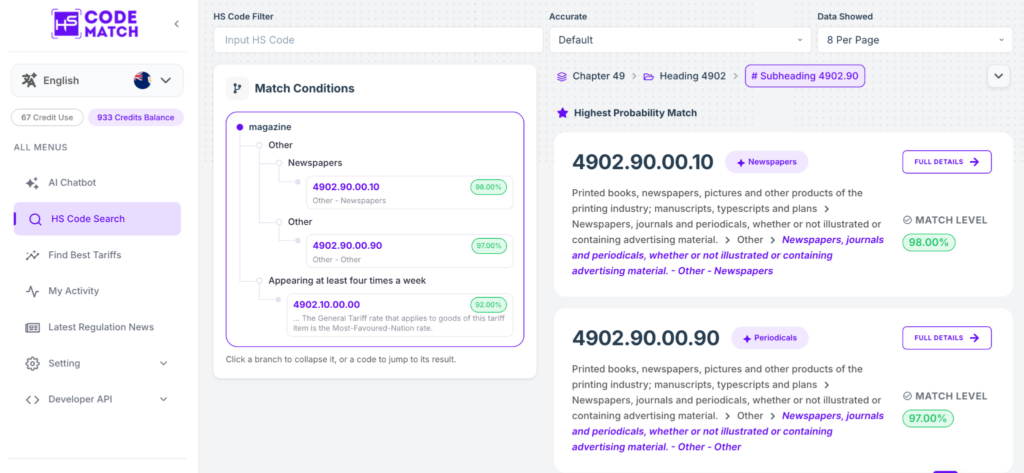
Step 2: Choose the most relevant HS code for the magazine
Once you have submitted the criteria, HSCodeMatch will automatically display the most relevant HS codes for the magazine. Choose the most accurate one, and in this example, we can choose magazine under HS code 4902.90.00.90 in Canada
Step 3: See full tariffs and regulations about magazines
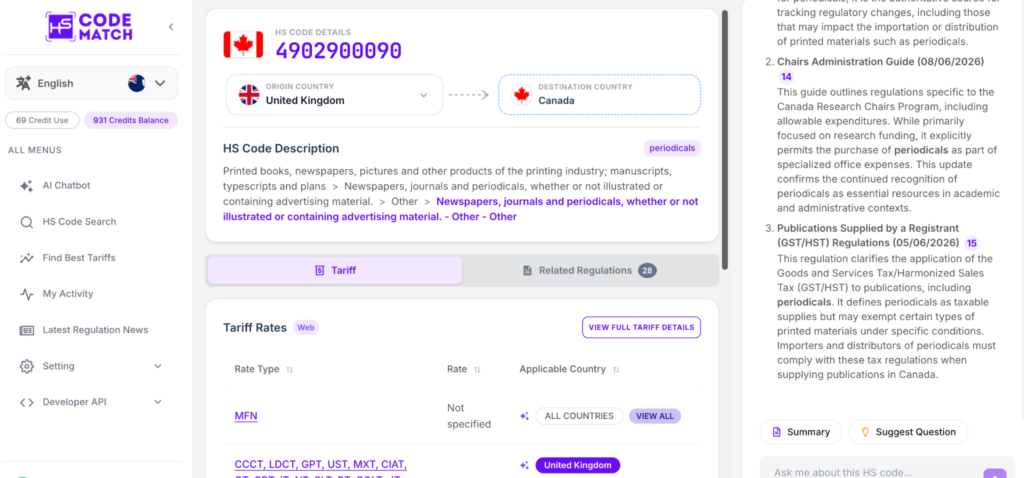
Click Full Details to see all regulations and tariff rates for exporting magazines in Canada.
Step 4: Ask AI Assistant to tackle complicated regulations
To simplify finding tariffs and regulations, you can ask an AI Chatbot Assistant. This built-in feature is very useful to solve your confusion and ensure that you can get insights about applicable regulations and tariffs.

To clarify how to use the AI Assistant, we will give you three questions and answers regarding exporting magazines from the United Kingdom to Canada below.
What is the tariff rate for exporting a magazine from the UK to Canada?
Exporting magazines from the UK to Canada is not subject to a tariff rate, whether under Most Favoured Nation (MFN) or a preferential tariff program. Therefore, the 0% tariff rate not only applies to magazines from the UK, but also from other countries. However, exporters and importers must comply with the applicable regulations in Canada, encompassing all documentation and content requirements to prevent penalties.
What are the labeling requirements to export a magazine from the UK to Canada?
Even though exporting magazines from the UK to Canada is not subject to a tariff rate, these products are subject to labeling requirements, including country of origin (especially with “Made in the UK”) and other specific requirements for publications. The following table displays the list of labeling requirements for magazine imports in Canada.
| Regulation | Requirement | Authority |
| Marking of Imported Goods Regulation | Country of origin must be included and can be visible by all consumers in Canada | Canada Border Service Agency |
| Country of Origin (CoO) | Goods must be labeled with the country of origin | Canada Border Service Agency |
| Packaging and Labeling Requirements | Labels on magazines must be truthful and avoid misleading information and should be placed in the specific area | Competition Bureau Canada |
| Memorandum D5–1-13 or regulation to import publication by Mail or Courier | Publication must meet the standard import procedure in Canada | Canada Border Service Agency |
Are there any restrictions on exporting physical magazines from the UK to Canada?
Exporting physical magazines from the UK to Canada generally does not have many restrictions. According to the Canadian regulatory framework for publications, there are no tariff rates for exporting magazines, but please note the import procedure and classification rules in Canada. Here is the list of regulations for exporting magazines from the UK to Canada.
| Regulation | Requirement | Threshold/Deadline | Agencies |
| Memorandum D5-1-13 | Mentions import policies for magazine imports and other publications sent by mail or courier | N/A | Canada Border Service Agency |
| Tariff Data | Magazines can enter Canada without tariffs | N/A | Canada Border Service Agency |
| Legal Deposit of Publication Regulation | Need to deposit publication with Library and Archives Canada if marketed in Canada | 1 week after publication | Library and Archives Canada |
Conclusion
Printed magazines are considered obsolete by many. This is supported by the fact that many major media companies struggle to release their printed version. However, it does not mean that printed magazines are rare commodities. Contrary to that belief, global magazine trade is still strong in certain regions. Several media companies shift their strategies to keep the printed magazine alive by implementing new strategies such as adding bonuses and using niche articles to allure subscribers. This is proven effective as the trade value of commodities with HS code 490290 remains hopeful, although unlikely to be considered lucrative.
Frequently Asked Questions (FAQ) about HS code for magazines
1. Can a magazine be classified as a book?
No, magazines and books are classified differently in WCO documents. HS code for magazines falls under subheading 490290, which regulates periodical publishing products with a release timeline of less than 4 times a week releasing timeline. Meanwhile, the HS code for printed books is 490199.
2. What is the HS code for a digital magazine?
Digital products do not have an HS code as this system is particularly made to regulate physical products’ circulation in the global market.
3. Can an advertisement catalogue affect a magazine’s HS code?
Yes, a magazine that is specifically made to showcase a catalogue of commercial products falls under subheading 491110. However, if the commercial ads only take up small parts of the whole magazine, the products are classified in subheading 490290.
4. What is the HS code for periodical magazines in Canada?
The applicable HS code for periodical magazines is covered under the tariff classification of Canada under code 4902.90.00.90. This national variation of the HS code is derived from the general HS code from the WCO, 4902.90.
5. What is the tariff rate for exporting magazines from the United Kingdom to Canada?
In order to export magazines from the UK to Canada, it does not incur any tariff rate, or 0%. Therefore, importing bulk or retail magazines can be done without paying any tariff rate in Canada.
Find and Match the Right HS Code for Your Products.
Try Our App