


 Mar 19,2026
  By Alice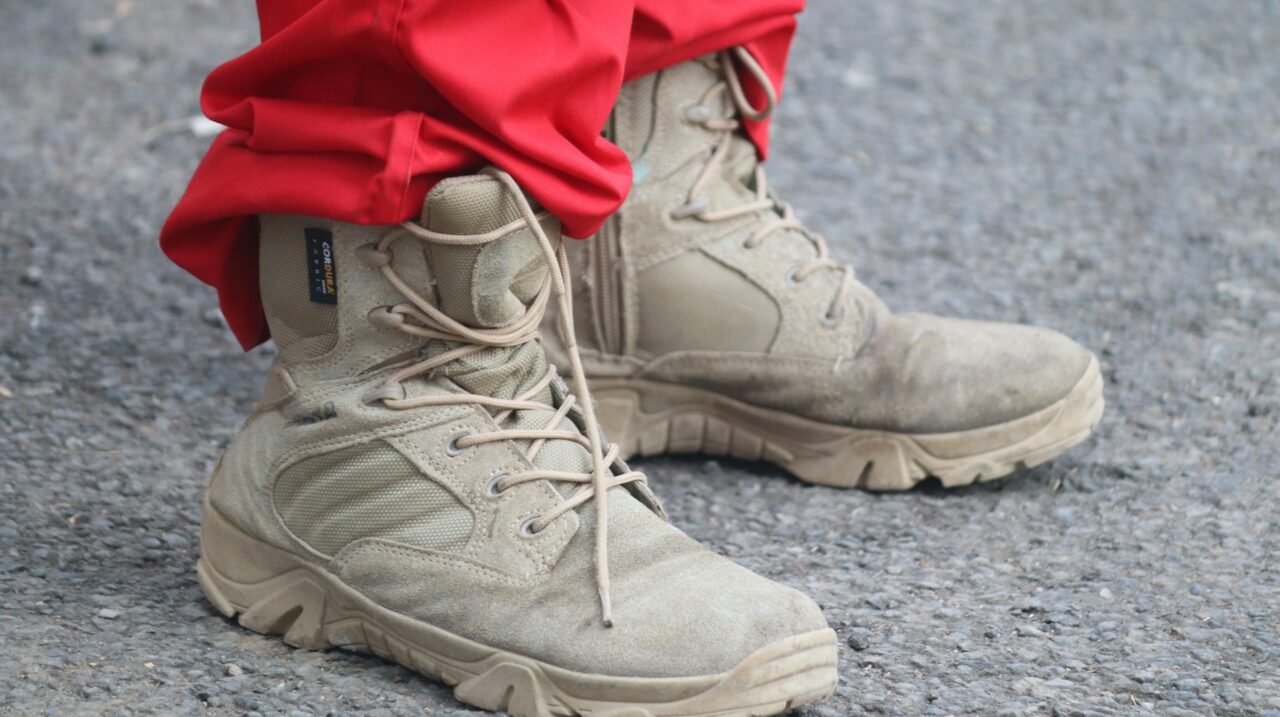
Shoes are one of the most used of apparel products, similar to clothes. Soes are classified as footwear, which is important for protecting our feet from cold, hot, or other harmful conditions. No wonder that shoes, including mining shoes, are among the most traded products in global trade. To accommodate international trade in safety shoes, there must be a declaration of the Harmonized System (HS) code from the World Customs Organization (WCO). So, what is the HS code for shoes? In this article, we will explain the HS code for safety shoes for mining and industry, its major international trade partners, and the steps to find the accurate HS code for safety shoes.
What is the difference between normal shoes and safety shoes?
As we know, in the modern era, there are many types of shoes produced to meet the high demand for shoes. Those shoes have different designs, shapes, and materials based on their functions. Most of us use normal shoes, such as sneakers, tennis shoes, or other sports shoes, or boots. Nonetheless, we rarely heard about safety shoes.
Unlike normal shoes, safety shoes are the footwear products that are similar to their name, which prioritizing on safeguard on our feet. Therefore, these pairs of shoes are designed differently from ordinary shoes. Moreover, safety shoes are mostly used for workers in heavy industries, especially mining, construction, chemicals, and others.
The materials of safety shoes are also dissimilar to those of normal shoes. These shoes are made from high-quality materials that have proven to withstand heat, chemicals, and other harmful static materials. Therefore, this type of shoe must meet the specific standard to guarantee extra protection for wearers. The other main difference is the metal toe as a main component of safety shoes to protect the toe from the hazardous materials, such as steel or other debris, in construction sites.
On the other hand, normal or ordinary shoes, including sneakers, tennis shoes, running shoes, trekking shoes, or other sports shoes, offer comfort for wearers. Thus, safety shoes have their own function to protect feet that can never be replaced by normal shoes, which are used for daily activities. In terms of comfort, safety shoes might be less lightweight and agile than normal shoes.
List of HS Codes for Shoes
After grasping the meaning of safety shoes and normal shoes, we need to know what the HS code is for shoes. The declaration of the HS code for shoes is essential and mandatory to ensure that the shoes destined to acountry are allowed to enter the recipient country. The accurate HS code also play important role in streamlining the customs process and determining how quickly your products can get customs clearance.
HS code for shoes or other footwear is under Chapter 64, which covers many types of footwear, gaiters, and other similar items. This chapter is followed by a 2-digit Heading and a 2-digit subheading to complete the 6-digit HS code that is recognized internationally. This is the list of common HS codes for shoes.
| HS code | Description |
| 640110 | A type of waterproof shoe that incorporates a protective metal toe cap. |
| 640230 | A type of footwear with outer soles made of rubber or plastic, and incorporate with metal toe cap for protection purposes. |
| 640340 | A type of shoe that has outer soles of rubber and is equipped with a metal toe cap. |
| 640411 | A type of sports shoe for tennis, basketball, or other sports and exercises. |
| 640510 | A type of other footwear that is made from leather on the upper side or has a leather composition. |
However, the 6-digit HS code is only the initial form of the national code. Meanwhile, all countries in the world have their own national standard code to classify products for statistical purposes. Therefore, you need to understand the national code as well to ensure the products meet the requirements based on the regulations in the destination country.
Top 5 Major Safety Shoes Exporters and Importers
For more understanding of the HS code for safety shoes, we may need to grasp the major exporters and importers of these products. It is important to know where the biggest producers and sellers of safety shoes are worldwide. Here are the largest exporting countries of safety shoes in the world in 2024, below.
| Country | Total Export Value (USD) |
| China | 855,118,140 |
| Italy | 333,388,229 |
| Tunisia | 149,260,849 |
| Germany | 124,122,729 |
| India | 109,010,234 |
Source: UN Comtrade Database, retrieved February 24, 2026
Based on the data above, China is the world’s largest exporter of safety shoes, with exports totaling more than 855 million USD in 2024. It is followed by Italy in the second position with a value of more than 333 million USD. Then, the remaining top safety shoe sellers are Tunisia, Germany, and India, respectively, with each country’s total export value exceeding 100 million USD.
After understanding the biggest safety shoes exporters, we shall know where the safety shoes from those countries are destined. Here are the biggest importing countries of safety shoes worldwide in 2024.
| Country | Total Import Value (USD) |
| United States | 431,229,673 |
| Italy | 201,112,944 |
| United Kingdom | 171,355,509 |
| France | 141,439,021 |
| Netherlands | 124,978,233 |
Source: UN Comtrade Database, retrieved February 24, 2026
Based on the provided data above, the United States is no doubt the biggest importer of safety shoes around the world in 2024, with a value of more than 430 million USD. The second place is Italy with more than 200 million USD. The two biggest importing countries are followed by the United Kingdom, France, and the Netherlands as the third, fourth, and fifth largest buyers of safety shoes.
Find the HS code for Shoes
Finding the HS code for shoes or safety shoes is indeed complicated due to many aspects of product classification. However, the most important thing for classifying HS code is know the General Rule of Interpretation (GRI) as well as the products themselves. Understanding these rules will ease your journey to find the correct HS code for shoes.
If you want to find the HS code easily, there is an application that assists you in finding the accurate HS code. As we know, the accuracy of the HS code and the national code will determine the streamlined customs process in the destination country. One of the pioneers of HS code finder is HSCodeMatch, which was developed with AI technology. Here is the step-by-step instruction to look up the HS code for safety shoes using HSCodeMatch.
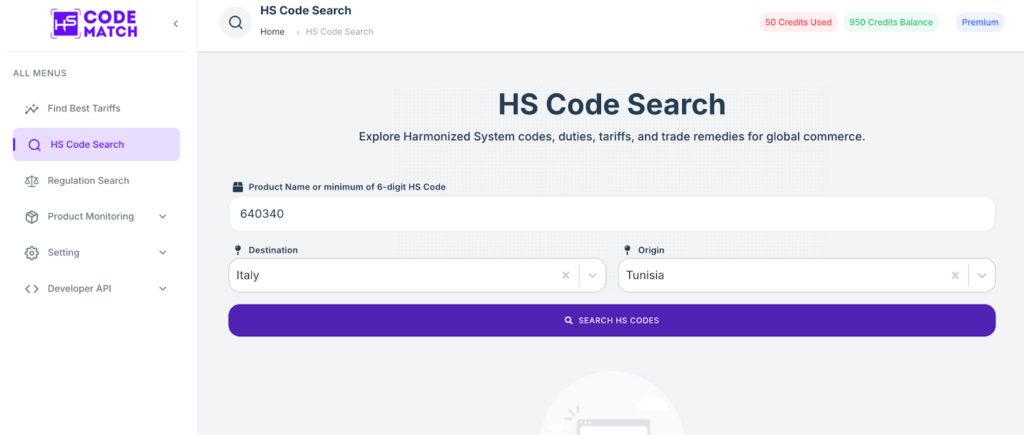
- First step: Open the HSCodeMatch homepage by accessing hscodematch.com. Then, click the Go to App option in the upper-right corner. Choose HS Code Search to find the HS code for shoes, and set the product name, origin, and destination country. For this example, we can use the safety shoes trade lanes between Tunisia and Italy.
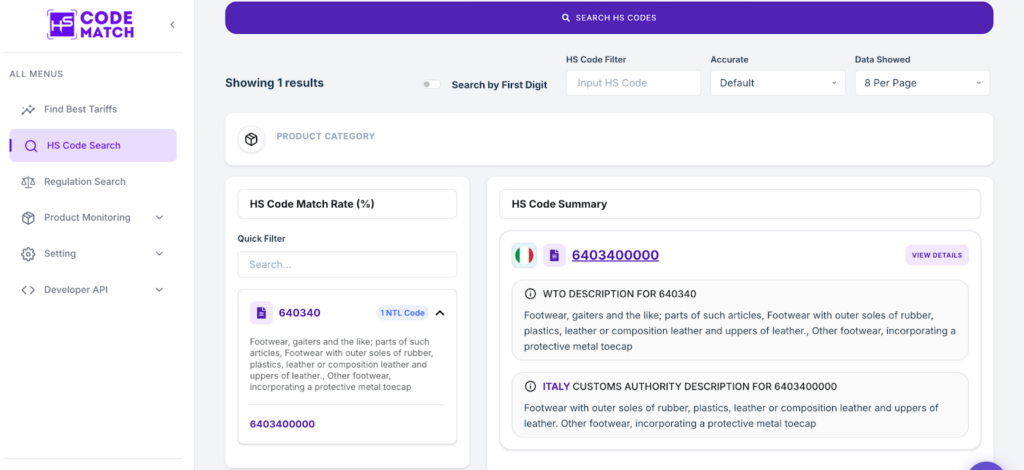
- Second step: Click Submit, and it will redirect to the list of HS codes for safety shoes. From the example, there is only one HS code for exporting safety shoes from Tunisia to Italy under 4603400000.
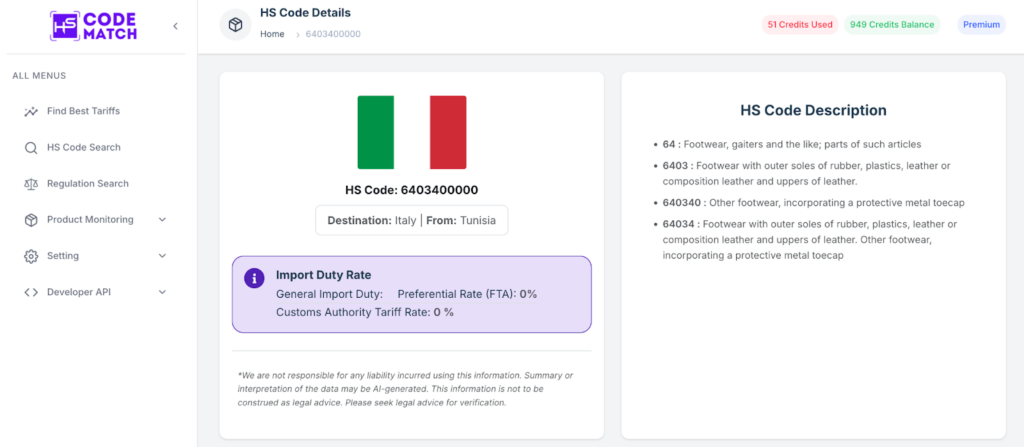
- Third step: Then, tap the View Details option to access the HS Code Details page. In this page, you can check the HS code description to ensure that this is the accurate HS code for your products. HS Code Details also provides the tariff rate on the left side of the page.
- Fourth step: Below the tariff and HS Code Description section, there is full information on the latest regulations in the destination country. On the right side, you can find an AI Assistant that allows you to ask anything regarding the latest regulations for exporting safety shoes from Tunisia to Italy.
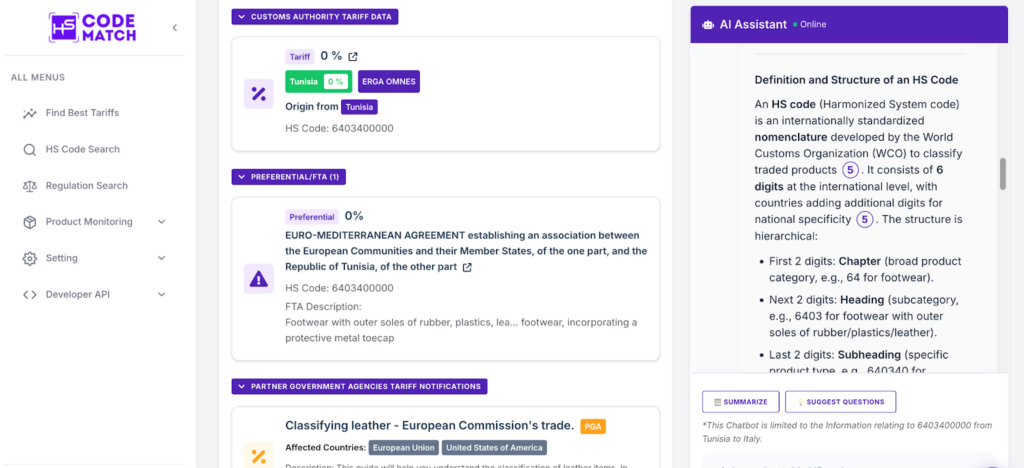
What is the tariff rate for exporting HS code 6403400000 from Tunisia to Italy?
In order to export safety shoes under HS code 6403400000 from Tunisia to Italy, the importers do not need pay a tariff. This is because Italy is part of the European Union (EU), which has a Free Trade Agreement (FTA) with Tunisia. This trade agreement has been enforced since March 1, 1998, to promote the trade relations between the EU and Tunisia. Here is the tariff and duty summary for products under HS code 6403400000 from Tunisia to Italy.
| Parameter | Details |
| HS Code | 6403400000 |
| Products Description | Footwear with outer soles of rubber, plastics, or leather, along with the leather in the upper part. |
| Tariff Rate under FTA | 0% |
| Most Favored Nations (MFN) | More than 0% tariff rate |
| Anti-Dumping Duties | Possible if there is an unfair practice to the products |
| Countervailing Duties | Possible if there is an unfair price of the products |
What documentation is required to prove origin for footwear under the EU-Tunisia FTA?
In order to prove the origin of the footwear products, including safety shoes for application on the EU-Tunisia Free Trade Agreement (FTA), exporters must supply a movement certificate EUR.1 or an origin declaration on an invoice or other commercial document. This document must be kept for at least 3 years after importation of goods. Other than this document, exporters must accommodate the supplier declarations for origin materials and proof of manufacturing processes. Here are other documents thatare required for claiming origin:
| Document | Purpose |
| Commercial Invoice | Proof of the description of the transaction between exporters and importers |
| Packing List | Depicts the content of the products and packaging during the shipping process |
| Bill of Lading/Airway Bill | Proof of shipping and transportation used |
| Proof of Origin | Verifies the goods to meet the origin criteria |
| Import License | Requirement for products that are restricted based on the EU import control |
| BIS Mark Certificate for leather products | This is a compulsory certificate for footwear made out of leather, especially from India |
How do I apply for a movement certificate EUR.1 for footwear exports to the EU?
Movement Certificate EUR.1 is a requirement document for the customs process to claim a preferential tariff in the EU based on the FTA. Therefore, this certificate needs to prove the origin of the goods. To apply for the EUR.1 certificate for footwear products, you need to follow these steps:
1. Ensuring that the goods meet the origin criteria based on the relevant EU trade agreement.
2. Submitting the application to the official customs authority in the exporting country.
3. Attach the supporting documents to prove that the footwear products are from the country that has an FTA with the EU, such as invoices, bill of lading or airway bill, and manufacturing records.
4. After all of the documents are submitted, the customs authority will verify the application. If all of the documents are approved, they will issue the EUR.1 certificate for your products.
Conclusion
An accurate HS code for shoes, including safety shoes, is a crucial part of international trade. However, finding the HS code for shoes is not as simple as it seems; it needs a meticulous process of product classification. Please note that the accuracy of the HS code can impact the customs process and tariff rates. To classify safety shoes under the HS code, all of them are under Chapter 64 and followed by a heading based on the materials of the shoes. Then, you can find the subheading based on the metal toe cap on description. Because most of the safety shoes have a metal toe cap used for protecting the toe from hazardous chemicals or solid hard materials.
Frequently Asked Questions (FAQs) about HS Code for Safety Shoes
1. What is the general tariff rate for exporting safety shoes from Tunisia to Italy?
The general tariff rate for exporting safety shoes under the HS code 6403400000 from Tunisia to Italy is 0% under the EU-Tunisia Free Trade Agreement (FTA). It allows exporters from Tunisia to export shoes to the EU without the need to pay a tariff.
2. Do we need documents to clarify the origin of footwear products under the EU-Tunisia FTA?
Yes, we need to provide the movement certificate EUR.1 to ensure that our footwear products are eligible for tariff reduction under the EU-Tunisia FTA.
3. What is the difference between normal and safety shoes?
The difference between normal and safety shoes are on the functions. Safety shoes are developed for a special purpose to protect our feet in manufacturing and mining. Meanwhile, normal shoes focus on comfort rather than safety.
4. What is the HS code for safety shoes?
HS code for safety shoes is similar to other footwear products under Chapter 64 and Heading based on their materials. However, the safety shoes mostly have a metal toe-cap to protect the feet from solid, hard, and chemical materials.
5. Is there any application to assist in finding the HS code for shoes?
Yes, of course, you can use HSCodeMatch to find the accurate HS code for shoes or other products instantly. This application also provides insight into the latest regulations, tariffs, and guides for the export and import process.
Find and Match the Right HS Code for Your Products.
Try Our App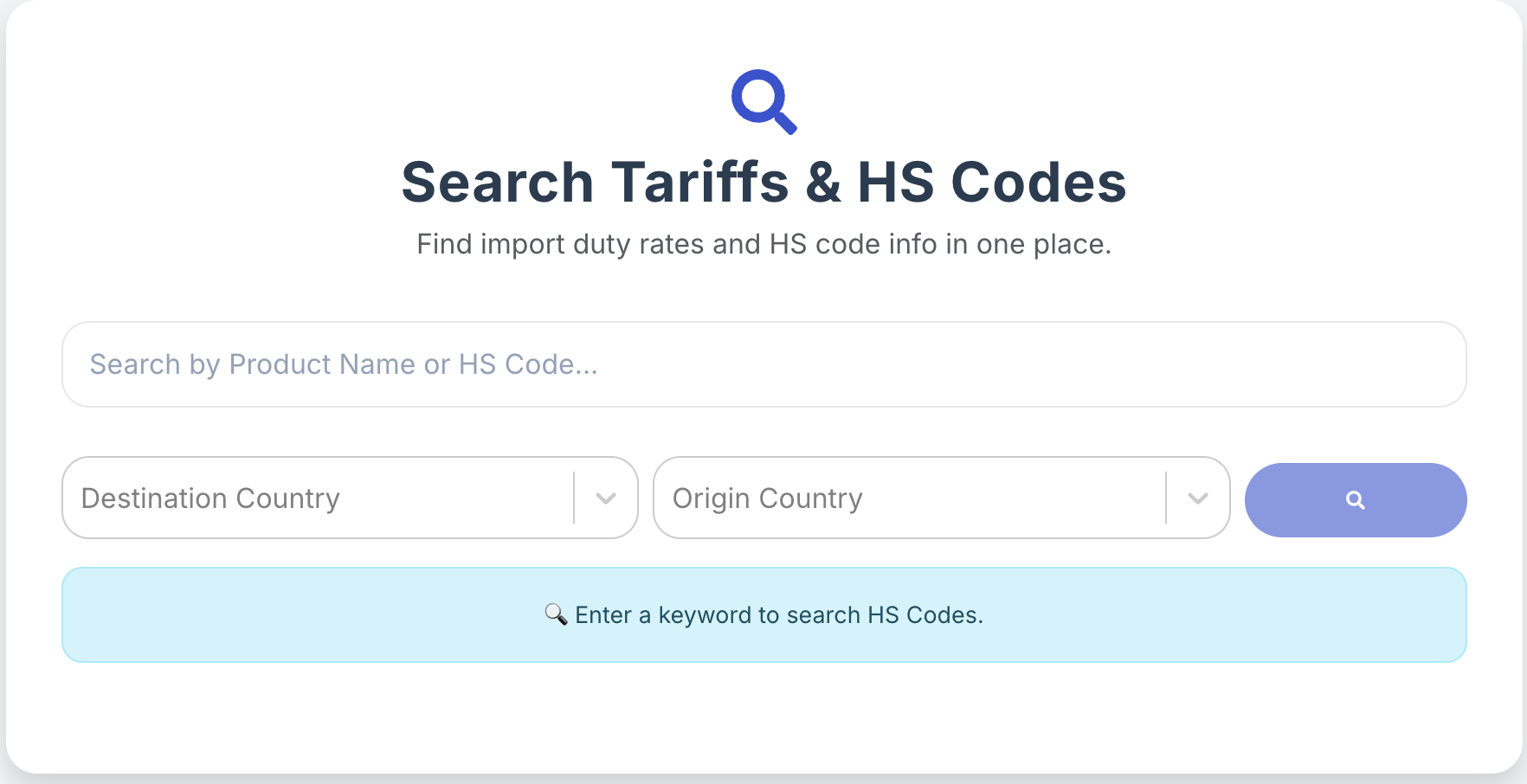

 Sep 10, 2026

