
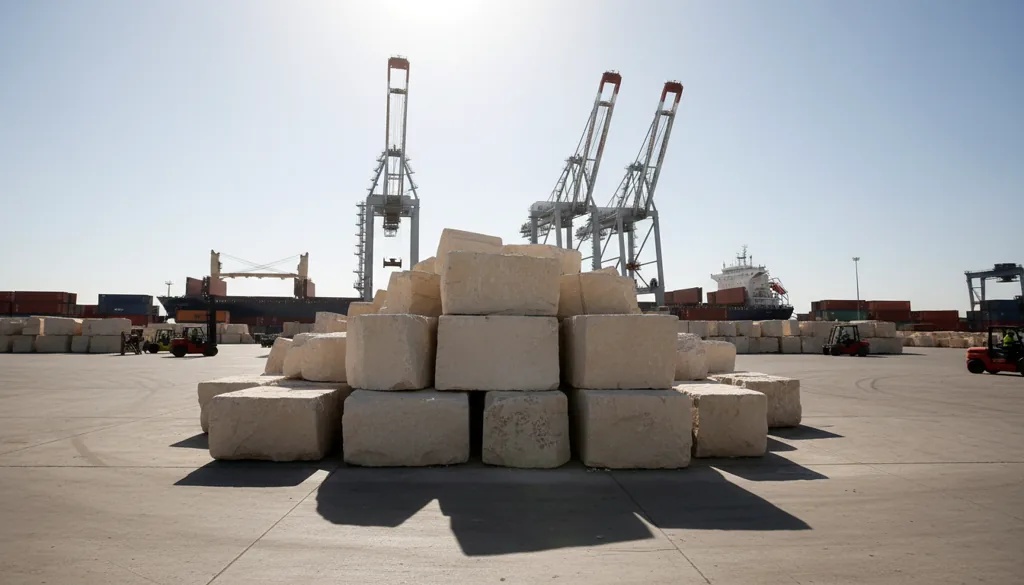
United Kingdom terminates the registration requirement for imports of creamy white limestone originating from Portugal starting 22 September 2026 following the closure of the anti-subsidy investigation.
The UK government is ending the registration requirement for imports of creamy or white limestone from Portugal across four commodity codes from 22 September 2026, after the Trade Remedies Authority closed its anti-subsidy investigation.1
The goods are natural stone slabs and finished stone used in high-end architectural projects, heritage restorations and premium commercial buildings. They can arrive as stone that has been cut or sawn, or as material shaped and surface-finished for installation.2
The registration was a precaution against possible countervailing duties if the investigation found that Portuguese subsidies had harmed UK producers. Importers and customs brokers carried the administrative burden through import declarations, while the potential duty would have fallen on the goods entering the UK. That burden ends with the registration requirement on 22 September 2026.3
Portuguese limestone registration
The change follows the Trade Remedies Authority’s decision on 21 September to terminate the investigation. The authority found no evidence that the Portuguese limestone concerned benefited from a countervailable subsidy. A countervailable subsidy is government support that meets specific tests and can be offset by an import duty.
From application to termination
The UK had opened the case on 14 January 2026 after an application from Albion Stone plc, a UK producer. The application alleged that Portuguese government support had helped producers and injured the UK industry. The investigation therefore covered both the alleged support and its effect on domestic producers.4
The Secretary of State for Business and Trade had instructed HM Revenue and Customs to register the imports while the case remained open. That instruction was issued under paragraph 29 of Schedule 4 to the Taxation (Cross-border Trade) Act 2018. The original registration notice was published on 5 February 2026.5
The registration did not itself impose a duty on every shipment. It created an official record of imports that could have been used if a trade remedy had later been introduced. The process linked the customs declaration to the investigation and preserved the possibility of collecting a duty on earlier entries.
That safeguard mattered because UK rules allow a definitive trade remedy to apply to registered goods from a date before a provisional measure. The possible look-back period can extend to up to 90 days before the implementation of a provisional remedy. The amount would have depended on any final duty adopted after the investigation.5
With the case closed without a finding of a countervailable subsidy, that mechanism no longer has a live investigation behind it. The notice terminating registration therefore supersedes the February measure. For importers, the immediate change is administrative rather than a new tariff rate.
Four codes leave HMRC records
The affected customs classifications cover four UK commodity codes: 6801000000, 6802210000, 6802290000 and 6802920000. The Trade Remedies Authority listed those codes in its termination update on 21 September.3
Customs codes named in each notice
The earlier registration notice used closely related code descriptions, including 68010000, 68029100, 68022100, 68029200 and 68022900. The difference reflects the level at which the codes appeared in the relevant customs systems and source notices. The commercial scope remained creamy or white Portuguese limestone in slab or finished form.
Before the termination, the import declaration for covered goods had to include the additional code 8C10. That code identified goods subject to registration under the February notice. From the effective date of the termination, the registration instruction to HMRC ceases to have effect.5
The classification point remains important because the codes capture a wider set of products than the trade remedy goods alone. Limestone that falls within a listed code is not automatically the limestone under investigation. Colour, origin and the form of the stone determine whether the product falls within the measure.
The notice described slab as natural stone that had simply been cut or sawn. Finished stone meant material processed and worked in a factory, including cutting, shaping and surface finishing to meet the intended use. Those descriptions connect the customs code to the physical product rather than to a generic limestone label.5
That distinction will continue to matter for declarations even after registration ends. A product can share a commodity code with the investigated goods while falling outside the specific description. The end of registration removes one trade-remedy reporting step, not the need to classify the stone correctly.
Why the investigation closed
The authority examined four alleged Portuguese support programmes. They included grants, non-refundable financing and funded payments intended to support the stone industry. The evidence did not establish all the elements required to treat the support as a countervailable subsidy.
The investigation considered whether there had been a financial contribution, whether a producer or overseas exporter had received a benefit during the relevant period, and whether the support was specific to particular companies, industries or regions. The authority said it could not establish the required combination of those elements.2
Some programmes and projects involved subsidies, and some recipients received a financial advantage, according to the Trade Remedies Authority. That was not enough under World Trade Organization rules to show that the imported limestone itself benefited from a countervailable subsidy. The case was consequently closed rather than followed by a duty recommendation.
The investigation used a period from 1 January to 31 December 2025. Its injury period ran from 1 January 2022 to 31 December 2025. Those dates set the evidence window for the subsidy and injury questions examined by the authority.2
That timing also explains why the September decision ends the registration measure quickly. The investigation had reached its final conclusion, so there was no remaining provisional finding to protect through continued customs registration. The result removes the route by which a later duty could have been attached to registered entries in this case.
The closure does not turn the February registration into a tariff. Nor does it alter the ordinary customs classification of Portuguese stone. It ends a temporary trade-remedy control created for an investigation that produced no finding supporting further action.
Excluded stone and declaration codes
The February notice already separated the investigated goods from other Portuguese limestone. Limestone that was not creamy, white or creamy-white was excluded from registration. Products in a listed commodity code that fell outside that description had to use additional code 8C15 to identify them as excluded.5
Three declaration regimes, one code list
| Registered stone | Excluded limestone | From 22 Sep 2026 | |
|---|---|---|---|
| Additional code | 8C10 | 8C15 | None |
| Which goods | Creamy, white or creamy-white | Other colours, same codes | All covered stone |
| Status | Registration ended | Regime superseded | Ordinary declarations only |
That exclusion shows why the measure was narrower than the commodity-code list suggested. A code could cover both the stone being investigated and other limestone products. The additional code acted as a declaration signal for goods that matched the classification but not the colour and origin description.
The evidence file also shows how the case developed after its opening. The authority published questionnaires and registration-of-interest material involving Portugal, exporters, UK producers, an importer and trade bodies. It later published extensions, business survey material and responses before recording a notice of termination on 21 September.4
The process was therefore more than a short customs coding exercise. It involved a subsidy assessment, an injury assessment and submissions from parties connected with production, importing and government. The termination closes that broader proceeding as well as the HMRC registration instruction.
For companies handling mixed stone ranges, the practical boundary remains the product description. Creamy or white Portuguese slabs and finished stone were the goods at issue. Other colours, origins or product forms may have different customs treatment even where a code appears similar.
The end of registration should reduce declaration work for the covered goods, because the special registration code no longer applies after the effective date. It does not remove normal import documentation, origin claims or the underlying customs declaration. Those requirements arise separately from the terminated trade-remedy measure.
What changes on 22 September
The termination notice was added to the government’s original registration page on 21 September. That page records that the registration requirement ceases to have effect from the following day. The change therefore has a one-day gap between publication of the update and its effective date.1
What changed, and what did not
The earlier registration had applied from 6 February 2026. It was introduced because the goods were the subject of an ongoing investigation and a possible anti-subsidy amount might have been imposed. The period of operation was less than eight months before the authority ended it.5
The new notice does not create a replacement measure. There is no countervailing duty in the documents supplied for this case, and no continuing registration instruction is identified after 22 September. The commercial effect is consequently the removal of a temporary customs control rather than a change from one duty to another.
Importers moving the specified Portuguese limestone after the effective date will no longer be making entries under the terminated registration requirement. Customs brokers will no longer need to apply the associated registration code for covered goods. The product still has to match the description and classification claimed on the declaration.
For goods outside the investigation but caught by one of the earlier codes, the old exclusion process is tied to the registration notice that has now been superseded. The former requirement to use 8C15 as an exclusion marker was part of that regime. The closure therefore removes the special registration framework rather than creating a permanent coding rule for all limestone.
The TRA’s finding leaves Portuguese creamy and white limestone without the anti-subsidy measure that registration had been designed to support. The immediate result is a cleaner customs process for the named stone products. The next import declarations after 22 September will show whether that administrative change reaches the trade flows without the extra record created by the investigation.
Sources
- ↩ Trade remedies notice: registration of imports of creamy/white limestone originating from Portugal https://www.gov.uk/government/publications/trade-remedies-notice-registration-of-imports-of-creamywhite-limestone-originating-from-portugal
- ↩ TRA closes subsidy investigation into Portuguese creamy/white limestone https://www.gov.uk/government/news/tra-closes-investigation-on-creamywhite-limestone-from-portugal
- ↩ Update to TRA Termination of Registration Measure on Imports of Creamy White Limestone from Portugal https://www.trade-tariff.service.gov.uk/news/stories/update-to-tra-termination-of-registration-measure-on-imports-of-creamy-white-limestone-from-portugal–21-september-2026-
- ↩ Subsidy Investigation: Creamy/White Limestone from Portugal https://public-file.trade-remedies.service.gov.uk/case/as0079
- ↩ Trade remedies notice 2026/08: Registration of creamy/white limestone imports from Portugal https://www.gov.uk/government/publications/trade-remedies-notice-registration-of-imports-of-creamywhite-limestone-originating-from-portugal/trade-remedies-notice-202608-registration-of-imports-of-creamywhite-limestone-originating-from-portugal