
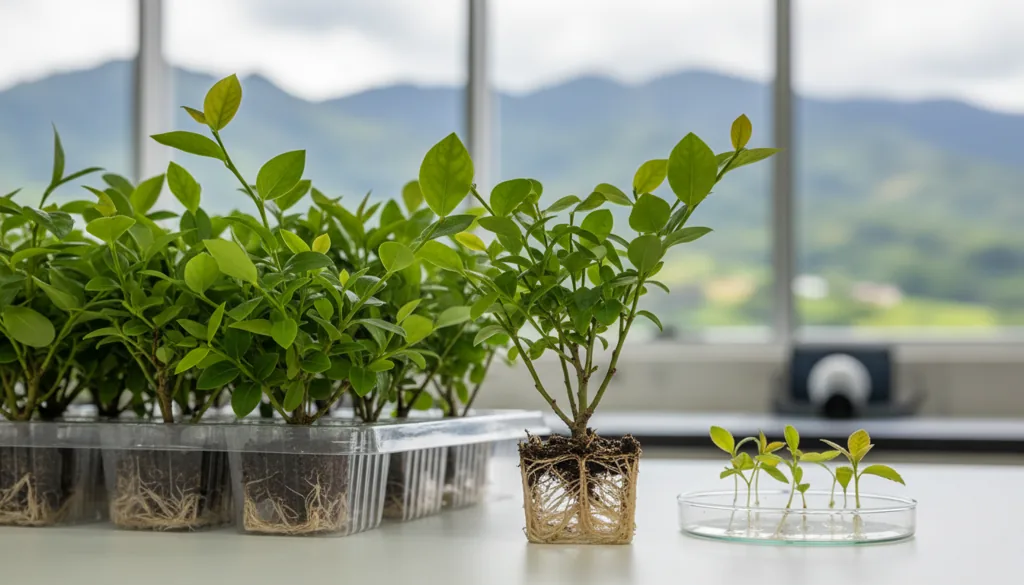
Costa Rica has established phytosanitary requirements for the importation of rooted blueberry plants from Spain and in vitro avocado plants from Israel, targeting disease-free propagation stock for plant health and territory protection
Costa Rica has set new plant-health rules for importing rooted blueberry plants from Spain and in-vitro avocado plants from Israel, aiming to keep out pests that could threaten its own crops and ecosystems. The requirements take effect on 8 August 2026 and apply only to propagation stock—seeds and cuttings meant for growing, not for eating.
The measure covers two high-value crops: blueberries (Vaccinium corymbosum) and avocados (Persea americana). Both are grown commercially in Costa Rica, but the country still imports elite varieties to improve yields and disease resistance. Last year Costa Rica imported 12 tonnes of blueberry planting material and 8 tonnes of avocado tissue culture, worth a combined $1.2 million. The delivered cost of each shipment will now include pre-shipment testing, post-entry quarantine and import permits issued before the plants leave the exporting country.
It comes after a decade in which Costa Rica’s State Plant-health Service (SFE) has tightened controls on live plant imports. In 2020 the agency suspended all rooted cuttings from countries that could not prove freedom from Xylella fastidiosa, a bacterial disease that has devastated olive groves in Europe. The new rules extend that logic to two more crops and two more trading partners, marking the first time Costa Rica has written species-specific requirements for Spain and Israel.
The new obligations on importers
Every shipment of rooted blueberry plants from Spain must now carry a pre-issued import permit and an official plant-health certificate that declares the shipment free of four pests: the carnation tortrix moth (Cacoecimorpha pronubana), two species of thrips (Scirtothrips aurantii and Scirtothrips dorsalis), and the dagger nematode (Xiphinema rivesi)1. The certificate must list the pests by name in the “additional declarations” section2.
Documents every shipment needs
For in-vitro avocado plants from Israel, the rules are simpler: the tissue culture must be grown in sterile agar, not soil, and must arrive without flowers or snails1. Both crops must also pass a post-entry quarantine—the plants are grown out under government supervision for at least 90 days before the importer can sell or replant them3.
The importer pays for all of it: the laboratory tests in the country of origin, the permit fee of ₡12,528 (about $24) per shipment, and the quarantine costs, which vary with the number of plants3. If the shipment fails inspection, the importer must either re-export it or destroy it at their own expense2.
What the rules replace
Before 8 August, Costa Rica had no published requirements for blueberry or avocado planting material from Spain or Israel. Importers could bring in small quantities under a general “low-risk plant” category, provided the shipment carried a basic plant-health certificate and passed a visual inspection at the border2. That regime placed the same instrument—rooted cuttings—in several categories at once, creating confusion for brokers and inspectors.
Planting stock from Spain and Israel, before and after
| Requirement | Until 8 Aug 2026 | From 8 Aug 2026 |
|---|---|---|
| Import category | General “low-risk plant” | Species-specific rules |
| Certificate | Basic plant-health certificate | Pests named in declarations |
| Border check | Visual inspection only | Post-entry quarantine, 90 days |
| Basis | No published requirements | 2025 pest-risk assessments |
The new rules remove the ambiguity. They also bring Costa Rica into closer alignment with the International Plant Protection Convention (IPPC), which requires member countries to base import rules on pest-risk assessments1. The SFE conducted those assessments in 2025 and published the results in WTO notification 26-04083 on 20 June 20261.
Who the rules affect
The measure lands hardest on three groups: Spanish blueberry nurseries, Israeli avocado tissue-culture labs, and Costa Rican fruit growers who rely on imported stock to refresh their orchards.
Blueberry and avocado planting material, tonnes
Spain is the world’s second-largest exporter of blueberry planting material, shipping 1,800 tonnes a year. Costa Rica took only 0.7 % of that volume in 2025, but the new rules could discourage smaller nurseries from entering the market. Israeli avocado tissue-culture labs face a similar hurdle: the agar requirement adds a step that some labs have not yet automated.
On the Costa Rican side, the rules add time and cost to the supply chain. A grower who orders 1,000 blueberry cuttings from Spain will now wait an extra 90 days before the plants can be sold or replanted. The delivered cost of each cutting rises by about $0.80, a 12 % increase on the current landed price of $6.503.
What the rules do not change
The measure leaves several things alone. It does not alter the maximum residue limits (MRLs) for pesticides on blueberries or avocados; those are still set by the Codex Alimentarius and adopted verbatim by Costa Rica4. It also does not touch the import rules for fresh fruit—only for propagation stock.
Nor does it change the broader framework for plant imports. Costa Rica still allows duty-free entry for most live plants under Central America’s regional free-trade agreement. The new rules simply add a layer of plant-health scrutiny on top of that tariff preference.
How the quota will be allocated is left open. The notification sets no volume limit, but the SFE can cap imports at any time if it detects a new pest risk1. The agency has not said whether it will publish an annual quota or issue permits on a first-come, first-served basis.
The next review
The rules come into force on 8 August 2026 and will be reviewed in March 20281. That review will look at two things: whether the pests named in the certificate are still the most urgent threats, and whether the post-entry quarantine period can be shortened without increasing risk.
The dates that bind
The timing matters. March 2028 is also when the European Union’s new MRLs for fungicides take effect5. Those changes will cut the permitted residues of methyl thiophanate, benomyl and carbendazim on Costa Rican exports of pineapple, melon and watermelon. If Costa Rica’s own MRLs do not match the EU’s by then, exporters could face rejections at European ports.
The SFE has said it will align its MRLs with the EU’s by February 2027, but the agency has not yet published the final list5. Until it does, exporters will have to navigate two sets of limits: one for the EU market and one for the Costa Rican market. The new plant-import rules add a third layer, but only for two crops and two countries. For the rest of the sector, the old ambiguity remains.
Sources
- ↩ WTO SPS notification 26-04083 — Costa Rica https://members.wto.org/crnattachments/2026/SPS/CRI/26_04083_00_s.pdf
- ↩ State Phytosanitary Service — Importacion / InicioImportaciones https://www.sfe.go.cr/SitePages/Importacion/InicioImportaciones.aspx
- ↩ State Phytosanitary Service — Tramites / tramites importacion vegetales https://www.sfe.go.cr/SitePages/Tramites/tramites_importacion_vegetales.aspx
- ↩ Codex MRL Review for Blueberries – CCPR 56 Report https://www.sfe.go.cr/CODEX/Informe-CR-CCPR%2056.pdf
- ↩ Progress in Chemical Substances Registration in Costa Rica (2023–2026) https://www.sfe.go.cr/SitePages/SFE_Transparente/Registro_boletines_2026.aspx