


 Jul 30,2026
  By Alice
Since electricity has intervened in our lives, candles have turned into decorative accessories rather than a primary source of light. Their main appeal orbits around visual aesthetic and ambience. Yet, the transformation does not change the demand status. Rather than promote candles as a lighting source, sellers find other niches that make the candle trade relatively consistent. If you are considering opening a business in this sector, let’s familiarize yourself with the candle products, material characteristics, and HS code for candles.
What is a candle?
A candle is an ignitable wick that is protected by a layer of slow-burning materials such as wax, tallow, or paraffin. In the past, candles were one of the primary sources of light for indoor purposes. Candles are designed to be lean and light to ensure practicality. They are also called a taper, a type of candle with pointed tips and wider bottom parts to guarantee a firmer position on a candle holder.
Candle: paraffin wax and tallow
Before rushing into determining the HS code for a candle, it is wiser to understand what the candle is made of. Candles are commonly made of three possible materials: wax, tallow, and paraffin. The first two materials can be found in nature, while the last one is manufactured. Here are more details on each candle’s materials.
- Wax
Wax is a natural material that can be extracted from plants and beehives. That is why you will hear several terms such as soy wax, beeswax, palm wax, etc. In plants, wax is basically a natural part of their leaves, stems, and fruits. To extract them, people boil the parts that are rich in wax for hours in water. This process will separate the wax from the plant fiber. For beeswax, the hive needs to be separated from the honey first. After that, the boiling process begins, and once it is done, it continues with the cooling process, where the beeswax will be separated from the remaining water and honey.
- Tallow
Tallow is also a natural slow-burning material. However, instead of plants, tallow is extracted from animals, usually cows or sheep. The process is called rendering, where animal fat is heated with a small amount of water and then let simmer for several hours. This process will produce similar materials as wax and is called tallow. Once it passes the cooling process, tallow will have a solid and creamy texture.
- Paraffin
Paraffin is a type of chemical compound consisting of hydrogen and carbon atoms, also known as hydrocarbons. Paraffin for wax is generally made from crude oil, and they are widely used for several purposes. Other than making candles, they are also functional in the pharmacy and cosmetics industry, as well as in paper and packaging making.
How to classify a candle based on the WCO document
Based on the World Customs Organization (WCO) document, candles are mentioned in Chapter 34, which regulates soap, surfactants, lubricants, waxes, and candles, including ones for dental purposes such as modelling paste and similar. If you only consider the HS code for candles, rest assured that you only need to check heading 3406. However, if you also consider trading wax and artificial wax such as paraffin not in the form of candles and tapers, you may check heading 3404. Check the table below to get more details on the HS code for candles and related product examples.
| HS code | Category/classification | Product examples |
| 3406.00 | candles, taper, and similar items | scented candle, decorative candle, either made of wax, tallow, or paraffin (synthetic wax) |
| 3404.10 | artificial wax made of modified lignite (brown coal) | artificial wax |
| 3404.20 | artificial wax made of poly(oxyethylene) (polyethylene glycol) | artificial wax |
| 3404.90 | artificial wax made of other compounds | artificial wax |
From the table above, you can see that each HS code represents the product in a specific way. The first HS code is specifically for candles as the finished product. The other three are targeted at synthetic wax as a raw material rather than as a finished product. They are widely used as polishes and lubricants, but it is not yet specified what things they can be used on, such as plastic, footwear, etc. Once they are specified, the HS code will also be different.
Candle Global Trade Overview
Using the HS code for candles 3406.00, you can easily check the global trade overview of candles each year. Let’s take a look at the trade lanes data in 2025 below.
Top Exporters
| Countries | Trade Value (millions USD) |
| China | 928.30 |
| Poland | 791.03 |
| Canada | 256.46 |
| Germany | 225.26 |
| Belgium | 213.28 |
Source: International Trade Centre, 2025, accessed 17th July 2026
Top Importers
| Countries | Trade Value (millions USD) |
| United States of America | 1,217.94 |
| Germany | 551.22 |
| United Kingdom | 377.22 |
| Netherlands | 201.71 |
| Belgium | 172.16 |
Source: International Trade Centre, 2025, accessed 17th July 2026
China confirmed its domination in the manufacturing sector, including candles, by 2025. Three European countries made the list, and according to the European Commission, half of the European-manufactured candles go to the United Kingdom. However, domestic consumption was also rather high due to cultural and religious reasons. Other than that, wellness and aesthetic purposes also affect the consistent demand for candles.
How to classify the HS code for a candle
Now, we can move to the next stage to categorize the HS code for candles. Finding the 6-digit HS code for candles is actually not that hard because all of them fall under the headings 3404 and 3406. However, the 6-digit HS code for candles is only the initial step; you need to classify it into a specific code issued by the destination country.
To simplify the process of finding the HS code for a candle and its regulations, you can use HSCodeMatch, an AI-assisted application that is specially designed to give insight about global trade. So, instead of classifying the HS code for candles manually, this app combines AI to search for the accurate HS code for your products. Check the following instructions to classify the HS code for a candle without ambiguity below.
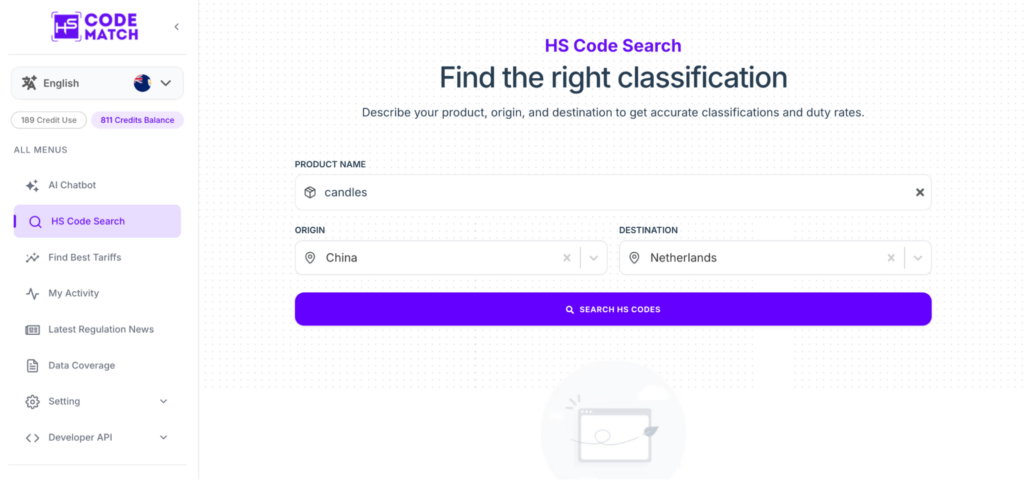
Step 1: Classify using HS Code Search
First things first, you need to access app.hscodematch.com and click HS Code Search, a specific feature to find the HS code for a candle. For this example, we can use the trade route between the major exporter and importer, such as China and the Netherlands.
Step 2: Find the most relevant list of HS codes for candles
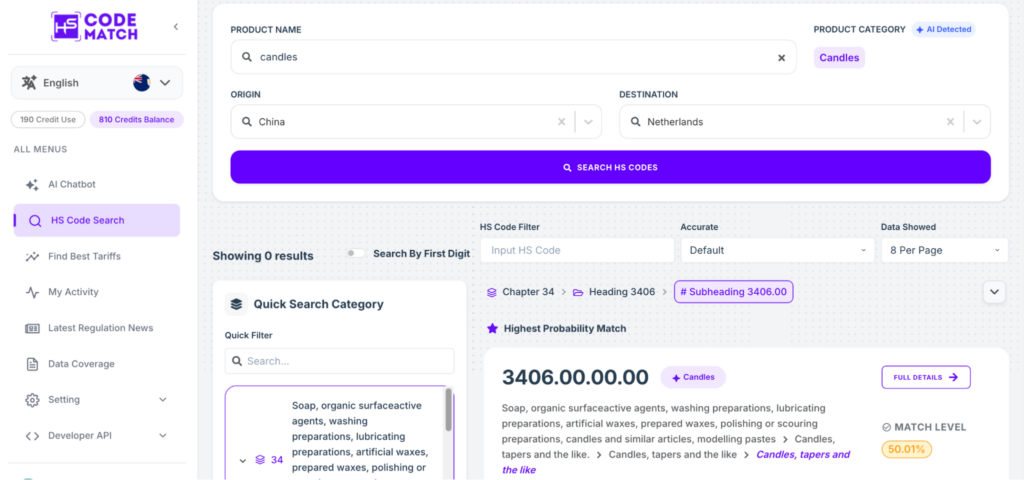
After submitting the product and countries, you will find the list of HS codes for candles. Then choose the most accurate HS code for candles based on the percentage of match level under 3406.00.00.00.
Step 3: Check the tariff and regulations for exporting candles
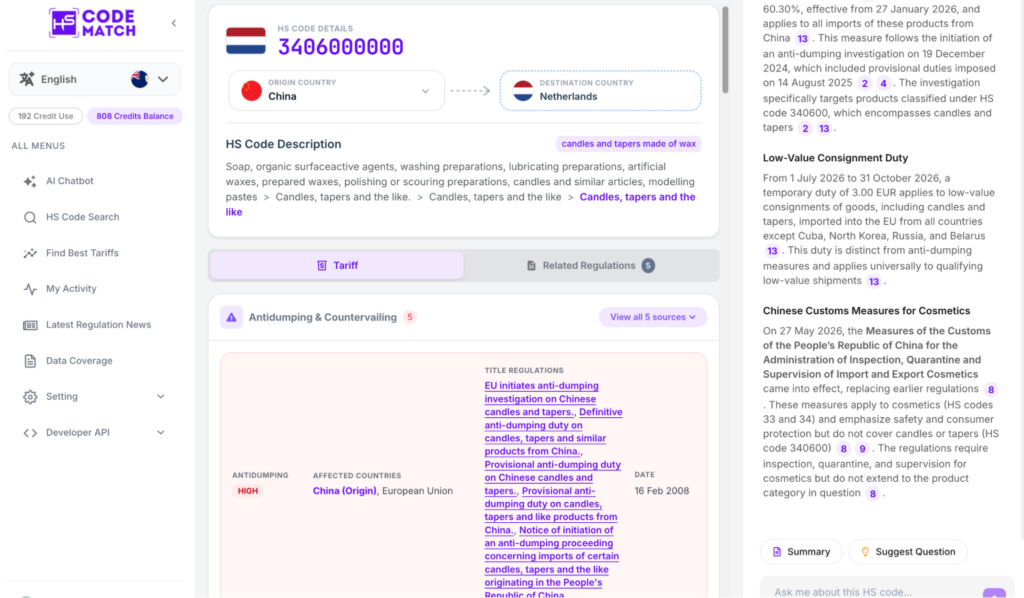
Select Full Details to see the tariff and regulations for exporting candles under the HS code 3406.00.00.00 from China to the Netherlands. You can also find the notification of antidumping duties applied to these products in the Netherlands and the EU.
Step 4: Ask the AI Assistant to search for the candle’s tariff and regulations in the EU
HSCodeMatch provides the complete tariff and regulations based on the products; therefore, you can check all of that in the related regulations. If you encounter any ambiguity. Just chat with the AI Chatbot Assistant to solve your problems.
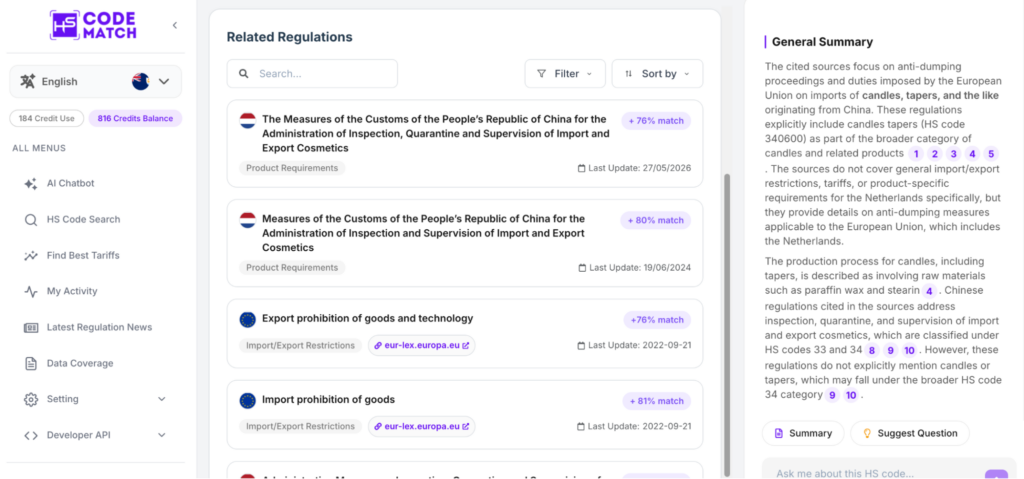
This feature is basically the AI chatbot, but it is specifically made to discover the tariffs and regulations in the destination country. Here are examples of answers and questions for exporting candles under 3406.00.00.00 from China to the Netherlands.
What is the tariff rate for exporting candles under HS code 3406.00.00.00 from China to the Netherlands?
The basic tariff rate for exporting candles under HS code 3406.00.00.00 from China to the Netherlands and the European Union (UE) is 0%. However, the European Commission has imposed a definitive anti-dumping duty of 60.30% for candle imports originating from China. In addition, there are low-value consignments with a fee of 3 EUR for all countries.
This antidumping duty does not apply to all countries, including countries under the preferential agreement with the EU, such as Switzerland, the EEA, or GSP countries. Here is the description table of tariff rates for candles from China to the EU.
| Regulation | Requirement | Date | Authority |
| SINCE OMNES Third Country Duty | 0% duty for all countries | Ongoing | European Commission |
| Low Value Consignments | 3 EUR per consignment for low-value shipments | 01/07/2026 to 31/10/2026 | European Commission |
| China Antidumping Duty | 60.30% definitive antidumping duty for candle imports from China | 27/01/2026 | European Commission |
What are the legal grounds for the EU to impose anti-dumping duties on Chinese candle imports?
The imposition of an antidumping duty by the EU on candle imports from China is grounded on the initiation by the European Commission. The legal basis is rooted in an investigation that has proven that there is a violation of the export price that is less than the normal value. The threshold is that a product can be deemed to violate the rule if the dumping margin is 2% of the normal value. Also, if the injury margin of dumping volume is more than 3% of the EU market share or cumulatively more than 7% for multiple countries.
What are the documentation requirements for claiming a low-value consignment exemption under TM01066?
The low-value consignment exemption under TM1066 is created to simplify the customs duty for imports of some products. The documentation includes the value, origin, and nature of the goods. However, this regulation does not apply to the products subject to antidumping duty, including candles from China.
There are preferential trade agreements that exempt low-value consignments, such as the EU-Korea FTA. This FTA will eliminate duties, but does not exempt importers from submitting proof of origin. All of the FTAs have their own requirements, deadlines, and thresholds based on the agreement between the two or more parties.
Conclusion
Fortunately, there will be no significant challenge to finding the HS code for a candle in the WCO document. They are specifically mentioned in headings and subheadings 340600 with no further classification. However, additional digits might be required depending on the country of destination, and they may ask you to specify whether you are shipping scented or decorative candles.
Frequently Asked Questions (FAQs): HS Code for Candle
1. Are candle, wax, and tallow the same?
No, to be more precise, a candle is a finished product that consists of an ignitable wick inside a layer of slow-burn material. This slow-burn material can be made of wax, tallow, or paraffin.
2. Are all candles environmentally safe?
No, not all candles are eco-friendly. Paraffin candles are made of a petroleum byproduct, which is not renewable and may release toxins at a certain rate. Only wax and tallow can be labeled as environmentally safe, as they are made of either plant or animal extracts.
3. Does a candle only have one HS code?
Yes, the HS code for candles is 340600, and there is no further classification. This means all types of candles, whether they are made of natural or synthetic wax, share the same HS code. However, in certain jurisdictions, additional digits may be required to specify more features in your candles, such as scent.
4. What is the TARIC code or national-level HS code for candles in the Netherlands and the EU?
The TARIC code or the national variation of the HS code for candles in the EU and the Netherlands is 3406.00.00.00. This tariff code is derived from the WCO-issued code under 3406.00.
5. What is the general tariff for exporting candles in the Netherlands?
The general tariff for exporting candles in the Netherlands and the EU is 0% for all countries. However, if the candles are subject to a definitive antidumping duty, then the antidumping duty supersedes the general tariff rate.
Find and Match the Right HS Code for Your Products.
Try Our App