


 Jun 04,2026
  By Alice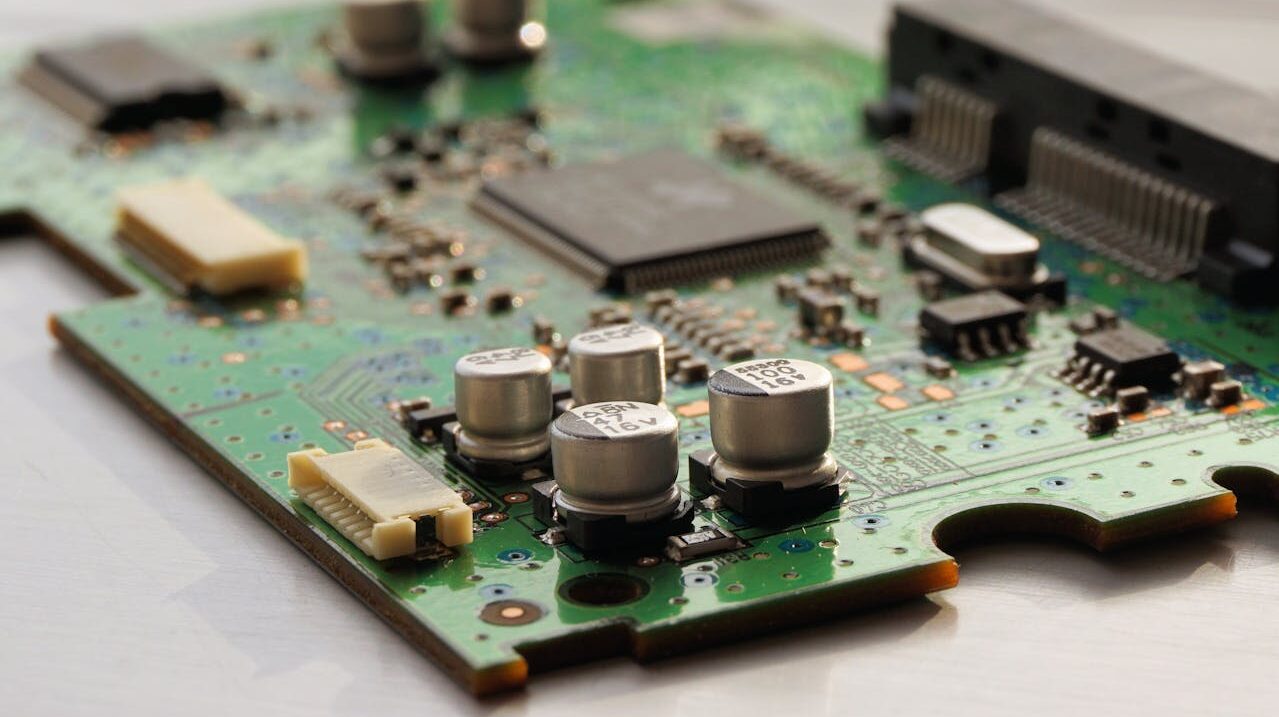
Printed circuit boards (PCBs) are integral to electronic appliances, so they are part of human lives in this modern era. The presence of PCBs is more essential these days due to the widespread use of digitalization and usage of gadgets, such as computers, laptops, smartphones, and even automotive and other machinery. Therefore, the demand for PCBs in the international market is persistent and growing. One of the important parts of export and import procedures is the declaration of the HS code. If you are an individual or a business involved in the international trade of PCBs, we can give you details structure of the HS code for PCBs, its major trading partners, and steps to find an accurate HS code for PCBs.
What are PCBs and why are they important for electronic appliances?
PCBs stand for printed circuit boards, which are non-conductive flat boards made from insulating materials. PCB’s structure consists of several mounted electronic components, including integrated circuits (ICs), resistors, capacitors, transistors, batteries, and others. Each component of PCBs is connected with wires and has its own functions.
The main materials to make PCBs are fibreglass, such as FR4 (Flame Retardant 4), and copper or aluminium for the circuit traces, coated with epoxy resins for protection. PCBs can be called the skeleton of electronics hardware as the main assembled component for electronic products, such as laptops, sound systems, and others.
The production of PCBs is essential since more and more people are dependent on electronic appliances. By using PCBs, the electronic device can save more space and be well integrated, which makes the design of the gadget simpler and thinner. In addition, PCBs are reliable because it proven durability for long-time usage and claim to be stable and able to resist humidity and high temperatures.
List of HS codes for PCBs assembly
After understanding the definition of PCBs and how important these products are, it is time to uncover the HS code for PCBs. First, we can explain that the Harmonized System (HS) code is a crucial aspect for export and import and has become a required element before exporting across national borders. The code from the World Customs Organization (WCO) was created as an identification number for goods in order to streamline the export and import process and determine the tariff rate and applicable regulations.
Under the classification from the WCO, the HS code for PCB assembly is mentioned under Chapter 85. The HS code for PCB can be further categorized into several headings and subheadings. The categorization of HS code for PCB varies depending on the design, application and condition, as well as material compositions. Thus, the HS code for PCB assembly can be classified under parts of electrical appliances rather than general PCBs. These are the examples of HS codes for PCBs.
| HS code | Description |
| 8507.60 | Assembly of PCB and lithium-ion battery |
| 8517.62 | Machine reception and transmission for telecommunication-related applications, including smartphones |
| 8518.21 | Assembly PCBs under single loudspeakers |
| 8534.00 | General or unassembled printed circuit boards |
| 8573.10 | PCB assembly with bimetal thermostat |
The general-purpose PCBs under HS code 8534.00 can be classified further into a category based on the classification of the destination country. For example, the HTSUS code for PCBs is subcategorised based on type, materials, and layers.
Top 5 PCB assembly exporters and importers
Once you know the classification of the HS code for PCB, we can move to the largest exporting and importing countries. This is important to comprehend the major players in the PCB trade lanes worldwide. Here is the list of the largest exporting countries of general PCBs under the HS code 8534.00.
| Country | Total Export Value (USD) |
| China | 20,182,989,470 |
| Hong Kong | 9,117,879,453 |
| Other Asia, including Taiwan | 4,921,724,218 |
| South Korea | 4,583,481,100 |
| Japan | 2,544,251,142 |
Source: UN Comtrade Database, retrieved May 24, 2025
As the data shown above shows, China is the biggest exporter of general-purpose PCBs, and Hong Kong comes in second place. The other biggest exporters include Other Asia (Taiwan), South Korea, and Japan. The interesting thing about this data is that all the biggest PCB exporters come from Asia.
| Country | Total Import Value (USD) |
| Hong Kong | 7,826,008,425 |
| China | 7,661,896,626 |
| Other Asia, including Taiwan | 4,803,402,189 |
| Mexico | 3,300,516,839 |
| South Korea | 2,933,939,999 |
Source: UN Comtrade Database, retrieved May 24, 2025
On the other hand, the biggest importer is Hong Kong with a value of more than 7.8 billion USD, followed by China with an amount of more than 7.6 billion USD. The remaining biggest buyers are Other Asia (Taiwan), Mexico, and South Korea.
How to find the HS code for PCB and its regulations
When we understand the classification HS code for PCB, the major trade flow of PCB, then it is time to find out how to find the HS code for PCB. The manual method to find the HS code for PCB or other products is by using the publication from the WCO that is published on its website. Additionally, you can use the national variation HS code for PCB on the destination countries’ websites.
To simplify your journey to find the HS code for PCB, there are various export and import application services you can use. One of the reliable applications you can use to look up the most accurate HS code for PCB or PCBA is HSCodeMatch. So, let’s find out how to find the HS code for PCB under the tariff code 8534.00 on HSCodeMatch below.
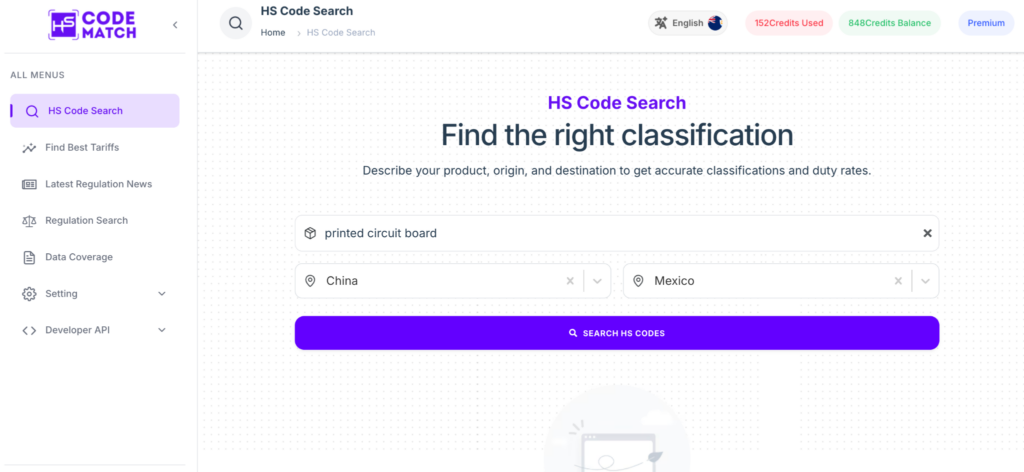
Step 1: Visit the HSCodeMatch app
We can start by opening app.hscodematch.com and choosing the HS Code Search tool. For the trade lane example, we can use one of the largest exporters and importers, China and Mexico. Setting the product’s name, printed circuit board, countries, China and Mexico.
Step 2: Look up the list of HS codes for PCBs in Mexico
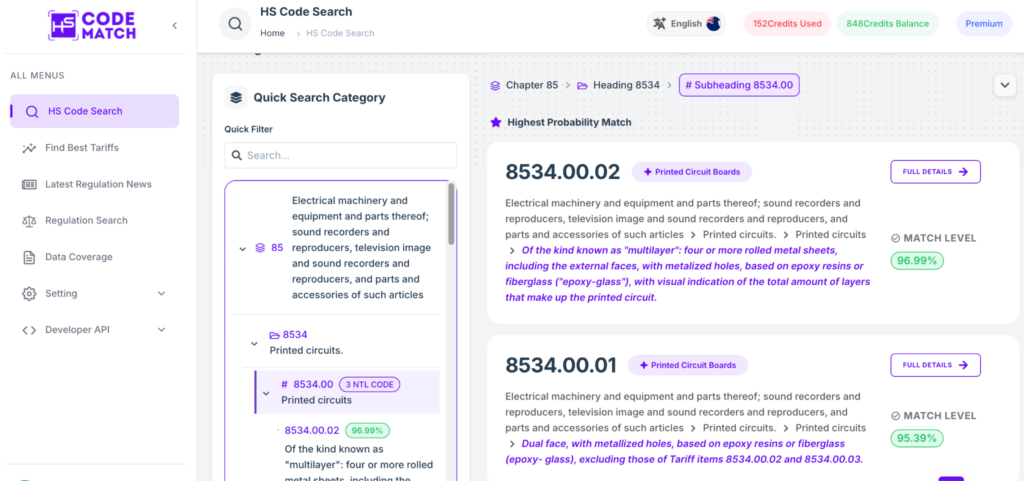
The HSCodeMatch engine will automatically select the most relevant HS code for PCBs in Mexico. Choose the HS code with the highest match level under HS code 8534.00.02.
Step 3: Check the description of HS code for PCBs (8534.00.02)
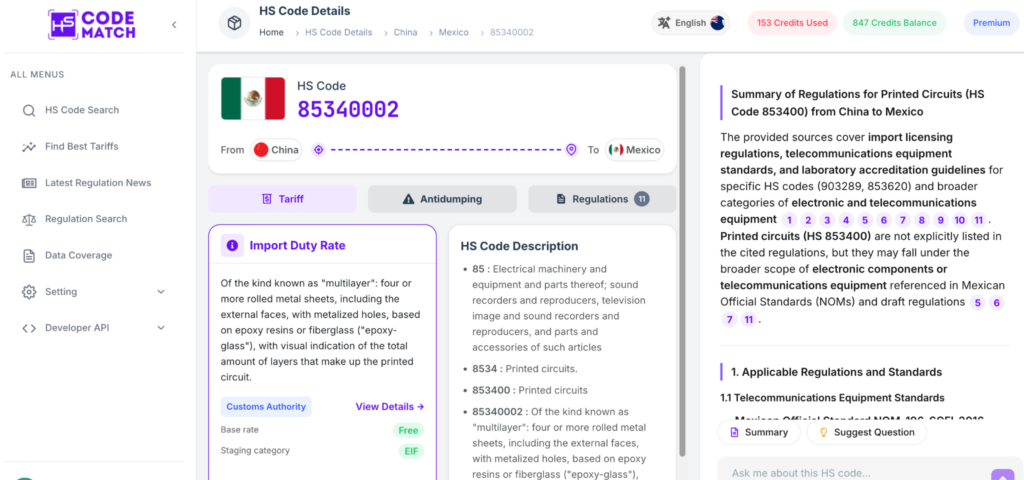
Once you have clicked the HS code for PCB (8534.00.02) in Mexico, you can find the full description along with the HS code. Also, you will find the latest tariff rate and regulations for exporting PCBs into Mexico.
Step 4: Ask the AI Assistant for HS code and regulations for PCBs in Mexico
If you encounter any confusion in finding the latest regulations for exporting PCBs in Mexico, HSCodeMatch give you a solution. Just ask the AI Chatbot Assistant about regulations to export PCBs into Mexico.
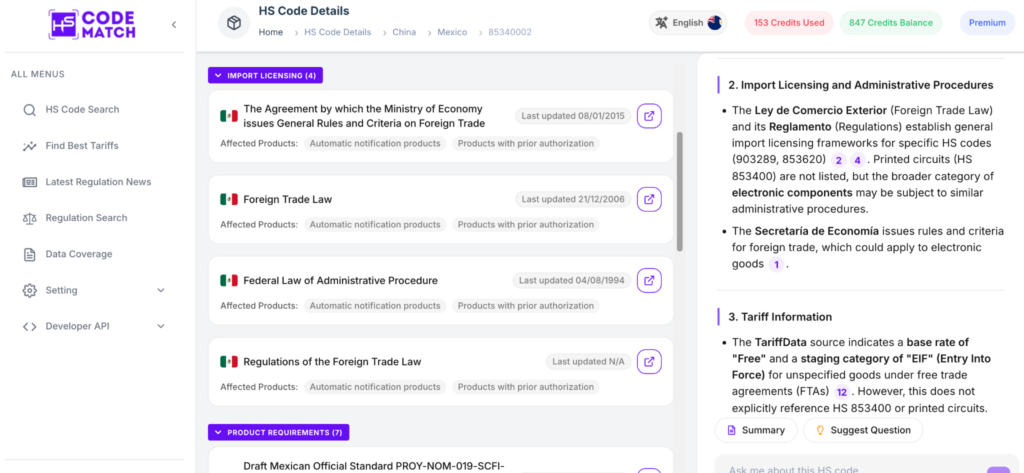
In order to understand the AI Assistant, we can give you examples of questions and answers about exporting PCBs (8534.00.02) from China to Mexico below.
Are there any restrictions on exporting PCBs and PCBA from China to Mexico?
Yes, Printed Circuit Boards (PCBs) can be under the categories of information technology equipment and terminal equipment for public telecommunications networks and electronic parts. The Mexican government has restricted the importation of PCBs into the country with safety standards under PROY-NOM-019-SCFI-2016 about electronic parts. Here is the scope of restriction for PCBs:
- Require all of the PCBs imports to follow the safety standards for information technology and office equipment, including their electronic equipment.
- Terminals for public telecommunication networks must comply with standard NOM-196-SCFI-2016 and Technical Provision IFT-004-2016.
Are there specific Mexican safety certifications required for PCBs used in telecommunications equipment?
Yes, Mexico has specific regulations about the terminal equipment connected or interconnected via wireless access to telecommunication networks and information technology. PCBs are also included within this regulation as a component for the terminal equipment. Here is the list of certifications for terminal equipment.
– Mexican Official Standard NOM-196-SCFI-2016 requires that terminal equipment must comply with the Technical Provision IFT-004-2016.
– PCBs within the telecommunication equipment must comply with PROY-NOM-019-SCFI-2016, which covers safety requirements for technology apparatus in Mexico.
– Testing laboratories for licensing before exporting to Mexico must be accredited, recognised, and designated by the local government or IFT.
| Regulation/Standard | Scope | Applicability to PCBs for telecommunications |
| NOM-196-SCFI-2016 | Terminal equipment connected and access to public networks | PCBs are part of the terminal equipment |
| PROY-NOM-019-SCFI-2016 | Information technology equipment and other apparatus | PCBs might be used for a broader category of electronic components |
| Technical Provision IFT-004-2016 | Mechanical and electrical specifications for terminal equipment | PCBs must comply with the requirements of terminal equipment in Mexico |
What documents are required for exporting PCBs to Mexico?
In order to export PCBs from China to Mexico, importers and exporters need to follow the regulations in Mexico. In addition, they need to fulfil all of the documents that adhere to the scopes, including Technical Provision IFT-004-2016 and comply with the PROY-NOM-019-SCFI-2016. The following documents are required to comply with the PCBs or electronic standards in Mexico:
1. Test reports: prove adherence with Technical Provision IFT-004-2016 (PCB for telecommunications)
2. Certification of conformity: PCB for information technology and office equipment needs PROY-NOM-019-SCFI-2016
3. Accreditation records: tests can only be done by laboratories authorised by IFT
Conclusion
Finding the HS code for PCB is actually quite challenging because there are many factors to consider, including materials, applications and others. The regular HS code for PCBs is under code 8534.00, but it is only for bare or general-purpose PCBs. However, if the PCBs are specifically built or assembled with other electronic components, then they can be classified under another HS code for other electronic products as finished goods. No wonder that classifying HS code for PCBs needs a thorough process in order to find the most accurate one.
Frequently Asked Questions (FAQs) about the HS tariff code for PCBA and PCBs
1. What are the tariff rates for exporting PCBs under HS code 8534.00 from China to Mexico?
The tariff rates for exporting PCBs under tariff code 8434.00.02 from China to Mexico is 0%. These tariff rates also apply to other PCBs in Mexico because it is considered a basic component of electronic products instead of finished goods.
2. What is the national variation of the HS code for multilayer four-roll metal sheet PCBs in Mexico?
The national variation of HS code for multilayer four-roll or more metal sheets PCBs in Mexico is 8534.00.02. This code is based on the basic 6-digit HS code for PCBs from the WCO that is recognised internationally.
3. Are the HS codes for PCB and PCB assembly different?
Yes, they are different. HS code for PCB or general-purpose PCBs under the code 8534.00. Meanwhile, the HS code for PCB assembly is mostly classified under the finished products rather than the regular PCBs. However, they are mostly under Chapter 85 for electronic apparatus.
4. Do materials affect the national variation of the HS code for PCBs?
Yes, obviously. Material composition is one of the main factors that determine the HS code for PCB. This is because PCB is constructed from several components and materials. For the national variation, the HS code for PCB can be classified further based on materials and types.
5. What are the determining factors to classify the national variation of HS code for PCBs according to the WCO?
In order to classify the national variation of the HS code for PCBs, it actually depends on each country’s regulation. In the United States, the code is called the Harmonised Tariff Schedule of the United States (HTSUS), which depends on the layers, types, and materials, such as impregnated papers or ceramics.
Find and Match the Right HS Code for Your Products.
Try Our App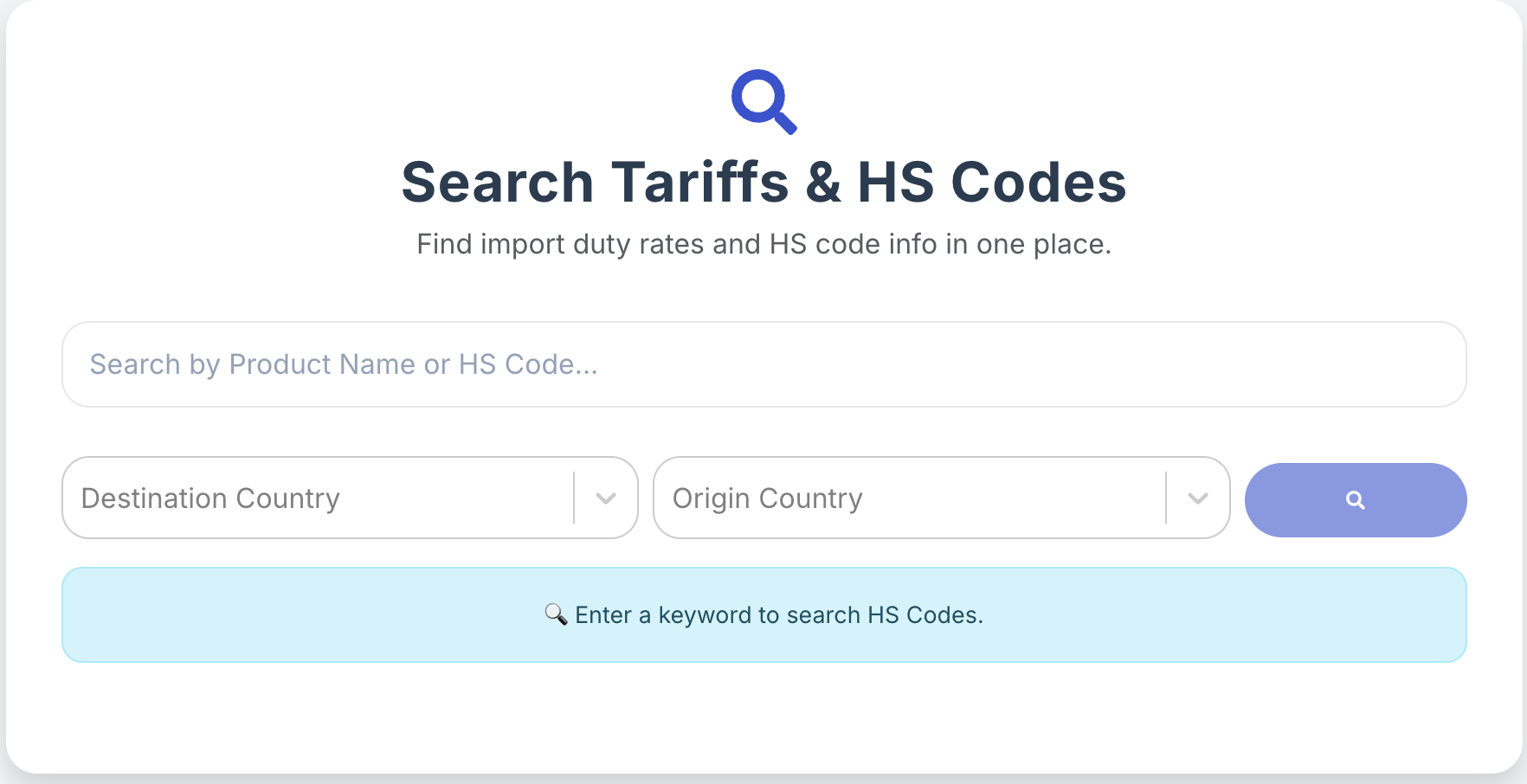

 Sep 10, 2026

