

 Jan 21,2026
  By Alice
Since globalization, the development of air transportation has expanded rapidly due to the huge demand for people to travel abroad, whether it is for business travel or leisure. Air transportation has become the most reliable option for long-distance travel because it is fast. Despite many airplane accidents, people still need air transportation as the main option for traveling. This is the reason why the demand for aircraft parts in international trade is essential. However, the declaration of the HS code is a requirement for exporting and importing aircraft parts. In this article, we will explain the HS code for aircraft parts, the major trading players, and how to find the correct HS code for aircraft parts.
What are the components of aircraft parts and their functions?
An aircraft is one of the air transportation modes that is very useful for transporting people or cargo within the country or to other countries. However, aircraft have different sizes and functions. It can be used for transporting civilians, and it can also be designed specifically for military purposes. However, the terms of aircraft include all of the air vehicles, such as airplanes, helicopters, drones, and others. The airplane is constructed from several crucial components, and here is the list of airplane parts and their functions.
- Wings
As we know, wings are a crucial part of the airplane. It has functions to lift the weight of the airplane’s body during takeoff. Meanwhile, it also holds the plane’s body while in the air. Beneath the wings, there are turbine engines that have functions to push the airplane into the air.
- Fuselage
The fuselage is the body of the airplane that is assembled from several compartments with a shape that looks like a long tube. The front fuselage is known as the cockpit, and the passenger and cargo are located in the rear of the fuselage behind the cockpit. The fuselage is connected with the wings and tail as well as the airplane engine.
- Tail for Vertical and Horizontal Stabilizer
All of the airplane has tail at the back of the body, the tail has a function to control and stabilize the movement of the airplane. The tail commonly consists of a horizontal and a vertical stabilizer. The horizontal stabilizer has a function to prevent the front part of the plane from moving uncontrollably up and down. Meanwhile, the vertical stabilizer prevents the airplane’s body from moving side to side due to instability in the air.
- Flaps and spoilers
Other important parts of the airplane are flaps and spoilers. These two parts play a role as a complement to the airplane parts, which are located in the wings. The flap helps to increase the power from the engine during takeoff and landing. Meanwhile, spoilers are developed to slow the airplane during landing and control the speed of the airplane in the air.
What is the HS code for aircraft parts?
After understanding the aircraft components, we can move to the structure of the HS code for aircraft. Harmonized System (HS) code is a universal code for export and import administered by the World Customs Organization (WCO). This code is important as a standard requirement in the destination country for identifying the products based on the recent regulations. Therefore, the declaration of the HS code is compulsory and cannot be overlooked for each of the international trade parties.
HS code for aircraft falls under Chapter 88, which contains the aircraft. spacecraft and other parts of them. It can be classified into four more specific additional digit HS codes, called headings and subheadings, based on the characteristics and materials. That sequence of numbers forms the full 6-digit HS code that is used for international trade. Here is the list of the common HS codes for aircraft parts.
| HS code | Description |
| 880110 | HS code for balloons and gliders which non equipped for aircraft. |
| 880230 | HS code for aeroplanes and other aircraft with a weight between 2000 kg and 15,000 kg. |
| 880400 | HS code for parachute, paragliding, and other rotochutes, and includes the accessories. |
| 880530 | HS code for ground training flying airplanes and other parts of them. |
| 880730 | HS code for other parts of aeroplanes, helicopters, or unmanned aircraft, such as drones. |
The 6-digit HS code is only the beginning for exporting products. You also need to understand that there is additional code from the recipient country, which is called the national code. In the United States, the national or country-specific code is called the Harmonized Tariff Schedule (HTS) code. Meanwhile, in the European Union or the United Kingdom, the national code or extension of the HS code is called the commodity code.
The top 5 aircraft parts exporters and importers
To gain a deeper understanding of the aircraft parts trade, we need to identify the largest exporters and importers of aircraft worldwide. This information will broaden your understanding of countries that have developed into producers and suppliers of aircraft parts. However, we can narrow the aircraft parts to the medium airplane products under the HS code 880230. Here is the list of the biggest aircraft parts exporting countries under the HS code 880230 in the world.
| Country | Trade export value (USD) |
| France | 1,829,193,102 |
| Canada | 1,626,597,264 |
| Switzerland | 1,198,659,168 |
| Brazil | 1,026,972,630 |
| United Kingdom | 589,341,704 |
Source: UN Comtrade Database, accessed January 14, 2026
The data above, it demonstrates that France is the largest exporter of airplanes under HS code 880230 in 2024. This European country was followed by Canada, Switzerland, Brazil, and the United Kingdom. As we know, France is the home of one of the civilian aerospace producers in the world, Airbus.
| Country | Total import value (USD) |
| United States | 4,500,674,200 |
| Brazil | 1,559,751,991 |
| Ireland | 1,519,317,519 |
| Australia | 1,349,969,598 |
| Republic of Korea | 983,236,677 |
Source: UN Comtrade Database, accessed January 14, 2026
The largest importer of aircraft parts under the HS code 880230 is the United States, with a value of more than 4.5 billion USD in 2024. Brazil and Ireland are in second and third positions as the largest buyers of aircraft parts under this code. Moreover, Australia and South Korea are the fourth and fifth-largest importers in the world.
How to find the HS code for aircraft with HSCodeMatch
Finding the HS code for aircraft is indeed complicated due to the many complex classifications of products. Moreover, the penalties for inaccurate HS codes will be imposed by the customs agency based on the degree of inaccuracy. Therefore, all of the international trade parties must consider the importance of the HS code to avoid penalties. To alleviate the complexities, HSCodeMatch appears as a countable assistant to help you find the most accurate HS code for your products. Here are the step-by-step instructions for finding the accurate HS code for civil aircraft parts on HSCodeMatch.
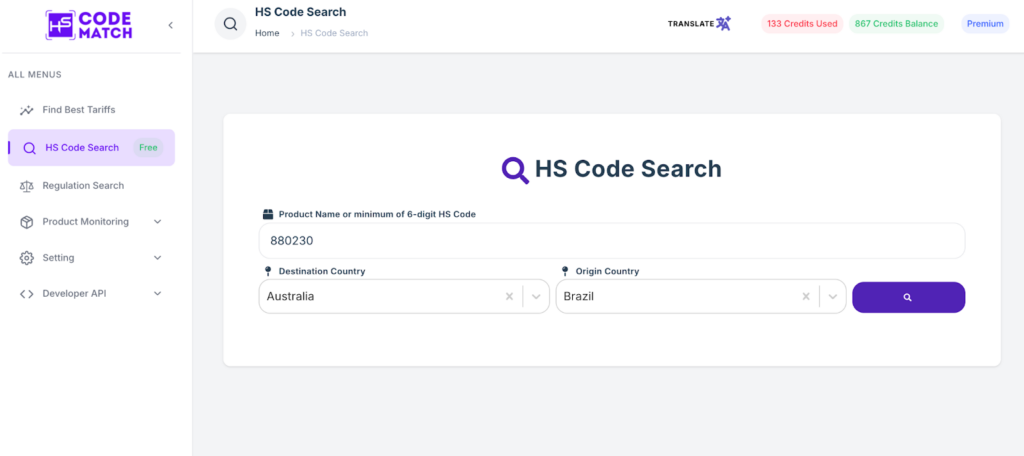
- First step: Open the HSCodeMatch application by clicking hscodematch.com. Then, click the HS Code Search and set the product’s name or 6-digit HS code, as well as the origin and destination countries. For example, we can use one of the largest exporting and importing countries above for products under HS code 880230, such as Brazil and Australia.
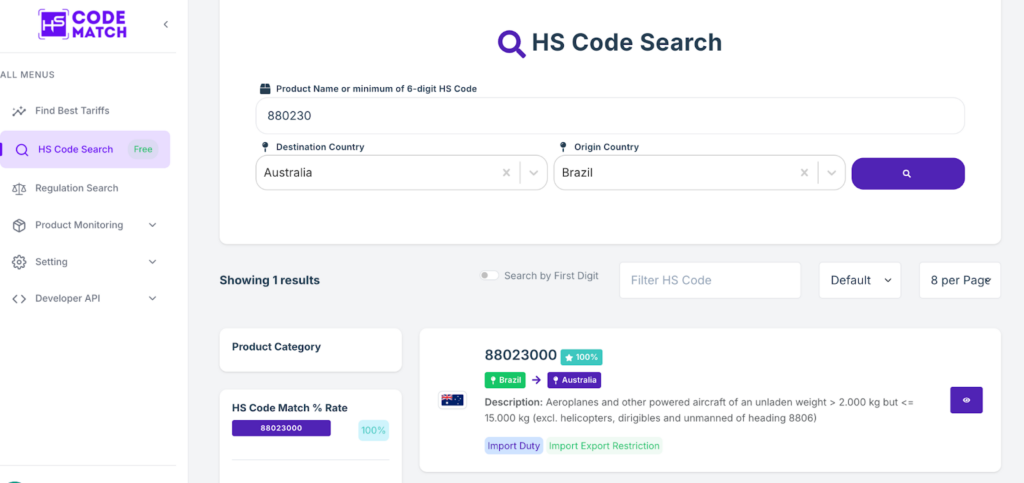
- Second step: Then, select the most relevant HS code for your products based on the HSCodeMatch results. For this example, we can choose the only one HS code 88023000 for exporting an aeroplane from Brazil to Australia.
- Third step: After selecting the HS code list, you will be redirected to the HS Code Details page. Through this page, HSCodeMatch allows you to check the accuracy of the classification of the HS code from the description.
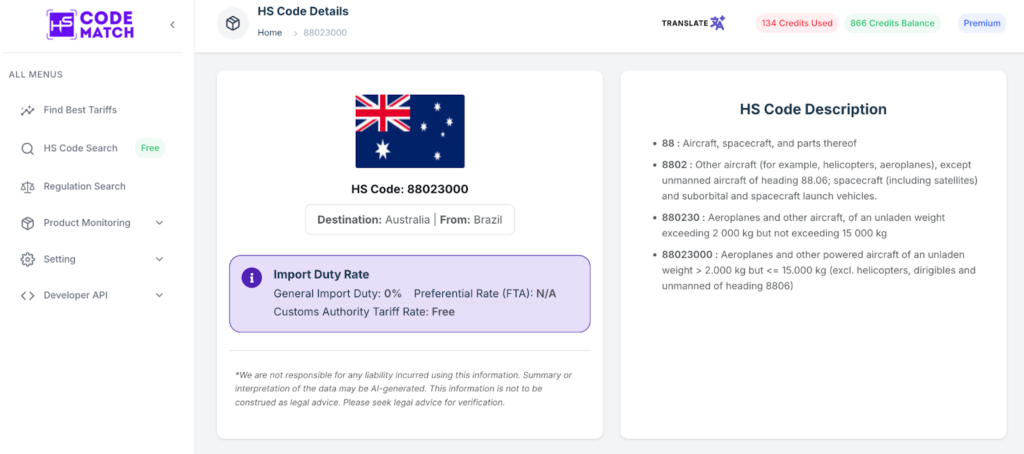
- Fourth step: For a better understanding of the HS code and the duty rate, you can move to the bottom section of HS Code Details. This allows you to check the latest regulation as well as the tariff imposed by the recipient country. You can also use the provided AI chatbot assistant to obtain more information.
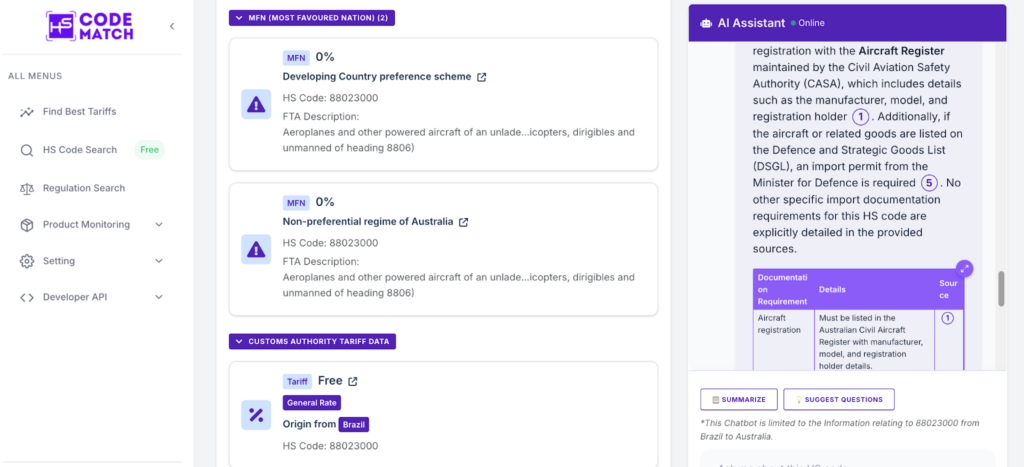
These are examples of answers from an AI chatbot assistant provided by HSCodeMatch regarding exporting aircraft parts under HS code 88023000 from Brazil to Australia.
Are there any additional tariffs for exporting aircraft under the HS code 88023000 from Brazil to Australia?
Exporting aircraft under HS code 88023000 from Brazil to Australia is not subject to an additional tariff. Therefore, the Australian government applied 0% or no tariff rate for aircraft products. This tariff is based on the Most Favoured Nations (MFN) or non-preferential regime, and Australia also applies the Generalized System of Preferences (GSP) for developing countries, including Brazil. Given this fact, the importer must not worry about the high tariff rate for exporting aircraft products from Brazil to Australia. Here is the summary table for exporting aircraft parts from Brazil to Australia.
| Tariff Type | Tariff Rate | Applicable Regime |
| Most Favoured Nation (MFN) | 0% | Non-preferential regime |
| Generalized System of Preferences (GSP) | 0% | The GSP regime is designed to support products from developing countries |
What are the import documentation requirements for aircraft under HS code 88023000 from Brazil to Australia?
Import documentation for exporting products under HS code 88023000 from Brazil to Australia requires following the Aircraft Register, which is administered by the Civil Aviation Safety Authority (CAS). The documentation is specially crafted for civil aircraft under this regulation, which includes the manufacturer, model, and registration holder. Meanwhile, if the aircraft is for defence, it should be listed in the Defence and Strategic Goods List (DGSL), which is an import certification from the Australian Ministry of Defence. Here is the summary table of documentation for exporting aircraft from Brazil to Australia.
| Documentation Requirement | Description |
| Aircraft Registration | All of the aircraft imported from other countries, including Brazil, must be listed in the Australian Civil Aircraft Register. This includes the information of the manufacturer, model, and registration holder details. |
| Defence and Strategic Goods List (DSGL) permit | This regulation is specifically implemented for the imported aircraft for military purposes. Then, it must be registered in the DSGL, which is administered by the Australian Ministry of Defence. |
What are the penalties for non-compliance with import regulations in order to export aircraft parts from Brazil to Australia?
Non-compliance with the aircraft import regulation in Australia will cause penalties based on the Customs Act 1901 and the Defence Trade Control Act 2012. The penalties vary, including fines, seizure of products, or even criminal charges and persecution based on the degree of inaccuracy or the intentional act to evade tariffs or other restrictions. One thing that should be considered is the listing on the DSGL, which is the specific requirement from the Australian Minister of Defence for military aircraft. If there are any violations, it has possibility that you may need to deal with the legal consequences in Australia.
| Penalty Type | Regulation | Consequence |
| Prohibited Items import | Customs Regulations 1958 for Prohibited Imports | Seizure of products, fines, and potential legal charges |
| Unauthorized defence goods | Defence Trade Control Act 2012 in Australia | Potential criminal persecution, fines, and imprisonment if there is proof of products not permitted from the DSGL lists. |
Conclusion
The declaration of HS code for aircraft parts is obviously an important aspect of global trade. Therefore, most of the international trade actors must be provided with strong knowledge about the latest HS code and regulations about their products, origin, as well as the destination country. If there is an inaccuracy or inconsistency of the HS code for aircraft, it will lead to e a serious consequences. To solve your complexities in finding the accurate HS code for aircraft, you can use a third-party application, such as HSCodeMatch. Using this application allows you to obtain information related to HS codes and the latest regulations easily and quickly.
Frequently Asked Questions (FAQs) about HS Code for Aircraft
What is the general tariff import for exporting aircraft parts from Brazil to Australia?
The general tariff import for exporting aircraft parts from Brazil to Australia is 0%, or there is no tariff rate. Meanwhile, the Customs Authority Tariff Rate is free; thus, you do not need to worry about the duty for exporting these products from Brazil to Australia.
Are there any Free Trade Agreements between Australia and Brazil?
No, Australia and Brazil are not involved in the same FTA. However, Australia has an FTA with Latin American countries, such as Chile, under the Australia-Chile Free Trade Agreement to promote business and trade relations between the two countries.
Are there any antidumping and countervailing duties for aircraft parts imported from Brazil to Australia?
No, the Australian government does not impose any antidumping and countervailing duties on aircraft products from Brazil. Therefore, there is no duty applied to the aircraft parts products from Brazil to Australia.
What is the specific structure of the HS code for aircraft parts?
All of the aircraft parts are under Chapter 88, which includes the aircraft and spacecraft. The chapter of HS code is followed by the heading and subheading to form the full HS code for aircraft parts based on their character and materials.
Where can we find the HS code for aircraft easily?
You can use the third-party application for assisting international trade called HSCodeMatch. HSCodeMatch allows you to find the accurate HS code for aircraft parts or other products quickly and easily. However, you also need to check the official sites of the local government, such as EU TARIC or HTSUS.
Find and Match the Right HS Code for Your Products.
Try Our App