


 Dec 09,2025
  By Alice
The appearance of solar panels or solar modules is a key part of supporting the energy transition from non-renewable to renewable energy. The solar panel is a product that utilises the abundance of solar energy as a primary source of energy in human daily life. Due ot its importance, some countries are producing solar modules and exporting them to other countries. Because of this, the inclusion of the HS code for solar modules is important as a requirement for international trade. This article will explain the HS code for solar modules, major exporters and importers, as well as how to find the right HS code for solar modules.
The structure of the HS code for solar modules or panels
HS code is an abbreviation for Harmonized System (HS) code, which was established, managed, and updated by the World Customs Organization (WCO). This code is created to easily identify the products based on their category and characteristics. HS code has the main functions to make the customs process run smoothly and allows the customs agency to determine the tariff rates, taxes, and other import regulations in its country.
HS code for solar modules is located under Chapter 85, which is categorized as electrical machinery and equipment. The Chapter is followed by two numbers of headings and two numbers of subheadings, namely, 8541.43. This is the breakdown of the HS code for solar modules:
- 85: Chapter for electrical machinery and equipment and parts thereof.
- 41: Semiconductor devices (for instance, diodes, transistors, semiconductor-based transducers), photosensitive semiconductor devices, including photovoltaic cells, whether it is assembled in modules or formed into panels or not.
- 43: Photovoltaic cells assembled in modules or made up into a panel
After the six-digit HS code, the two numbers are the other subheading based on the destination country. Due to the specific code, please note that you need to understand the structure of the additional code from the country where your business partner is based. The additional code from one country to another varies; it can be an 8- to 11-digit HS code.
The top 5 largest exporters and importers of solar modules
After understanding the structure of the HS code for solar modules, you might need to know the main players of the solar module trade around the world. It is important to know which countries have a significant record in solar panel trades. This is the list of the top 5 largest exporting countries of solar modules in the world.
| Country | Trade export value (USD) |
| China | 27,989,580,419 |
| Thailand | 1,930,798,862 |
| Malaysia | 1,759,807,394 |
| India | 1,487,858,202 |
| Netherlands | 1,487,020,371 |
Source: UN Comtrade Database, accessed November 24, 2025
From the data above, we can see that China is no doubt the dominant exporter in the solar module trade. The East Asian country has an export value of slightly less than 27 billion US dollars. Behind China, there are other Asian countries, including Thailand, Malaysia, and India, that are the largest solar panel exporters. Meanwhile, the fifth position is the Netherlands, as the only European country in the list of the largest exporters of solar modules.
After the grasp of the top largest exporters above, we must see the 5 top largest importers of solar modules worldwide. These are the top 5 biggest importing countries of solar modules under HS code 854143.
| Country | Trade import value (USD) |
| United States | 15,193,756,743 |
| Brazil | 2,875,444,624 |
| India | 2,875,192,304 |
| Pakistan | 2,197,252,312 |
| Germany | 1,994,236,735 |
Source: UN Comtrade Database, accessed November 24, 2025
Based on the data above, the United States has become the largest importer of solar modules in the world, with a valuation of more than 15 billion US dollars. This country is followed by Brazil, India, and Pakistan as the second, third, and fourth largest importers, respectively. The only European country is Germany, as the fifth largest importer of solar modules.
Importance of the correct HS code for solar modules
Inserting the accurate HS code for solar modules is important. The inclusion of the HS code is one of the requirements for international trade, and it would have a severe impact if there were a mistake. Not only to determine the tariff rates, taxes, and other restrictions of the importation of solar modules, but it is also an assessment to eliminate tariffs and other restrictions based on Free Trade Agreements (FTAs).
If there is a failure to insert the HS code for solar modules, there are several impacts on business, especially on financial aspects. The customs body will take consequences based on the degree of failure on the HS code. The penalties vary from seizure of products to huge fines, which result in business loss. Thus, all of the parties in international trade must ensure the accuracy of the HS code for solar panels or other products.
Challenges in finding the accurate HS code for solar modules
Finding the accurate HS code for solar modules is quite complicated. This is because the solar modules are considered a rapidly developing technology. Similar to other renewable alternative products, the development of the solar panel is updated from time to time. Therefore, the classification can be different based on the latest classification.
Not only because of the rapid evolution, but also because solar panels sometimes have two different uses for charging a vehicle and for storing the energy. The solar panels or modules are also commonly made from a combination of two or more different materials. These two reasons lead to a challenge in case of classifying the HS code for solar modules before exporting the products.
Finding the HS code for solar modules using HS Code Match
We know that finding the HS code for solar modules is quite complicated and sometimes takes a lot of time. In order to find the HS code for solar modules easily, you can use a third-party application called HS Code Match to assist in finding the accurate HS code and guide you in international trade. These are the steps for finding the right HS code for solar modules using HS Code Match.
- First step: Open the HS Code Match on your browser by clicking hscodematch.com. Then, click Go to App in the corner of the HS Code Match page. Please select the product name and the country of origin, as well as the recipient country. For this, we can use an example based on the largest exporting and importing solar module countries, such as China to Brazil.

- Second step: HS Code Match will provide the result. However, based on the results of solar modules from China to Brazil, there is only one HS code. Then, we can select that to see the details of the HS Code Details.
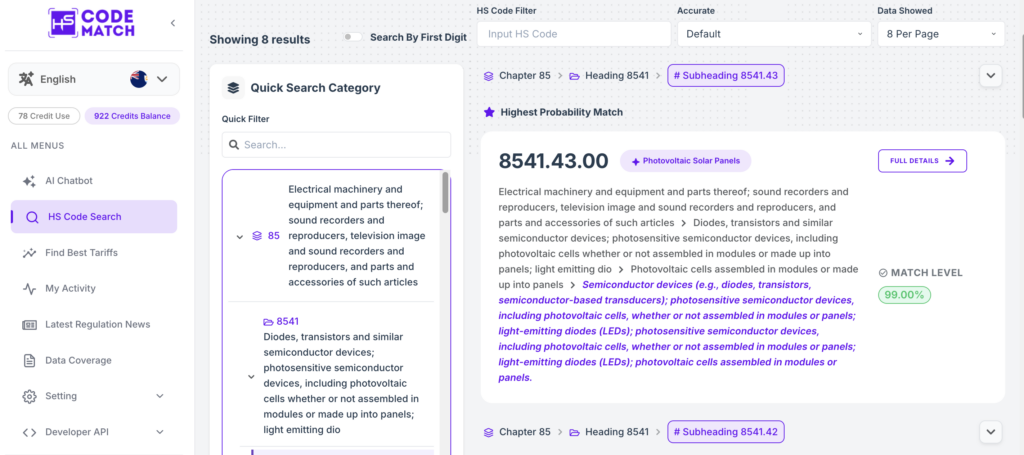
- Third step: After the HS Code Details opens, you can see the HS code description. Also, you can see the import duty rate, with the general import duty for exporting solar modules from China to Brazil being 12%.
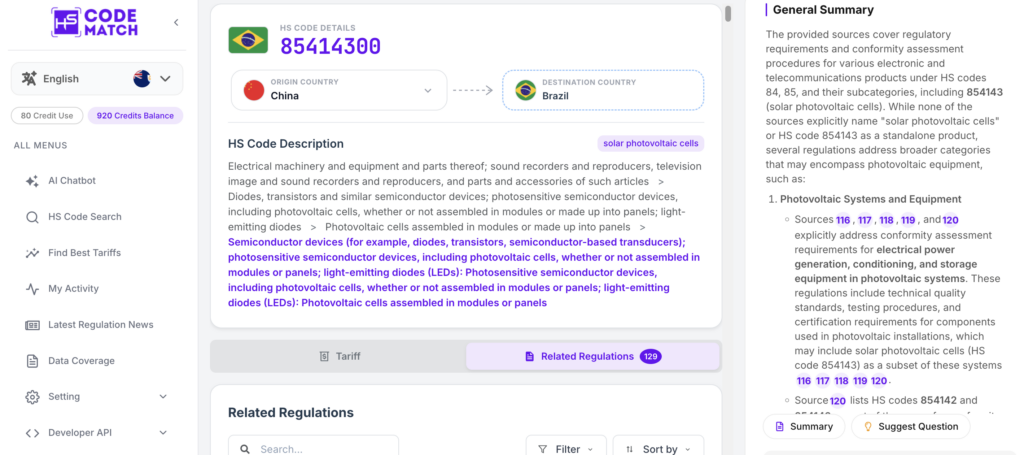
- Fourth step: Move to the bottom part of the HS Code Details. You can see the explanation about the import duty and import regulations. On this page, there is an AI Assistant to find the specific parts of the regulation based on this HS code for solar modules.
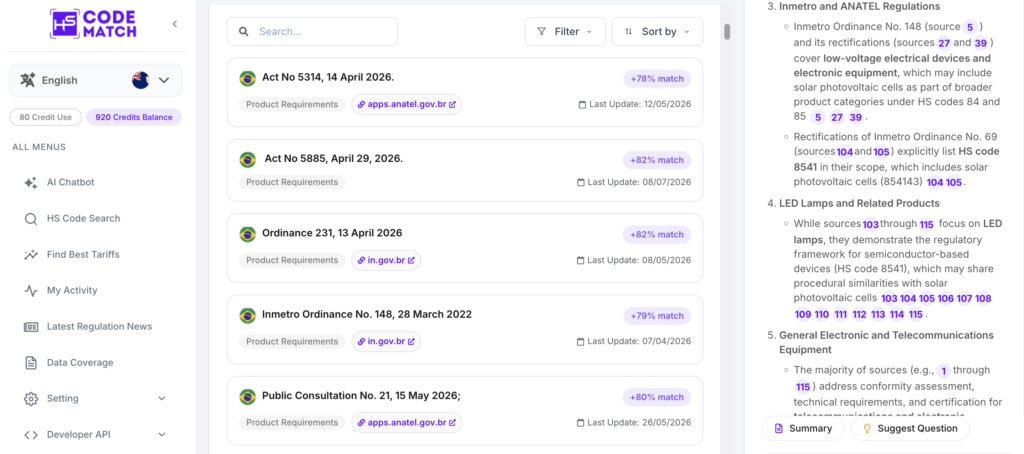
In order to guide you to use the AI chatbot, you can select a question suggestion. The AI will generate the questions based on frequently asked questions about regulations for this HS code. These are examples of answers about exporting solar modules from China to Brazil using the AI chatbot on HS Code Match:
Are photovoltaic cells considered under HS code 8541?
Photovoltaic cells are included under HS code 8541 based on the HS code description, which states that semiconductor devices, including photovoltaic cells. Moreover, the standalone or assembled photovoltaic cells are still under this HS code. However, photovoltaic generators are not included in the HS code 8541, and it is classified under the HS code 8542. It is because the photovoltaic cells and photovoltaic generators are different in terms of usage and functions. This is the summary table for the classification of HS codes for solar modules.
| HS code | Description | Photovoltaic cells or not? | Assembled module or not? |
| 8541 | Diodes, transistors and similar semiconductor devices; photosensitive semiconductor devices, incl. photovoltaic cells whether or not assembled in modules or made-up into panels (excl. photovoltaic generators); light emitting diodes; mounted piezo-electric crystals; parts thereof | Yes | Yes |
| 8542 | Photovoltaic generators | No | Not applicable |
| 8541 (exclude photovoltaic generators) | Similar to the HS code 8541 above, but not including photovoltaic generators. | Yes | Yes |
Which authority checks the solar modules in Brazil?
If you want to export solar modules to Brazil, you need to pass the requirements standard from the National Institute of Metrology, Standardization, and Industrial Quality (Inmetro). This agency is the main body that ensures the standard of solar modules before entering Brazil’s territory. The assessment process for solar panels or modules includes certification from the International Laboratory Accreditation Cooperation (ILAC). After the assessment process, Inmetro will conduct the public consultations to bring all of the stakeholders to finalize the amendment of regulations. However, the National Telecommunications Agency (Anatel) is not directly responsible for analyzing the solar modules, but is only involved if there is radiation from the equipment. This is the table of the authorities for regulating the importation of solar panels to Brazil.
| Authority | Role in solar module regulation | Key documents for the agency |
| Inmetro | Primary regulatory body for conformity assessment of solar modules | Ministerial Act No. 211/2009 and Ministerial Act No. 4/2011; Ordinance No. 357/2014; Public Consultations |
| Accredited Laboratories | Conduct mandatory tests per Inmetro requirements | Must be certified by ILAC or IAAC for testing validity |
| Public consultations | Gathering input on technical standards | Public Consultation No. 4 (14 January 2022) and others |
What happens if a solar module fails the assessment from Inmetro?
Inmetro has a mandatory requirement to assess the solar modules from other countries before entering Brazil. This procedure was developed to guarantee that the imported solar modules meet the safety standards in Brazil. If the solar module fails to meet the assessment, it cannot be sold in Brazil. These tests are based on the results from accredited laboratory studies that have the credibility to evaluate the standard of solar panels. Inmetro will publish the non-conformity notice on its website in order to make everyone aware of the results. This is the table of updates on Inmetro regulations.
| Date | Regulatory Action | Key implication |
| January 4, 2011 | Inmetro Ordinance No.4 | Established baseline conformity requirements for PV systems and equipment under G/TBT/N/BRA/344 |
| August 1, 2014 | Inmetro Ordinance No. 357 | Approved adjustments to conformity assessment requirements, including updated test procedures |
| March 21, 2022 | Inmetro Ordinance No.140 | Consolidated technical quality regulations for PV equipment, aligning with Decree No. 10.139/2020 |
| November 20, 2023 | Inmetro Ordinance No. 515 | Amended Ordinance No. 140, updating conformity requirements and adding new performance criteria |
Conclusion
Solar modules have become one of the most important products these days due to the trend of the renewable energy transition. Therefore, the solar panel or module product is exported widely to many countries around the world. Please note that the inclusion of the HS code for solar modules should not be neglected because it is one of the requirements in transnational trade. However, inserting the correct HS code for solar modules is only the beginning of the process. You also need to pay attention to the import regulations and other procedures for exporting solar panels.
Frequently Asked Questions (FAQs)
What is the structure of the HS code for solar panels or modules?
The structure of the HS code for solar modules is included in Chapter 85. The full structure of six numbers of HS code for solar modules is 854143.
What are the challenges in finding the HS code for solar modules?
The challenges of finding the HS code for solar modules are the different combinations of materials, dual functions of products, and the rapidly evolving technologies, which require some criteria for the HS code.
What are the largest exporting countries of solar panels?
The largest exporter of solar modules or panels is China. This country is followed by Thailand, Malaysia, India, and the Netherlands.
What are the biggest importing countries of solar panels?
The biggest importer of solar modules is the United States. The second to fifth largest importers are Brazil, India, Pakistan, and Germany.
Is there any application to find the HS code for solar modules easily?
Yes, you can use HS Code Match to find the HS code for solar modules easily, similar to searching on a search engine. By using hscodematch.com, you can also find the latest import regulations from all countries.
Find and Match the Right HS Code for Your Products.
Try Our App

 Sep 10, 2026

