
How to use the Find Best Tariff tool
Find Best Tariffs is one of the advanced tools from Jureem HS Code Match. This tool provides a comprehensive assistant tool for every party that is involved in international trade. By using Find Best Tariffs, you can see full insights related to importing or exporting products from the origin country to the destination country, along with a summary from the AI Assistant.
Using Find Best Tariffs is quite easy, even for people who have never used it before. You might be wondering about the details of how to use Find Best Tariffs. Before trying to use it, you can see the instructions for using the Find Best Tariffs tool below.
Step 1: Open the HS Code Match
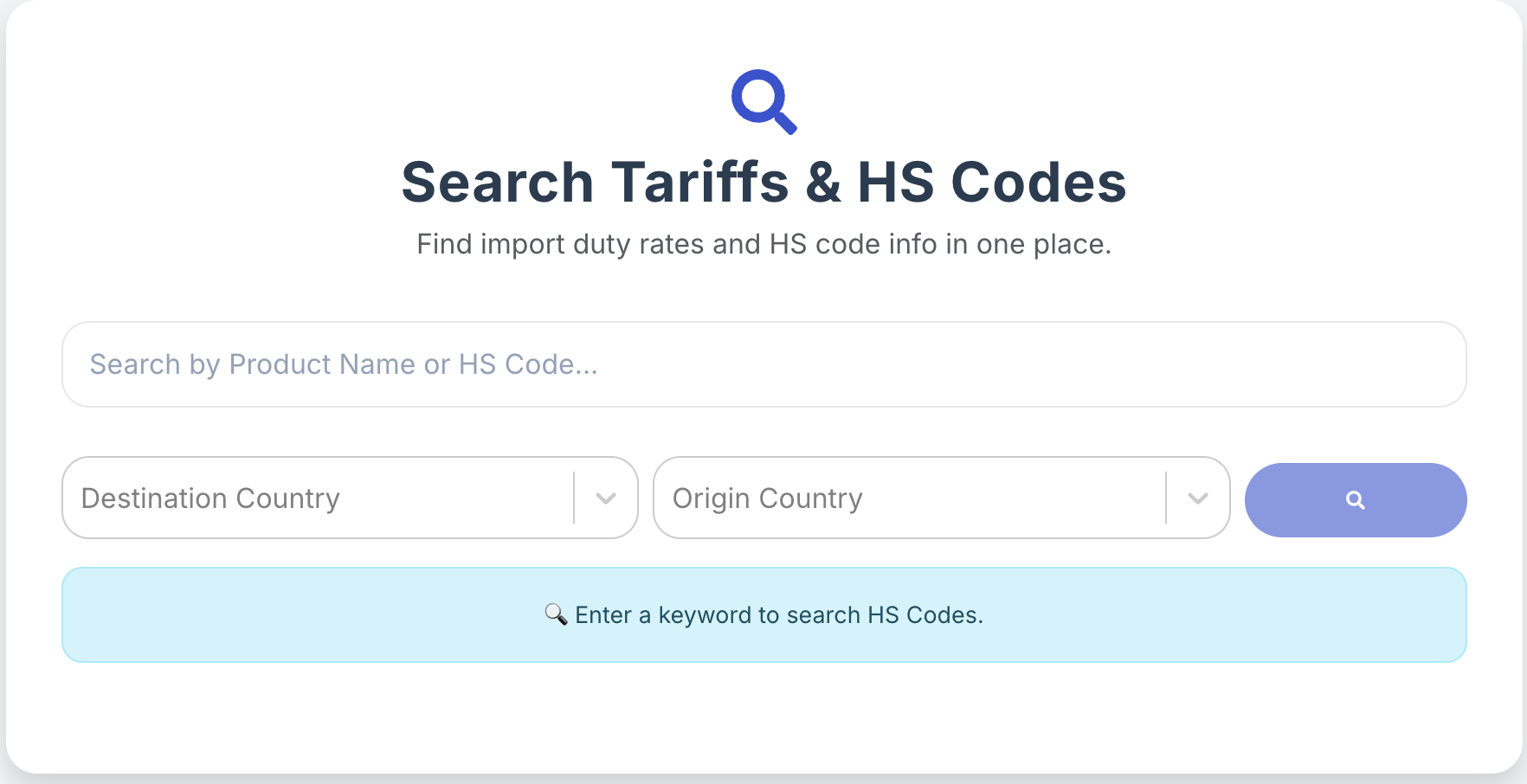
You can access Find Best Tariffs by opening this link: app.hscodematch.com/find-best-tariffs. Or you can open the HSCodeMatch app, and Find Best will be available on the main page.
Step 2: Set the product’s name and the countries you are looking for
Once the HS Code Match opens, you can just set the product name and the origin and destination countries. This is similar to using common search engines, but this tool is specifically for export and import procedures.
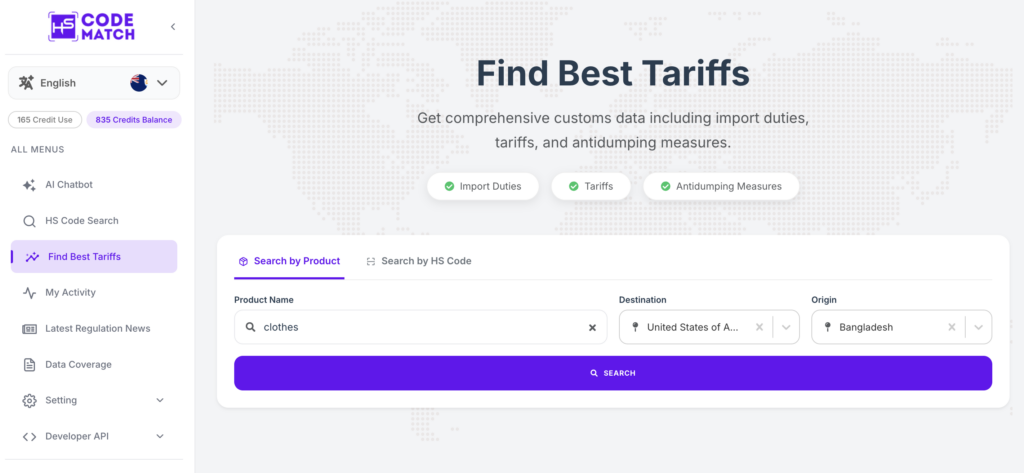
Step 3: Then you can get the full tariff insights
After that, you can get the full tariff insights along with the procedures. For example, this is the result of the procedure, duty, and other important insights in order to export clothes from Bangladesh to the United States.
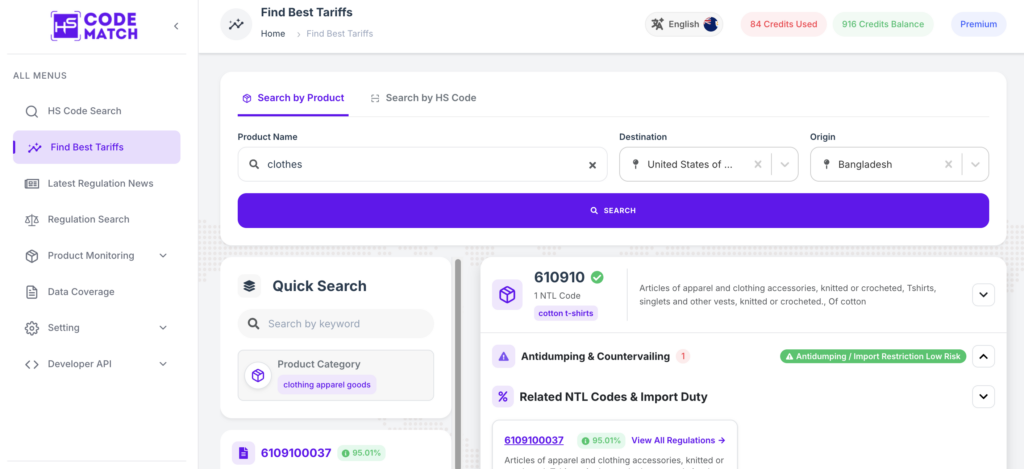
Step 4: Quick Search to find the specific procedure
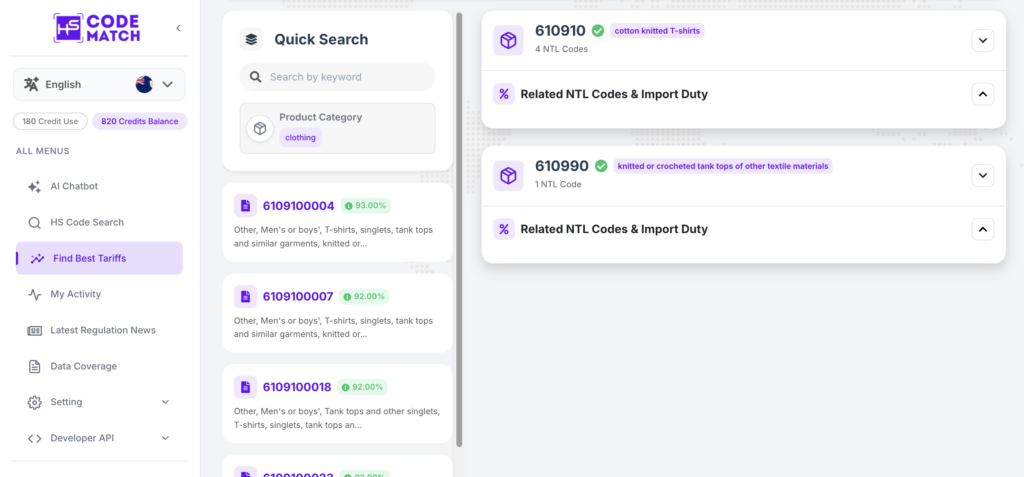
You can also use Quick Search in the left corner of the page to find the specific procedure or regulations. The Quick Search will help you to analyze the regulation deeply and specifically without needing to look at a long page document.
What is covered under Find Best Tariff
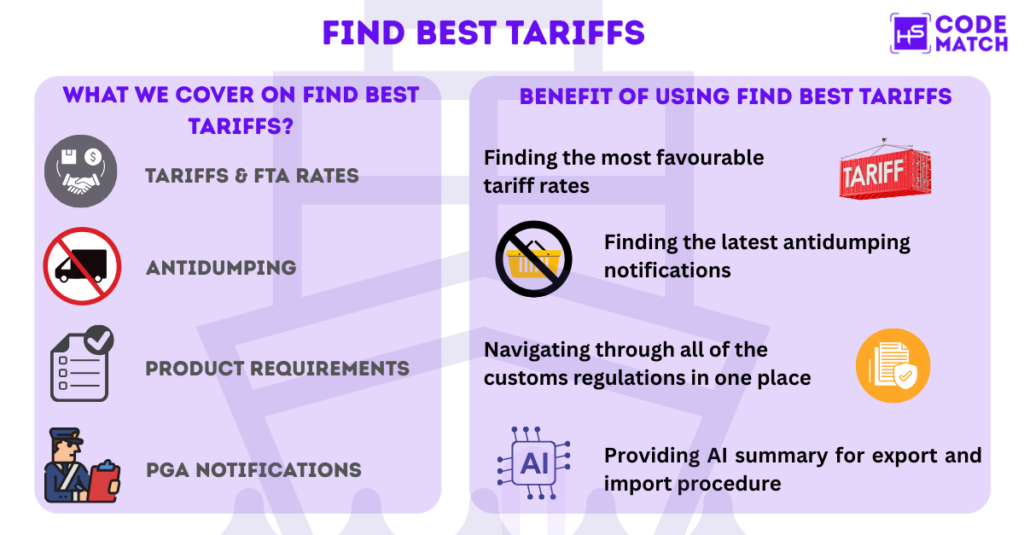
Find Best Tariffs covers many insights based on the regulations issued by the government in all countries in the world. As we know, looking at the regulations is quite complicated, and it takes time to find what we are looking for. The Find Best Tariffs will help you find the latest regulations from the government. This is the list of regulations covered by the Find Best Tariffs.
Tariff & FTA Rates
Tariff rates are an import tax or duty imposed by a destination country based on the imported products and the country of origin. The tariff rates are developed in order to protect the political and economic interests of a country. Another function of tariffs is to serve as a source of income for the country, in addition to domestic taxes and natural resources.
Due to the complexity of the barriers imposed by many countries, some countries have agreed on free trade agreements (FTAs). The FTAs are a way to promote the reduction of tariffs, eliminate quotas, and other barriers in international trade. Therefore, FTA rates are commonly lower to expand business and economic relations between two or more countries. These are the tariff rates provided by the Find Best Tariffs on HS Code Match.
- HS Code national classification standard
The Harmonized System (HS) code is a standard code that is recognized internationally and established by the World Trade Organization (WTO). This code has been used by more than 200 countries all around the world to facilitate international trade. The national classification standard is an extension of the 6-digit basic HS code used by some countries to identify more about some products. For example, the United States uses a 10-digit HS code by expanding the basic HS code, or commonly called the Harmonized Tariff Schedule (HTS).
- MFN rates
Most Favored Nation (MFN) is an act to treat all countries equally without any discrimination. Based on the WTO agreements, all countries must be respected in international trade. Therefore, if one country implements a reduction of a tariff rate or other special treatment to a certain country, it should treat the other WTO member countries to the same reduction in tariff rates as well. In practice, most countries implement MFN status to all WTO members.
- FTA rates
Free Trade Agreement (FTA) rates are a reduction of tariff rates between two or more nations based on the agreements. These reductions are mostly lower than the MFN rates, which apply to all of the WTO members. The FTA rates aim to promote trade relations between two or more countries and help expand economic growth for all members of the FTA. The regulation of the FTA includes several types, such as rules of origin (ROO), sanitary and phytosanitary (SPS), customs procedures, etc.
- FTA rules of origin and certification requirements
FTA rules of origin(ROO) are the criteria in an FTA based on the country of origin. The products should have a certain certification or proof that they originate from a specific country member of the FTA. If the products do not meet the standard of the ROO, the products are only eligible for the MFN tariff. The FTA ROO has several elements of regulations, including Change of Tariff Classification (CTC), Regional Value Content, and Process Rules.
Antidumping
Antidumping is an illegal practice by a country to export its products at a lower price in the destination country than in its own country. This practice will have a severe impact on the domestic market of a country. If a country is allegedly conducting an antidumping practice, the destination country will investigate with a special commission. For example, in Australia, there is the Anti-Dumping Commission that investigates this unfair international trade.
- Antidumping Notice by government agencies
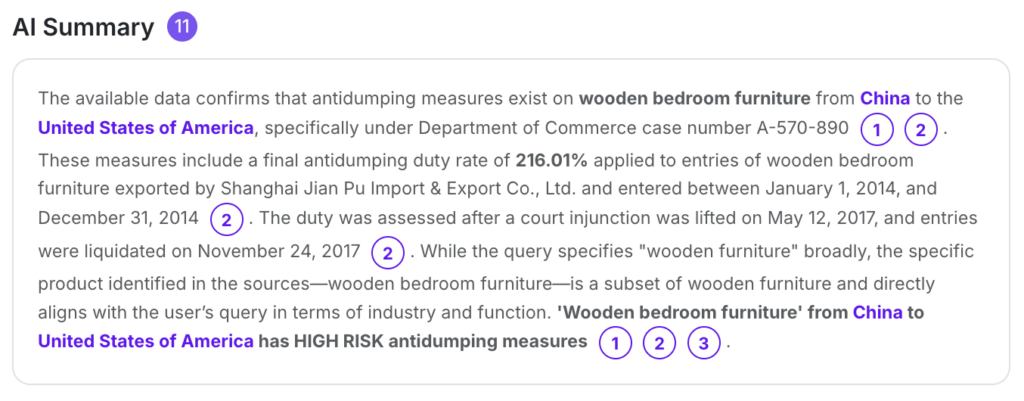
After or during the investigation, the special agency or commission will publish notifications regularly, and also if there is a countermeasure. The latest antidumping notice for all countries is available on Find Best Tariffs. For example, there is an antidumping notice by the American government on furniture products from China.
- AI analysis of affected products, countries, and regulation summary
Find Best Tariffs is equipped with AI to give a summary of the regulations based on certain products, country of origin, and destination countries. This feature allows us to gain more insights about the latest regulations of the destination country easily. This insight is very important because it determines the policy of the companies to alleviate the excessive amount of costs.
Product requirements
Product requirements are some of the prerequisite materials from the government of a specific country in order to bring the goods to its territory. If there are any missing requirements, it will lead to delays, confiscation, fines, or other punishment. Several product requirements are available on the Find Best Tariffs below:
- Sanitary and phytosanitary measures (SPS)
Sanitary and phytosanitary measures (SPS) are designed by the government to protect humans, animals, and plants in a country. These measures include inspections to check the potential of spreading disease from animals or plants.
- Technical Barriers to Trade (TBT)
Technical Barriers to Trade (TBT) are measures by the members of the WTO to control goods from other countries entering their country. However, this practice can be supported by legitimate or scientific proof. If not, it would be a case of discrimination against other nations in international trade.
Partner Government Agencies (PGAs) Notifications
Partner Government Agencies (PGAs) have the authority to publish the specific criteria based on the latest condition of the country of origin. PGAs will notify the exporters of certain requirements for goods before shipping. The PGAs ‘ notification is available in Find Best Tariffs. This notification is based on the latest regulations from the PGAs in a country, and it will help you to make a decision in order to meet the requirements.
Benefits of using Find Best Tariff
After following the steps of using the list of regulations, we can see that Find Best Tariffs is very convenient and comprehensive. By using one tool from HS Code Match, you have access to much information, and it gives you a summary of the export and import procedures. This process of finding information about the import procedure commonly takes time, and you have to deal with long documents. As an AI-driven tool for finding export and import assistance, there are several benefits to using the Find Best Tariff tool, which you can see below.
Finding the most favorable tariff rates
Find Best Tariffs provides the best tariff rates based on the product, the country of origin, and the destination country. Through these tools, you can easily see the list of tariff rates that are sorted by the most favorable. These favorable tariff rates are important to ensure the measurement of the cost of duties and other taxes in the destination country. We can give an example of how easy to compare the tariff rates of cotton shirts from Bangladesh to the United States using the Find Best Tariffs under different HS codes below.
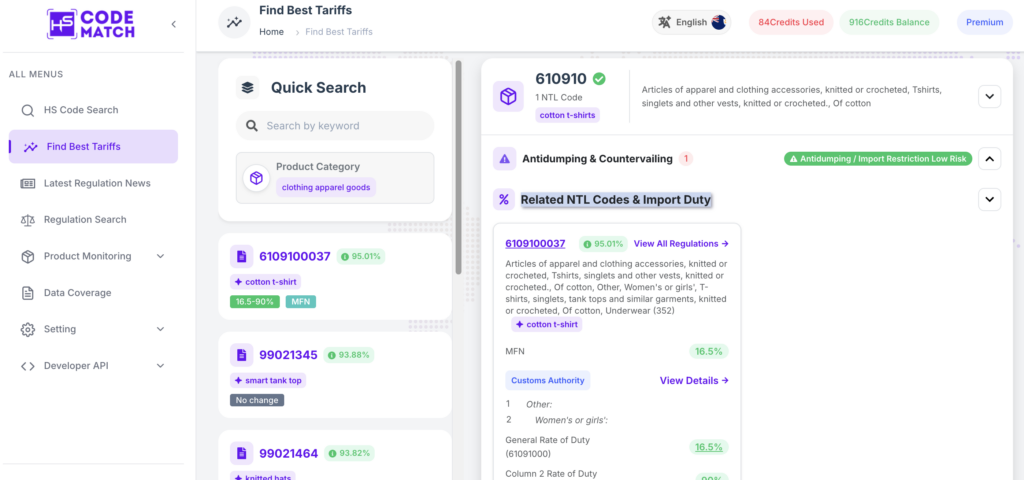
(Image: Tariff rates on cotton shirts under HS code 610910 from Bangladesh to the United States)
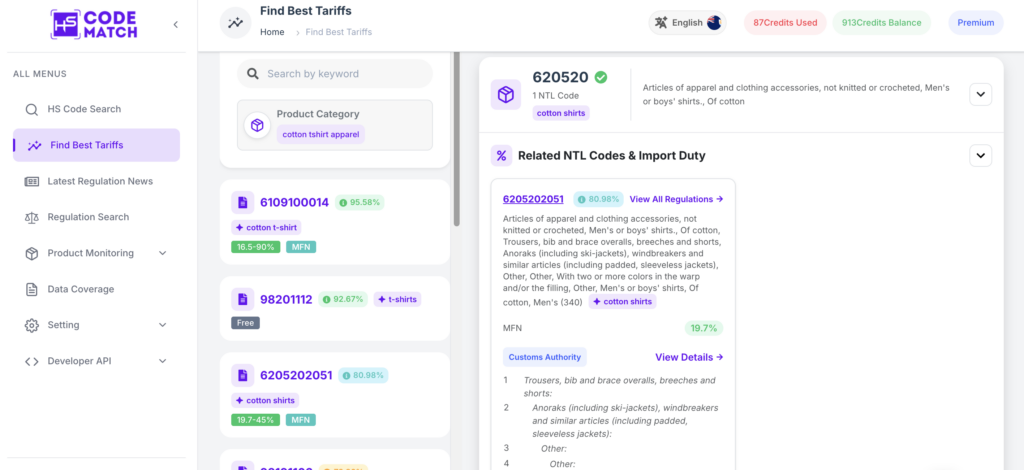
(Image: Tariff rates on cotton shirts under HS code 620520 from Bangladesh to the United States)
We can compare the nations for importing cotton shirts into the United States. For example, we can compare cotton shirts from Bangladesh. There are differences in the tariff rates between the cotton shirts under HS codes 610910 and 620520 from Bangladesh. It shows that the products under HS code 610910 have a lower tariff rate of 16.5%, whereas products under HS code 620520 have a tariff rate of 19.5%.
Finding the latest antidumping notifications
The Find Best Tariffs will assist you in finding the recent antidumping notifications of a certain country. The notification of antidumping is very important to assist you with information that there might be some antidumping duties from the government of a specific country. This is an example of finding the latest antidumping notifications using Find Best Tariffs.
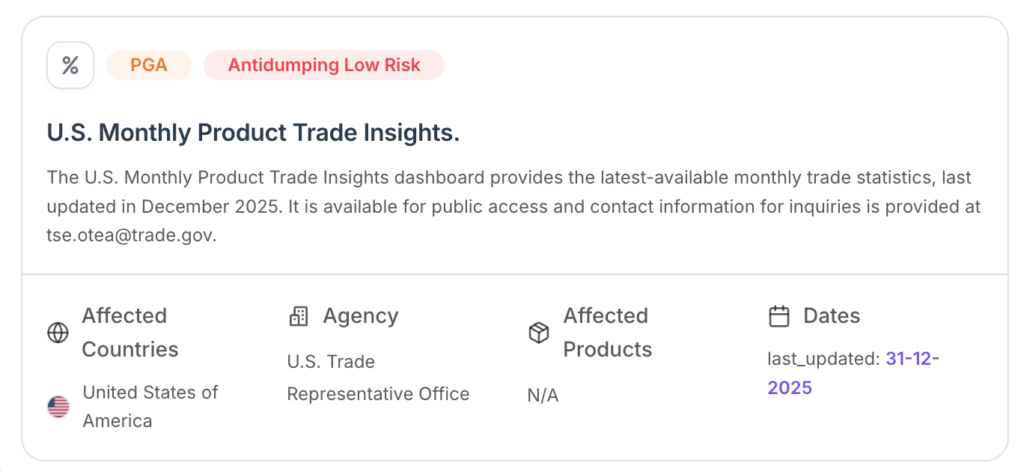
(Image: Low Risk Antidumping Notification in the United States)
The notification from Find Best Tariffs will give you details of the PGA that set the antidumping measures. For example, the PGA Antidumping is imposed by the US Trade Representative Office. The following image is an example of notifications on Find Best Tariffs regarding the high risk of antidumping measures on wooden furniture from China to the United States.
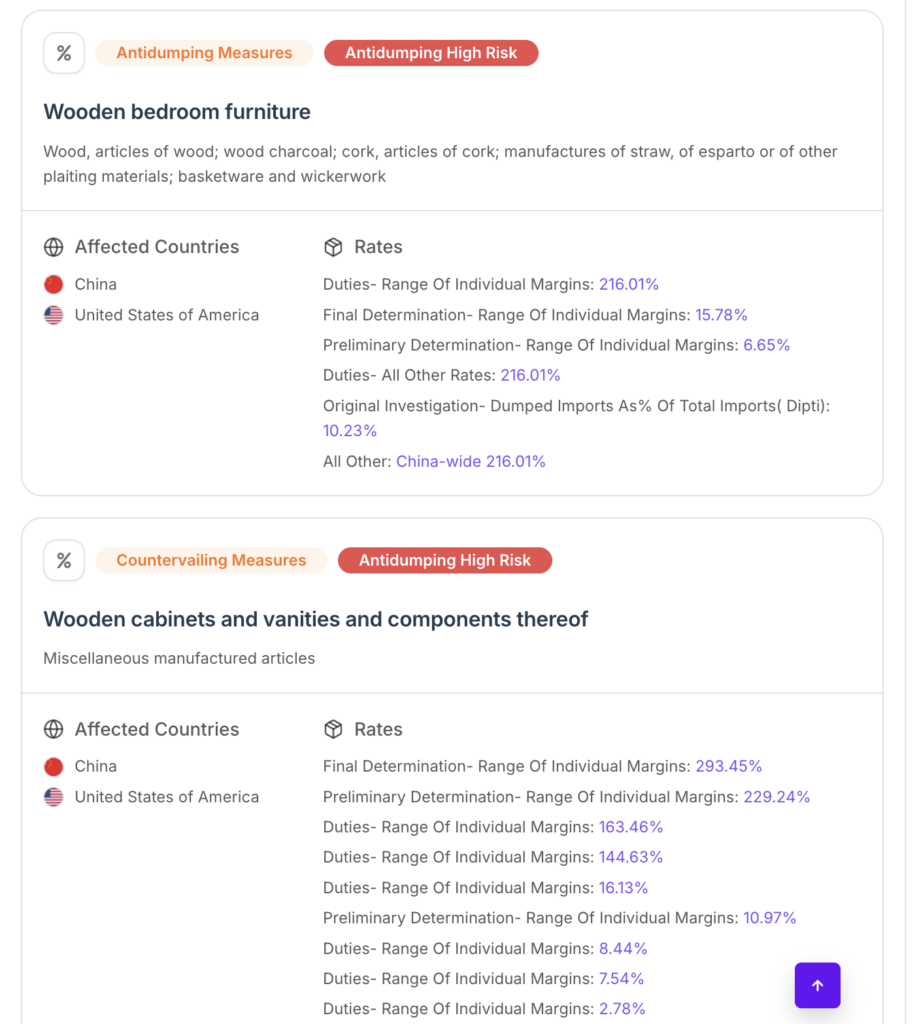
(Image: Antidumping Measures and Countervailing Measures on Find Best Tariffs)
The Antidumping measures from Find Best Tariffs will give you an estimate of the potential antidumping tariff. From the image above, we can see that the potential antidumping tariff for the furniture products from China to the United States varies. Understanding the risks of countervailing and antidumping duties is essential to predict the profit for businesses and avoid huge losses due to the new measures.
Navigating through all customs import/export regulations in one place
The main benefit that you can get by using Find Best Tariffs is that you can navigate all of the customs regulations within the tool. This will reduce the time to read all of the long-page regulation documents and the export and import procedures for all countries. By using Find Best Tariffs, you can get it all in one with the easy-to-use interface, and it is easy to manage based on your preferences.
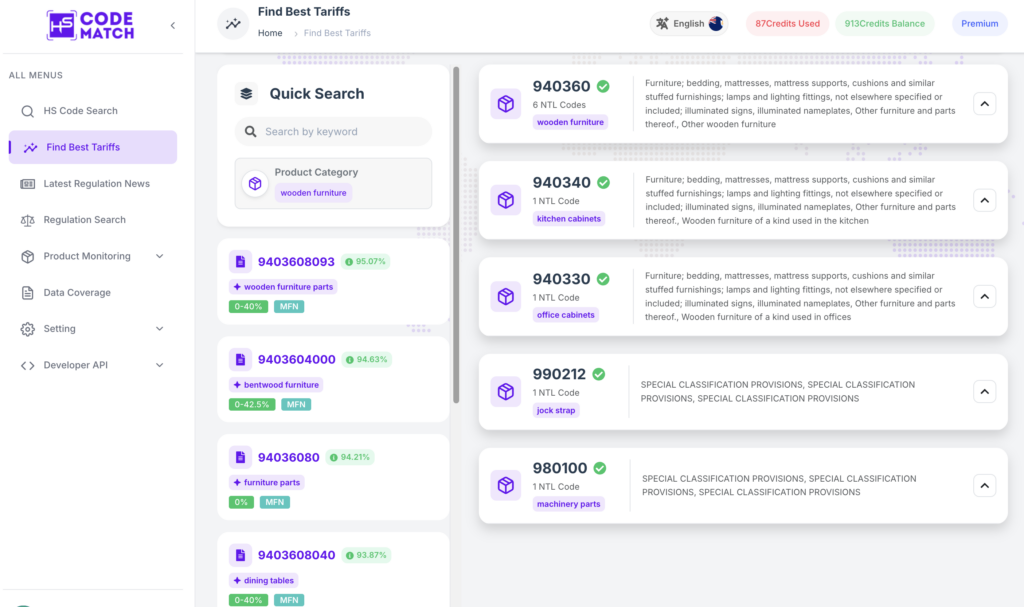
AI summary for import and export procedure
Last but not least, Find Best Tariffs is equipped with an AI that can be used to summarize the export and import procedures within a minute. These features will give you a chance to know the information about the export and import procedures instantly. You do not need to worry because all of this summary is based on the legitimate and latest official documents of a certain country. You can access the official documents and websites by clicking the reference numbers.